As a couple of generations of film students have shown us, you shouldn’t try to imitate David Lynch. You should, however, learn from David Lynch. At his best, the director of Eraserhead, Blue Velvet, and Mulholland Drive has managed, in the words of David Foster Wallace, to “single-handedly broker a new marriage between art and commerce in U.S. movies, opening formula-frozen Hollywood to some of the eccentricity and vigor of art film.” How has Lynch brought his enduringly strange and richly evocative visions to the screen, and to a surprising extent into the mainstream, without much apparent compromise?
You can get an idea of his method in Room to Dream: David Lynch and the Independent Filmmaker, the twenty-minute documentary above. Since Lynch hasn’t released a feature film since 2006’s Inland Empire — an especially uncompromising work, admittedly — some fans have wondered whether he’s put the movies, per se, behind him.
But Room to Dream shows the director in recent years, very much engaged in both the theory and process of filmmaking — or rather, his distinctive interpretations of the theory and process of filmmaking.
This touches on his childhood obsession with drawing weapons, his discovery of “moving paintings,” his endorsement of learning by doing, how he uses digital video, his enjoyment of 40-minute takes, why people fear the “very dark,” conveying meaning without explaining meaning (especially to actors), the process of “rehearsing-and-talking, rehearsing-and-talking,” how Avid (the short’s sponsor, as it would happen) facilitates the “heavy lifting” of editing his footage, how he finesses “happy accidents,” how he composes differently for different screens, and the way that “sometimes things take strange routes that end up being correct.” Take Lynch’s words to heart, and you, too, can enjoy his experience of crafting what he calls “sound and picture moving along in time” — with or without an Avid of your own.
Jimi Hendrix lived fast, and I don’t just mean to evoke a rock star cliché, but to get at the speed at which his career moved. He arrived in England near the end of September, 1966, at the tender age of 23. In less than a month, he and his manager Chas Chandler had recruited Noel Redding and Mitch Mitchell into the Experience and booked the band’s first gig on October 13 across the channel in Évreux, France, one of four French bookings as a supporting act for The Blackbirds and Johnny Hallyday. They played mostly covers, including Howlin’ Wolf’s “Killing Floor,” Otis Redding’s “Respect,” Don Covay’s “Mercy, Mercy,” and Chris Kenner’s “Land of a Thousand Dances,” and traditional song “Hey Joe,” soon to become the band’s first single. It’s unclear whether anyone recorded that first gig, but we do have some audio of the fourth, on October 18 at the Olympia in Paris. Just above hear them play “Hey Joe” from that night, and below, they do The Troggs’ “Wild Thing.”
Hendrix was already a highly seasoned performer by this time, having blown minds all over the South while touring with, among others, the Isley Brothers, Little Richard, and King Curtis in the early sixties. He had been highly in demand as a backing and session player, but he grew tired of standing in the back and wanted to go solo. He met manager Chandler, then bassist for the Animals, while fronting his own band in New York. Chandler, writes PRI, “knew just what to do with the young guitarist” upon their arrival in England.
Six days after the short tour through France, the band played its first official show in the UK, at the Scotch of St. James, where the Beatles had a private booth. Hendrix proceeded to blow minds all over England, including, of course, those of all the British guitar greats: “Everyone’s eyes were glued to him,” remembers then girlfriend Kathy Etchingham, “He looked different. His guitar playing was superb. People in England hadn’t seen anything like it before. It was quite… out of this world.”
People in the U.S. hadn’t seen anything like it either. While Hendrix had honed many of his signature stage tricks on the soul circuit, by the time he appeared at the Monterey Pop Festival in 1967, he had fully come into his own as a charismatic singer as well as a “near miraculous” guitarist. But in his move from R&B to rock and roll, he never lost his blues roots. “Hendrix wasn’t a typical pop or rock musician,” says Hendrix scholar and English professor Joel Brattin. He “was an improviser. So, if there are 100 different recorded versions of Purple Haze, it’s really worth listening to all 100 because he does something different each time.” The same can be said of the songs he covered, and made his own. Just above, see them play “Hey Joe” at The Marquee for German TV show Beat Club just months before the release of their 1967 debut album. And below, Hendrix exhorts the crowd to sing along before launching into “Wild Thing,” in a Paris appearance one full year after the recording above at the Olympia. Compare, contrast, get your mind blown.
We are, it appears, in the midst of a “podcasting renaissance,” as Colin Marshall has recently pointed out. And yet, like him, I too was unaware that “podcasting had gone into a dark age.” Nevertheless, its current popularity—in an age of ubiquitous screen technology and perpetual visual spectacle—speaks to something deep within us, I think. Oral storytelling, as old as human speech, will never go out of style. Only the medium changes, and even then, seemingly not all that much.
But the differences between this golden age of podcasting and the golden age of radio are still significant. Where the podcast is often off-the-cuff, and often very intimate and personal—sometimes seen as “too personal,” as Colin writes—radio programs were almost always carefully scripted and featured professional talent. Even those programs with man-on-the street features or interviews with ordinary folks were carefully orchestrated and mediated by producers, actors, and presenters. And the business of scoring music and sound effects for radio programs was a very serious one indeed. All of these formalities—in addition to the limited frequency range of old analog recording technology—contribute to what we immediately recognize as the sound of “old time radio.” It is a quaint sound, but also one with a certain gravitas, an echo of a bygone age.
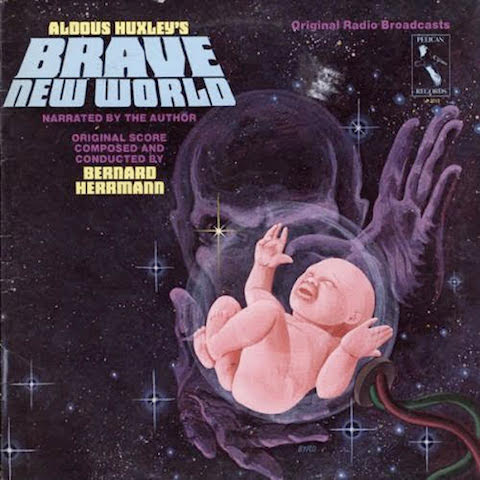
That golden age waned as television came into its own in the mid-fifties, but near its end, some broadcast companies made every effort to put together the highest quality radio programming they could in order to retain their audience. One such program, the CBS Radio Workshop, which ran from January, 1956 to September, 1957, may have been “too little too late”—as radio preservationist site Digital Deli writes—but it nonetheless was “every bit as innovative and cutting edge” as the programs that came before it. The first two episodes, right below, were dramatizations of Aldous Huxley’s Brave New World, read by the author himself. (Find it also on Spotify here.) The series’ remaining 84 programs drew from the work of Antoine de Saint-Exupéry, James Thurber, H.L. Mencken, Mark Twain, Robert Heinlein, Eugene O’Neil, Balzac, Carl Sandburg, and so many more. It also featured original comedy, drama, music, and This American Life-style profiles and storytelling.
Huxley returned in program #12, with a story called “Jacob’s Hands,” written in collaboration with and read by Christopher Isherwood. The great Ray Bradbury made an appearance, in program #4, introducing his stories “Season of Disbelief” and “Hail and Farewell,” read by John Dehner and Stacy Harris, and scored by future film and TV composer Jerry Goldsmith. Other programs, like #10, “The Exurbanites,” narrated by famous war correspondent Eric Sevareid, conducted probing investigations of modern life—in this case the growth of suburbia and its relationship to the advertising industry. The above is but a tiny sampling of the wealth of quality programming the CBS Radio Workshop produced, and you can hear all of it—all 86 episodes—courtesy of the Internet Archive.
Sample streaming episodes in the player above, or download individual programs as MP3s and enjoy them at your leisure, almost like, well, a podcast. See Digital Deli for a complete rundown of each program’s content and cast, as well as an extensive history of the series. This is the swan song of golden age radio, which, it seems, maybe never really left, given the incredible number of listening experiences we still have at our disposal. Yes, someday our podcasts will sound quaint and curious to the ears of more advanced listeners, but even then, I’d bet, people will still be telling and recording stories, and the sound of human voices will continue to captivate us as it always has.
For many people, the arguments and analysis of Karl Marx’s three-volume Das Kapital (or Capital: A Critique of Political Economy) are as relevant as ever. For many others, the work is a historical curiosity, dated relic, or worse. Before forming an opinion either way, it’s probably best to read the thing—or as much of the huge set of tomes as you can manage. (Vol. 1, Vol. 2. and Vol. 3.) Few thinkers have been as frequently misquoted or misunderstood, even, or especially, by their own adherents. And as with any dense philosophical text, when embarking on a study of Marx, it’s best to have a guide. One could hardly do better than David Harvey, Distinguished Professor of Anthropology and Geography at the City University of New York’s Graduate Center.
Harvey’s work as a geographer focuses on cities, the increasingly predominant mode of human habitation, and he is the author of the highly popular, two-volume Companion to Marx’s Capital. The books grow out of lectures Harvey has delivered in a popular course at the City University. They’re very readable (check them out here and here), but you don’t have to read them—or attend CUNY—to hear Harvey himself deliver the goods. We’ve previously featured his Capital: Volume 1 lectures (at top, preceded by an interview with a colleague). Now Harvey has made his lectures on Capital, Volume II and some of Volume III available. Watch all twelve classes above or view them individually here. As Harvey admits in an interview before the first lecture, the neglected second volume of Marx’s masterwork is “a very difficult volume to get through,” due to its style, structure, and subject matter. With Harvey’s patient, enthusiastic guidance, it’s worth the trouble.
You can view the lectures from Harvey’s course on multiple platforms. Below we provide an easy-to-access list. You can also see all lectures on David Harvey’s website, where you can also download class notes.
Of course, anyone who decides to jump into cooking in the 21st century realizes how simple it isn’t, or at least how complicated we’ve made it. Pollan, as luck would have it, realizes this, so today we’ve rounded up some of his resources that can help you learn to cook better, or indeed cook at all. Surprisingly, the man himself has never written a cookbook. “While I enjoy cooking, I’ll leave the art of perfecting and disseminating recipes to the pros,” he writes. “That said, I believe that if you can read, you can cook, and I have a few cookbooks that I use regularly and recommend to those of you wanting good, healthy and basic recipes” — from Mark Bittman’s How to Cook Everything and How to Cook Everything Vegetarian to Chez Panisse chef Alice Waters’ The Art of Simple Food, and even (“when I have an ingredient I want to use but don’t know what to do with it”) epicurious.com.
Sandor Katz, he of The Art of Fermentation, has videos on just that, starting with basic fermentation and moving on to specific dishes like sauerkraut and kimchi.
New York Times Magazine recipe tester Jill Santopietro has done her own “series of videos filmed in her tiny New York kitchen.”
Pollan’s section on cooking classes and other ways to learn to cook, aside from a variety of suggestions of regional institutions, includes these useful options:
A “free, beautiful book full of recipes that fit a food stamp budget” called Good and Cheap.
SkillShare, whose “innovative platform allows almost anyone, anywhere to teach a project-based class either online to a global community or offline in their local community. You can search for cooking, brewing or bread baking classes in your region.”
LifeHacker and its “cooking advice, recipes and how to’s.”
And if you missed it, don’t forget to take Pollan’s own course “Edible Education,” free from UC Berkeley. I like to think he’d second my own advice on the matter: just cook something that sounds good, anything that sounds good, right now. Not that I dare inflict the result on friends and family until I’ve learned a little more — which is when all those links above come in handy.
How often does a film adaptation of a novel you love meet your expectations? Circle one: A) Always B) Often C) Rarely D) Never.
I’m guessing most people choose C, with a few falling solidly in the perennially disappointed D camp. There are, of course, those very few films that rise so far above their source material that we needn’t speak of the novel at all. I can think of one off the top of my head, involving a certain well-dressed mobster family.
Then there are adaptations of books that depart so far from the source that any comparison seems like a wasted exercise. Spike Jonze’s Adaptation is one intentional example, one that gleefully revels in its meta-poetic license-taking.
Perhaps no single author save Shakespeare, Jane Austen, or Stephen King has had as many of his works adapted to the screen as sci-fi visionary Philip K. Dick. The results vary, but the force of Dick’s imagination seems to make every cinema version of his novels worth watching, I’d argue.
But all this talk of adaptation brings us to the question that the internet must ask of every subject under the sun: what are nth best films made from novels—list them, damn you! Okay, well, you won’t get just my humble opinion, but the collective votes of hundreds of Guardian readers, circa 2006, when writers Peter Bradshaw and Xan Brooks took a poll, then posted the results as “The Big 50.”
The list includes those dapper mafiosi, but, as I said, I’m not much inclined—nor was Francis Ford Coppola—to Mario Puzo’s novel. But there are several films on the list made from books I do like quite a bit. In the 15 picks below, I like the movies almost or just as much. These are films from The Guardian’s big 50 that I feel do their source novels justice. Go ahead and quibble, rage, or even agree in the comments below—or, by all means, make your own suggestions of cases where film and book meet equally high standards, whether those examples appear on “The Big 50” or not.
1. A Clockwork Orange (1971)
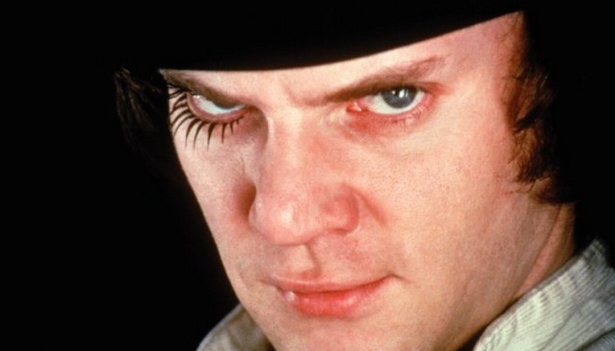
Stanley Kubrick’s take on Anthony Burgess’ 1962 dystopian fable replicates the highly disorienting experience of traversing a fictional world through the eyes of a Beethoven-loving, Nadsat-speaking, sociopath. Malcolm McDowell gives the performance of his career (see above). So distinctive is the set design, it inspired a chain of Korova Milk Bars. Burgess himself had a complicated relationship with the film and its director. Praising the adaptation as brilliant, he also found its bleak, sardonic ending, and omission of the novel’s redemptive final chapter—also missing from U.S. editions of the book prior to 1986—troubling. The film’s relentless ultraviolence, so disturbing to many a viewer, and many a religious organization, also disturbed the author who imagined it.
2. One Flew Over the Cuckoo’s Nest (1975)
A film adaptation with an even more bravado ensemble cast (Danny DeVito, Brad Dourif, Louise Fletcher, Christopher Lloyd) and incredibly charismatic—and dangerous—lead, Jack Nicholson, Milos Forman’s Cuckoo’s Nest stands perfectly well on its own. But lovers of Ken Kesey’s madcap novel have many reasons for favorable comparison. One vast difference between the two, however, lies in the narrative point-of-view. The book is narrated by willfully silent Chief Bromden—the film mostly takes McMurphy’s point-of-view. Without a voice-over, it would have been near-impossible to stay true to the source, but the result leaves the novel’s narrator mostly on the sidelines—along with many of his thematic concerns. Nonetheless, actor Will Sampson imbues the towering Bromden with deep pathos, empathy, and comic stoicism. When he finally speaks, it’s almost like we’ve been hearing his voice all along (see above).
3. To Kill a Mockingbird (1962)
“Miss Jean Louise, stand up! Your father’s passing.” If this scene (above), doesn’t choke you up just a little, well… I don’t really know what to say.… The sentimental adaptation of the reclusive Harper Lee’s only novel is flawed, righteous, and loveable. Gregory Peck is Atticus Finch (and as far as adaptations go—despite the brave attempts of many a fine actor—is Ahab as well). And the young Mary Badham is Scout. Robert Duvall makes his screen debut as kindly shut-in Boo Radley, audiences learn how to pronounce “chiffarobe”…. It’s as classic a piece of work as the novel—seems almost impossible to separate the two.
4. Apocalypse Now (1979)
Francis Ford Coppola and screenwriter John Milius—the Hollywood character so well caricatured by John Goodman in The Big Lebowski—transform Joseph Conrad’s lean 1899 colonialist novella Heart of Darkness into a grandiose, barely coherent, psychedelic tour-de-force set in the steaming jungles of Vietnam. Brando glowers in shadow, Robert Duvall strikes hilariously macho poses, Martin Sheen genuinely loses his mind, and a coked-up, manic Dennis Hopper shows up, quotes T.S. Eliot, and nearly upstages everyone (above). Roger Ebert loved the even longer, crazier Redux, released in 2001, saying it “shames modern Hollywood’s timidity.” Novelist Jessica Hagedorn fictionalized the movie’s legendary making in the Philippines. How much is left of Conrad? I would say, surprisingly, quite a bit of the spirit of Heart of Darkness survives—maybe even more than in Nicolas Roeg’s straightforward 1994 adaptation with John Malkovich as Kurtz and Tim Roth as Marlow.
5. Trainspotting (1996)
Danny Boyle’s adaptation of Irvine Welsh’s addiction-themed first novel—or rather collection of interlinked stories—about a scrappy bunch of Scottish lowlifes may be very much a product of its moment, but its hard to imagine a more perfect screen realization of Welsh’s punk prose. Character-driven in the best sense of the phrase, Boyle’s comic Trainspotting manages the estimable feat of telling a story about drug addicts and criminal types that doesn’t feature any golden-hearted hookers, mournful interventions, self-righteous, didactic pop sociology, or other Hollywood drug-movie staples. A sequel—based on Welsh’s follow-up novel Porno—may be forthcoming.
And below are 10 more selections from The Guardian’s top 50 in which—I’d say—film and book are both, if not equally, great:
6. Blade Runner (1982) 7. Dr. Zhivago (1965) 8. Empire of the Sun (1987) 9. Catch-22 (1970) 10. Lolita (1962) 11. Tess (1979) 12. The Hound of the Baskervilles (1939) 13. The Day of the Triffids (1962) 14. Alice (1988) 15. Lord of the Flies (1963)
So, there you have it—my top 15 from The Guardian’s list of 50 best adaptations. What are your favorites? Look over their other 35—What glaring omissions deserve mention (The Shining? Naked Lunch? Dr. Strangelove? Lawrence of Arabia? The Color Purple?), which inclusions should be stricken, forgotten, burned? (Why, oh, why was the Tim Burton Charlie and the Chocolate Factory remake picked over the original?) All of the films mentioned are in English—what essential adaptations in other languages should we attend to? And finally, what alternate versions do you prefer to some of the most-seen adaptations of novels or stories?
In his book, Abject Terrors: Surveying the Modern and Postmodern Horror Film, Tony Magistrale talks about Stanley Kubrick’s deep and abiding obsession with the color red. He writes2001: A Space Odyssey “commences Kubrick’s directorial fascination with vivid color, particularly the color red, that becomes the defining trait of the auteur’s subsequent cinema… [T]he particular use of red as the keynote color in Kubrick’s cinematic palette speaks directly to cinematic meaning: The color red underscores varying levels of physical and psychological violence present in Clockwork, The Shining and Barry Lyndon; forces the viewer to make a connection between HAL and demonic energies in 2001; and is associated with the carnal sexuality that is present in nearly every sequence of Eyes Wide Shut.” But it’s one thing to read about this obsession, and another thing to see it. Above we have Rishi Kaneria’s “Red: A Stanley Kubrick Supercut,” which artfully weaves together footage from Spartacus,2001,A Clockwork Orange,Barry Lyndon,The Shining,Full Metal Jacket and Eyes Wide Shut. Now you’ll see what Magistrale means.
The history of American music—the blues, jazz, gospel, etc.—has been told, and sold, so many times over that it seems hard to justify yet another retrospective. And yet, I for one am very happy to see the huge two-volume box set The Rise & Fall of Paramount Records appear on the scene. Granted, I can’t cough up $800 for, in total, 1600 remastered digital tracks, 12 LPs, 900 pages of artist bios, portraits, discographies, and fully-restored advertisements from the Midwestern musical powerhouse of the 20s and 30s. And that’s not to mention the beautiful, period packaging, “first-of-its-kind music and image player app… housed on custom metal USB drive,” and more. But even those of us too skint to afford all the glorious swag can sample some of the fruit of the enormous labors that went into this joint production of Jack White’s Third Man Records and folk guitar hero John Fahey’s Revenant Records (if only by proxy). And we can learn a little about the labors that went in to making the original records themselves.
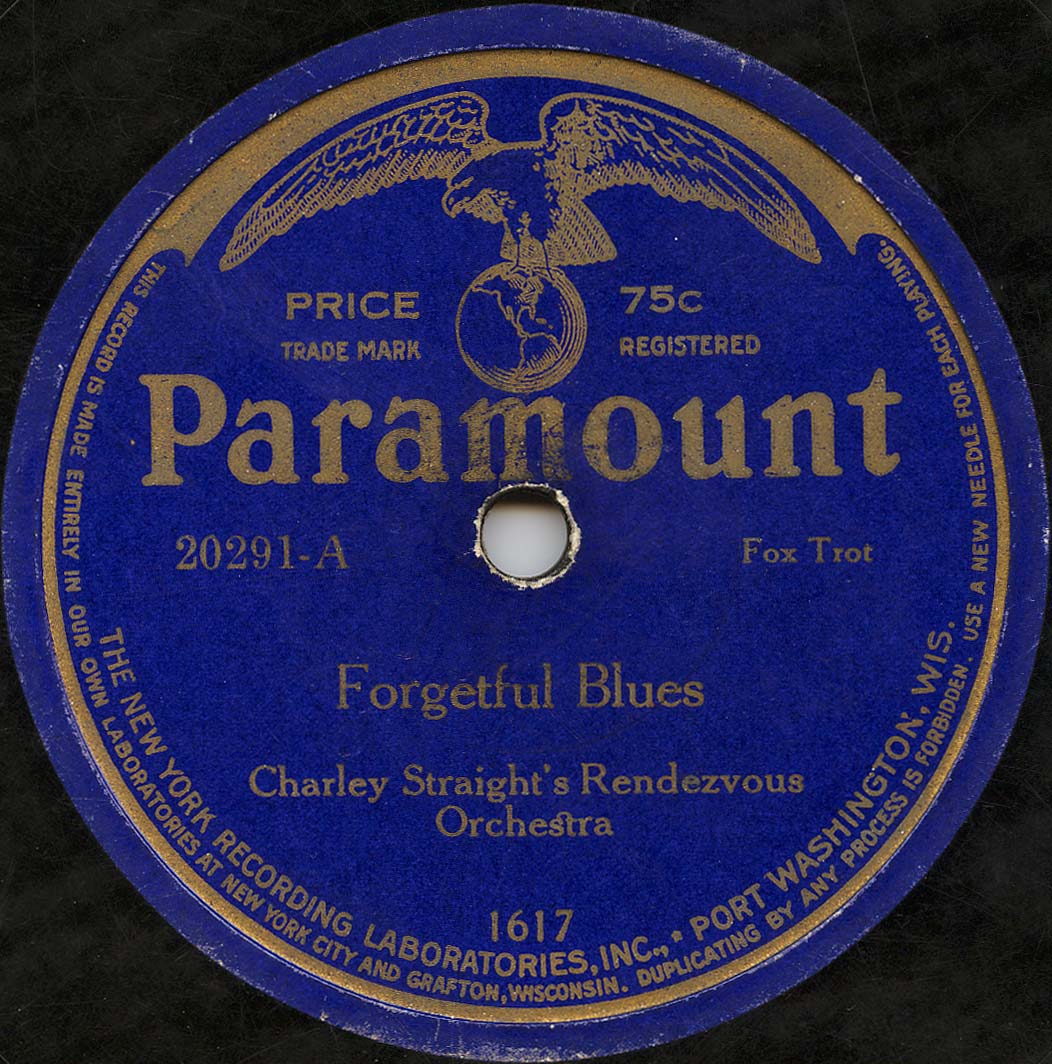
Just above, we have a beautiful handmade video by Kelli Anderson which “recreates the inner workings of the defunct Paramount Records Factory (where records by artists like Blind Lemon Jefferson, Louis Armstrong and Charley Patton were pressed in the 1920s and ‘30s).” Made “entirely from paper atop a plywood set,” the stop-motion animation simulates the production of Paramount’s “race records,” accompanied by Charley Patton’s 1930 “High Water Everywhere, Part 1,” whose “thick, analog noise,” Anderson writes on her blog, “is a reminder that some of history’s most inventive musicians were recorded on the most inferior equipment of their day.” She quotes Dean Blackwood of Revenant, who writes that the Paramount factory “sat perched above the Milwaukee River riverbed. Dirt from that riverbed was one of the key ingredients in their shellac dough, which was lower on shellac content and higher on unexpected components like riverbed clay, cotton flock, and lamp black.”
But from these humble, dirty, cheap materials came a sound like no other—one that can never be duplicated and which deserves the highest quality preservation. Just above, see a video trailer for volume 1 of the massive box set, and read much more about this project at Third Man’s site (Volume 1, Volume 2).
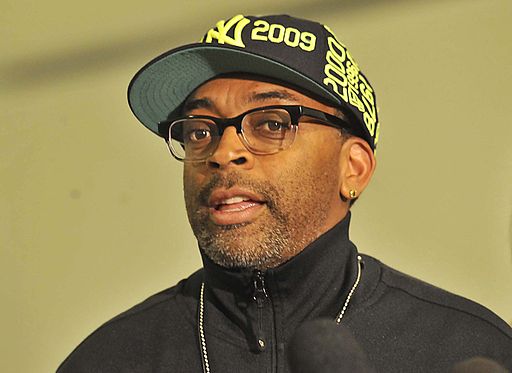
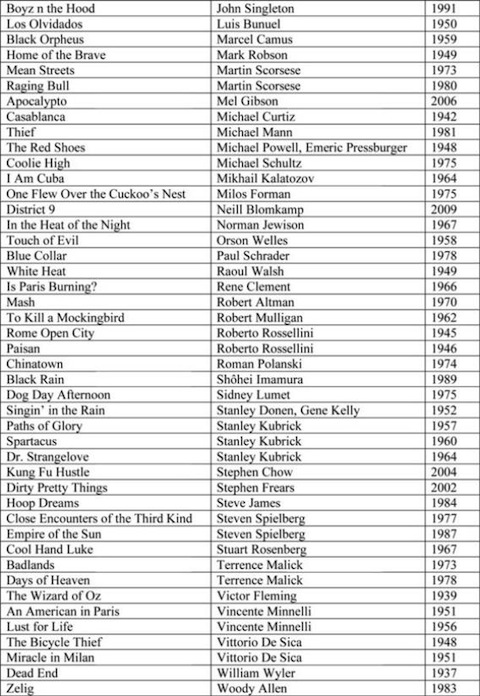
Last year, independent film icon and NYU professor Spike Lee turned to the crowdsourcing site Kickstarter to raise $1.25 million dollars for his latest film. To drum up publicity, he published his list of 87 “essential” movies that he hands out in his graduate film classes. And it is a very idiosyncratic list. Some great, overlooked movies like Charles Burnett’s Killer of Sheep and Steve James’s Hoop Dreams make the cut while other inclusions are more puzzling — Mel Gibson’s Apocalypto, for instance. Or Abel Ferrera’s Bad Lieutenant. The list’s exclusions, however, raised eyebrows. Citizen Kane (?!) somehow didn’t get a mention. Neither did Seven Samurai. Stanley Kubrick’s Spartacus somehow won out over 2001: A Space Odyssey. And such canonical directors as Yasujiro Ozu, Ingmar Bergman, Fritz Lang, John Ford and Charlie Chaplin were left out entirely.
But the internet really took Lee to task for the list’s most glaring omission – there are no women. To that last issue, Lee made amends. In his updated blog entry – “Thank You For That Coat Pulling” – Lee revamped the list to include eight movies by five female directors, bringing the total to 95.
Three of the four women ever to be nominated for a Best Director Oscar wound up on the list – Wertmuller, Campion, Bigelow. I guess Lee isn’t a fan of Sophia Coppola.
Lina Wertmuller managed to get four films on the new list – a feat not shared by any of her male counterparts. That’s right, she bested Kurosawa, Kubrick and Hitchcock. In her heyday, Wertmuller courted controversy by combining sex and left wing politics, which sounds right up Lee’s alley. Fairly or not, Wertmuller’s reputation hasn’t aged well, mostly because feminist critics pilloried her movie for being misogynous. And Guy Ritchie’s unfortunate remake of her 1974 movie Swept Away, starring Madonna, did little to burnish her prestige.
Also on the list is Julie Dash’s Daughter of the Dust, a lyrical landmark of indie cinema about Gullah women living on one of South Carolina’s barrier islands, and French director Euzhan Palcy’s little seen Sugar Cane Alley is about blacks toiling in the sugar cane fields of rural Martinique.
Indiewirenotes that Lee’s additions bump the gender disparity up from 0% to about 8.7%. That’s not a lot, but according to Celluloid Ceiling’s 2013 report, it’s better than it is currently in Hollywood. Of the top 250 earning movies last year, only 6 were directed by women.
Jonathan Crow is a Los Angeles-based writer and filmmaker whose work has appeared in Yahoo!, The Hollywood Reporter, and other publications. You can follow him at @jonccrow. And check out his blog Veeptopus, featuring lots of pictures of vice presidents with octopuses on their heads. The Veeptopus store is here.
Schools like Harvard, Oxford, and the Sorbonne surely have qualities to recommend them, but to my mind, nothing would feel quite as cool as saying your degree comes from the Jack Kerouac School of Disembodied Poetics. If you aspire to say it yourself, you’ll have to apply to Naropa University, which Tibetan Buddhist teacher (and, incidentally, Oxford scholar) Chögyam Trungpa established in Boulder, Colorado in 1974. This rare, accredited, “Buddhist-inspired” American school has many unusual qualities, as you’d expect, but, as many of us remember from our teenage years, your choice of university has as much to do with who has passed through its halls before as what you think you’ll find when you pass through them. Naropa, besides naming a school after the late Kerouac has hosted the likes of Allen Ginsberg, Anne Waldman, William S. Burroughs, Gregory Corso, Philip Whalen, and Lawrence Ferlinghetti.
But you don’t actually have to attend Naropa to partake of its Beat legacy. At the Naropa Poetics Audio Archives, freely browsable at the Internet Archive, you can hear over 5000 hours of readings, lectures, performances, seminars, panels, and workshops recorded at the school and featuring the aforementioned luminaries and many others. “The Beat writers had intervened on the culture,” says Waldman in an interview about her book Beats at Naropa. “It wasn’t just a matter of simply offering the usual kind of writing workshops, but reading and thinking lectures, panels, presentations as well. The Beat writers have been exceptional as political and cultural activists, investigative workers, translators, Buddhists, environmental activists, feminists, seers. There’s so much legendary history here.” Emphasis — I repeat, 5000 hours — on so much.
To help you dive into this legendary history, we’ve rounded up today some previously featured highlights from Naropa. Begin here, and if you keep going, you’ll discover varieties of Beat experience even we’ve never had — and maybe you’ll even consider putting in a Kerouac School application, and doing some cultural intervention of your own.
We're hoping to rely on loyal readers, rather than erratic ads. Please click the Donate button and support Open Culture. You can use Paypal, Venmo, Patreon, even Crypto! We thank you!
Open Culture scours the web for the best educational media. We find the free courses and audio books you need, the language lessons & educational videos you want, and plenty of enlightenment in between.