25 years ago, the hip hop trio De La Soul released its debut album 3 Feet High and Rising (above). Robert Christgau, the self-proclaimed “Dean of American Rock Critics” and long-time music editor for the Village Voice, declared that it was “unlike any rap album you or anybody else has ever heard.” And it wound up 23rd on The Source Magazine’s list of The 100 Best Rap Albums.
To celebrate the anniversary of this release, De La Soul has gone over and beyond and made all (but one) of their studio albums free to download until noon tomorrow (Saturday). Head over to the band’s web site, select the albums that you want to download, enter your name and email address, click “Submit for Sounds” and then wait until you receive an email containing the download links. It’s as simple as that. Happy listening.
The website of Abbey Road studios has an EarthCam trained on the intersection of Abbey Road and Grove End Road, right outside its stately Georgian Townhouse. You can monitor the site all day and night if you like, and the prospect of doing so seems no crazier to me than indulging a fixation with Paul is dead conspiracies. It’s a magical place, as likely to inspire awe as blind obsession. Although it has recorded artists from Paul Robeson to Lady Gaga, the historic studio acquired its shrine status from one moment only—The Beatles final recorded album, Abbey Road, and its infamous cover shot.
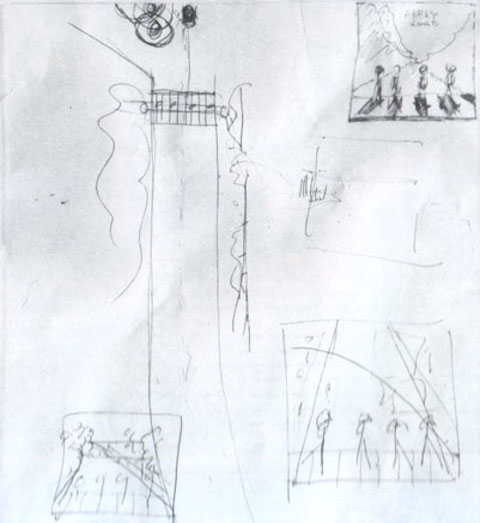
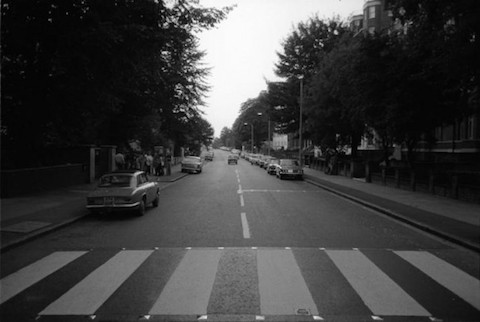
Seeing the sausage of that cover made in the alternate takes posted at the Beatles Bible site (two of which have Paul wearing sandals) doesn’t necessarily dispel the mystique, but it does disabuse one of illusions of total spontaneity. Even more so does the drawing at the top, which Paul McCartney made for photographer Iain Macmillan, who had 10 minutes to get the handful of shots he captured with his Hasselblad. In the top right-hand corner, you can see a small drawing added by Macmillan which adds depth to McCartney’s rudimentary compositions. These sketches show McCartney and Macmillan carefully visualizing the symmetries, strides, and even shadows of the crosswalk photo. (See the landmark above, empty, in a photo taken that same day.)
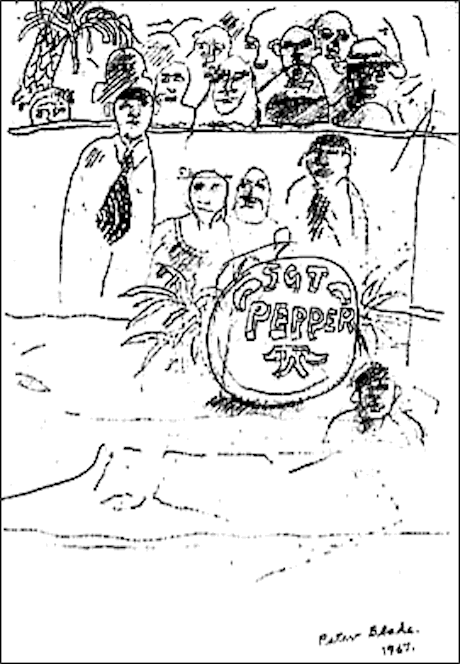
Sketching out important shots like these is common practice. For example, above you can see Peter Blake’s 1967 outline for the Sgt. Pepper’s Lonely Hearts Club Band cover art. But the Abbey Road sketch is further evidence of McCartney’s guiding hand in The Beatles’ image-making. Of Sgt. Pepper’s, John Lennon went on record as saying of the concept that “Sgt Pepper is Paul.” In this case, McCartney’s idea for the cover was instrumental in Blake’s eventual design: “a presentation featuring a mayor and a corporation, with a floral clock and a selection of photographs of famous faces on the wall behind The Beatles.” McCartney circulated a list among the band members, asking them to list their choice of celebrities. Many of the suggested figures ended up on the cover.
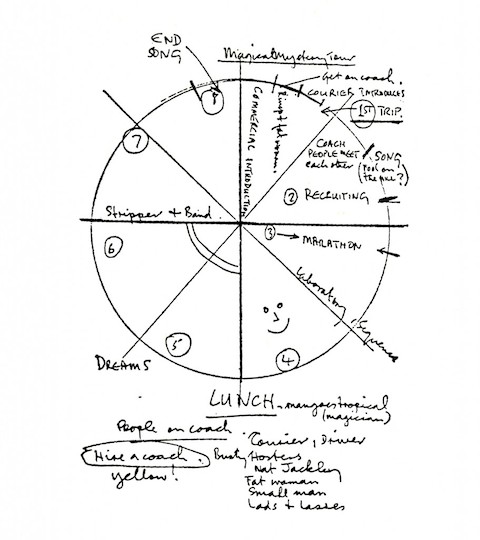
Of their subsequent concept album, The Magical Mystery Tour, Ringo likewise claimed “it’s Paul’s idea really, he came up with this.” Whenever McCartney formulated his ideas—for album structures, cover designs, or movies—he says in this video (which we can’t embed, unfortunately) that he would “draw something out.” Above, see his conceptual map for the Magical Mystery Tour film (click to enlarge). It may only be a coincidence that it looks something like a dreamcatcher. Maybe it’s more of a pie chart. In any case, McCartney describes it in fairly matter-of-fact terms as “virtually a script” that allowed him to “focus his thoughts.”
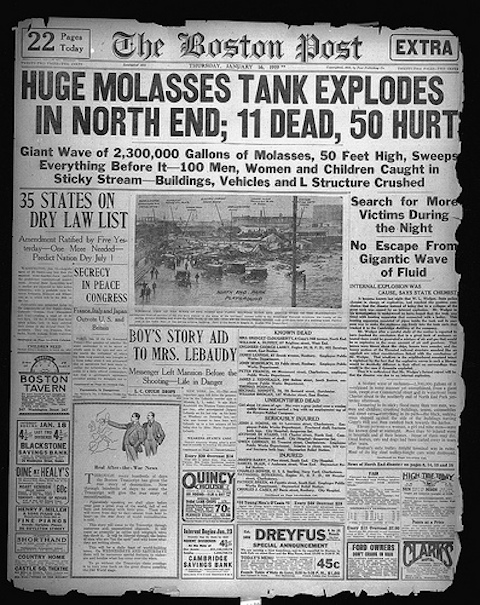
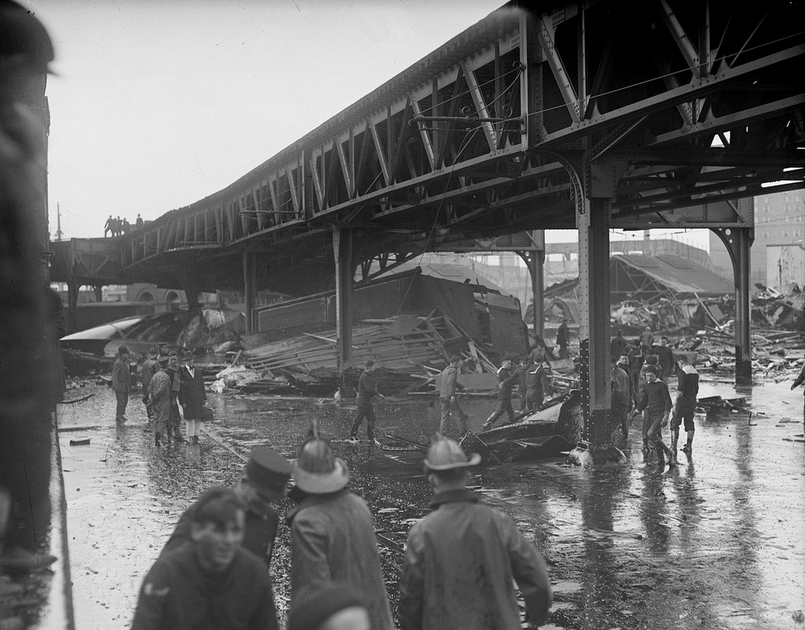
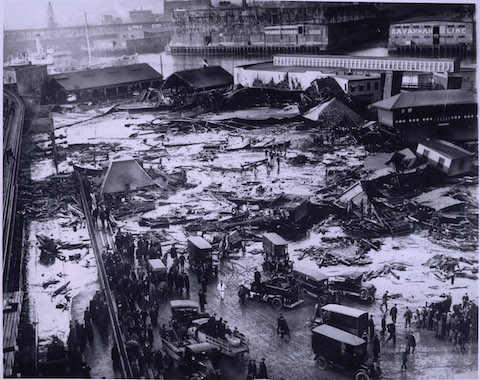
It fits perfectly into early 20th-century American lore, this all-too-real disaster: on January 15, 1919, a fifteen-foot wall of molasses rushed through Boston’s North End, killing 21, injuring 150, doing $100 million in today’s dollars worth of damage, and requiring 80,000 man-hours to clean up. Those figures come from a post on the subject at Mental Floss, which investigates what loosed the Great Molasses Flood in the first place. The United States Industrial Alcohol Company, owners of the brown, sticky substance in question and the exploding tank that contained it, pinned it on bomb-chuckers, claiming that, “since its alcohol was an ingredient in government munitions, anarchists must have sabotaged the tank.” Investigations later revealed the cause as none other than seat-of-the-pants capitalistic hubris, another standby of early 20th-century America.
The tank’s “absurdly shoddy construction work,” led by a man who “couldn’t even read a blueprint,” came down to this: they “threw up a gigantic tank as quickly and cheaply as possible, skimped on inspections and safety tests, and hoped for the best.” You can learn more about what happened in the video above, a dramatization of the events leading up to the Great Molasses Flood from the pilot episode of The Folklorist.
The contemporary images above and below come from the Boston Public Library’s Flickr set. For the most definitive study of this gooey calamity, you’ll want to seek out Dark Tide: The Great Boston Molasses Flood of 1919 by Stephen Puleo, who speaks in some detail about the event and its aftermath in this Real History video. All these well-documented facts aside, legend has it that, on a particularly hot day on Commercial Street, you can still smell the stuff.
Musical experimentalists Collective Cadenza’s Valentine’s Day Special “A History of Men Moving On” is to wallowing as speed dating is to courtship.
It’s a five minute medley of male romantic pain that takes us all the way from Roy Orbison’s 1960 “Only the Lonely” to CeeLo Green’s pointed “Fuck You.”
Vocalist Forest Van Dyke exhibits considerable dexterity, navigating these stylistic switchbacks. A shame he was directed to deliver so much of this choice material to a framed photo, awkwardly positioned on an upstage music stand. I know that the room was crowded, but I would’ve liked to see his feet, too. A man who can dance is something to see.
Kudos to musical director Michael Thurber for making explicit the similarities between Gotye’s “Somebody That I Used To Know” and Usher’s “Papers” (as covered by a goat). As with Hemingway’s couplet, the latter failed to make the round up. Does the heartbreak ever cease?
Peter Capaldi is best known in the States for being the most recent actor to play Doctor Who. But did you know that he is also an Oscar-winning filmmaker? His brilliant short film Franz Kafka’s It’s a Wonderful Life took the prize for Best Short Film in 1995.
The movie shows Kafka, on Christmas Eve, struggling to come up with the opening line for his most famous work, The Metamorphosis.
As Gregor Samsa awoke one morning from uneasy dreams he found himself transformed in his bed into a gigantic insect.
Capaldi wrings a lot of laughs out of Kafka’s inability to figure out what Samsa should turn into. A giant banana? A kangaroo? Even when the answer is literally staring at him in the face, Kafka is hilariously obtuse.
Richard E. Grant stars as the tortured, tightly-wound writer who is driven into fits as his creative process is interrupted for increasingly absurd reasons. The noisy party downstairs, it turns out, is populated by a dozen beautiful maidens in white. A lost delivery woman offers Kafka a balloon animal. A local lunatic searches for his companion named Jiminy Cockroach.
Jonathan Crow is a Los Angeles-based writer and filmmaker whose work has appeared in Yahoo!, The Hollywood Reporter, and other publications. You can follow him at @jonccrow.
If you don’t have enough existential angst in your life — and if you’re operating on the theory that there’s no such thing as too much Kafka (see our post from earlier today) — then check out this radio play called Samsa & Seuss, which aired originally on the CBC show Wiretap before appearing on This American Life. The piece is based on an epistolary short story by the late, great David Rakoff and is performed by Rakoff along with Jonathan Goldstein.
The story begins with a desperate Gregor Samsa reaching out to Dr. Seuss looking for some way to cure him of his malady — i.e. being a bug. Seuss’s reply is written entirely in verse — “Rest assured, I’ll endeavor to glean and deduce. You’ll be better than ever or my name isn’t Seuss” – which confuses Samsa to no end. At one point, Samsa asks, “Is metrical rhyme an American mode of correspondence?”
Yet what could be a one-joke novelty grows surprisingly poignant in Rakoff’s deft hands. When it becomes clear that the doctor’s eccentric health regime – “magnolia custard and rosehip soufflé and some dew drops with mustard” – has failed to fix the ailment of the increasingly depressed Samsa, Seuss’s cheery can-do attitude turns reflective:
I’m astonished at times when I think of the past, of my thousands of rhymes, of how life is so vast. I’m left, then, to wonder how anyone gleans a purpose or sense of what anything means. It’s not ours for the knowing. It’s meaning abstruse. We both best be going. Your loving friend, Seuss.
Jonathan Crow is a Los Angeles-based writer and filmmaker whose work has appeared in Yahoo!, The Hollywood Reporter, and other publications. You can follow him at @jonccrow.
If you have 22 minutes, why not sit back and watch the classic piece of television above, Alfred Hitchcock Presents’ 1961 episode “Bang, You’re Dead”? You may well have seen it before, quite possibly long ago, but you’ll find it holds up, keeping you in suspense today as artfully as it or any other Hitchcock production always has. But why do we get so emotionally engaged in this simple tale of a five-year-old boy who comes into possession of a real handgun that he mistakenly thinks a harmless toy? Here with detailed answers rooted in the mechanics of the human brain, we have “Neurocinematics: the Neuroscience of Film,” a presentation by Uri Hasson of Princeton University’s Neuroscience Institute.
Hitchcock conceived of his style of cinema, says Hasson in the clip below, as “doing experiments on the audience,” and of a movie itself as “a sequence of stages designed to have an effect on your brain.”
The brains of everyone sitting in the theater thus, theoretically, all become “resonant and aligned with the movie in a very powerful and complicated way.” Various types of research bear this out, from measuring the skin temperature, perspiration, and blood flow in the brains of subjects as they watch Hitchcock’s young protagonist add more “toy” bullets to the “toy” gun he brandishes around the neighborhood. In the clip below, you can see exactly how the scientists’ functional MRI machines scan the viewers as they watch the episode, whose plot, as one of the research team puts it, “keeps the participants a bit on their feet,” flat on their back though they need to remain for the duration. You’ll find the watching experience much more comfortable in your chair. It won’t produce much data for the scientific community, but at least now you’ll know what goes on in your brain as it happens, something about which even Hitchcock himself could only guess. To conduct your own experiments, see our collection of 21 Free Hitchcock Movies Online.
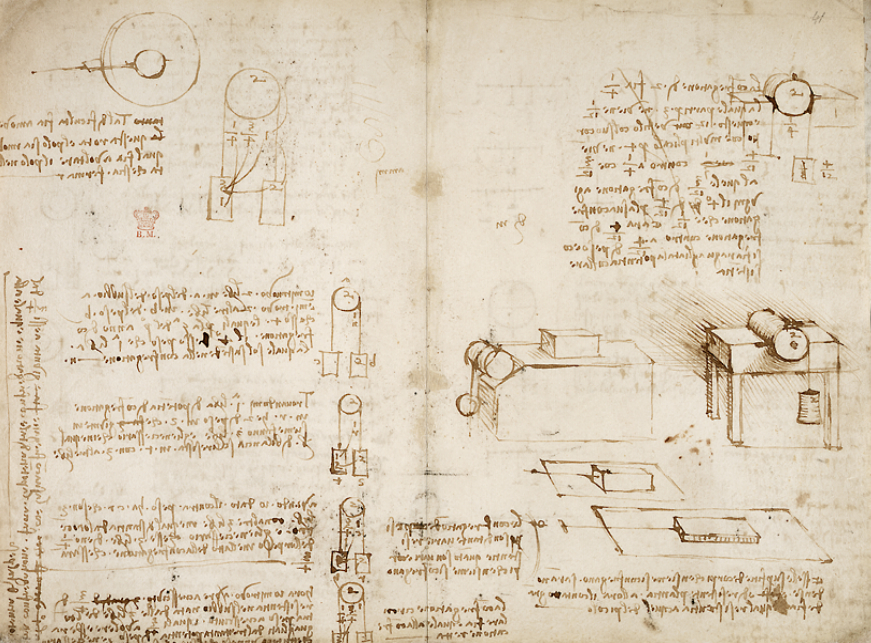
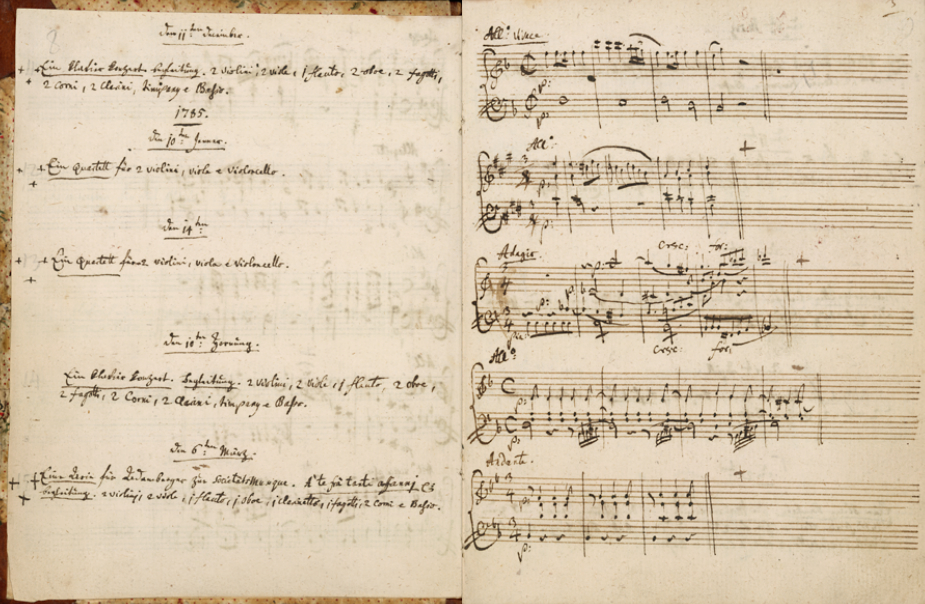
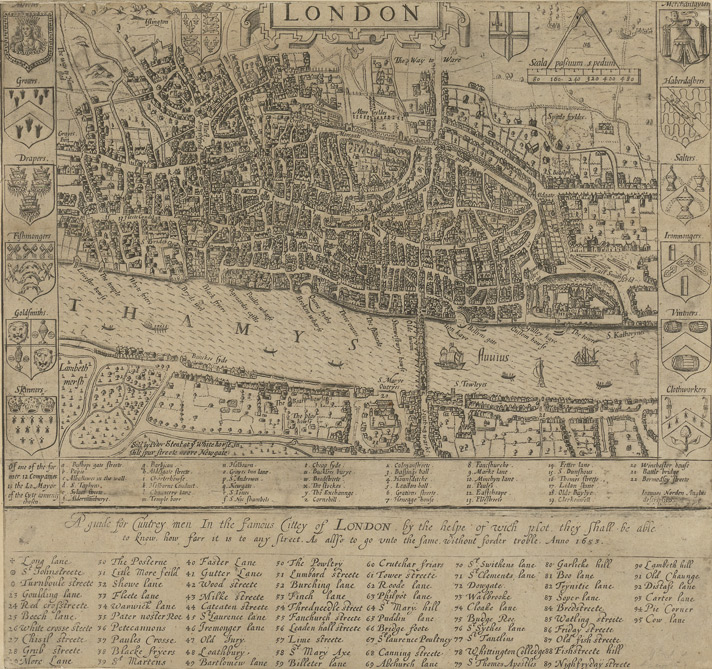
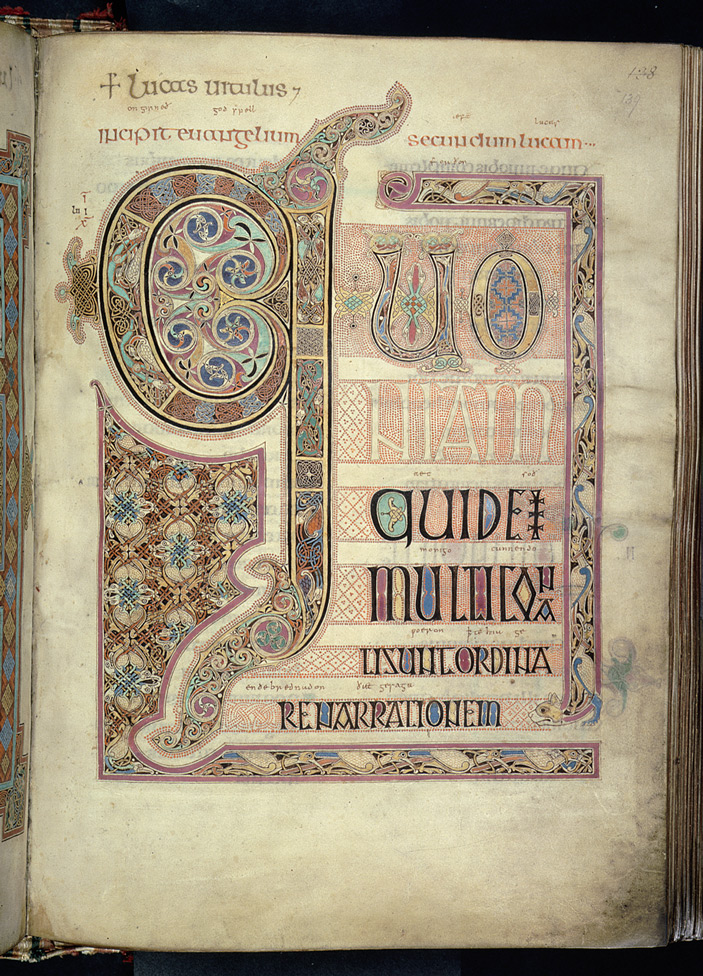
The vast digital collection includes books, ancient maps, and priceless prints. Amid the countless virtual tomes, some of the more impressive holdings include Mozart’s musical diary from the last seven years of his life, and Leonardo da Vinci’s notebook (find both above) where the artist and inventor theorized about mechanics. Da Vinci also recorded riddles in his notes, including: “The dead will come from underground and by their fierce movements will send numberless human beings out of the world” (Answer: “Iron, which comes from under the ground, is dead, but the weapons are made of it which kill so many men”).
Today we feature recordings of Langston Hughes reading two of his earliest and best-known poems from his debut 1926 collection The Weary Blues. The first, “The Negro Speaks of Rivers,” Hughes wrote in 1920 when he was only 17. In her very close reading of this poem, Alexandra Socarides tells us that Hughes was just “emerging from a distinctly Midwestern childhood” and taking a train to Mexico City to spend a year with his estranged father when he wrote the lines: “I’ve known rivers: / I’ve known rivers ancient as the world and older than the / flow of human blood in human veins.” (You can hear Hughes tell the story of writing the poem here). The short poem spans four rivers in three different continents, though “at the moment of its composition, it was the landscape of the Midwest [Hughes] knew best.”
Even before he had traveled the globe, Hughes’ concerns were global in scope. But he is most often associated with the jazz-age Harlem Renaissance scene, and rightly so. After his year in Mexico City, Hughes moved to New York to study at Columbia and helped pioneer a jazz poetry that anticipated Beats and Black Arts poets alike. The title poem of The Weary Blues is firmly situated in Harlem—“Down on Lenox Avenue” where a bluesman “made that poor piano moan with melody.” It’s a poem meant to be read aloud, and in the video above, you can see Hughes do so with accompanying jazz ensemble The Doug Parker Band for a 1958 Canadian program. That next year, Hughes collaborated with Charles Mingus and Leonard Feather on an album of jazz readings called The Weary Blues.
Critic Donald B. Gibson once noted that Hughes may have “read his poetry to more people (possibly) than any other American poet.” His generous populism didn’t always mean critical success—the two are often at odds—such that in 1969, Lindsay Patterson called him “the most abused poet in America” for the neglect or outright scorn his accessible poetry received from both black and white critics at the time. In a review of Ossie Davis and Ruby Dee’s hard-to-find recorded readings of 50 of Hughes’ poem, Patterson wrote that Hughes’ work “must be heard, rather than read silently, for one to realize its emotional scope.” I disagree. From early short poems like “A Wooing” to later, longer works like “Prelude to Our Age,” Hughes’ work on the page is deeply evocative, complex, and rewarding. But while Hughes was steeped in history, he was also steeped in poetic tradition of a very American variety—Walt Whitman, Claude McKay, Countee Cullen—that privileged musical language, vernacular expressions, and an exuberant personal voice, and that makes his work a particular joy to hear read, especially by the poet himself.
Emile de Antonio is one of those people who simply had a knack for being in the right place at the right time. He was a Harvard classmate of John F. Kennedy. He knew all of the core members of the Beat movement, even helping to distribute the seminal Beat movie Pull My Daisies. And De Antonio was a friend with virtually everyone in the New York art scene from Jasper Johns to Willem de Kooning. He once drank himself into a stupor for Andy Warhol’s experimental movie Drink. Warhol even famously praised De Antonio saying, “Everything I learned about painting, I learned from De.”
De Antonio was also a major voice of dissent during the Cold War. He directed a series of scathing documentaries including Point of Order(1964), about the McCarthy hearings; Rush to Judgment (1966), a staple among JFK assassination theorists; and the Oscar-nominated anti-Vietnam war movie In the Year of the Pig. (1968)
For his 1972 movie Painters Painting: The New York Art Scene 1940–1970, De Antonio managed to get artists like Warhol, Johns, and De Kooning along with Robert Rauschenberg, Frank Stella, Barnett Newman and Helen Frankenthaler to talk about their craft. It is the definitive documentary portrait of the New York art world.
De Antonio talked about Painters Painting in a 1988 interview:
I was probably the only filmmaker in the world who could [have made Painters Painting] because I knew all those people, from the time that they were poor, and unsuccessful and had no money. I knew Warhol and Rauschenberg and Jasper Johns and Stella before they ever sold a painting, and so it was interesting to [do the film about them]. They appeared in the film along with De Kooning, whom I knew very well, and Barnett Newman, who is now dead. They talked to me in a way that they would never have talked to anybody else because they knew I knew the subject.
The film, a tad grainy, appears above. A higher res version of the film can “rented” on Amazon. Amazon Prime member can watch it for free.
Jonathan Crow is a Los Angeles-based writer and filmmaker whose work has appeared in Yahoo!, The Hollywood Reporter, and other publications. You can follow him at @jonccrow.
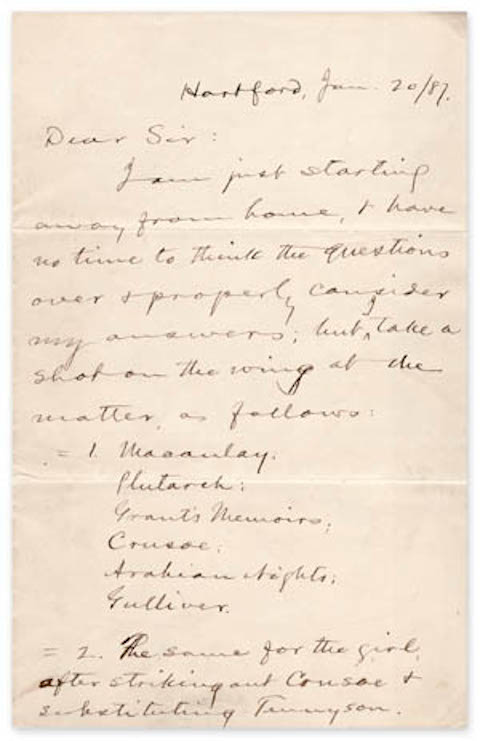
In January of 1887, Mark Twain wrote the above letter to a Reverend Charles D. Crane, pastor of a Methodist Episcopal Church in Maine, to advise him of the most suitable reading for both children and adults. Twain’s letter—which, as he did nearly all his letters, he signed with his given name of Samuel Clemens (or “S.L. Clemens”)—came in response to a query in three parts from the Rev. Crane. But we do not seem to have Crane’s letter (at least a thorough search of the exhaustive catalog at the online Mark Twain Project yields no results.) Nonetheless, we can reasonably infer that he asked the famous author—who was between Adventures of Huckleberry Finn and A Connecticut Yankee in King Arthur’s Court—something like the following:
1) What books should young boys read? 2) And young girls? … 3) [and both/either] What should grown-ups read? [and/or] What are Mr. Samuel Clemens’ favorite books?
Twain, in a hurry, “took a shot on the wing” and replied with the letter below, which, despite his protestations of haste, seems fairly well-considered. I’ll admit that the ambiguity of the last sentence, however, gives me the researcher’s buzz to go back and dig through more archives for Crane’s original letter.
Dear Sir:
I am just starting away from home, & have no time to think the questions over & properly consider my answers; but I take a shot on the wing at the matter, as follows:
= 2. The same for the girl, after striking out out Crusoe & substituting Tennyson.
I can’t answer No. 3 in this sudden way. When one is going to choose twelve authors, for better for worse, forsaking fathers & mothers to cling unto them & unto them alone, until death shall them part, there is an awfulness about the responsibility that makes marriage with one mere individual & divorcible woman a sacrament sodden with levity by comparison.
In my list I know I should put Shakspeare [sic]; & Browning; & Carlyle (French Revolution only); Sir Thomas Malory (King Arthur); Parkman’s Histories (a hundred of them if there were so many); Arabian Nights; Johnson (Boswell’s), because I like to see that complacent old gasometer listen to himself talk; Jowett’s Plato; & “B.B.” (a book which I wrote some years ago, not for publication but just for my own private reading.)
I should be sure of these; & I could add the other three — but I should want to hold the opportunity open a few years, so as to make no mistake.
We're hoping to rely on loyal readers, rather than erratic ads. Please click the Donate button and support Open Culture. You can use Paypal, Venmo, Patreon, even Crypto! We thank you!
Open Culture scours the web for the best educational media. We find the free courses and audio books you need, the language lessons & educational videos you want, and plenty of enlightenment in between.