The Dearth of Conservative Professors Explained
Liberals outnumber conservatives in the academy. That’s a known fact. What explains this divergence? Some have attributed it to liberals creating a hostile environment for conservatives. But new research calls that view into question and offers an intriguing alternative explanation.
As described in The Chronicle of Higher Education, Matthew Woessner (a conservative academic) and April Kelly-Woessner (a liberal academic) looked at surveys completed by 15,569 college seniors, and what an analysis of the data suggests is that “the personal priorities of those on the left are more compatible with pursuing a Ph.D.” “Liberalism is more closely associated with a desire for excitement, an interest in creative outlets, and an aversion to a structured work environment. Conservatives express greater interest in financial success and stronger desires to raise families. From this perspective, the ideological imbalance that permeates much of academia may be somewhat intractable.” Or, put differently, this imbalance may not be going away any time soon.
To delve further into their research, you can read their report online here.
Read More...
Who Do We Vote For This Time Around? A Letter from Michael Moore
The Iowa caucus is finally and mercifully upon us. And right in time, filmmaker Michael Moore has offered an analysis of the Democratic field of candidates. There’s much here that I don’t particularly agree with here, but Moore makes two large claims that strike me as being fundamentally (and regretfully) true:
- The “Democratic front-runners are a less-than-stellar group of candidates, and … none of them are the slam dunk we wish they were.”
- “For months I’ve been wanting to ask the question, “Where are you, Al Gore?” You can only polish that Oscar for so long. And the Nobel was decided by Scandinavians! I don’t blame you for not wanting to enter the viper pit again after you already won. But getting us to change out our incandescent light bulbs for some irritating fluorescent ones isn’t going to save the world. All it’s going to do is make us more agitated and jumpy and feeling like once we get home we haven’t really left the office.”

Privacy Policy
Last modified: July 27, 2024
Open Culture, LLC (“Open Culture,” “we” or “us”) knows that you care how information about you is used and shared. This Privacy Policy explains how Open Culture collects and uses information at its website located at www.openculture.com and at other websites and mobile services provided by Open Culture (collectively the “Network Websites”). This Privacy Policy also explains how you can control the collection, correction and/or deletion of certain types of information that we collect. We will not use or share your information with anyone except as described in this Privacy Policy. This Privacy Policy does not apply to information we collect by other means (including offline) or from other sources. Further, this Privacy Policy does not apply to any websites, webpages, blogs, applications, widgets or other services operated by any third party, including our affiliates, advertisers, providers and partners.
1. Information We Collect
A. Personally Identifiable Information
In general, Open Culture does not collect personally identifiable information on the Open Culture Services, except as set forth below. For purposes of this Privacy Policy, “personally identifiable information” is data intended to be used to identify, contact or locate a person, including, name, address, telephone number or e‑mail address and any other information (even if non-personally identifiable) provided in combination with such personally identifiable information.
You may provide us information about yourself, such as your name or e‑mail address, when you use or post content on or though the Open Culture Services, including registering for the use of certain features such as email RSS feeds. If you correspond with us by email, we may retain the content of your email messages, your email address, and our responses. We may also retain any messages or other content you send through or post on the Open Culture Services.
Citizens of any country that has promulgated a data localization law may not utilize the Open Culture Services in any way, including viewing pages on the Open Culture website or subscribing to the Open Culture newsletter.
The advertisements we deliver may offer the ability to interact, including playing a game or viewing a video. The ad may also give you the opportunity to provide the advertiser with information about yourself. In some instances, if you choose to interact with an advertisement or provide an advertiser with information about yourself, Open Culture may collect information on behalf of the advertiser. In that case, the advertiser’s privacy policy would apply to the data collected and we will abide by the instructions given to us by the advertiser in our handling of the data. Open Culture will not associate any information (non-personally identifiable or personally identifiable) we collect for an advertiser with any other information we may have collected about you through the Open Culture Services.
B. Non-Personally Identifiable Information
When you visit the Open Culture Services, Open Culture or third parties such as advertisers, third-party advertising networks, and third-party advertising serving companies may collect non-personally identifiable information. For purposes of this Privacy Policy, “non-personally identifiable information” is data that is not personally identifiable. Open Culture and these third parties may implement certain technologies to enable the collection of such information. An explanation of these technologies is below.
Cookies Information: When you visit the Open Culture Services, we may send one or more cookies—a small text file containing a string of alphanumeric characters—to your computer that uniquely identifies your browser and lets Open Culture help you log in faster and enhance your navigation through the site. A cookie may also convey information about how you browse the Open Culture Services. Open Culture uses session, persistent, flash and browser cookies. The use of cookies on the Open Culture Services is anonymous and does not allow us to gather personally identifiable information about you. A persistent cookie remains on your hard drive after you close your browser. Persistent cookies may be used by your browser on subsequent visits to the site. Persistent cookies can be removed by following your web browser’s directions. A session cookie is temporary and disappears after you close your browser. You can set your web browser to refuse all cookies or to indicate when a cookie is being sent. However, some features of the Open Culture Services may not function properly if the ability to accept cookies is disabled.
Device Identifiers: When you access the Open Culture Services by or through a mobile device, we may access, collect, monitor and/or remotely store one or more “device identifiers.” Device identifiers are small data files or similar data structures stored on or associated with your mobile device that uniquely identify your mobile device and are used by Open Culture to enhance your use of the Open Culture Services. A device identifier may be data stored in connection with the device hardware, data stored in connection with the device’s operating system or other software, or data sent to the device by Open Culture. A device identifier may convey information to us about how you browse the Open Culture Services. A device identifier does not collect or share any personally identifiable information about you. However, a device identifier may be used in conjunction with other information in a manner that may constitute personally identifiable information. A device identifier may remain persistently on your device, to help you log in faster and enhance your navigation through the Open Culture Services. Some features of the Open Culture Services may not function properly if use or availability of device identifiers are impaired or disabled.
Web Beacons/Click-Stream Data: A web beacon is an electronic file that signals when a webpage, advertisement, video, other content, an email, or a newsletter has been viewed. We may use web beacons in our emails and newsletters, or on our websites and services. Open Culture may use web beacons in conjunction with cookies to collect click-stream data that helps us better understand how visitors move from page to page within our websites. As with cookies, our use of web beacons is anonymous and does not allow us to gather personally identifiable information about you.
Passive Browser Information: Open Culture collects passive browser information though its web servers. We use the passive browser information to help us understand how many visitors come to our websites and where they come from, and ultimately to help us make decisions about how to organize the websites and deliver advertising.
Log File Information: Log file information is automatically reported by your browser each time you access a web page. When you use the Open Culture Services, our servers automatically record certain log file information. These server logs may include information such as your web request, Internet Protocol (“IP”) address, browser type, referring / exit pages and URLs, number of clicks, domain names, landing pages, pages viewed, data about how you interact with links on the Open Culture Services, and other such information. We may display your IP address to the owners or maintainers of certain blogs, groups or communities if you post to those blogs, groups or communities and the owner or maintainer has enabled functionality for this purpose.
Scripts: A script is a short segment of computer code included in a web page or other content that can be used to set and access a cookie on your computer’s hard drive and to record your activity on a website. Open Culture may use scripts on the Open Culture Services, on third-party websites, or in our emails and newsletters.
C. Third Party Advertisements
If an advertiser asks Open Culture to show an advertisement to a certain audience and you respond to that advertisement, the advertiser or ad server may conclude that you fit the description of the audience they are trying to reach. In addition, third-party advertisers may use non-personally identifiable information about your visits to the Open Culture Services in order to provide advertisements about goods and services that they believe may be of interest to you. If you would like more information about this practice and to know your choices about not having this information used by these companies, please see the list provided immediately below. This Privacy Policy does not apply to, and we cannot control the activities of, third-party advertisers. Please consult the respective privacy policies of such advertisers for more information.
- Google Analytics: Privacy Policy
- Google Adsense: Privacy Policy
- Amazon Affiliate Program: Privacy Policy
- Feedburner: Privacy Policy
- Commission Junction Affiliate Program: Privacy Policy
- ShareaSale: Privacy Policy
- LinkShare/Rakuten: Privacy Policy
- Impact Radius: Privacy Policy
- Publift: Privacy Policy
2. How We Use Your Information
A. Personally Identifiable Information
We use the personally identifiable information that we collect to operate, maintain, and provide to you the features and functionality of the Open Culture Services.
By providing Open Culture with your email address, you consent to our use of the email address to send you notices related to the Open Culture Services, including any notices required by law, in lieu of communication by postal mail. We may also contact you via email with transactional or relationship messages, such as notifications of changes to the terms of services provided. By providing your email address, you agree that we may send you notifications of activity on the Open Culture Services to that email address, in accordance with any applicable privacy settings. We may use your email address to send you other messages, such as information about changes to features of the Open Culture Services. If you do not want to receive such email messages, you may opt out or change your preferences by sending an email to ma**@*********re.com. Opting out may prevent you from receiving email messages regarding updates, improvements, or offers. You may not opt out of service-related emails or transactional or relationship email messages.
Open Culture may use your personally identifiable information and user content internally for purposes such as operating or improving its websites, determining which users have access privileges to certain content, services or resources that we offer, diagnosing service or technical problems, maintaining security, doing something that you have asked us to do, telling you about Open Culture products, services and marketing events that we think may be of interest, analyzing how the Open Culture Services are used, and personalizing content.
B. Non-Personally Identifiable Information
We may use non-personally identifiable information, including cookies, device identifiers, location data, web beacons/click-stream data, passive browser information, demonstration data, log file information, and scripts to: (a) remember information so that you will not have to re-enter it during your visit or the next time you visit the site; (b) provide custom, personalized content and information; © monitor the effectiveness of our services; (d) monitor aggregate metrics such as total number of visitors, traffic, and demographic patterns; (e) diagnose or fix technology problems reported by our users or engineers that are associated with certain IP addresses; (f) help you efficiently access your information after you sign in; (g) monitor and prevent fraud and abuse; (h) identify you as an account holder; (i) require you to re-enter your password after a certain period of time has elapsed to prevent others from accessing your account contents; (j) keep track of preferences you specify while you are using Open Culture Services; (k) conduct research to improve Open Culture Services; (l) monitor advertising-related metrics, in order to provide you with more helpful and relevant advertising; (m) administer our business (e.g., to calculate payments due to our network websites); and (n) track user content and users to the extent necessary to comply as a service provider with the Digital Millennium Copyright Act.
Third-party advertising networks and advertisers may also use non-personally identifiable information to assist them in delivering advertising that may be relevant to your interests.
3. How We Share Your Information
A. Personally Identifiable Information
Open Culture will not rent or sell your personally identifiable information to others. Open Culture only shares personally identifiable information with other companies or individuals outside of the Open Culture Services as follows: (1) if Open Culture has your consent to the sharing of personally identifiable information; (2) to provide Open Culture’s services to you; (3) to respond to subpoenas, court orders or legal process, to assist government enforcement agencies, to establish or exercise our legal rights, or to defend against legal claims; (4) if we believe it is necessary in order to investigate, prevent, or take action regarding third-party claims or allegations, illegal activities, suspected fraud, situations involving potential threats to the safety or property of another person, violation of our Terms and Conditions of Service; or (7) as otherwise required by law. Open Culture may also store personally identifiable information and user content in locations outside the direct control of Open Culture (for instance, on servers or databases co-located with hosting providers).
Any personal information or content that you voluntarily disclose for posting to the Open Culture Services, such as messages, comments or other user content, becomes available to the public.
B. Non-Personally Identifiable Information
In the event that we use a third party to provide services or to support aspects of our business on our behalf, Open Culture may share non-personally identifiable information with the third party to be used by them only for the purpose of providing their services to Open Culture.
We may share non-personally identifiable information (such as anonymous usage data, referring/exit pages and URLs, platform types, number of clicks, etc.) with third parties to help them understand the usage patterns for certain Open Culture Services, and as part of the function of our business.
C. Transfer of Data
In the event that Open Culture sells, transfers or otherwise relinquishes all or part of our assets, business offerings, or services, including any of the Open Culture Services, information that you have shared with Open Culture or that Open Culture has collected, including both personally identifiable information and non-personally identifiable information, may be one of the business assets that will be transferred. We may also transfer or assign such information in the course of corporate divestitures, mergers, or dissolution. The transferred information will remain subject to the terms of this Privacy Policy or those of subsequent policies to which you have consented. If Open Culture is involved in a merger, acquisition, or sale of all or a portion of its assets, you will be notified via a prominent notice on our website of any change in ownership or uses of your personal information, as well as any choices you may have regarding your personal information.
4. Content Removal
Open Culture reserves the right, but has no obligation, to monitor the user content you post on any of the Open Culture Services. We reserve the right to remove any such information or material for any reason or no reason, including without limitation if in our sole opinion such information or material violates, or may violate, any law or our Terms and Conditions of Service, or to protect or defend our rights or property or those of any third party. Open Culture also reserves the right to remove information upon the request of any third party.
5. Data Retention
Open Culture may retain and continue to use indefinitely all information (including user content) posted to the Open Culture Services.
Open Culture retains the specific anonymous data collected and tied to your computer’s unique ID as described in this Privacy Policy for a period of up to twelve months. Such data may be aggregated and used for analytical purposes indefinitely.
6. How We Protect Your Information
Open Culture cares about the integrity and security of your personal information. We cannot, however, ensure or warrant the security of any information you transmit to Open Culture or guarantee that your information on the Open Culture Services may not be accessed, disclosed, altered, or destroyed by breach of any of our physical, technical, or managerial safeguards. The transmittal of information from you to us is done at your own risk.
7. Compromise of Personal Information
In the event that personal information is compromised as a result of a breach of security, Open Culture will promptly notify those persons whose personal information has been compromised, in accordance with the notification procedures set forth in this Privacy Policy, or as otherwise required by law.
8. Your Choices About Your Information
You may, of course, decline to submit personally identifiable information through the Service, in which case Open Culture may not be able to provide certain services to you.
You can limit targeted advertising by configuring your browser’s settings or changing the management panel of the Adobe Flash Player to limit your acceptance of or delete cookies. Because the management of cookies in various browsers differs, you should consult the documentation for your browser in order to manage your cookies. In order to limit the acceptance of or disable “flash” cookies, you must access the management panel of the Adobe Flash Player installed on your computer. To learn more about the management panel of the Adobe Flash Player and the management of “flash” cookies, please access the following link: http://www.macromedia.com/support/documentation/en/flashplayer/help/index.html. You can also opt-out of receiving cookies from third-party data providers by following the instructions at: http://www.networkadvertising.org/managing/opt_out.asp. You can opt-out of receiving cookies from Targusinfo, a specific third-party data provider, by following the instructions at: http://www.adadvisor.net/optout.html. Also, because your choices are not associated with you as a particular individual, if you change computers, web browsers or cookie settings, you will need to re-implement your preferences as described above. Note that if you limit or disable cookies, this does not mean that you will not see ads on the Open Culture Services. Instead, ads will be displayed that are based on passive browser information or other information that that may be provided by the Open Culture Services at the time of your visit.
9. Children’s Privacy
Protecting the privacy of young children is especially important. Open Culture and its related websites are not structured to attract children under 13 years of age. Open Culture prohibits the use of our websites or services by anyone under 13 years of age. Open Culture does not knowingly collect or solicit personal information from anyone under the age of 13 or knowingly allow such persons to register for any of the Open Culture Services. If you are under 13, please do not access the Open Culture Services or send any information about yourself to us, including your name, address, telephone number, or email address. In the event that we learn that we have collected personal information from a child under age 13 without verification of parental consent, we will delete that information as quickly as possible. If you believe that we might have any information from or about a child under 13, please contact us at ma**@*********re.com.
10. Links to Other Websites
We are not responsible for the practices employed by websites linked to or from the Open Culture Services, nor the information or content contained therein. Please remember that when you use a link to go from within the Open Culture Services to an outside website, our Privacy Policy is no longer in effect. Your browsing and interaction on any other website, including those that have a link on the Open Culture Services, is subject to that website’s own rules and policies. Please read over those rules and policies before proceeding.
11. Notification Procedures
It is our policy to provide notifications, whether such notifications are required by law or are for marketing or other business related purposes, to you via email notice, written or hard copy notice, or through conspicuous posting of such notice on the applicable Open Culture website or service, as determined by Open Culture in its sole discretion. We reserve the right to determine the form and means of providing notifications to you, provided that you may opt out of certain means of notification as described in this Privacy Policy.
12. Governing Law
This Privacy Policy is governed by the laws of the State of California and the United States of America.
13. Changes to this Privacy Policy
Open Culture may modify or update this Privacy Policy at its sole discretion from time to time, and so you should review this Privacy Policy periodically. When we change the policy in a material way, we will notify you by means of a notice on our website prior to the change becoming effective. Changes to this Privacy Policy are effective when they are posted on this page. Your continued access to the Open Culture Services after the Privacy Policy has been modified and posted will signify your acceptance of such modifications.
If you have any questions about this Privacy Policy, the practices of the Open Culture Services, or your dealings with Open Culture, please contact us at ma**@*********re.com.
14. California Consumer Privacy Act (“CCPA”)
Satirizing Ahmadinejad: The New Yorker Picks Up Where SNL Left Off
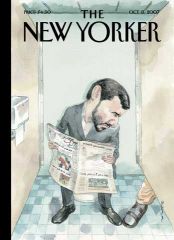
The satirists are getting a lot mileage out of Mahmoud Ahmadinejad’s declaration that Iran is gay-free. Last week, Saturday Night Live spoofed Ahmadinejad, as we noted. Then, The New Yorker parodied Ahmadinejad on the magazine’s cover with one of its famed cartoons. (The image included a not-so-oblique reference to Larry Craig, the conservative US Senator who recently got caught up in some mens’ room high jinks. Unfamiliar readers can get the scoop on Craig here.) Of all the inane comments Ahmadinejad has made, and there are many, it’s interesting that the satirists have chosen to focus on this one. Denying the existence of gays in Iran is no more empirically absurd than denying the Holocaust. So why the emphasis on the sexuality comment? Because Ahmadinejad has been playing the anti-semitism card for some time, but the homophobia card is relatively new, hence making it worthy of attention? Or is it because sexuality offers an always convenient way to take a political enemy down a peg? Or since there’s no good way to satirize a genocide, perhaps sexuality becomes a good default. Ok, I’m stumped. Note to self: think twice next time before over-analyzing jokes. Speaking of jokes, make you check out the footage we posted of Woody Allen doing standup in 1965.
Beyond Free Speech: Ahmadinejad at Columbia (on Video)
 There was a lot of hand-wringing leading up to Mahmoud Ahmadinejad’s appearance at Columbia University on Monday. But, as it turns out, freedom of speech seemingly worked as it was intended. Ahmadinejad entered the marketplace of ideas and quickly came out the wrong side of the exchange. (You can watch the full video of his appearance here or read the transcript here.) The deciding factor wasn’t so much the unbecoming introduction offered by Lee Bollinger, Columbia’s president. It was more just a matter of giving Ahmadinejad enough rope to hang himself (i.e., letting him doubt the existence of the Holocaust and also gays in Iran) and then sitting back and watching it happen.
Of course, the “marketplace of ideas” metaphor only goes so far when you’re dealing with international politics. Ahmadinejad’s speech wasn’t about winning a competition at Columbia. It was mostly about playing to an audience at home, one for whom his rhetorical strategies score points. But then there are the unintended consequences to consider. Far better than a discredited Bush administration ever could, Ahmadinejad realistically softened up the American public to any military plans that the US government has on the table. At the very least, this has to qualify for a Darwin Award. I’ll save further analysis for the pundits and talking heads since I know that politics and political opinions only go so far on this blog.
Related Note:
Last week, KQED’s Forum here in San Francisco had a good conversation about free speech in the university. It touched on Ahmadinejad’s appearance at Columbia, but also Don Rumsfeld’s invitation to Stanford’s Hoover’s Institution and Larry Summers canceled invitation to speak before the UC Board of Regents. Listen here: iTunes — Feed — Mp3 — Web site.
Read More...Life-Changing Books: Your Picks
Image by George Redgrave, via Flickr Commons
We asked our readers what books made the biggest difference in their lives, and here’s what they had to say. The list below tells you what books shaped their lives and why.
1984 “was the first book I actually enjoyed reading. It completely blew my mind at the time (I was 16) and it opened my eyes to the power of ideas and to the joy of reading a good book.” — Tim
A Short History of Nearly Everything — Bill Bryson
“Wow this book is incredible. At close to 500 pages Bryson covers everything from the moment the universe expanded from the intensely dense matter that was (aka the big bang) to man’s origin. Reading this book has impacted the way I look at everything from bacteria to asteroids.” — Alex
“After reading through these suggestions, I realized there’s a big hole: Poetry! So much poetry has affected my life: Sylvia Plath’s _Ariel_; Campbell McGrath’s _Road Atlas_; James Wright’s _Above the River_; Brenda Hillman’s _Cascadia_…Walt Whitman, Emily Dickinson, Robert Bly… Poetry may not be the “winning pick” here, but it definitely should be celebrated! And not just in April.” — Amanda
Cat’s Cradle — Kurt Vonnegut
“This book reignited the pilot light of my imagination like no other book had done in quite awhile. The whimsy of its narrative, which ended with the utter destruction of our world thanks to mankind, was stark, shocking, yet refreshing when it seemed every other book I read was just an exercise towards getting to a happy ending. Great book!” — Spamboy
Crooked Cucumber — The Life and Zen Teaching of Shunryu Suzuki
“Although I am not practicing Zen (yet), this book is like my Bible in that I plan to always read over it and reflect upon the messages therein. Suzuki had a humble vision that in order to change this world, we need to change the way people think and live, not just to change the symptoms of what is wrong. Not just to get rid of pop-prejudice and hatred, but to get rid of labels entirely, to ‘fight’ war and injustice with peace and understanding instead of anger.… That’s just some of the stuff that is shaping the way I think right now.” — Luella
Disturbing the Peace — Vaclav Havel
“I read it as a junior in high school, picked up on the bargain pile at a B. Daltons. It impacted me because it illustrated the concept of learning throughout life and how people can live with dignity. I’ve loaned it out several times and re-bought it at least three times.” — Emmett
Extremely Loud and Incredibly Close — Jonathan Safran Foer
“…It’s as though that book has taken so much life from the past and made it all tangible to us here in the present. I love the emotional complexity that’s replicated in the grandmother’s and grandfather’s manuscript and letters, how they show how memory is fragmented, overwhelming, and sometimes incomprehensible. Seriously, I could go on and on. And I can think of hundreds of other books that have changed me just as much. It’s just this one has been at the forefront of my mind ever since I read it a couple of months ago.” — Amanda
Great Expectations — Charles Dickens
“I think it was the first time I had felt such a bond with a character. I triumphed with [Pip’s] successes, felt the blow of failure in his defeats, and felt sorrow when he broke his own principles. I saw values in Pip that I wanted to emulate in my own life — a dedication to pursuing my dreams, overcoming my weaknesses, and treating others respectfully regardless of what frustrations I may have in my own life…” — Jamie
Healing Invisible Wounds: Paths to Hope and Recovery in a Violent World — Richard F. Mollica
“A stellar book released last year that I believe will quietly grow to classic status on par with Victor Frankl and Elie Wiesel… Mollica’s thesis, radical for a professor of medicine, is that humans have the tools to heal themselves from even the worst imaginable traumas. He gently shows the recipe for self-recovery, and reveals that the survivor is, in fact, the greatest hero for us all.” — Megan
“Hersey retells what happens when an atomic bomb falls on your city. Culled from interviews with survivors of the atomic bomb attack, this narrative was originally published as an entire issue of The New Yorker magazine. Haunting.” — Morgan
How to Read a Book — Mortimer J. Adler and Charles Van Doren
“Quite simply it has enabled me to get more out of the books that I’ve read.” — Greg
In Cold Blood — Truman Capote
It was the first “adult book that I read upon graduating to the adult section of the Municipal Library in Krakow. Having read all the classic science fiction on the shelves, Capote’s matter of fact prose was as disturbing to me as it was new. No aliens here among far away stars but a world almost ordinary and within reach, tangible and so totally frightening. Reading it felt like being caged with a wild animal, a quick fear followed repeatedly by the mind’s pangs of pride to subdue the brute. This was no fiction yet it read stranger than anything else up till then.”
Language in Thought and Action — S.I. Hayakawa
A book that “provides a whole rationale for reading fiction that I have never forgotten. I grew up in a time and a household where reading fiction was analagous to wasting your time. Hayakawa writes of fiction as a tool to increase your experience of life, to increase the number and variety of experiences in your life, your appreciation of those experiences, to understand others and so much more!” — Terry
Love in the Time of Cholera — Gabriel Garcia Marquez
–“It’s for me ‘life imitates art’ because an old lover appeared in my life after 31 years. And if I hadn’t read that book I think I would have refused him.” — Regina
–“Epic. Beautiful. My inspiration to become a writer.” — Valentina
Man’s Search for Meaning — Victor Frankl
“[It] is one of the best books I have read. The book describes the author’s imprisonment in several concentration camps. Faced with terrible suffering and loss he survives by finding meaning in the midst of this. He discovers that all of our freedoms can be taken from us….except one….the freedom to choose how we think and act under the very worst of circumstances.” — Andrea
Meditations — Marcus Aurelius
“A how-to manual of human behaviour, one that should be required reading for all aspiring politicians and leaders.” — Carol
Narrow Road to a Far Province — Basho
“A quarter century ago, I set out on a bicycle trip across North America, and a friend stuck a paperback copy of Basho’s ‘Narrow Road to a Far Province’ in one of my panniers. ‘Narrow Road’ … is a diary kept by the Japanese poet Basho in 1689 as he made a journey into the northern provinces of Japan. When I was in the Sierras, delayed by snow, I read through ‘Narrow Road’ two or three times. I don’t know whether the book affected me more greatly because I was traveling or my traveling affected my perception of the book (one of those zenny questions), but I came away with a much better sense of the journey that we all make through life, both the physical and philosophical journey, and a more humble sense of my place among the sojourners.” — Charlie
Now What? 90 Days to a New Life Direction — Laura Berman Fortgang
“I’ve read this book 3 times over the past 2 years and it’s allowed me to overcome my fears, realize my dreams and start working toward new goals in my career, relationships, etc. It’s given me the courage to leave the things (marriage, career, etc.) that weren’t working for me and to face the fear of the unknown to start working toward a new future.” — Merlene
Slaughterhouse 5 — Kurt Vonnegut
“Read at 12 or 13 this book certainly opened my eyes to a whole new world.” — Jason
Teaching as a Subversive Activity — Neil Postman
“One title that has had a big impact on me throughout my teaching career has been Neil Postman’s Teaching as a Subversive Activity. His concepts of helping kids develop their instincts for evaluating and analyzing all the messages tossed at them during their lives (he called it their crap detector) are more valid today than when he wrote the book in the 70’s.” — Tim
The Brothers Karamazov — Fyodor Dostoevsky
“As a teenager I was mystified by the audacity of the grand inquisitor. I’d never read such a succint indictment of faith. As I got to my twenties I read the whole book, but in my late twenties I began to appreciate it. I’ve never read a more powerful and realistic testament to faith in my life, and as I’ve grown, my reading of the book has grown with me.” — Don
The Candles of Your Eyes – James Purdy
“If the devil were alive he would be writing the works of James Purdy. ‘The Candles of Your Eyes’ changed my outlook on literature forever.” — John
The Catcher in the Rye — J. D. Salinger
–“This novel touched my heart deeply.” — Ellen
–“I’m going to go back to high school and say that Catcher in the Rye had a big impact on my life. While the content of the book in terms of character and story were accessible to me at 16, that isn’t really what made the difference. It was only after reading some criticism and talking with others in school and out that I began to see all that was going on in a novel beyond the plot: symbolism, irony, language and the rest. When I saw how much could go on in a book, how many things were going on simultaneously, I became very impressed with the complexity of literature as art. From then on I was pretty well hooked on books.” — Jack
The Chaneysville Incident — David Bradley
This book “arrived in my library, as part of our rental collection, in the mid-70s. Since then, I have given away at least half a dozen copies, bought it for other libraries I’ve worked at, and had a brief correspondence with David Bradley, the author. It’s about time for me to reread it…. If only one of you, reading this, gets the book, I’ll be satisfied. Even if you don’t get past the dissertation on long distance public transportation.” — Papermaven
“I read this book as a teenager. I remember being completely fascinated with the Jewish culture portrayed in the novel, but the main impact came in the way Potok emphasized the values of intelligence, intellectual achievement, and compassion for others. I was incredibly moved by the conflict between these values, and find myself re-reading this novel and the sequel “The Promise” almost yearly for over 20 years.” — Judy
The Complete Stories of Edgar Allan Poe
“Short and punchy, his macabre tales pack a visual whollop that modern longer stories lack. He can create mood and tone in less than a page. When I need a break from student narratives, I read a short story by Poe. There is a reason the guy’s writing has survived.” — Chris
The Grapes of Wrath — John Steinbeck
“I read The Grapes of Wrath in the 7th grade. That was 43 years ago. Steinbeck’s tender and loving prose and voice have never left me. I don’t think it’s too much to say that I actually, factually, love that book, and its author, very, very much.” — Fuzzo
The History of Sexuality & Discipline and Punish — Michel Foucault
“Both of these books philosophically ushered me into the modern world, changing the way I saw power, sex, sexuality, school, and nothing less than the Modern Self.” — Dragon Management
The Journey to the East — Hermann Hesse
“For a young reader, this became a portal for enjoying books.” — Bob
The Lord of the Rings — J.R.R. Tolkien
“The book that most influenced my life was “The Lord of the Rings” that I read when I was 15 years old. That book introduced me to the world of fantasy books. Ever since I keep reading this genre of books (plus a lot others of course), both in English and in Italian.” — Francesco
The Illuminatus! Trilogy - Robert Shea and Robert Anton Wilson
– “It’s chock full of free-thinking anarchism and did a lot to push me towards my current semi-libertarian view point.” — Dave
–“I would imagine this book had a similar effect on a lot of people who read it. This book really changed the way I think and introduced me to a lot of really great information. I went on to read almost all of Robert Anton Wilson’s books. He was a great philosopher who wasn’t afraid to state his mind. He recently passed away and I know a lot of people will and are missing him. His greatest effect on me was the introduction of ‘maybe logic.’” — Cyen
The Pleasure of Finding Things Out — Richard Feynman
“A collection of assorted writings by a great scientist shows the full palette of a sharp intelligence animated by all-around curiosity.” — Davide
The Secret Garden — Frances Hodgson Burnett
“I have two books that impacted my life; one from childhood and one from early adulthood. In the sixth grade, our teacher read The Secret Garden to us every day. I was captivated by the imagination, compassion, and touch of fantasy that this book awakened in me.” — Jan
“I love it so much. This book is for me pure philosophy.” — Ellen
Ways of Seeing — John Berger
“A book that first opened up my eyes to the fact that there are many ways that one can examine things.” — Darcy
Zen and the Art of Motorcycle Maintenance: An Inquiry into Values — Robert M. Pirsig
–“Although I am not too much into philosophy, this book really made me see a lot of things differently!” — Harish
–“After 18 years exploring philosophies I still return to Pirsig for clarity. Although I see many parallels now with more “respectable” philosophers, such as Hume, there is also a very human dimension to these books which manages always to move me. There is a sensation for many who read Pirsig of re-connecting with some long-forgotten wellspring of wisdom long lost to the reductionism of our daily existences.” — David
Read More...Did Tony Get Whacked? (And The First Full Episode of John From Cincinnati)
If you haven’t quite gotten the last episode of The Sopranos out of your head (clearly, I haven’t) … if you’re still mulling over what happened during those closing moments, then you may want to peruse a TV writer’s intriguing and informed take on whether Tony got whacked in the last episode. There’s a lot of good analysis and interpretation here. For an alternative view, you can also listen to this week’s podcast from TV Talk Machine. Here, Tim Goodman, who writes for The San Francisco Chronicle, and Joe Garofoli mull over which interpretations hold water, and which don’t. Plus, you can also read Goodman’s blog entry — “Sopranos” finale: What really happened” — and the many reader comments, reactions and theories at the bottom of the page.Now, with this chapter of television history closed, HBO is hoping to start another new and important one with John From Cincinnati. If you don’t have cable, you can watch the first episode here in its entirety. Good thinking HBO. Have they found another Sopranos? I’m not too optimistic. Have a look and see what you think.
Read More...The Death of the Book Review?
|
|
|
Michael Connelly, a crime fiction writer, published an op-ed in the LA Times protesting the move and he paints a dire picture of our cultural future:
Should we blame cash-strapped newspaper companies or a culture that’s shifting away from traditional media altogether? Ladies and gentlemen, start your iPods–to lend reasoned analysis, we now turn to Steven Colbert, who interviewed Salman Rushdie on this subject earlier this week (click below or watch the full show on iTunes): |

The Supreme Court Goes Digital
The Supreme Court has long taken heat for being in the technological arrière-garde, a criticism that has seemed fair given its unwillingness to even allow cameras into its oral arguments.
Slowly, however, that perception may be about to change. According to the ABA Journal eReport, the Court has stuck a small toe into the technology waters by providing web access to videotaped evidence that figured into a recent case, Scott v. Harris. The url for the video gets referenced within the written opinion for the case, and a link is provided from the Court’s opinions web page. (You’ll need Real Player to watch it.)
The video itself is nothing special. It features very low quality footage of a car chase taken from the dashboard of a police car, and it’s essentially the same scenario that America has seen played out for almost 20 years on Fox’s COPS. As you watch the video, you can’t help but feel that this landmark moment for the court is a non-moment. But that’s perhaps to be expected when a tradition-bound institution banally enters a brave new world.
Read More...25 UC Berkeley Courses Available via Free Video
Not long ago, we wrote a popular piece about UC-Berkeley’s iTunes initiative which, to sum it up,allows anyone, anywhere, to download complete university courses to their iPods for free. Amazing. Today, we want to point out that Berkeley also makes available full-fledged courses via video/webcast. You can find the complete list of courses here, but below we have listed below 25 courses that figure into a “core” undergraduate curriculum. In short, this list includes many good nuts and bolts courses, which will teach you a lot and, even better, cost you nothing. Each of these courses, coming straight from the classroom, can be accessed with Real Player, and some can also be accessed as MP3s.
On a related note, our University Podcast Collection and our collection of Free Courses will give you access to many more university lectures and courses, so be sure to give them a look. You may also want to check out our “playlist” of intelligent videos on YouTube as well as our recent piece: 10 Signs of Intelligent Life at YouTube.
UC Berkeley Courses:
- Buddhist Psychology
- Cell Biology
- Descriptive Introduction to Physics
- Economic Analysis — Micro
- European Civilization from the Renaissance to the Present
- General Biochemistry and Molecular Biology
- General Biology
- General Human Anatomy
- General Psychology
- Introduction to Computers
- Introduction to Chemistry
- Introduction to General Astronomy
- Introduction to Human Nutrition
- Introduction to Nonviolence
- Introduction to Statistics
- Issues in Foreign Policy After 911
- Open Source Development and Distribution of Digital Information
- Macroeconomic Analysis
- Physics for Future Presidents
- Search Engines: Technology, Society and Business
- The American Languages
- The Structure and Interpretation of Computer Programs
- US History: from Civil War to Present
- US Foreign Policy After 9/11
- XML Foundations
Support Us
We're hoping to rely on loyal readers, rather than erratic ads. Please click the Donate button and support Open Culture. You can use Paypal, Venmo, Patreon, even Crypto! We thank you!

About Us

Open Culture scours the web for the best educational media. We find the free courses and audio books you need, the language lessons & educational videos you want, and plenty of enlightenment in between.
Advertise With Us
FREE UPDATES!
GET OUR DAILY EMAIL
Get the best cultural and educational resources on the web curated for you in a daily email. We never spam. Unsubscribe at any time.
FOLLOW ON SOCIAL MEDIA
Open Culture editor Dan Colman scours the web for the best educational media. He finds the free courses and audio books you need, the language lessons & movies you want, and plenty of enlightenment in between.
Advertise With Us


