Classics from The Atlantic Monthly
The Atlantic Monthly has been around a long time. Since 1857 to be exact. And, over the many years, it has published works by legendary authors. Quite nicely, The Atlantic web site makes available some of these classic writings for free (although if you’re a subscriber you’ll get access to much more). Here are a few that we uncovered:
- The Aurelian — Vladimir Nabokov (1941)
- A True Story, Repeated Word for Word As I Heard It — Mark Twain (1874)
- The Facts Concerning the Recent Carnival of Crime in Connecticut — Mark Twain (1876)
- Some Rambling Notes of an Idle Excursion — Mark Twain (1877)
- A Telephonic Conversation — Mark Twain (1880)
- The Disturber of the Traffic — Rudyard Kipling (1891)

Who Do We Vote For This Time Around? A Letter from Michael Moore
The Iowa caucus is finally and mercifully upon us. And right in time, filmmaker Michael Moore has offered an analysis of the Democratic field of candidates. There’s much here that I don’t particularly agree with here, but Moore makes two large claims that strike me as being fundamentally (and regretfully) true:
- The “Democratic front-runners are a less-than-stellar group of candidates, and … none of them are the slam dunk we wish they were.”
- “For months I’ve been wanting to ask the question, “Where are you, Al Gore?” You can only polish that Oscar for so long. And the Nobel was decided by Scandinavians! I don’t blame you for not wanting to enter the viper pit again after you already won. But getting us to change out our incandescent light bulbs for some irritating fluorescent ones isn’t going to save the world. All it’s going to do is make us more agitated and jumpy and feeling like once we get home we haven’t really left the office.”

The Best Photoblogs of 2007
The best photoblogs of last year, as declared by Photoblogsawards.com. Some beautiful images here:
- [daily dose of imagery] — http://wvs.topleftpixel.com
- c h r o m a s i a — http://www.chromasia.com/iblog
- fotograf by imran — http://www.fotobyimran.com
- J.R. PhotoBlog — http://www.j‑roumagnac.net
- Photo-Passion — http://www.photo-passion.eu
- Shazeen Samad Photography — http://www.shazeensamad.com
- Seeking Focus — http://www.seekingfocus.com
- SHOTZZ.EU™ — http://shotzz.eu
- The G8 — http://g8.no
- Wink — http://wink.nixone.com
Via: Andrew Sullivan’s Daily Dish
Related Content:
Read More...

Open Culture’s YouTube Playlist
This seemed like a logical follow up to our recent post “10 Signs of Intelligent Life at YouTube,” which highlighted some of the enriching video collections on YouTube.
Here’s a playlist that centralizes the YouTube videos that we’ve recently highlighted on our site. Think of it as the Open Culture YouTube Collection, or another way of organizing culturally redeemable videos on YouTube.
You can access the video collection here (feel free to subscribe to the collection), or by playing around with the video player added right below. A permanent link to the collection will reside in the section called “Essentials” on our website. We’ll add to it on an ongoing basis.

10 Signs of Intelligent Life at YouTube (Smart Video Collections)
(UPDATED: See 70 Signs of Intelligent Life at YouTube)
It’s been a constant lament that YouTube offers its users scant little intellectual content. And that content is itself hard to find. Just visit YouTube’s so-called Education Section, and you’ll be hard-pressed to find anything actually educational. But the good news is that we’re seeing some recent signs of intelligent life at YouTube. The video service hosts an increasing number of intellectually redeemable video collections. And so we figured why not do some heavy lifting and bring a few your way. If YouTube won’t make them easy to find, then we will. (Also see 10 Ways to Make Your iPod a Better Learning Gadget.)
1.) UC Berkeley: We have mentioned this collection before, but we might as well mention it again. UC Berkeley launched in October a YouTube channel that contains over 300 hours of academic programming. And, most notably, you’ll find here a series of university courses that can be watched in their entirety (for free). It’s a deep collection worth starting with.
2.) @GoogleTalks: Many big names end up speaking at Google. That includes political figures and cultural figures such as Paul Krugman, Steven Pinker, Joseph Stieglitz, Jonathan Lethem and more. Since Google owns YouTube, it’s good to see that they’re making an effort to record these talks and raise the intellectual bar on GooTube just a bit. Have a look.
3.) The Nobel Prize: TheNobelPrize channel presents current and past Nobel Laureates — courtesy of Nobelprize.org, the official web site of the Nobel Foundation. The collection features official Nobel Prize Lectures and also more casual presentations. It looks like talks by the 2007 winners are being added slowly.
4.) TED Talks: Every year, a thousand “thought-leaders, movers and shakers” get together at a four-day conference called TED (which is short for Technology, Entertainment and Design). In recent years, the list of speakers has ranged from Sergey Brin and Larry Page to Bill Gates, to Herbie Hancock and Peter Gabriel, to Frank Gehry, to Al Gore and Bill Clinton. In this collection, you’ll find various talks presented at the conference. They usually run about 20 minutes.
5.) FORA.tv: In case you don’t know about it, FORA.tv is a web service that hosts videos featuring important thinkers grappling with contemporary cultural, social and political questions. It’s like YouTube, but always intelligent. You can find extended videos on FORA’s site, and a decent sampling of their content on YouTube.
6.) Philosophers and Theorists: The European Graduate School (or EGS) hosts a video collection on YouTube that includes talks by some very important theorists/philosophers of the past generation — for example, Jacques Derrida and Jean Baudrillard. There are also some filmmakers mixed in — take for example, Peter Greenaway and John Waters.
7.) Pulitzer Center on Crisis Reporting: This channel promotes coverage of international affairs, “focusing on topics that have been under-reported, mis-reported — or not reported at all.” Most of these videos were featured on the public television program “Foreign Exchange with Fareed Zakaria.”
8.) BBC Worldwide: The leading British broadcaster is now live on YouTube, and there’s some good content in the mix, although it won’t leap off of the homepage. The trick is to look at their playlist where you will find more educational pieces of video: documentaries, science, drama, travel, and more. The notable downside is that the videos typically fall within YouTube’s customary 10 minute video limit. (Many others cited here run longer.) Too bad more couldn’t have been done with this opportunity.
Other smart media properties that have opted for the soundbite strategy here include National Geographic and PBS.
9.) UChannel: Formerly called the University Channel, this video service presents talks on international/political affairs from academic institutions all over the world. It’s spearheaded by Princeton University, and you can find an even more extensive video collection on their web site.
10.) Other University Channels on YouTube: UC Berkeley launched the biggest channel on YouTube, but there are some others out there. Unfortunately, finding them is something of a crapshoot. We’ve managed, however, to pull together a good list of ten. See 10 University Collections on YouTube
Bonus: We cobbled together our own playlist of smart YouTube videos that will grow over time. Have a look.
In putting together this list, one thing became clear: YouTube has enough quality content to keep you busy, and there’s clearly more that I don’t know about (again, because they don’t make it easy to find). If you want to add other good YouTube collections to our list, please list them in the comments and I can add them selectively to the list.
Want more smart media? Check out our big list of free university courses available via podcast.

10 Ways to Make Your iPod a Better Learning Gadget
The iPod can supercharge your learning. But it’s often a matter of finding the right software and content. Below, we’ve listed several new pieces of software that will let you suck more educational media (DVDs, web videos, audio files, etc.) into your iPod. And we’ve also listed some important pieces of content that will make your iPod a better learning gadget. So here it goes (and be sure to see our related piece 10 Signs of Intelligent Life at YouTube):
1) Put Wikipedia on Your Ipod: Encyclopodia is a free piece of software that brings Wikipedia to the iPod. Encyclopodia can be installed on iPod generations 1 through 4, as well as iPod Minis. Definitely worth a try.
2) Watch DVDs on Your iPod: This free, open source software works on MacOS X, Linux and Windows, and makes it simple to load and watch DVDs on your video iPod. Here are some helpful instructions to get you started.
3) Load YouTube Videos to Your iPod: ConvertTube allows you to take any YouTube video and convert it to a format that works on your iPod. It’s as simple as entering a url and clicking “convert and download.” If you want to give the software a test run, try converting these UC Berkeley courses that were recently launched on YouTube. Or these Nobel Prize speeches.
4) Make Other Video Formats iPod-Ready: Lifehacker recently mentioned three other pieces of software that will make a variety of other video formats iPod-ready. For Windows, see Videora; for Mac, see iSquint. Or more generally see Zamzar. In a nutshell, these items will turn a wide range of video formats into the one video format (MPEG‑4) that your iPod likes.
5) Convert MP3 files into One Big iPod Audiobook File: Downloading free audiobooks can often require you to work with a series of separate mp3 files, which can make things rather cumbersome. This software does you a favor and mashes the files into one manageable file. And it has a feature that will let your Ipod remember where you stopped if you decide to take a break. (If this one appeals to you, be sure to see item # 10.)
6) Create eBooks for the iPod: This bit of software turns text files into ebooks that you can read on your iPod. After you load a text file, it will make the text readable through iPod Notes (which you can find under “Extra Setttings”). Then, voila, a portable text. Thanks to Pachecus.com for pointing this one out.
7) Record Web Audio and Move it To Your iPod: Designed for Macs, iRecordMusic enables you to easily record audio from web pages and Internet radio streams. So if you’re surfing the web and find a good piece of streamed audio, it lets you record it and then transfer the media to your iPod. The only downside is that the software isn’t free. It will run you $24.95, but it may well be worth it. You can download a trial version here.
8) Get a Civic Education on Your Ipod: This site allows you to download to your iPod ten important documents that any educated American should be familiar with. The texts include: The Declaration of Independence, Constitution of the United States, Bill of Rights, Louisiana Purchase Treaty, Emancipation Proclamation, Gettysburg Address, Civil Rights Act, and several others. (Note: You can also download here an iPod version of Merriam-Webster’s Pocket Dictionary for $9.95.)
9) Load Maps onto Your iPod: If you travel to New York City, Paris, Berlin or Moscow, how will you find your way to the museums? iSubwayMaps is the answer. It lets you download subway maps from 24 major cities across the globe. You’ll only need an iPod with photo capability and you’ll be good to go. (By the way, if you want to load Google Maps to your iPod, here is a tutorial that will explain how.)
10) Study Foreign Languages, Take University Courses, and Listen to AudioBooks on Your iPod — All for Free: Ok, so this is a cheap but worthwhile plug for some of our richest podcast collections. Our Foreign Language Podcast Collection lets your learn over 25 different foreign languages. Our AudioBook podcast collection will give you portable access to 100+ classic works of literature and nonfiction. And this university podcast collection provides access to over 85 courses recorded at leading American universities. Not bad, if I say so myself. For our complete podcast library, click here.
Know of more software or content that will supercharge your iPod? Feel free to list them in our comments. And if they’re good, we’ll happily add them to the list.
For more great iPod utilities, see the recent features by Lifehacker and Pachecus.com.
Read More...
A Conversation with Benazir Bhutto
Again, no commentary needed. Informative in many ways, Bhutto’s talk was taped at the Council on Foreign Relations in August. More info here.

How Did Hannibal Cross the Alps?: The #2 Podcast on iTunesU
 During a week when university podcasts received widespread attention (thanks to a very popular article in the NY Times), we’ve kept a close eye on the high-ranking podcasts on iTunesU. Quite consistently, one podcast — How Did Hannibal Cross the Alps? — has ranked at the top. It currently sits in the #2 position, right behind What is Existentialism?.
The Hannibal lecture was presented at Stanford by Patrick Hunt, an archaeologist who recently wrote Ten Discoveries That Rewrote History (see related post) and whose long term project is to figure out how the great military leader crossed the Alps in 218 BCE with his large army, which included dozens of war elephants. I had a chance to catch up with Patrick and ask him why, over 2,000 years later, the adventures of Hannibal still manage to capture our imagination. Here is what he had to say:
“Here are some reasons I think the Hannibal topic is mesmerizing. First, the logistics of moving a large army — at least 25,000 surviving soldiers — over sometimes terrifying mountain barriers is very daunting and immensely challenging. Second, this is exponentially compounded by the fact that even with able scouts the increasingly steep terrain and bad weather en route to the summit were threateningly unfamiliar to the vast majority of Hannibal’s army in this early winter of 218 BCE. Even in summer, the weather can be harsh and wildly unpredictable. In winter, it can be that much worse. Third, there were Celtic tribes to contend with, who would roll boulders down on troops and ambush them from (more…)
Read More...Ten Discoveries That Rewrote History
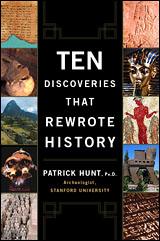
Patrick Hunt: “First I should say that not every archaeologist would agree that these are the ten most important discoveries of all time. On the other hand, the ten stories retold in this book are often regarded as among the most exciting archaeological discoveries of the modern era (since 1750). And no one would deny that these ten vital discoveries have forever changed the world of archaeology, transforming how and what we know about ancient history. Let me tell you a little about them.
1) Rosetta Stone: This exciting discovery in 1799 was the key to deciphering Egyptian hieroglyphs and unlocking the history of the ancient world texts. It provides a window into the real history of Egypt rather than an imaginary one; all other decipherings of ancient languages since the Rosetta Stone’s initial decoding in 1822 are based on its precedents. (See photo here.)
2) Troy: Its discovery and excavation beginning in 1870 proved once and for all that Troy was not just a myth based on Homer; Troy was a historical site where real people lived and fought. Its earliest excavator, the oft-maligned and often-unethical Heinrich Schliemann has been mostly credited — right or wrong — as being the “Father of Archaeology” and his techniques became the foundation of archaeological research, however greatly improved, afterward.
3) Nineveh and the Royal Assyrian Library: This riveting find beginning in 1849 by Austen Henry Layard, a sleuth of antiquity, eventually unearthed a whole lost library of cuneiform texts, including ones not only from ancient Assyria but also from far older Sumer, Akkad, Babylon and other great civilizations. This had a very significant impact on world literature, introducing such seminal works as the Epic of Gilgamesh.
4) King Tut’s Tomb: The dramatic opening of this royal tomb in 1922 — sought for years by a determined Howard Carter — was the first time in millennia a pharaoh’s tomb had actually been found intact; its treasure gave the world a unique opportunity to actually account for staggering Egyptian royal wealth. [Dan’s note: National Geographic has a nice web site on this archaeological find.]
5) Machu Picchu: The remarkable high jungle mountain discovery in 1911 of the remote Lost City of the Inca by Hiram Bingham made it possible for the world to finally see an undisturbed Inca royal city mysteriously abandoned on a mountaintop but neither conquered nor changed by the colonial world. (See photo here.)
6) Pompeii: Preserved by the eruption of Vesuvius in AD 79 and not dug out for almost two millennia, Pompeii (probably accidentally found by a farmer digging a well) is the single most important Roman site in the world; its artifacts offer the largest and fullest record of life in a Roman city. Pompeii’s misfortune is our great fortune. It preserves a city with thousands of objects virtually unchanged. (See images here.)
Read More...The Final Cut of Blade Runner: Now Out on DVD
Back in October, Ridley Scott released a final and definitive director’s cut of Blade Runner, presenting to audiences the film that he would have made if studio execs hadn’t meddled with things. A short two months later, the final cut is now out on DVD. It was released yesterday, barely in time for the holidays. For more on the making and remaking of Blade Runner, you can listen to this recent interview with Ridley Scott.
Read More...
Support Us
We're hoping to rely on loyal readers, rather than erratic ads. Please click the Donate button and support Open Culture. You can use Paypal, Venmo, Patreon, even Crypto! We thank you!

About Us

Open Culture scours the web for the best educational media. We find the free courses and audio books you need, the language lessons & educational videos you want, and plenty of enlightenment in between.
Advertise With Us
FREE UPDATES!
GET OUR DAILY EMAIL
Get the best cultural and educational resources on the web curated for you in a daily email. We never spam. Unsubscribe at any time.
FOLLOW ON SOCIAL MEDIA
Open Culture editor Dan Colman scours the web for the best educational media. He finds the free courses and audio books you need, the language lessons & movies you want, and plenty of enlightenment in between.
Advertise With Us


