An Animated History of Cats: How Over 10,000 Years the Cat Went from Wild Predator to Sofa Sidekick
Dogs sees us as their masters while cats sees us as their slaves. — Anonymous
The next time your friend’s pet cat sinks its fangs into your wrist, bear in mind that the beast is probably still laboring under the impression that it’s guarding the granaries.
Anthropologist Eva-Maria Geigl’s animated Ted-Ed Lesson, The History of the World According to Cats, above, awards special recognition to Unsinkable Sam, a black-and-white ship’s cat who survived three WWII shipwrecks (on both Axis and Allied sides).
It’s a cute story, but as far as directing the course of history, Felis silvestris lybica, a subspecies of wildcat that can be traced to the Fertile Crescent some 12,000 years ago, emerges as the true star.
In a Neolithic spin of “The Farmer in the Dell,” the troughs and urns in which ancient farmers stored surplus grain attracted mice and rats, who in turn attracted these muscular, predatory cats.
They got the job done.
Human and cats’ mutually beneficial relationship spelled bad news for the rodent population, but survival for today’s 600-million-some domestic cats, whose DNA is shockingly similar to that of its prehistoric ancestors.
Having proved their value to the human population in terms of pest control, cats quickly found themselves elevated to welcome companions of soldiers and sailors, celebrated for their ability to knock out rope-destroying vermin, as well as dangerous animals on the order of snakes and scorpions.
Thusly did cats’ influence spread.
Bastet, the Egyptian goddess of domesticity, women’s secrets, fertility, and childbirth is unmistakably feline.
Cats draw the chariot of Freya, the Norse goddess of love.
Their popularity dipped briefly in the Late Middle Ages, when humankind mistakenly credited cats as the source of the plague. In truth, that scourge was spread by rodents, who ran unchecked after men rounded up their feline predators for a gruesome slaughter.
Nowadays, a quick glimpse at Instagram is proof enough that cats are back on top.
(Yes, you can haz cheezburger with that.)
Dogs may see our service to them as proof that we are gods, buts cats surely interpret the feeding and upkeep they receive at human hands as evidence they are the ones to be worshipped.
Related Content:
Edward Gorey Talks About His Love Cats & More in the Animated Series, “Goreytelling”
What Happens When a Cat Watches Hitchcock’s Psycho
Ayun Halliday is an author, illustrator, theater maker and Chief Primatologist of the East Village Inky zine. See her onstage in New York City January 14 as host of Theater of the Apes book-based variety show, Necromancers of the Public Domain. Follow her @AyunHalliday.
Read More...Watch an Art Conservator Bring Classic Paintings Back to Life in Intriguingly Narrated Videos
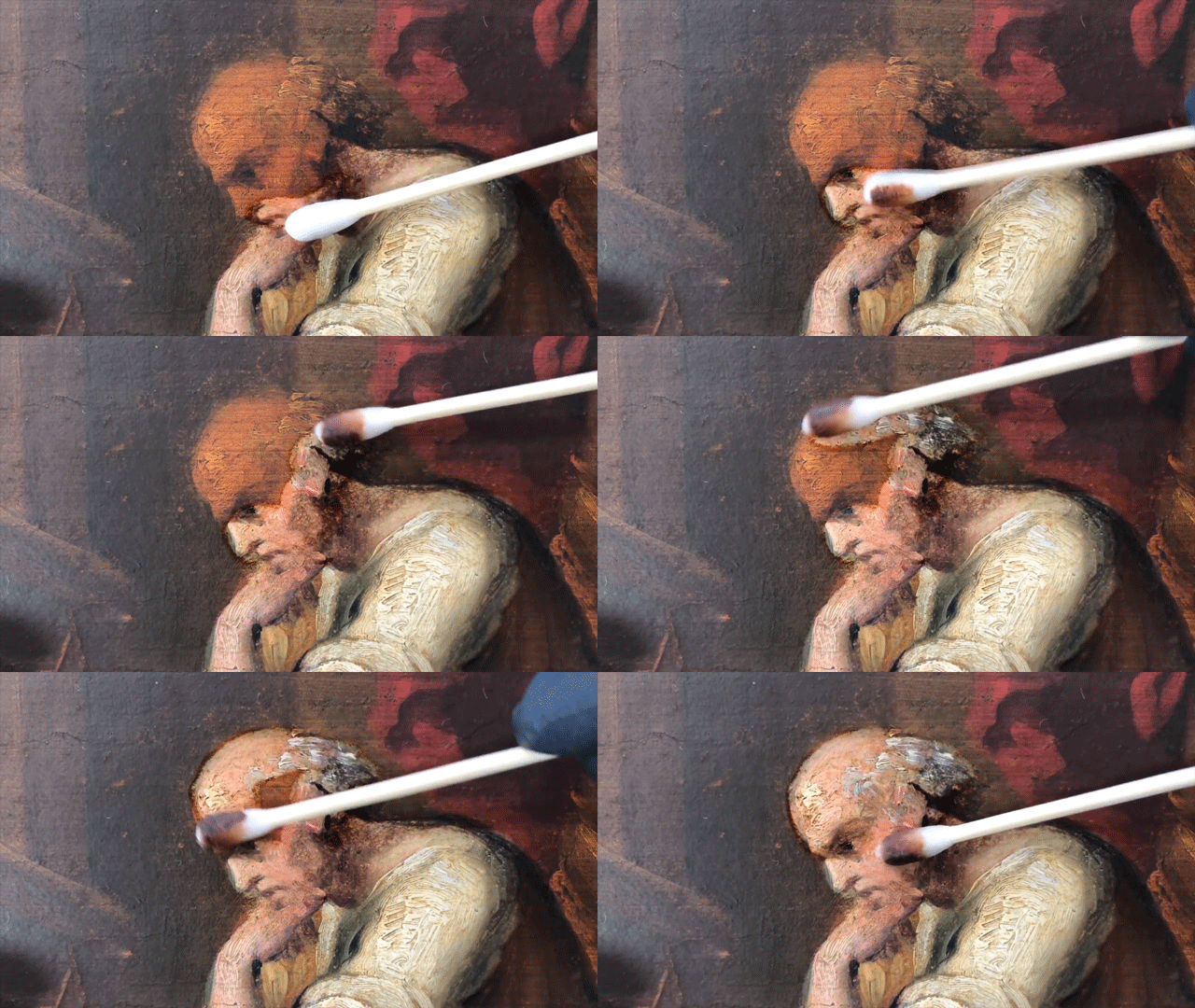
Even in our age of unprecedentedly abundant images, delivered to us at all times by print, film, television, and especially the ever-multiplying forms of digital media, something inside us still values paintings. It must have to do with their physicality, the physicality of oil on canvas or whatever tangible materials the painter originally used. But in that great advantage of the painting lies the great disadvantage of the painting: tangible materials degrade over time, and many, if not most, of the paintings we most revere have been around for a long time indeed, and few of them have come down to us in pristine shape.
Enter the art restorer, who takes on the task of undoing, painstakingly and entirely by hand, both the ravages of time and the blunders of less competent stewards who have come before. In this case, enter Julian Baumgartner of Chicago’s Baumgartner Fine Art Restoration, a meditative short documentary on whose practice we featured earlier this year here on Open Culture.
You can see much more of it in these videos: in the one above, writes Colossal’s Kate Sierzputowski, Baumgartner “condenses over 40 hours of delicate swiping, scraping, and paint retouching into a 11.5 minute narrated video” showing and explaining his restoration of The Assassination of Archimedes.
The project, not atypical for a painting restoration, “involved cleaning a darkened varnish from the surface of the piece, removing the work from its original wooden panel using both modern and traditional techniques, mounting the thin paper-based painting to acid-free board, and finally touching up small areas that had become worn over the years.” Baumgartner’s Youtube channel also offers similar condensed restoration videos of two other paintings, Mother Mary and a portrait by the American Impressionist William Merrit Chase.
Baumgartner packs into each of these videos an impressive amount of knowledge about his restoration techniques, which few of us outside his field would have had any reason to know — or even imagine —before. They’ve racked up their hundreds of thousands of views in part thanks to that intellectual stimulation, no doubt, but all these physical materials and the sounds they make have also attracted a crowd that shares a variety of enthusiasm unknown before the age of digital media. I’m talking, of course, about ASMR video fans, whom Baumgartner has obliged by creating a version of his The Assassination of Archimedes restoration especially for them. Now there’s an art restorer for the 21st century.
via Colossal
Related Content:
The Art of Restoring a 400-Year-Old Painting: A Five-Minute Primer
The Art of Restoring Classic Films: Criterion Shows You How It Refreshed Two Hitchcock Movies
Based in Seoul, Colin Marshall writes and broadcasts on cities, language, and culture. His projects include the book The Stateless City: a Walk through 21st-Century Los Angeles and the video series The City in Cinema. Follow him on Twitter at @colinmarshall or on Facebook.
Read More...Haruki Murakami Day: Stream Seven Hours of Mixes Collecting All the Jazz, Classical & Classic American Pop Music from His Novels
What makes the novels of Haruki Murakami — originally written in Japanese and almost unfailingly filled with some odd but deeply characteristic mixture of cats, wells, parallel worlds, mysterious disappearing women with well-formed ears, and much else besides — so beloved around the world? A large part of it must have to do with Murakami’s cultural references, sometimes Japanese but most often western, and even more so when it comes to music. “Almost without exception,” writes The Week music critic Scott Meslow in an extensive piece on all the songs and artists name-checked in these novels, “Murakami’s musical references are confined to one of three genres: classical, jazz, and American pop.”
Even the very names of Murakami’s books, “including Norwegian Wood, Dance Dance Dance, and South of the Border, West of the Sun — derive their titles from songs, and his characters constantly reflect on the music they hear.”
You’ll hear all these songs and many more in Meslow’s three streaming mixes, totaling seven hours of listening, that just this month made up “Haruki Murakami Day” on London-based internet radio station NTS. (We previously featured NTS here on Open Culture when they put up a twelve-hour “spiritual jazz” experience featuring John Coltrane, Sun Ra, Herbie Hancock, and many others, a fair few of whom surely appear in Murakami’s own famously large collection of jazz records.)
Haruki Murakami begins with Brook Benton’s 1970 ballad “Rainy Night in Georgia,” the first song Murakami ever included in a novel. In fact, he included it in his very first novel, 1978’s Hear the Wind Sing, which he wrote in the wee hours at his kitchen table after closing up the Tokyo jazz bar he ran in those years before becoming a professional writer. He even created a radio DJ character, whose voice recurs throughout the novel, to announce it and other songs (though his techniques for including his favorite music in his writing have grown somewhat subtler since). “Okay, our first song of the evening,” the DJ says. “This one you can just sit back and enjoy. A great little number, and the best way to beat the heat” — or the cold, or whatever the weather in your part of the world. Wherever that is, it’s sure to have plenty of Murakami fans who want to listen in.
Related Content:
A 3,350-Song Playlist of Music from Haruki Murakami’s Personal Record Collection
A 26-Hour Playlist Featuring Music from Haruki Murakami’s Latest Novel, Killing Commendatore
Haruki Murakami’s Passion for Jazz: Discover the Novelist’s Jazz Playlist, Jazz Essay & Jazz Bar
Based in Seoul, Colin Marshall writes and broadcasts on cities, language, and culture. His projects include the book The Stateless City: a Walk through 21st-Century Los Angeles and the video series The City in Cinema. Follow him on Twitter at @colinmarshall or on Facebook.
Read More...Artificial Intelligence Creates Realistic Photos of People, None of Whom Actually Exist

Each day in the 2010s, it seems, brings another startling development in the field of artificial intelligence — a field widely written off not all that long ago as a dead end. But now AI looks just as alive as the people you see in these photographs, despite the fact that none of them have ever lived, and it’s questionable whether we can even call the images that depict them “photographs” at all. All of them come, in fact, as products of a state-of-the-art generative adversarial network, a type of artificial intelligence algorithm that pits multiple neural networks against each other in a kind of machine-learning match.

These neural networks have, it seems, competed their way to generating images of fabricated human faces that genuine humans have trouble distinguishing from images of the real deal. Their architecture, described in a paper by the Nvidia researchers who developed it, “leads to an automatically learned, unsupervised separation of high-level attributes (e.g., pose and identity when trained on human faces) and stochastic variation in the generated images (e.g., freckles, hair), and it enables intuitive, scale-specific control of the synthesis.” What they’ve come up with, in other words, has made it not just more possible than ever to create fake faces, but made those faces more customizable than ever as well.
“Of course, the ability to create realistic AI faces raises troubling questions. (Not least of all, how long until stock photo models go out of work?)” writes James Vincent at The Verge. “Experts have been raising the alarm for the past couple of years about how AI fakery might impact society. These tools could be used for misinformation and propaganda and might erode public trust in pictorial evidence, a trend that could damage the justice system as well as politics.”
But still, “you can’t doctor any image in any way you like with the same fidelity. There are also serious constraints when it comes to expertise and time. It took Nvidia’s researchers a week training their model on eight Tesla GPUs to create these faces.”

Though “a running battle between AI fakery and image authentication for decades to come” seems inevitable, the current ability of computers to create plausible faces certainly fascinates, especially when compared to their ability just four years ago, the hazy black-and-white fruits of which appear just above. Put that against the grid of faces at the top of the post, which shows how Nvidia’s system can combine the features of the faces on one axis with the features on the other, and you’ll get a sense of the technological acceleration involved. Such a process could well be used, for example, to give you a sense of what your future children might look like. But how long until it puts convincing visions of moving, speaking, even thinking human beings before our eyes?
via Petapixel
Related Content:
Artificial Intelligence Program Tries to Write a Beatles Song: Listen to “Daddy’s Car”
Based in Seoul, Colin Marshall writes and broadcasts on cities, language, and culture. His projects include the book The Stateless City: a Walk through 21st-Century Los Angeles and the video series The City in Cinema. Follow him on Twitter at @colinmarshall or on Facebook.
Read More...David Byrne Curates a Playlist of Great Protest Songs Written Over the Past 60 Years: Stream Them Online
When you hear the words “protest song,” what do you see? Is it a folkie like Bob Dylan or Joan Baez delivering songs about injustice? Is it an earnest young thing with a guitar? Is it trapped in 1960s amber, while time has moved on to more ambiguity, more nihilism, more solipsism?
British writers–and may we add amateur folksingers–Jonathan Luxmoore and Christine Ellis made this lament over two years ago in the pages of The Guardian, in an opinion piece entitled, “Not talkin’ bout a revolution: where are all the protest songs?” Here they blame the immediacy of social media, the rise of aspirational hip hop, and the decline of radical politics. They end, presciently, with a Jeremy Corbyn-shaped hope for change. Well, look where we are now. Things developed rather quickly, did they not?
(And as a side note, I would suggest the 1980s as a way more protest-filled music decade than the 1960s. Because of the self-aggrandizement of 1960s curators, they claim more than they did. But nearly every pop, rock, r’n’b, and hip hop act of the ‘80s has at least one political song in its discography.)
Enter David Byrne, whose mission apart from his day job as a musician is to bring hope to the masses with a determined optimism. He’s here to say that the protest song never went away, only our definition of it. And he’s brought the receipts, or rather the playlist above, to prove his point:
…in fact, they now come from all directions in every possible genre—country songs, giant pop hits, hip hop, classic rock, indie and folk. Yes, maybe there weren’t many songs questioning the wisdom of invading Iraq, but almost every other issue has been addressed.
Stretching over six decades, the playlist demonstrates the various forms protest can take, from describing racial violence (Billie Holiday’s “Strange Fruit” to Janelle Monae’s “Hell You Talmbout”) to bemoaning economic injustice (The Specials’ “Ghost Town”) and railing against war and conflict (U2’s “Sunday Bloody Sunday”, Edwin Starr’s “War”). Sometimes declaring the positive and gaining a voice is enough of a protest: you could argue that James Brown’s “Say It Loud (I’m Black and I’m Proud)” did more for equality than any song about racism. Bikini Kills’ “Rebel Girl” does similar things for third-wave feminism.
But Byrne wisely gives voice to those who feel they’re swimming against any resistance tide:
I’ve even included a few songs that “protest the protests.” Buck Owens, the classic country artist from Bakersfield, for example, has two songs here. “Rednecks, White Socks and Blue Ribbon Beer,” is a celebration of Americans who feel they are unnoticed, left behind. One might call it a populist anthem, but I think the reference to white socks is intentionally meant to be funny—in effect, it says: “we know who we are, we know how uncool white socks are.”
Look, it’s easy to believe that songs “changed the world” when they are easily accessible to hear decades later but the boots-on-the-ground marches and revolutionary acts from which they sprang are now just photographs, film reels, and foggy memories. But who can deny the gut punch of this year’s “This Is America” from Childish Gambino, the continued excellence of Killer Mike and/or Run the Jewels, and any number of songs that document our outrage? The songs of protest continue as long as there is injustice.
And in the case of David Byrne, covering a modern protest song and adding to its list of names, is what can keep an idea, a memory, and a feeling alive for a new audience. Here he is at the encore of his current tour, covering Janelle Monae’s “Hell You Talmbout,” a memorial to all the black lives killed by law enforcement.
“Here was a protest song that doesn’t hector or preach at us,” he said in an article for the Associated Press. “It simply asks us to remember and acknowledge these lives that have been lost, lives that were taken from us through injustice, though the song leaves that for the listener to put together. I love a drum line, so that aspect of the song sucked me in immediately as well. The song musically is a celebration and lyrically a eulogy. Beautiful.”
He also wisely asked permission to cover such a recent song, especially when it’s an older white man lending his voice to it. But Monae gave her blessing:
“I thought that was so kind of him and of course I said yes. The song’s message and names mentioned need to be heard by every audience.”
Related Content:
David Byrne Creates a Playlist of Eclectic Music for the Holidays: Stream It Free Online
Ted Mills is a freelance writer on the arts who currently hosts the artist interview-based FunkZone Podcast and is the producer of KCRW’s Curious Coast. You can also follow him on Twitter at @tedmills, read his other arts writing at tedmills.com and/or watch his films here.
Read More...David Byrne Creates a Playlist of Eclectic Music for the Holidays: Stream It Free Online
Whose music do you put on when the holiday season comes around? Perhaps musicians like Lonnie Holley, Gurrumul, Erkin Koray, and Juan Luis Guerra? Maybe you’ve just thrilled with recognition at one or more of those names, or maybe you’ve never heard of any of them — but in either case, you should get ready for a highly unconventional holiday experience featuring their songs and those of many others, all of them curated by David Byrne. Each month the peripatetic, oft-collaborating musician and former Talking Heads frontman posts a new playlist on Radio David Byrne, and the latest, “Eclectic for the Holidays,” will get us into a kind of seasonal spirit into which we’ve never got before.
“So… who recommends this stuff to me?” Byrne asks. “I’ve known Lonnie Holley as an artist for quite some time. I saw him do a show at National Sawdust not too long ago with trombonist Dave Nelson, who toured with St. Vincent and I a few years ago.”
“I heard an orchestral interpretation of this song by Gurrumul when I was waiting to do an interview at the radio station in Melbourne, Australia. I asked, ‘Whose music is that?’ ” “Erkin Koray I heard after first hearing Barış Manço, who may have been recommended by some friends in Istanbul when I was there years ago… Turkey had a serious psychedelic period.” “Juan Luis Guerra may have been recommended many years ago by music journalist Daisann McLane at a music festival in Cartagena, Colombia.”
The 41-song journey that is “Eclectic for the Holidays,” which you can stream below or on Byrne’s official site, offers not just a chance to happen upon intriguing artists you’d never come across before — as happened to Byrne in all those chance encounters that went into its construction — but a break from the same fifteen or twenty songs that have long dominated the holiday-season rotation in homes and public spaces around the world. The holidays themselves teach us that tradition has its place, but Byrne, whose compulsion to discover new music from an ever farther-flung range of societies and subcultures, shows us that you can’t let them get you comfortable enough to close your ears.
Related Content:
Hear Paul McCartney’s Experimental Christmas Mixtape: A Rare & Forgotten Recording from 1965
Based in Seoul, Colin Marshall writes and broadcasts on cities, language, and culture. His projects include the book The Stateless City: a Walk through 21st-Century Los Angeles and the video series The City in Cinema. Follow him on Twitter at @colinmarshall or on Facebook.
Read More...Japanese Artist Creates Bookshelf Dioramas That Magically Transport You Into Tokyo’s Back Alleys
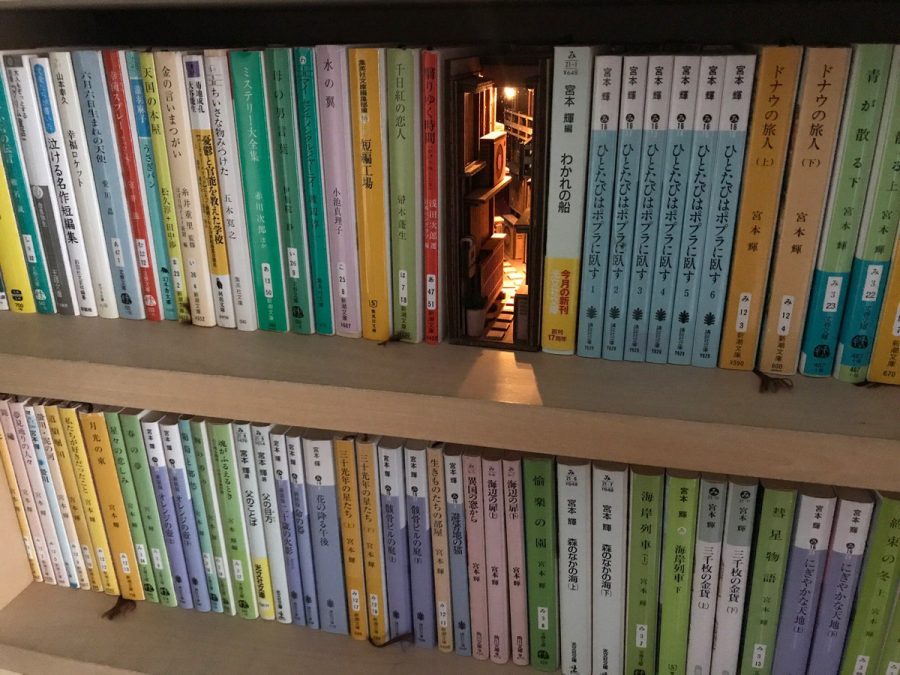
Should you find yourself in a Japanese city, spend time not on the Starbucks- and McDonald’s-lined boulevards but on the back streets that wind in all directions behind them. Or better yet, head into the back alleys branching off those streets, those half-hidden spaces that offer the most evocative glimpses of life in urban Japan by far. Only there can you find passage into the wonderfully idiosyncratic businesses tucked into the corners of the city, from bars and restaurants to coffee shops and of course bookstores. Those bookstores have long occupied Japan’s back alleys, but now an artist by the name of Monde has brought the back alleys onto bookshelves.

Monde’s handcrafted wooden bookend dioramas, which you can see on his Twitter feed as well as in a Buzzfeed Japan article about them, replicate the back alleys of his hometown of Tokyo. They do it in miniature, and down to the smallest detail — even the electric lights that illuminate the real thing at night.
Scaled to the height of not just a book but a small Japanese paperback, the likes of which fill those back-alley bookstores from floor to ceiling, they’re designed to slot right into bookshelves, providing a welcoming street scene to those browsing through their own or others’ volumes in the same way that the actual alleys they model come as a pleasant surprise to passersby on the main streets.

Tokyo has become a beloved city to Japanese and non-Japanese alike for countless reasons, but who can doubt the appeal of the way it combines the feeling of small-town life in its many neighborhoods that together make for a megacity scale? Monde’s dioramas capture the distinctive mixture of domesticity and density in the capital’s back alleys, reflecting the narrowness of the spaces in form and their somehow organically manmade nature — stepping stones, potted-plant gardens, and all the small pieces of infrastructure that have accumulated to support life in the homes of so many — in content. Though Tokyo has for decades been regarded, especially from the West, as a place of thorough hypermodernity, its alleys remind us that within the sometimes overwhelming present exists a mixture of eras that feel timeless — just like the content of a well-curated bookshelf.

via Twisted Sifter
Related Content:
A Photographic Tour of Haruki Murakami’s Tokyo, Where Dream, Memory, and Reality Meet
Based in Seoul, Colin Marshall writes and broadcasts on cities, language, and culture. His projects include the book The Stateless City: a Walk through 21st-Century Los Angeles and the video series The City in Cinema. Follow him on Twitter at @colinmarshall or on Facebook.
Read More...The Making of “Bohemian Rhapsody”: Take a Deep Dive Into the Iconic Song with Queen’s 2002 Mini Documentary
Despite being fraught with production difficulties, an absent director, and a critical quibbling over its sexuality politics, Bohemian Rhapsody, the biopic of Freddie Mercury and Queen, has been doing very well at the box office. And though it has thrust Queen’s music back into the spotlight, has it even really gone away?
The song itself, the 6 minute epic “Bohemian Rhapsody,” was the top of the UK singles charts for nine weeks upon its release and hasn’t been forgotten since. It’s part of our collective DNA, but with a certain caveat…it’s notoriously difficult to cover. It is so finely constructed that it can’t be deconstructed, leaving artists to stand in the shadow of Mercury’s delivery. Brian May, in the above video, gives credit to Axl Rose for getting close to the powerful high registers of Mercury, but even that was a kind of karaoke. And let’s not even talk about Kanye West’s stab at it.
So it’s a good time to check in with this 45 minute-long mini-doc on the making of the song, which took the band into the stratosphere. Produced in 2002 for the band’s Greatest Hits DVD, it features guitarist Brian May and drummer Roger Taylor. The first part is on the writing of the song, the second part on the making of the music video, and the third, the bulk of the doc, on the production.
Don’t expect any explanation of the subject matter of the song–as May says, Mercury would have shrugged off any interpretation and dismissed any search for depth. And while Mercury always took care over his lyrics, the power is all there in the music.
As for the video, that came about from necessity, as the band wanted to be on Top of the Pops and tour at the same time. By using their rehearsal stage at Elstree studios for the performance footage and a side area for the choral/close-up segments, they made a strangely iconic video. (Who doesn’t think of Queen’s four members arranged in a diamond when those vocals start up?). The two main effects were a prism lens on the camera and video feedback, all done live.
The last part is fascinating and a deep dive into the mix. Brian May, alongside studio engineer Justin Shirley Smith, play just the piano, bass, and drums from the song at first. Mercury was a self-taught pianist who played “like a drummer,” with a metronome in his head, says May.
The guitarist also isolates his various guitar parts, including the harmonics during the opening ballad portion, the “shivers down my spine” sound made by scraping the strings, and the famous solo, which he wrote as a counterpoint to Mercury’s melody. It’s geekery of the highest order, but it’s for a song that deserves such attention.
Inside The Rhapsody will be added to our collection of Free Documentaries, a subset of our collection, 4,000+ Free Movies Online: Great Classics, Indies, Noir, Westerns, Documentaries & More.
Related Content:
What Made Freddie Mercury the Greatest Vocalist in Rock History? The Secrets Revealed in a Short Video Essay
Hear Freddie Mercury & Queen’s Isolated Vocals on Their Enduring Classic Song, “We Are The Champions”
Ted Mills is a freelance writer on the arts who currently hosts the artist interview-based FunkZone Podcast and is the producer of KCRW’s Curious Coast. You can also follow him on Twitter at @tedmills, read his other arts writing at tedmills.com and/or watch his films here.
Read More...Free Guided Imagery Recordings Help Kids Cope with Pain, Stress & Anxiety
I don’t have to tell you modern life is full of stressors that exacerbate hypertension, depression, and everything in-between. Therapeutic stress reduction techniques based in mindfulness meditation, trauma research, and a number of other fields have proliferated in our daily lives and everyday conversation, helping people cope with chronic pain, career anxiety, and the toxic miasma of our geopolitics.
These methods have been very successful among adult populations—of monks, veterans, clinical subjects, etc.—but adults process information very differently than children. And as every parent knows, kids get majorly stressed out too, whether they’re absorbing our anxieties second-hand or feeling the pressures of their own social and educational environments.
We can’t expect young children to sit still and pay attention to their breath for thirty minutes, or to change their mental scripts with cognitive behavioral therapy. It’s far easier for kids to process things through their imagination, channeling anxiety through play, or art, or—as pediatric psychologists at the Children’s Hospital of Orange County (CHOC) explain—guided mental visualization, or “guided imagery,” as they call it. How does it work?
Guided imagery involves envisioning a certain goal to help cope with health problems or the task or skill a child is trying to learn or master. Guided imagery is most often used as a relaxation technique that involves sitting or lying quietly and imagining a favorite, peaceful setting like a beach, meadow or forest.
The therapists at CHOC “teach patients to imagine sights, sounds, smells, tastes or other sensations to create a kind of daydream that ‘removes’ them from or gives them control over their present situation.” In the video at the top, Dr. Cindy Kim describes the technique as “akin to biofeedback,” and it has been especially helpful for children facing a scary medical procedure.
While all of us might need to go to our happy place once in a while, most kids find it hard to relax without some form of creative redirection, like the guided imagery program above from Johns Hopkins All Children’s Hospital. At the CHOC website, you’ll find over a dozen other audio programs tailored for pain and stress management and relaxation, for both young children and adolescents. Lifehacker’s parenting editor Michelle Woo describes a representative sampling of the programs:
- For pain management for young kids, listen to “The Special Cake.” Sample line: “With your next deep breath in, notice the sweet smell of the yummy frosting.”
- For pain management for teens, listen to “Climbing a Ladder.” Sample line: “Let’s have a look at the first step. As you put your foot on it, you begin to remember a time when you realize that you can have control over your body.”
- For anxiety, listen to “The Magic Kite.” Sample line: “All of the uncomfortable feelings or sadness or anger or pain or worry are all on the ground and you are flying away from it.”
As kids listen to audio, Woo writes, “have them notice how their body feels—their breathing may slow and their muscles might relax.” And hey, there’s no reason guided imagery can’t work for grown-ups too. Try it if you’re feeling stressed and let us know how it works for you.
via Lifehacker
Related Content:
Daily Meditation Boosts & Revitalizes the Brain and Reduces Stress, Harvard Study Finds
How Stress Can Change Your Brain: An Animated Introduction
Meditation 101: A Short, Animated Beginner’s Guide
Josh Jones is a writer and musician based in Durham, NC. Follow him at @jdmagness.
Read More...The History of Philosophy Visualized in an Interactive Timeline
The connections we make between various philosophers and philosophical schools are often connections that have already been made for us by teachers and scholars on our paths through higher education. Many of us who have taken a philosophy class or two leave it at that, content we’ve got the gist of things and that specialists can parse the details perfectly well without us. But there are those curious people who continue to read abstruse and difficult philosophy after their intro classes are over, for the sheer, perverse joy of it, or from a burning desire to understand truth, beauty, justice, or whatever.
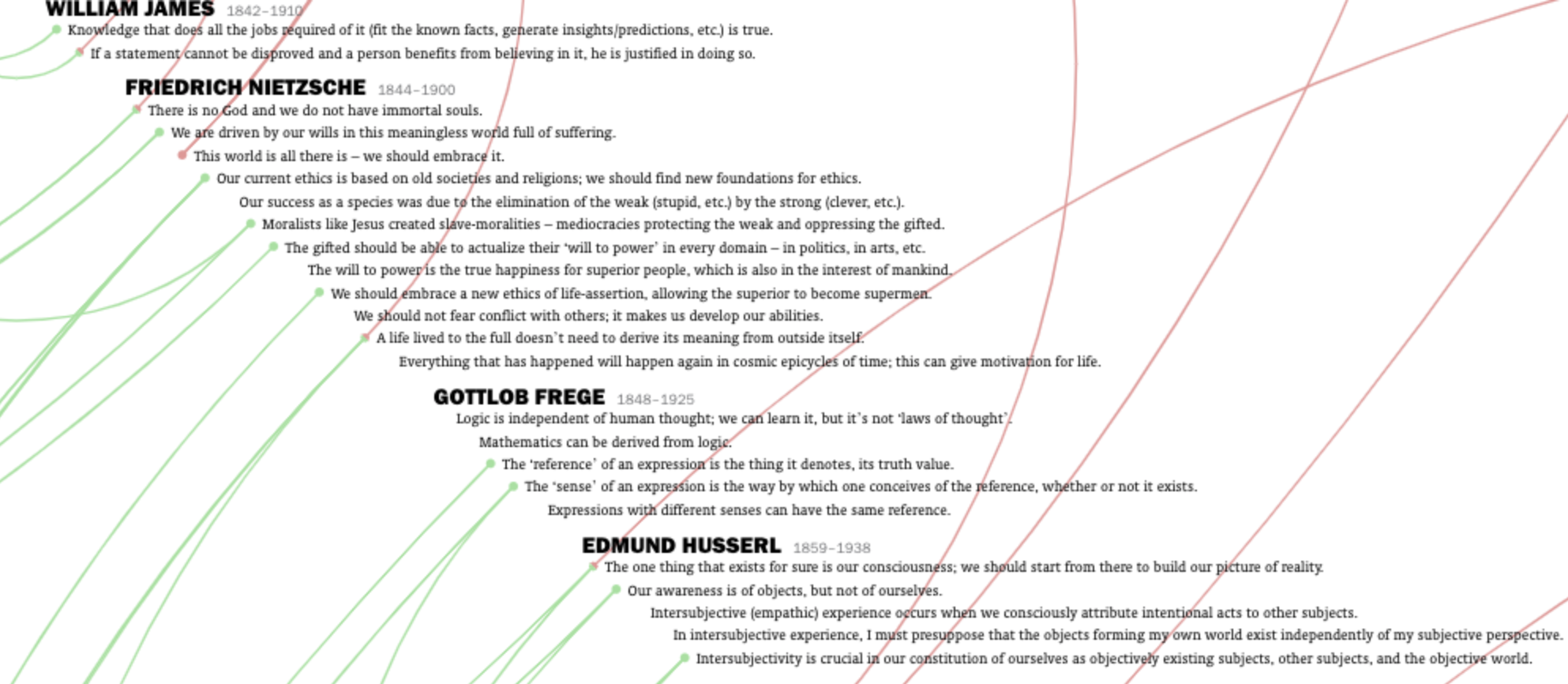
And then there are those who embark on a thorough self-guided tour of Western philosophical history, attempting, without the aid of university departments and faddish interpretive schemes, to weave the disparate strains of thought together. One such autodidact and academic outsider, designer Deniz Cem Önduygu of Istanbul, has combined an encyclopedic mind with a talent for rigorous outline organization to produce an interactive timeline of the history of philosophical ideas. It is “a purely personal project,” he writes, “that I’m doing in my own time, with my limited knowledge, for myself.”
Önduygu shares the project not to show off his learning but, more humbly, to “get feedback and to make it accessible to those who are interested.” It may be precious few people who have both the time and inclination to teach themselves the history of philosophy, but if you are one of them, this incredibly dense infographic is as good a place to start as any, and while it may appear intimidating at first glance, its menu in the upper right corner allows users to zero in on specific thinkers and schools, and to confine themselves to smaller, more manageable areas of the whole.
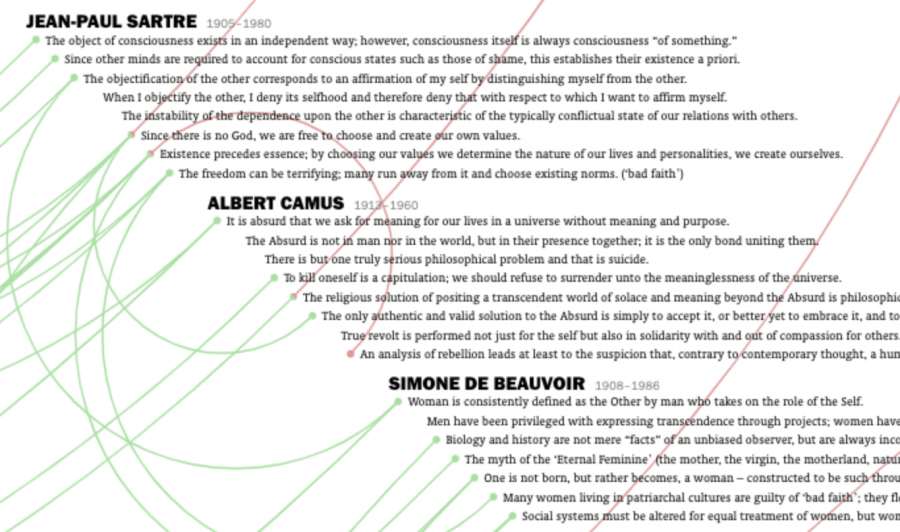
As for the timeline itself, “viewers can zoom in and out,” notes Daily Nous, “and see philosophers listed in chronological order, with ideas they’re associated with listed beneath them. These ideas, in turn, are connected by green lines to similar or supporting ideas elsewhere on the timeline, and connected by red lines to opposing or refuting ideas elsewhere on the timeline. If you hover your mouse cursor over a single idea, all but it and its connected ideas fade. You can then click on the idea to bring those connected ideas closer for ease of viewing.”
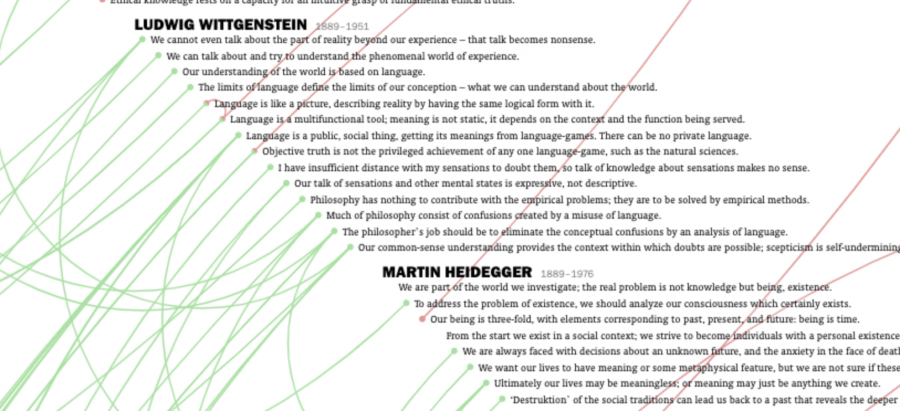
The designer admits this is a “never-ending work in progress” and mainly a source for reminding himself of the main arguments of the philosophers he’s surveyed. The major sources for his timeline are “Bryan Magee’s The Story of Philosophy and Thomas Baldwin’s Contemporary Philosophy, along with other works for specific philosophers and ideas.” But many of the connections Önduygu draws in this extensive web of green and red are his own.
He explains his rationale here, noting, “The lines here do not always depict a direct transfer between two people; I think of them as tracing the development of an idea throughout time within our collective conception.” Spend some more time with this impressive project at the History of Philosophy Summarized & Visualized (the site works best in Chrome), and feel free to get in touch with its creator with constructive criticism. He welcomes feedback and is open to opposing ideas, as every lifelong learner should be.
via Daily Nous
Related Content:
150+ Free Online Philosophy Courses
The History of Philosophy Visualized
A History of Philosophy in 81 Video Lectures: From Ancient Greece to Modern Times
The History of Philosophy … Without Any Gaps
Josh Jones is a writer and musician based in Durham, NC. Follow him at @jdmagness
Read More...Support Us
We're hoping to rely on loyal readers, rather than erratic ads. Please click the Donate button and support Open Culture. You can use Paypal, Venmo, Patreon, even Crypto! We thank you!

About Us

Open Culture scours the web for the best educational media. We find the free courses and audio books you need, the language lessons & educational videos you want, and plenty of enlightenment in between.
Advertise With Us
FREE UPDATES!
GET OUR DAILY EMAIL
Get the best cultural and educational resources on the web curated for you in a daily email. We never spam. Unsubscribe at any time.
FOLLOW ON SOCIAL MEDIA
Open Culture editor Dan Colman scours the web for the best educational media. He finds the free courses and audio books you need, the language lessons & movies you want, and plenty of enlightenment in between.
Advertise With Us

