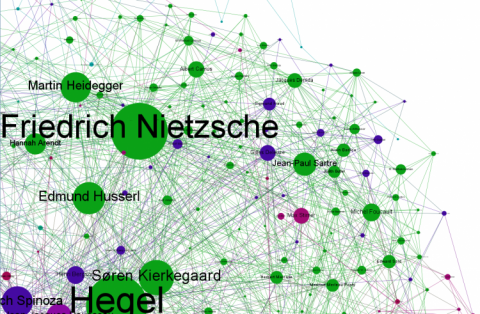
 Simon Raper at Drunks & Lampposts has composed a data visualization of the relations of influence among philosophers. This was put together to demonstrate Raper’s data extraction algorithm; he collected the contents of all the “influenced by” fields on Wikipedia, displaying each philosopher as a node connected to all other philosophers that he or she influenced. The more connections, the bigger the node. The result is visually fascinating and an interesting touchstone for philosophy fans.
Who was more important, Edmund Husserl or Jean-Paul Sartre? Well, you may not have heard of Husserl, but the size of his node is a bit bigger than Sartre’s, so according to the graph, he’s had more of an influence on the profession. The fact that Husserl’s heyday was thirty years earlier than Sartre’s may explain that fact, but as Mark De Silva at the New York Times Opinionater points out, it’s also unclear how well these “influenced by” relations in Wikipedia correlate with real influences in the history of philosophy. Raper’s graph seems to provide an excellent start for pondering the question. More graphs by historical period can be found here.
Mark Linsenmayer appears on The Partially Examined Life Philosophy Podcast, offering lively, in-depth introductions to Husserl, Sartre, and many other figures in philosophy.




Yes, totally reliable!
I knew that Che Guevara was a philosopher
That Saussure and Piaget had much less influence than, say, Derrida
That the entire stoicism had a very small influence on western thought
That Murray Rothbard was slightly more important than Thomas Aquinas
:)
This only tells how useless the “influenced by” tag is, if complied by non-professionals
Where is Albert Einstein (Relativity theory)? Where is Isaac Newton? (laws of motion). Where is Claude Shannon (Information theory)? Where is Turing (theory of computation)?
These three caused revolutions of thought that changed the 20th century and beyond.
This is very related to a visualization project in which we visualized influences and similarities among philosophers, painters and musicians. We used similarity in interest (or time) as implicit relations and directed influence connections as explicit relations. We decided against showing all the links all the time in favor of differentiating between incoming and outgoing influences. Check it out: http://mariandoerk.de/edgemaps/demo
This is probably more representative of the areas of interest or knowledge of the Wiki editors than of reality.
RETITLUNG AND OR WIDENING THE SCOPE IF THE CANON OF OHILOSOPHY :
INTRO
To begin with;I appreciate the rather relaxed; enlightened ;sonetimes original and light-hearted content approaches here.
European contributions to the study of philosophy is immense.And the world is grateful for the archival and current contemporary largesse of Europe in this .
I would like to suggest that you retitle your name to” Treatises of European Philosophy”
You seem to have appropriated the word philosophy as to be of and emanating from only your parochial limited world where only 10% of humanity resides.
Let us do ourselves ;our next generation by widening the scope of OpenCulture.com .
Include within the horizons of ohilosophy non-European contributions from Africa;from Asia;from The Americas etc.
Philosophy cones naturally to all of humanity (and may be also to animals) whether it gets published and “reecognized“or not or whether it is recorded in this or that milieu or format.
POVERTY OF TGE CANON OF OHILOSOPHY
It is poverty in the pursuit of the study of philosoohy anywhere in the wirld when we focus only on primarily men;focus on the bougeois upper middle class ;on only available published material .
Poverty here can be easily gitten rid of by widening the scope of the pursuit of tthe study of philosophy.
Thanks
Pls ignore some typos above
I just learn the site of Open Culture and hope to find any valid explanation on the significant regression of the Western philosophy influence to a status similar to the latin tongue i.e.
near a dead culture regarding the enlightenment and safeguard of our mankind.
Worst nowadays Western philosophy has turned out to be a joke as most Westerns religions have become. And this is very sad to the mankind.