Behavioral Economics and Underwater Mortgages
What if people behaved like banks? Or, more precisely, what if individuals holding “underwater” mortgages stopped following the social norms of ‘personal responsibility’ and ‘promise-keeping’ and instead acted like capitalist players in a free market? Most would dump their sinking mortgages and walk away. That’s the finding of Brent White, a law professor at the University of Arizona, who has published a new paper called “Underwater and Not Walking Away: Shame, Fear and the Social Management of the Housing Crisis.” (PDF) The bottom line is that homeowners and banks play by two different sets of rules. Main Street accepts the “emotional constraints … actively cultivated by the government, the financial industry,” and they hold the bag. Wall Street acts in its own self interest and gets a fresh start. The only thing they have in common these days are (you guessed it) guns.
Just for the record: I’m not advocating a position here, and I don’t hold an underwater mortgage…
Read More...Elvis Mitchell Talks “Bad Lieutenant” with Werner Herzog
Werner Herzog, one of Germany’s finest living directors, has a new film out, The Bad Lieutenant (watch trailers here), which has a loose relationship with Abel Ferrara’s own Bad Lieutenant from 1992. The new film, starring Nicolas Cage and Eva Mendes, gets reviewed by A.O. Scott in the New York Times. And now a former Times film critic, Elvis Mitchell, sits down with Herzog and talks about his “anarchist” noir film set in New Orleans. The interview was aired by KCRW in LA and can be downloaded in several formats here, or streamed right below. And, film fans, don’t forget to check out our new collection of free movies online. (It now includes about 120 individual films, and lists 35 sites where you can watch free movies online.)
Read More...The Velvet Revolution Revisited: Havel at Columbia
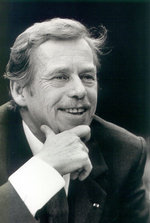 20 years ago, the dominoes fell in Eastern Europe. Not long after the Wall fell in Berlin, a non-violent revolution got underway in Czechoslovakia. The Velvet Revolution took just a matter of six weeks (November 17 — December 29, 1989) to unfold. It was fast and bloodless, and it put on the world stage Václav Havel — the playwright, turned anti-Soviet dissident, and soon democratic president of Czechoslovakia (and later the Czech Republic).
In 2006, Havel arrived in New York City, to spend 8 weeks at Columbia University. To mark the occasion, the university built a web site called Havel at Columbia that reconsidered Havel and the Velvet Revolution. Along with some intriguing historical footage, the site features video interviews with George H.W. Bush, David Remnick (the New Yorker editor and author of Lenin’s Tomb), Milos Forman (the great movie director of Czech heritage), Edward Albee (the playwright best known for Who’s Afraid of Virginia Woolf?), George Soros, and Lou Reed. Collectively, these conversations give you a very good feel for the man, the artist, and his historical contributions. You will also then find a conversation between Presidents Bill Clinton and Václav Havel, and a reading of Havel’s play, The Garden Party, directed by Israel Horvitz featuring Dustin Hoffman and Robert Klein. Podcasts of many of these wonderful events can be found on iTunes.
Note: The media-packed website, Havel at Columbia, was created by the Columbia Center for New Media for New Media Teaching and Learning (CCNMTL) and the Columbia University Arts Initiative (CUArts). Great work here, and I want to thank John F. for helping us put this post together.
Read More...Royal Society Launches Web Site Celebrating 350 Years of Science
A quick mention: The Royal Society, the UK’s national academy of science, will celebrate next year its 350th anniversary. To mark the occasion, a team of scientists and historians have launched a new web site called “Trailblazing,” and it essentially lets you take a virtual tour through three and a half centuries of scientific discovery (1660–2010). Moving at your own pace, you can review key scientific discoveries (some of them famous, some of them less so) and read corresponding commentary on each one. Quite nicely, all of the commentary can be downloaded via one big PDF file. (It runs about 110 pages long.)
Thanks to Phantom Engineer for the tip here. And thanks all for the many leads I’ve received lately. They’re all really appreciated, and they frankly make the site much better. Keep ’em coming.
Read More...Making Money By Giving Your Movie Away (But How Much?)
Nina Paley created some buzz earlier this year when she decided to give her award-winning animated film, Sita Sings the Blues, to the public, releasing it under a Creative Commons license. This was another test of the concept that artists can make money by giving their work away. Today, The Wall Street Journal gives an accounting of how this theory played out in practice. Here’s how things break down:
- Total donations from people who appreciate her giving out free content: $23,000
- Profits from her online store which sells merchandise and DVDs: $19,000
- Theatrical distribution revenues: $3,000 (out of total box office tally of $22,350)
- Additional DVD distribution: $3,000
- Broadcast television distribution: $3,000
- Revenue from Central Cinema in Seattle which showed the film: $4,000
- The grand total: $55,000
As the WSJ notes, these numbers don’t reflect the money she spent making the film . (Paley puts the number at $150,000 in hard costs.) They also don’t account for the indirect revenue that she will generate down the line. But putting Sita Sings the Blues in front of so many people, the world now knows a lot more about Nina Paley and her talents. I have to believe that she can trade on that (if she wants to) whenever she agrees to direct a film, or accepts a speaking engagement. The WSJ equation doesn’t take this piece into account (it’s admittedly hard to measure), but it’s probably the most important part of the overall analysis.
You can download Sita Sings the Blues here, watch it on YouTube here, or find it in our collection of Free Movies Online.
Related Content:
How I Sold My Book by Giving It Away: You should all see this separate post by Seth Harwood. It focuses on similar issues, but translated to the book world.
Read More...Stanford Online Writing Courses – The Winter Lineup
A quick fyi: On Monday morning (8:30 am California time), Stanford Continuing Studies opens up registration for its winter lineup of online writing courses. Offered in partnership with the Stanford Creative Writing Program (one of the most distinguished writing programs in the country), these online courses give beginning and advanced writers, no matter where they live, the chance to refine their craft with gifted writing instructors. As you will see, there are a couple of courses offered in conjunction with The New York Times. The idea here is that you’ll learn writing from a Stanford writing instructor and then get your work reviewed by a New York Times book critic/writer. Quite a perk. And the courses sell out quickly. For more information, click here, or separately check out the FAQ and the testimonials.
Caveat emptor: These classes are not free, and I helped set them up. So while I wholeheartedly believe in these courses, you can take my views with a grain of salt.
- Feature Writing with The New York Times
- Writing Fiction with The New York Times
- Getting Started in Creative Writing
- Short Story Writing
- Novel Writing: The Powerful Beginning
- Novel Writing II: Continuing Your Novel
- Creative Nonfiction: Telling the Truth and Where to Begin
- The Essential Art: Making Movies in Your Reader’s Mind
- Writing the Great Poem
- Magazine Writing
- Writing the Graphic Novel
- The Story of the Self: Writing Personal Essays and Memoir
- Creative Nonfiction III: Completing the Creative Nonfiction Book
Three Free Luis Buñuel Films
 A quick note for US readers: Right now, you can find three films by Luis Buñuel, the great Spanish (later turned Mexican) director. The films, presented by theauteurs.com, include Death in the Garden (1956) and two cinematic works from his earlier surreal period: Un chien andalou (1929) and L’âge d’or (1930). These films are (somewhat ironically) available only to a US audience. But if you live outside the US, you can find many more free films in our Free Movie Collection. As a quick side note, this collection was the jumping-off point for a short interview that I did with Jon Gordon, the host of the public radio show, Future Tense. You can listen to it below, or catch it here. Have a good Thanksgiving.
Advertise on Open Culture
Reach Savvy Education/Culture Audience Online:
- 3.5 million page views / month
- 914,000 followers and friends on Twitter and Facebook
- 83,000 RSS and email subscribers
Audience Statistics:
- Gender: 56% male/44% female
- Age: 72% in 18–54 bracket.
- Education: 69% with college or grad school degree
Data according to Quantcast.
Advertise with us Through Adwords:
You can immediately place ads on Open Culture by using Google’s Adwords platform. This will give you the ability to target the whole site or specific pages. Find directions on how to target our site here.
Read More...Your Favorite TED Talk Ever?
What’s the best TED Talk ever? That’s the little debate taking place on Reddit.com, and the answer is not obvious, seeing that TED now has over 500 talks available in its archive. (You can find a constantly updated list of every TED Talk in a Google spreadsheet here.)
Now, what are some of the Reddit favorites? Here are five talks that get frequent mentions.
- Sir Ken Robinson on “Do Schools Kill Creativity” (See my mea culpa in the comments.)
- Dan Gilbert on “Why are We Happy”
- Elizabeth Gilbert (Eat, Pray, Love) on Nurturing Creativity (Not one of my personal favorites.)
- Richard Dawkins on our “Queer” Universe
- Dan Ariely asks “Are We in Control of our Own Decisions?”
Meanwhile, it’s worth mentioning that TED keeps its own running list of its 10 most popular talks. Some good ones here. And now your turn. Tell us your favorites in the comments below, and don’t be shy.
Read More...The American Novel Since 1945: A Free Online Course from Yale University
The video above is the first of 26 lectures making up a free Yale course called The American Novel Since 1945. Taught by Amy Hungerford, the course introduces you to the novels of America’s finest post-war writers — Nabokov (émigré), Salinger, Kerouac, and Pynchon, and also Philip Roth, Toni Morrison, Cormac McCarthy and Jonathan Safran Foer. You can watch all lectures in the following formats: YouTube – iTunes Audio – iTunes Video. Yale also offers the files as mp3s/movs here. For more full-fledged courses from other top universities (including many others from Yale), visit our collection of Free Online Literature Courses, a subset of our collection 1,700 Free Online Courses from Top Universities.
You can stream all of the lectures, from start to finish, below:
If you would like to support the mission of Open Culture, consider making a donation to our site. It’s hard to rely 100% on ads, and your contributions will help us continue providing the best free cultural and educational materials to learners everywhere. You can contribute through PayPal, Patreon, and Venmo (@openculture). Thanks!
Read More...Support Us
We're hoping to rely on loyal readers, rather than erratic ads. Please click the Donate button and support Open Culture. You can use Paypal, Venmo, Patreon, even Crypto! We thank you!

About Us

Open Culture scours the web for the best educational media. We find the free courses and audio books you need, the language lessons & educational videos you want, and plenty of enlightenment in between.
Advertise With Us

FREE UPDATES!
GET OUR DAILY EMAIL
Get the best cultural and educational resources on the web curated for you in a daily email. We never spam. Unsubscribe at any time.
FOLLOW ON SOCIAL MEDIA

Open Culture editor Dan Colman scours the web for the best educational media. He finds the free courses and audio books you need, the language lessons & movies you want, and plenty of enlightenment in between.
Advertise With Us

