Watch the 1953 Animation of Edgar Allan Poe’s “The Tell-Tale Heart,” Narrated by James Mason
Back by popular demand, and certainly the right video for today’s holiday — the 1953 animated film version of Poe’s “The Tell-Tale Heart,” narrated by James Mason. Upon its release, the film was given a bizarre reception. In the UK, the British Board of Film Censors gave the film an “x” rating, deeming it unsuitable for adult audiences. Meanwhile, “The Tell-Tale Heart” was nominated for the Academy Award for Best Animated Short Film in the US, though it ultimately lost to a Disney production. The film runs a short 7:24, and now appears in our collection of Free Movies Online.
And then we have another small Halloween treat — your favorite actor, Christopher Walken, reading another classic Poe story, The Raven. It’s now added to our collection of Free Audio Books, and don’t miss other readings by Walken right below.
Christopher Walken Reads “The Three Little Pigs”
Christopher Walken Reads Lady Gaga
Read More...James Franco Reads Short Story in Bed for The Paris Review
James Franco gave The Paris Review a hand when he jumped into bed and started reading “William Wei,” a short story published in a recent edition of the storied literary journal. Find a cleaned up audio file here, or in our collection of Free Audio Books.
Last year, the aspiring writer and Yale doctoral student also made a cameo appearance in Gary Shteyngart’s rather hilarious video trailer for his novel, Super Sad True Love Story.
A short story by Franco, “Just Before the Black,” appears in Esquire. His fiction collection, Palo Alto, can be picked up here.
Related Content:
The Paris Review Interviews Now Online
Read More...Roman Polanski’s The Fearless Vampire Killers, a Halloween Treat
Over the years, when Roman Polanski was asked to name the film he was happiest with, his answer was surprising: The Fearless Vampire Killers.
The film was a commercial and critical flop when it was released in 1967, and Polanski was furious when MGM chopped 20 minutes out of the movie and changed the title from Dance of the Vampires to the farcical The Fearless Vampire Killers, or Pardon Me, But Your Teeth Are In My Neck. A reviewer for The New York Times pronounced the film “as dismal and dead as a blood-drained corpse.”
But as the years went by, Polanski professed a fondness for it. “The film reminds me of the happiest time of my life,” he told Le Nouvel Observateur in 1984. “It’s Proust’s Madeleine to the power of a thousand. All my memories come flooding back in one shot.” Polanski fell in with actress Sharon Tate while filming on a soundstage in England and on location in the Italian Alps.
Polanski also liked the film because it was unpretentious. He told Cahiers du Cinéma in 1969, “As a filmmaker who wants to show something interesting or new cinematically speaking, I made Cul-de-sac. But for those people who want to go to the cinema for two hours and have a good time, I made The Fearless Vampire Killers.”
Some viewers have protested that the film is not especially funny or scary. Polanski said his intention was to create a kind of cinematic fairy tale, a fantasy adventure. “I wanted to tell a romantic story that was funny and frightening at the same time,” he told Positif in 1969. “These are the things we like to see when we’re children. We go to the funfair, sit in the ghost train, and hope to be frightened. When we laugh or get goose-pimples at the same time it’s a pleasant feeling because we know there’s no real danger.”
The film tells the story of the eccentric Professor Abronsius (Jack McGowran) and his young apprentice Alfred (Polanski) as they venture into Transylvania in search of vampires. They arrive at an isolated Jewish inn, where a hapless proprietor (Alfie Bass) has trouble keeping tabs on his beautiful daughter (Tate).
“In the film there’s an Eastern European culture which was desolated by the Germans and that’s been killed off for good thanks to Polish Stalinism,” Polanski told Positif. “It’s the kind of thing that you can see in the work of figures like Chagall and Isaac Babel, and also in certain Polish paintings. This culture, which never reappeared after the war, is part of my childhood memories. There just aren’t any traditional Jews in Poland any more.”
There are some beautiful, dreamlike moments in The Fearless Vampire Killers. The opening scene, in which the protagonists are pursued by a pack of wild dogs, evokes the sort of childhood nightmare in which we find ourselves unable to call out for help. In another scene, a hunchback uses a coffin as a sled, gliding over the curving hills like a surreal Norelco Santa.
The Fearless Vampire Killers is good fun as long as you follow the director’s lead and don’t take it too seriously. This version (which has been added to our collection of Free Movies) runs one hour and 43 minutes. The American theatrical release ran one hour and 28 minutes, so it appears that most of the missing footage has been restored. Make some popcorn, turn down the lights and enjoy the film!
Read More...Books Come to Life in Classic Cartoons from 1930s and 1940s
Remember Spike Jonze’s stop motion film Mourir Auprès de Toi? When we featured it last week, one of our readers called it “Slow, boring and unimaginative.” He then continued:
Warner Brothers’ animation department did several cartoons based on this concept over 50 years ago that packed much more energy and humor into a very few minutes worth of dazzling animation.
The reader was also good enough to point us to one such early cartoon, which we’re featuring today. (See above.)
Released in 1946, the Looney Tunes cartoon Book Revue starts with a scene that may look familiar if you watched Jonze’s film: It’s midnight. The bookstore is closed. The lights are off. No creatures are stirring, not even … Scratch that, the books are stirring. They’re coming to life. And the hormones are running high, a little too high. You can watch the rest, but we’ll leave you with this tidbit. In 1994, Book Revue was voted one of the 50 greatest cartoons of all time by a group of 1,000 animation professionals. We thank Mike for sending this our way.
For good measure, let’s also rewind the clock to 1938, when Merrie Melodies released Have You Got Any Castles? It may well be the original books-come-to-life cartoon. We start again at midnight, and the book covers do their thing. Dr. Jekyll and Mr. Hyde, Fu Manchu, The Phantom of the Opera, and Frankenstein make an appearance, along with other famous literary characters. When TBS re-released this cartoon decades later, several characters from this original film (Bill “Bojangles” Robinson from The 39 Steps, and Cab Calloway singing “I’ve Got Swing For Sale”) were edited out because of the indelicate way that African-Americans were caricatured here. Talent these 1930s animators had. But also their blindspots too.…
Read More...Free: Download Copy of New Steve Jobs Biography
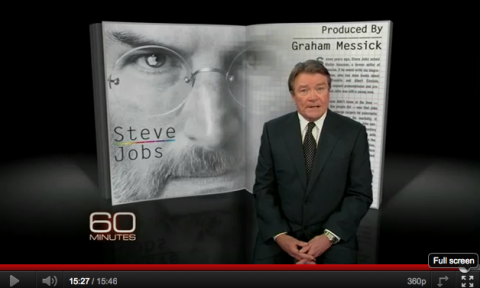
Just a few short weeks after the death of Steve Jobs comes a 627 page biography by Walter Isaacson, the former Managing Editor of TIME and CEO of CNN. Isaacson first discussed writing the book with Jobs seven years ago and has since interviewed the Apple CEO more than 40 times. Now, appearing on 60 Minutes, he talks publicly about the new book simply called Steve Jobs. It hit bookshelves yesterday and already stands atop the Amazon Bestseller list.
The 29 minute interview (Part 1 here, Part 2 here) gives you a feel for the book that’s willing to tell the good, the bad and the sometimes ugly of Jobs’ life. If you’re looking to get your hands on the biography, give this some thought: If you sign up for a 14-day free trial with Audible.com, you can download pretty much any audio book in Audible’s catalogue for free. And that catalogue now includes Isaacson’s unabridged biography. Once the trial is over, you can continue your Audible subscription (as I did), or cancel it, and still keep the free book. The choice is yours.
Note: CBS didn’t allow the 60 Minutes interview to appear on external sites like ours. Hence you will need to watch the interview on YouTube itself. We provide the links above.
Read More...The Decline of Civilization’s Right Brain: Animated
The mind, they say, is a house divided: The right hemisphere of the brain is predominantly intuitive; the left, predominantly rational.
In his recent book, The Master and His Emissary: The Divided Brain and the Making of the Western World, the British psychiatrist and writer Iain McGilchrist looks at the evolution of Western Civilization through a neuropsychological prism. In McGilchrist’s view our left hemisphere has, over the past four centuries, progressively pushed aside our right hemisphere. “My belief,” McGilchrist told The Morning News last year, “is that it has now taken over our self-understanding, for a variety of reasons, and is leading us all down the road to ruin.”
McGilchrist is quick to point out that the old left-brain, right-brain clichés of the 1960s and 1970s were greatly oversimplified. Recent research has shown that both sides of the brain are deeply involved in functions such as reason and emotion. But the dichotomy is still useful, McGilchrist says, and should not be abandoned.
“The right hemisphere gives sustained, broad, open, vigilant alertness, whereas the left hemisphere gives narrow, sharply focused attention to detail,” McGilchrist says in a new RSA Animate feature (see above). “People who lose their right hemispheres have a pathological narrowing of the window of attention.” McGilchrist sees this narrowing process occurring at the societal level. The left brain, he argues, conceives of the world as a set of decontextualized, static, material, abstract things, whereas the right brain holistically embraces a world of evolving, spiritual, empathic, concrete beings.
Both hemispheres are necessary, McGilchrist says in the Morning News interview, “but one is more fundamentally important than the other, and sees more than the other, even though there are some things that it must not get involved with, if it is to maintain its broader, more complete–in essence more truthful–vision. This is the right hemisphere, which, as I demonstrate from the neuropsychological literature, literally sees more, and grounds the understanding of the left hemisphere–an understanding which must ultimately be re-integreted with the right hemisphere, if it is not to lead to error. The left hemisphere is extraordinarily valuable as an intermediate, but not as a final authority.”
McGilchrist is not without his critics. The British philosopher A.C. Grayling writes in the Literary Review, “Unfortunately, if one accepts the logic of his argument that our Western civilisation has declined from a right-hemisphere to a left-hemisphere dispensation, we do not have to imagine what the former would be like, because history itself tells us: in it most of us would be superstitious and ignorant peasants working a strip farm that we would never leave from cradle to grave, under the thumb of slightly more left-hemispheric bullies in the form of the local baron and priest.”
After The Master and His Emissary was published, McGilchrist discovered a quotation attributed to Albert Einstein that he felt neatly supported his thesis. He uses this quote at the end of his RSA talk: “The intuitive mind is a sacred gift and the rational mind is a faithful servant. We have created a society that honors the servant and has forgotten the gift.” But did Einstein actually say that? The Internet is awash with dubious Einstein quotations, and we were unable to locate the original source of this one. If any reader can verify its authenticity (by citing the original text, speech or conversation) please leave a note in our comments section. Meanwhile, you can watch McGilchrist’s entire half-hour RSA lecture here.
via Brain Pickings
Read More...Spike Jonze Presents a Stop Motion Film for Book Lovers
It all started when filmmaker Spike Jonze (Being John Malkovich, Where the Wild Things Are) met handbag designer Olympia Le-Tan and asked her to create a Catcher in the Rye embroidery for his wall. She asked him to collaborate on a film in return. And so Jonze and Le-Tan, together with French director Simon Cahn, spent six months writing a script, then animating 3,000 pieces of felt cut by Le-Tan herself. The result is Mourir Auprès de Toi (To Die By Your Side), a short stop motion film set inside the famous Parisian bookstore, Shakespeare and Company, and it features a skeleton, his lover, and some famous book covers that spring to life.
For more backstory, don’t miss this short “Making of” film, a short interview with Olivia Le-Tan, and an interview with Spike Jonze. Here, you can also watch Mourir Auprès de Toi (now added to our Free Movie collection) in a larger format.
If you would like to support the mission of Open Culture, consider making a donation to our site. It’s hard to rely 100% on ads, and your contributions will help us continue providing the best free cultural and educational materials to learners everywhere. You can contribute through PayPal, Patreon, and Venmo (@openculture). Thanks!
Very Related Content:
1,000 Free Audio Books: Download Great Books for Free
Books Savored in Stop Motion Film
Going West: A Stop Motion Novel
800 Free eBooks for iPad, Kindle & Other Devices
Read More...Math Doodling
Doodling — it’s usually a sign of boredom, an escape from tedium. Vi Hart turns it all upside down, and shows how doodling can be an engaging form of pedagogy. On her web site, you will find other math doodling videos called Stars, Snakes + Graphs, Binary Trees, Sick Number Games and Squiggle Inception. The video above is called Infinity Elephants. Thanks Kim for sending this our way.…
Related Content:
Multiplication: The Vedic Way
Read More...Getz and Gilberto Perform ‘The Girl from Ipanema’ (and the Woman Who Inspired the Song)
Take a deep breath and watch this 1964 television performance of “The Girl from Ipanema” by Brazilian bossa nova singer Astrud Gilberto and American jazz saxophonist Stan Getz.
The arrangement is from the classic album, Getz/Gilberto, which launched the bossa nova craze of the early 60’s. The album was primarily a collaboration between Getz and Astrud’s husband, the guitarist and vocalist João Gilberto, but when someone got the idea of including an English translation of Antonio Carlos Jobim’s “The Girl from Ipanema,” Astrud was recruited. She had never sung professionally before. The recordings launched her as an international sensation.
Since then, “The Girl from Ipanema” has weathered a half-century of heavy rotation on the Holiday Inn lounge circuit and Muzak. (Remember the elevator scene in The Blues Brothers?) So it can be hard to imagine just how cool the song must have seemed in 1964 with the release of Getz/Gilberto. That saxophone. That voice. As the person who posted this video on YouTube put it: “Chill, baby, chill…”
When it’s all said and done, you can also meet Heloisa Pinheiro, the woman who inspired the song all of those years ago.
Related Content:
Classic Jazz Album Covers Animated, or the Re-Birth of Cool
Billie Holiday Sings “Strange Fruit”
Learn Brazilian Portuguese and 40 Other Languages for Free
Read More...Ai Weiwei and the Seeds of Freedom
In the state-controlled propaganda art of revolutionary China, sunflowers carried a blunt symbolism: Mao Zedong was the sun and the Chinese people were the sunflowers, all facing one direction to receive the nourishing rays.
A generation later, in the work of Chinese artist Ai Weiwei, the symbolism is a bit more subversive. In 2010 Ai launched a show called Sunflower Seeds, where a riot of individual porcelain seeds–more than a hundred million of them, all hand-painted–were spread across the floor of a large hall at the Tate Modern in London. Ai wanted visitors to move freely across the installation, picking the seeds up, moving them around, doing whatever they wanted — all shown in the video above.
As a champion of freedom and an outspoken critic of China’s human rights record, Ai has come under heavy pressure from the Chinese regime. Early this year his Shanghai studio was demolished and he was later arrested and detained at secret locations for 81 days. Now he is forbidden from giving interviews or using the Internet. But before he was arrested, Ai was able to send a videotaped speech to the TED conference, outlining his views. You can watch it below. To learn more about the extraordinary Sunflower Seeds 2010 exhibit, you can watch the “TateShots” film above.
Read More...Support Us
We're hoping to rely on loyal readers, rather than erratic ads. Please click the Donate button and support Open Culture. You can use Paypal, Venmo, Patreon, even Crypto! We thank you!

About Us

Open Culture scours the web for the best educational media. We find the free courses and audio books you need, the language lessons & educational videos you want, and plenty of enlightenment in between.
Advertise With Us

FREE UPDATES!
GET OUR DAILY EMAIL
Get the best cultural and educational resources on the web curated for you in a daily email. We never spam. Unsubscribe at any time.
FOLLOW ON SOCIAL MEDIA

Open Culture editor Dan Colman scours the web for the best educational media. He finds the free courses and audio books you need, the language lessons & movies you want, and plenty of enlightenment in between.
Advertise With Us

