Google’s Answer to Wikipedia Now Live
Last December, Google announced that it was testing a new content initiative — dubbed “Knol” — intended to rival Wikipedia. The fruits of their labor are now live (in beta), available for all to see.
As we mentioned in our initial piece, Knol caters to the individual author/expert, not to the wisdom of crowds (à la Wikipedia). Each encyclopedia entry is generally written, edited, and revised by one individual. The author reigns supreme here. But that doesn’t mean that Wikipedia’s collaborative approach is being entirely abandoned.
Google’s model leaves ample room for collaborative writing. It keeps open the possibility that multiple authors will write an encyclopedia entry. And, they allow for “moderated collaboration” — meaning that “any reader can make suggested edits to a knol which the author may then choose to accept, reject, or modify before these contributions become visible to the public.” Collaboration is built into Google’s model. It’s just not taken to an extreme conclusion. (Get more info on the positioning of Knol here.)
Knol is not the only content platform trying to strike a balance between the author and mass collaboration. In June, Encyclopedia Britannica launched a beta of a new online encyclopedia that takes “a collaborative-but-not-democratic approach” to producing knowledge. Users can make contributions to a growing storehouse of knowledge. But whether these contributions get accepted remains up to the experts and editors. (“At the new Britannica site, we will welcome and facilitate the increased participation of our contributors, scholars, and regular users, but we will continue to accept all responsibility of what we write under our name. We are not abdicating our responsibility as publishers or burying it under the now-fashionable “wisdom of the crowds.”)
I have little doubt that the Google and Britannica models will generate some solid encyclopedia entries. That’s a safe bet. But whether these encyclopedias will ever become as comprehensive as Wikipedia, or as widely used, is another question. And the same holds true for whether the content will generally be qualitatively better than what Wikipedia has to offer. When Google first announced Knol last December, I voiced my doubts. Now that the rubber is finally hitting the road, we can see whether my skepticism is warranted (or not).
Read More...
The Great Dictator: A Classic Chaplin Moment
It’s 1940. The film is The Great Dictator, Charlie Chaplin’s famous satire of Nazi Germany. In this celebrated scene, Chaplin dances with a large globe with Richard Wagner’s Lohengrin Overture playing in the background.

When the Flintstones Peddled Cigarettes
What can you say about this? A quick trip back to the 1950s… File this under Random …
(For foreign readers, all you need to know is that The Flintstones was a classic American cartoon.)

Related Content:
Rewind the Videotape: Mike Wallace Interviews 1950s Celebrities
Read More...School of Life: An Award-Winning Short Indie Film
Now featured in The YouTube Screening Room: Jake Polonsky’s School of Life. “The film may be set in an elementary school, but it tells a poignantly ironic story that any adult will relate to. School of Life won the 2004 British Independent Film Award for Best Short.” A higher quality version can be watched here. But make sure you have a high speed connection.

10 New iPhone Apps for the Thinking Person
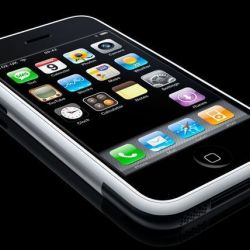 In advance of tomorrow’s release of the new 3G iPhone, Apple has launched its new App Store on iTunes, which features new tools that will immediately make the iPhone (and iPod Touch) a more versatile — and, in some cases, enlightening — device. Below, we have highlighted ten apps worth exploring if you’re hungry for enriching information. 9 of the 10 are free. (Please note: To access the App Store, you will need to download the latest version of iTunes (here) and also the new iPhone 2.0 firmware, which has yet to be officially released — although you can find an unofficial release and directions on how to install it here. The official release should be coming any time now.)
1.) The New York Times: Thanks to this app, you can read “All the News That’s Fit to Print” on your iPhone. It lets you customize the news you read, and also read articles offline.
2.) AOL Radio: One downside to the first generation iPhone is that it didn’t allow you to access internet radio. This app helps to change some of that. It gives you access to 150 CBS radio stations across the US, including some key news stations.
3.) Mandarin Audio Phrasebook: Lonely Planet, the publisher of fine travel guides, has produced a free Mandarin audio phrasebook, which includes 630 commonly used phrases. Via the iPhone you can hear how the phrases are spoken (and also see how they are phonetically written). For $9.99, you can purchase phrasebooks in nine other languages, including Spanish, French, Japanese, Italian, Thai, Vietnamese and Czech. See full collection here.
4.) Truveo Video Search: The Wall Street Journal calls Truveo the “best web-wide video-search engine.” And now, with this Truveo app, you can use the iPhone to find videos from across the web, and, regardless of their format, play them all in one application. This sounds like a great addition, especially since many videos weren’t playable on 1st generation iPhones.
5.) NetNewsWire: With this app, you can add an RSS reader to the iPhone, allowing you to read RSS feeds in a neat and clean way. It also lets you “clip” articles that you like and read them later. Don’t forget to sign up for our feed, and you can always add more cultural feeds by perusing our list of 100 Culture Blogs.
6.) Google Mobile App: Let’s face it. In today’s information world, Google is a must-have. And so it’s nice to have an app that makes Google and its many functionalities completely iPhone friendly.
7.) AppEngines E‑Books: For 99 cents, you can download a classic e‑book to your iPhone, and read it in a quite legible format. In this collection, you will find Crime and Punishment, Pride and Prejudice, Dickens’ Great Expectations, and about 40 other e‑books.
8.) Talking Spanish Phrasebook: Too busy to learn a new language? Then you’re in luck. This app will do the talking for you. It takes basic phrases in English and then converts them into spoken Spanish. There are also free versions in French, German, and Italian.
9.) Epocrates: This free app turns your iPhone into a comprehensive drug database. Very handy for the medical community.
10.) NearPics: If you’re traveling, and if you want to discover great places nearby, this app lets you discover pictures that have been taken in the vicinity. The app offers a way to discover intriguing places (or things) that normally fly below the radar. Also, this other app lets you put Flickr on your iPhone. More ways to satisfy your inner photographer.
Related Content:
10 Ways to Make Your iPod a Better Learning Gadget
Read More...Will Google Kill Science?
Not an obvious conclusion, I’ll agree. However, Chris Anderson, editor of Wired, presents the argument like this: as all sorts of data accumulate into a vast ocean of petabytes, our ability to synthesize it all into elegant theories and laws will disappear. The story is the cover of this month’s issue of Wired but I came across it in a newsletter from The Edge, a group of thinkers trying to promote a “third culture” of online intellectual thought.
Anderson’s argument isn’t really that the scientific method will disappear, but rather that correlation will become as good as it gets in terms of analyzing real-world data. Everything will be too messy, noisy and changing too quickly for proper hypotheses and theorems. As Anderson puts it, it will be “the end of theory.”
The nice thing about reading this on Edge is that the newsletter comes with several critical responses included from “The Reality Club,” which includes thinkers like George Dyson, Kevin Kelly and Stuart Brand. But I say that as the consumers and producers of most of these masses of data, the vote should lie with you, reader: does Google’s brute force approach to data hording spell the end scientific elegance?
Read More...Looking Inside Darwin’s Room (and Also Where Virginia Woolf, Lord Byron, & Kipling Did Their Thing)
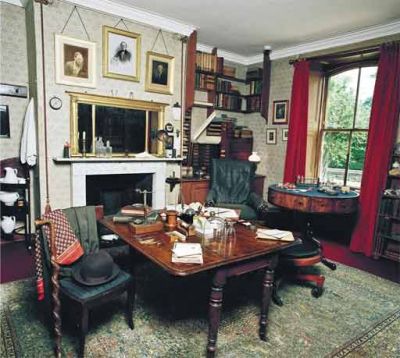
Darwinmania (as The New York Times dubbed it) is about to begin. During the next year, we will celebrate Darwin’s 200th birthday and the 150th anniversary of the Origin of Species (download zip audio here) and the discovery of natural selection. It’s pretty much a given that the minutiae of Darwin’s life will get thoroughly reexamined. So I figured why not get ahead of the curve and give you this — Darwin’s writing room. It’s provided courtesy of the Guardian Book Section, which lets you take a peek at the writings rooms of Virginia Woolf, Lord Byron, Rudyard Kipling, Martin Amis and many other important writers. (You can also visit our piece from last year for more room photos.)

Find Any Song Online and Share. Now.
Tinysong.com offers a service that’s rather impressive. You go to their homepage, search for a song, and then you can listen to it online and share it with a friend (via a specially created url). Just how it all works (copyright included), and just how deep the collection actually goes, I am not totally sure. But, the various tests that I threw at it suggest that there’s a fair amount of depth there.
Read More...
Top 10 TEDTalks (and Do Schools Today Kill Creativity?)
Late in the week, TEDTalks named its top ten videos. Whether this is a quantitative or qualitative judgment, I am not sure. On the list, you’ll find Al Gore talking about how to avert a climate crisis, David Gallo showing amazing underwater creatures, and Ken Robinson describing why schools kill creativity (we’ve posted that one below). Again the full list is here.
Support Us
We're hoping to rely on loyal readers, rather than erratic ads. Please click the Donate button and support Open Culture. You can use Paypal, Venmo, Patreon, even Crypto! We thank you!

About Us

Open Culture scours the web for the best educational media. We find the free courses and audio books you need, the language lessons & educational videos you want, and plenty of enlightenment in between.
Advertise With Us

FREE UPDATES!
GET OUR DAILY EMAIL
Get the best cultural and educational resources on the web curated for you in a daily email. We never spam. Unsubscribe at any time.
FOLLOW ON SOCIAL MEDIA

Open Culture editor Dan Colman scours the web for the best educational media. He finds the free courses and audio books you need, the language lessons & movies you want, and plenty of enlightenment in between.
Advertise With Us

