One possible response to the tantalizing notion of a Terry Gilliam film about Don Quixote: How hasn’t he made one already? Another possible response: Wait, hasn’t he made one already? The Man Who Killed Don Quixote, which premiered at Cannes last month, arrives 29 years after Gilliam first started working on it — and 16 years after Lost in La Mancha, a well-received documentary about one of his failed attempts to shoot it. Long the perfect symbol of a “cursed” production doomed to an eternity in “development hell,” it has somehow come back from the dead, resurrected by the sheer doggedness of Gilliam and his collaborators, time and time again.
The movie even survives John Hurt and Jean Rochefort, two of the stars previously signed on to play Quixote himself. (The list also includes Robert Duvall and Gilliam’s fellow Python Michael Palin.) Jonathan Pryce, best known at the moment as Game of Thrones’ High Sparrow, has ultimately taken on the role, having been attached to play others in the project over the previous decades. But just as Gilliam’s film doesn’t straightforwardly adapt Cervantes’ classic of Spanish literature, Pryce doesn’t straightforwardly portray Cervantes’ iconic character. He does it, rather, through a Spanish shoemaker who truly believes he is Cervantes’ iconic character, having played him in a student film years before.
The student filmmaker has grown up to become a cynical adman, one meant to be played in previous versions of The Man Who Killed Don Quixote by Robin Williams, Johnny Depp, Ewan McGregor, and Jack O’Connell. In the trailer above you’ll see the character played by Adam Driver, who in recent years has fast ascended into the realm of indie-film royalty. Whereas earlier scripts flung him back through time from modern day into 17th-century Spain, this one stays in the present and forces him to confront the outsized impact of his small film on the even smaller village in which he shot it. And so the story of the film, not just the story behind it, takes on themes of the unpredictable complications, consequences, and even dangers of filmmaking.
Those complications have ground on for The Man Who Killed Don Quixote. The latest manifestation of the film’s supposed curse takes the form of a lawsuit by a former producer, Paulo Branco, who insists he still owns the rights to it. Gilliam’s current producer says otherwise, but their recent loss in the Paris Court of Appeals has given the notoriously forceful Branco reason — valid or not, nobody seems quite able to say — to publicly declare victory. Whichever party will finally have to cough up however much money to settle all of this, the epic journey of Gilliam’s Don Quixote project looks as if it has entered its home stretch. However the world receives the film itself, Gilliam’s fans can almost certainly look forward toanother acclaimed documentary about it as well.
Based in Seoul, Colin Marshall writes and broadcasts on cities and culture. His projects include the book The Stateless City: a Walk through 21st-Century Los Angeles and the video series The City in Cinema. Follow him on Twitter at @colinmarshall or on Facebook.
Above, James Corden visits Liverpool and takes Paul McCartney on a trip down memory lane. The 23-minute segment features a little “carpool karaoke” and some live performances by Sir Paul. Songs on the playlist here include “Drive My Car,” “Penny Lane,” “Let It Be,” “When I’m 64”, “Blackbird,” “Hard Day’s Night,” “Obladi Oblada,” “Love Me Do,” and “Hey Jude.” Enjoy!
If you would like to support the mission of Open Culture, consider making a donation to our site. It’s hard to rely 100% on ads, and your contributions will help us continue providing the best free cultural and educational materials to learners everywhere. You can contribute through PayPal, Patreon, and Venmo (@openculture). Thanks!
Judging by the outpouring of affection in online comment sections, Chicago folk musician John Prine (may he rest in peace) has helped a great many of his fans through tough times with his humanist, oft-humorous lyrics.
Taping a video in support of The Tree of Forgiveness, Prine’s first album of new material in over a decade, Murray recalled a grim period in which a deep funk robbed him of all enjoyment. Though he carefully stipulates that this “bummer” could not be diagnosed as clinical depression, nothing lifted his spirits, until Gonzo journalist Dr. Hunter S. Thompson—whom Murray embodied in the 1980 film, Where the Buffalo Roam—suggested that he turn to Prine for his sense of humor.
Murray took Thompson’s advice, and gave his fellow Illinoisian’s double greatest hits album, Great Days, a listen.
But the song that left the deepest impression on Murray is a silly country-swing number “Linda Goes to Mars,” in which a clueless husband assumes his wife’s vacant expression is proof of interplanetary travel rather than disinterest.
To hear Murray tell it, as he thumbs through a copy of John Prine Beyond Words, the moment was not one of gut-busting hilarity, but rather one of self-awareness and relief, a signal that the dark clouds that had been hanging over him would disperse.
I just found out yesterday that Linda goes to Mars
Every time I sit and look at pictures of used cars
She’ll turn on her radio and sit down in her chair
And look at me across the room as if I wasn’t there
Oh, my stars, my Linda’s gone to Mars
Well, I wish she wouldn’t leave me here alone
Oh, my stars, my Linda’s gone to Mars
Well, I wonder if she’d bring me something home
Something, somewhere, somehow took my Linda by the hand
And secretly decoded our sacred wedding band
For when the moon shines down upon our happy humble home
Her inner space gets tortured by some outer space unknown
Oh, my stars, my Linda’s gone to Mars
Well, I wish she wouldn’t leave me here alone
Oh, my stars, my Linda’s gone to Mars
Well, I wonder if she’d bring me something home
Now I ain’t seen no saucers ‘cept the ones upon the shelf
And if I ever seen one I’d keep it to myself
For if there’s life out there somewhere beyond this life on earth
Then Linda must have gone out there and got her money’s worth
Oh, my stars, my Linda’s gone to Mars
Well, I wish she wouldn’t leave me here alone
Oh, my stars, my Linda’s gone to Mars
Well, I wonder if she’d bring me something home
Yeah, I wonder if she’d bring me something home
Listen to a Great Days Spotify playlist here, though neither Open Culture, nor Bill Murray can be held accountable if you find yourself blinking back tears.
Bonus: Below, watch Prine and Murray “swap songs and stories about the early days in Chicago crossing paths with the likes of John Belushi, Steve Goodman and Kris Kristofferson.” Plus more.
“Breton believed art and literature could represent the unconscious mind,” says the video’s narrator Peter Capaldi, well known as one of the Doctors of Doctor Who. He then names some artists who agreed with Breton on this point, such as Salvador Dalí, Max Ernst, Joan Miró, and Rene Magritte — just a few of the Surrealists. “Surreal,” as an adjective, has perhaps fallen victim to debasement by overuse in the past 84 years. But Breton had specific ideas about Surrealism’s potential effects, its sources of power, and its methods.
Desire, for instance, “was central to the Surrealist vision of love, poetry, and liberty. It was the key to understanding human beings.” Surrealist artistic practices included putting objects “that were not normally associated with one another together, to make something that was playful and disturbing at the same time in order to stimulate the unconscious mind.” Think of Dalí’s 1936 Lobster Telephone, made out of those very objects. “It’s about food and sex,” Capaldi pronounces. The Surrealist vision also extended to more complicated endeavors, such as elaborate paintings and films that still fascinate today.
You can catch up on Surrealist film here on Open Culture, beginning with Luis Buñuel & Salvador Dalí’s nightmarish 1929 short Un Chien Andalou, continuing on to the Surrealist feature Dreams That Money Can Buy (a collaboration by the likes of Man Ray, Marcel Duchamp, Alexander Calder, Fernand Léger and Hans Richter), and the history of Surrealist cinema as presented by David Lynch, a filmmaker widely considered one of the movement’s modern heirs. Whether Breton would recognize the Surrealist sensibility in its current manifestations will remain a matter of debate, but who could watch this Unlock Art primer and fail to sense the fascination its basic ideas — or basic compulsions, perhaps — still hold today?
Based in Seoul, Colin Marshall writes and broadcasts on cities and culture. His projects include the book The Stateless City: a Walk through 21st-Century Los Angeles and the video series The City in Cinema. Follow him on Twitter at @colinmarshall or on Facebook.
Take an innocuous statement like, “we should teach children about the life of Helen Keller.” What reasonable, compassionate person would disagree? Hers is a story of triumph over incredible adversity, of perseverance and friendship and love. Now, take a statement like, “we should teach children the political writing of Helen Keller,” and you might see brawls in town halls and school board meetings. This is because Helen Keller was a committed socialist and serious political thinker, who wrote extensively to advocate for economic cooperation over competition and to support the causes of working people. She was an activist for peace and justice who opposed war, imperialism, racism, and poverty, conditions that huge numbers of people seem devoted to maintaining—both in her lifetime and today.
Keller’s moving, persuasive writing is eloquent and uncompromising and should be taught alongside that of other great American rhetoricians. Consider, for example, the passage below from a letter she wrote in 1916 to Oswald Villard, then Vice-President of the NAACP:
Ashamed in my very soul I behold in my own beloved south-land the tears of those who are oppressed, those who must bring up their sons and daughters in bondage to be servants, because others have their fields and vineyards, and on the side of the oppressor is power. I feel with those suffering, toiling millions, I am thwarted with them. Every attempt to keep them down and crush their spirit is a betrayal of my faith that good is stronger than evil, and light stronger than darkness…. My spirit groans with all the deaf and blind of the world, I feel their chains chafing my limbs. I am disenfranchised with every wage-slave. I am overthrown, hurt, oppressed, beaten to the earth by the strong, ruthless ones who have taken away their inheritance. The wrongs of the poor endure ring fiercely in my soul, and I shall never rest until they are lifted into the light, and given their fair share in the blessings of life that God meant for us all alike.
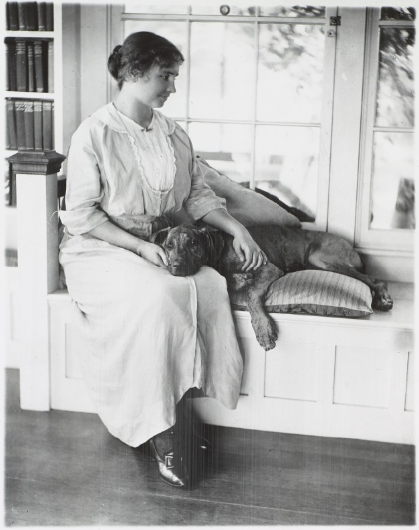
It is difficult to choose any one passage from the letter because the whole is written with such expressive feeling. This is but one document among many hundreds in the new Helen Keller archive at the American Foundation for the Blind (AFB), which has digitized letters, essays, speeches, photographs, and much more from Keller’s long, tireless career as a writer and public speaker. Funded by the National Endowment for the Humanities, the archive includes over 250,000 digital images of her work from the late 19th century to well into the 20th. There are many films of Keller, photos like that of her and her dog Sieglinde at the top, a collection of her correspondence with Mark Twain, and much more.
In addition to Keller’s own published and unpublished work, the archive contains many letters to and about her, press clippings, informative AFB blog posts, and resources for students and teachers. The site aims to be “fully accessible to audiences who are blind, deaf, hard-of-hearing, low vision, or deafblind.” On the whole, this project “presents an opportunity to encounter this renowned historical figure in a new, dynamic, and exciting way,” as AFB writes in a press release. “For example, despite her fame, relatively few people know that Helen Keller wrote 14 books as well as hundreds of essays and articles on a broad array of subjects ranging from animals and atomic energy to Mahatma Gandhi.”
And, of course, she was a lifelong advocate for the blind and deaf, writing and speaking out on disability rights issues for decades. Indeed, it’s difficult to find a subject in which she did not take an interest. The archive’s subject index shows her writing about games, sports, reading, shopping, swimming, travel, architecture and the arts, education, law, government, world religions, royalty, women’s suffrage, and more. There were many in her time who dismissed Keller’s unpopular views, calling her naïve and claiming that she had been duped by nefarious actors. The charge is insulting and false. Her body of work shows her to have been an extraordinarily well-read, wise, cosmopolitan, sensitive, self-aware, and honest critical thinker.
Two years after the NAACP letter, Keller wrote an essay called “Competition,” in which she made the case for “a better social order” against a central conceit of capitalism: that “life would not be worth while without the keen edge of competition,” and that without it “men would lose ambition, and the race would sink into dull sameness.” Keller advances her counterargument with vigorous and incisive reasoning.
This whole argument is a fallacy. Whatever is worth while in our civilization has survived in spite of competition. Under the competitive system the work of the world is badly done. The result is waste and ruin [….] Profit is the aim, and the public good is a secondary consideration. Competition sins against its own pet god efficiency. In spite of all the struggle, toil and fierce effort the result is a depressing state of destitution for the majority of mankind. Competition diverts man’s energies into useless channels and degrades his character. It is immoral as well as inefficient, since its commandment is “Thou shalt compete against thy neighbor.” Such a rule does not foster Truthfulness, honesty, consideration for others. [….] Competitors are indifferent to each other’s welfare. Indeed, they are glad of each other’s failure because they find their advantage in it. Compassion is deadened in them by the necessity they are under of nullifying the efforts of their fellow-competitors.
Keller refused to become cynical in the face of seemingly indefatigable greed, cruelty, and hypocrisy. Though not a member of a mainstream church (she belonged to the obscure Christian sect of Swedenborgianism), she exhorted American Christians to live up to their professions—to follow the example of their founder and the commandments of their sacred text. In an essay written after World War I, she argued movingly for disarmament and “the vital issue of world peace.” While making a number of logical arguments, Keller principally appeals to the common ethos of the nation’s dominant faith.
This is precisely where we have failed, calling ourselves Christians we have fundamentally broken, and taught others to break most patriotically, the commandment of the Lord, “Thou shalt not kill” [….] Let us then try out Christianity upon earth—not lip-service, but the teaching of Him who came upon earth that “all men might have life, and have it more abundantly.” War strikes at the very heart of this teaching.
We can hear Helen Keller’s voice speaking directly to us from the past, diagnosing the ills of her age that look so much like those of our own. “The mythological Helen Keller,” writes Keith Rosenthal, “has aptly been described as a sort of ‘plaster saint;’ a hollow, empty vessel who is little more than an apolitical symbol for perseverance and personal triumph.” Though she embodied those qualities, she also dedicated her entire life to careful observation of the world around her, to writing and speaking out on issues that mattered, and to caring deeply about the welfare of others. Get to know the real Helen Keller, in all her complexity, fierce intelligence, and ferocious compassion, at the American Foundation for the Blind’s exhaustive digital archive of her life and work.
The field jacket, the mohawk, the “real rain” that will “wash all this scum off the streets,” the virtuoso tracking shot over the aftermath of a massacre, “You talkin’ to me?”: so many elements of Taxi Driver have found permanent places in cinematic culture, and almost as many have found permanent places in the culture, period. Thanks to its wide-ranging influence as well as its presence that endures more than forty years on, even those who’ve never seen the movie in some sense already know it.
What makes Taxi Driver so powerful? Lewis Bond, video essayist and creator of Channel Criswell, sets out to answer that question in the two-part, feature-length analysis above. Martin Scorsese’s fifth film, and the second of his collaborations with Robert de Niro, Taxi Driver came out in 1976.
Adapting the film noir tradition for an even more cynical post-Vietnam era, it ostensibly mounted a grim critique of America. Audiences of the 1970s, especially audiences of New Yorkers, might have readily identified with the judgments of moral, social and urban decay bitterly aired by de Niro as Travis Bickle.
But before long, those first viewers surely realized that they were watching a work of art both more complex and more universal than that. Bond’s reading of the film gets right to the study at its heart of isolation, hypocrisy, purity, corruption, desire, and vengeance, characteristics found in but hardly unique to the human experience in 70s New York City. “Martin Scorsese’s 1976 film is a film that does not grow dated, or over-familiar,” writes Roger Ebert in a 2004 appreciation. “I have seen it dozens of times. Every time I see it, it works; I am drawn into Travis’ underworld of alienation, loneliness, haplessness and anger.”
Ebert understands, as Bond does, that “utter aloneness is at the center of Taxi Driver, one of the best and most powerful of all films, and perhaps it is why so many people connect with it even though Travis Bickle would seem to be the most alienating of movie heroes. We have all felt as alone as Travis. Most of us are better at dealing with it.” Yet over the past four decades, even as New York has emerged from near-bankruptcy to become one of the most expensive and glamorous of all cities, real-life Travis Bickles have visited their violent, misbegotten vengeance all over America. Making Taxi Driver, Scorsese and his collaborators thoughtthey were capturing the dying gasp of a city. Instead, they captured an aspect of the human condition that haunts us more than ever today.
Based in Seoul, Colin Marshall writes and broadcasts on cities and culture. His projects include the book The Stateless City: a Walk through 21st-Century Los Angeles and the video series The City in Cinema. Follow him on Twitter at @colinmarshall or on Facebook.
Born out of evening reading of spooky stories on a rain-soaked holiday, Mary Shelley’s 1818 novel Frankenstein has resonated through the years into pop culture, a warning against science and technology, of how the thirst for knowledge can literally create monsters. If you’ve been binging Westworld or loved Ex Machina you are seeing Shelley’s legacy, both filled with scientific creations that question their own reason for existence.
Just like those works are products of our era, Frankenstein did not just arise from a dream state—-Shelley was influenced by the concerns, events, and news of her day.
“Annotated for scientists, engineers, and creators of all kinds,” is how the website describes the project, created in January 2018 by Arizona State University to honor the bicentennial of the book’s publication. “Frankenbook gives readers the opportunity to trace the scientific, technological, political, and ethical dimensions of the novel, and to learn more about its historical context and enduring legacy.”
You will have to sign up (just an email and a password is necessary) to actually see the novel, but once in, you can get reading. Along the way on the right hand side of the margin, a cluster of black dots indicate if a section is annotated. Click on the dots with your mouse and the annotation will appear. (The annotations are also available at the end of each of the novel’s three parts for those who just want to read the novel straight through.)
Dozens of experts have contributed to the annotations so far, and opening an account allows you to submit your own to the editors for consideration. You can also filter annotations by one of eight themes: “Equity & Inclusion” (social justice issues), “Health & Medicine,” “Influences and Adaptations,” “Mary Shelley” (personal information about the author), “Motivations & Sentiments,” “Philosophy & Politics,” “Science,” and “Technology.”
The site also features several essays on the novel’s various themes, including ones by Cory Doctorow, Anne K. Mellor, Josephine Johnston, and others.
If you’ve been putting off reading Shelley’s classic for whatever reason, this is probably the best chance to read it. And if you’ve read it before, it’s time to revisit it alongside a host of virtual experts. The web, that Promethian creation of our own time, is actually good for some things, you know!
Ted Mills is a freelance writer on the arts who currently hosts the FunkZone Podcast. You can also follow him on Twitter at @tedmills, read his other arts writing at tedmills.com and/or watch his films here.
From Shamoon Zamir, a literature professor at NYU Abu Dhabi, comes a “research archive of historical and contemporary photography from the Middle East and Northern Africa (MENA),” designed to be fully accessible to the public. We’re told:
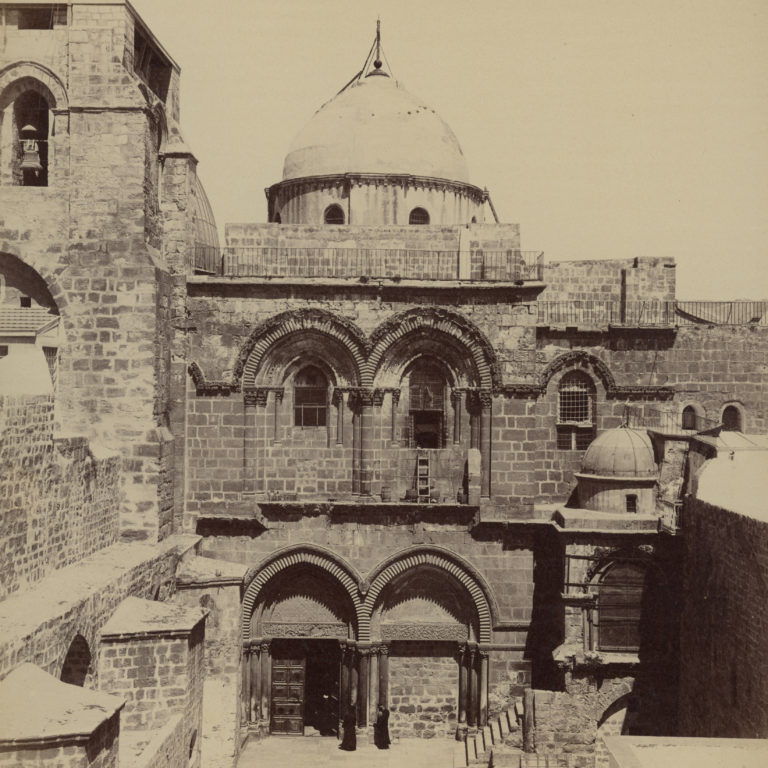
Today, Akkasah: The Center for Photography at NYU Abu Dhabi boasts an archive of 62,000 images from the UAE and across the MENA region – of which 9,000 are already digitized and available online — the only of its kind in the Middle East. These images offer new insights into the history and rapid transformation of the UAE and the broader Arab world. They include historical collections ranging from the nineteenth century to the late twentieth, covering a variety of themes and topics, from early images of the Holy Lands and from the Ottoman Empire, to images from family albums, institutional archives and the history of Egyptian cinema.
If you would like to support the mission of Open Culture, consider making a donation to our site. It’s hard to rely 100% on ads, and your contributions will help us continue providing the best free cultural and educational materials to learners everywhere. You can contribute through PayPal, Patreon, and Venmo (@openculture). Thanks!
Pregnancy and parenting are “extreme experiences that stretch our understanding,” writes Lily Gurton-Wachter at the Los Angeles Review of Books. They “push us beyond comfort or even comprehension.” Women risk their own lives to give life to a stranger, a tiny human whose future is entirely uncertain. Parents live with constant dread of all that could befall their children, an anxious state, but also a vulnerability that can make us deeply sensitive to the fragility of human life. Gurton-Wachter compares motherhood to going to war, “a profound, frightening, exhilarating, transformative experience at the boundary of life, an experience from which one comes back a different person.”
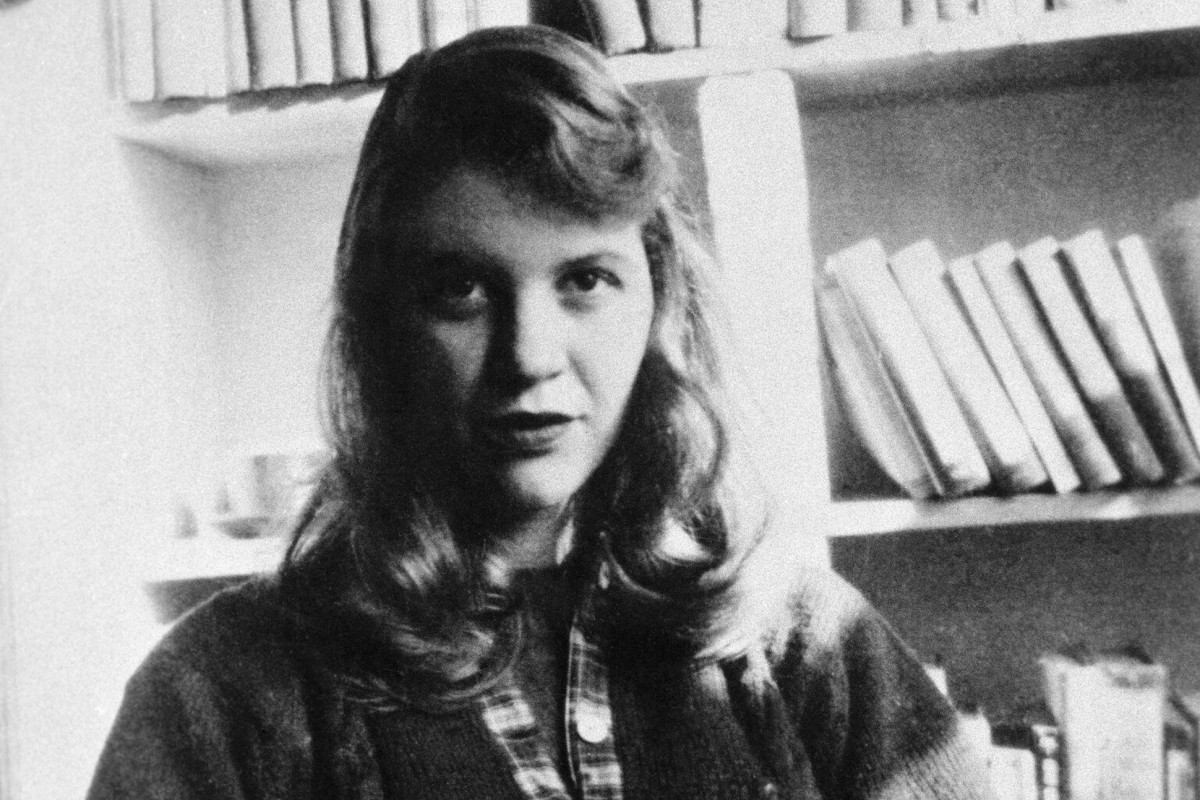
It’s a comparison Sylvia Plath would likely appreciate. With her ability to compress personal experience in collections of surprising, often violent, images, Plath expressed deep ambivalence about motherhood, undercutting a tradition of sentimental idealization, giving voice to fear, discomfort, bewilderment, and mystery.
In “Metaphors,” from 1960’s Colossus, she begins with a playful description of pregnancy as “a riddle in nine syllables.” Within a few lines she feels effaced and starts to “see herself merely as a ‘means,’” notes Shenandoah, “almost an incubator… This culminates with the last line, where she realizes that she is forever changed, irrevocably”: “Boarded the train,” she writes, “there’s no getting off.”
In 1961, after the birth of her daughter, Frieda, Plath wrote “Morning Song, which might be read as almost an extension of “Metaphors.” It is “one of her most unusual poems,” writes Maria Popova at Brain Pickings, “both paean and requiem for new motherhood—the love, the strangeness, the surreal and magnetic disorientation of it.” Published posthumously in Ariel, the poem addresses itself to the new arrival, in a series of stanzas that capture the awe and anxiety of those first hours after her birth. In the audio above from the Academy of American Poets’ annual Poetry & the Creative Mind event, hear Meryl Streep read the poem “with uncommon sensitivity,” Popova writes, “to the innumerable nuances it holds.” As you listen, read along below.
MORNING SONG
Love set you going like a fat gold watch.
The midwife slapped your footsoles, and your bald cry
Took its place among the elements.
Our voices echo, magnifying your arrival. New statue.
In a drafty museum, your nakedness
Shadows our safety. We stand round blankly as walls.
I’m no more your mother
Than the cloud that distills a mirror to reflect its own slow
Effacement at the wind’s hand.
All night your moth-breath
Flickers among the flat pink roses. I wake to listen:
A far sea moves in my ear.
One cry, and I stumble from bed, cow-heavy and floral
In my Victorian nightgown.
Your mouth opens clean as a cat’s. The window square
Whitens and swallows its dull stars. And now you try
Your handful of notes;
The clear vowels rise like balloons.
All throughout his career, Carl Sagan cited the events in his formative years that set him on the road to becoming, well, Carl Sagan: the introduction to “skepticism and wonder” provided by his parents; his visit to the 1939 New York World’s Fair; his first trips to the public library, the American Museum of Natural History, and the Hayden Planetarium; his discovery of Astounding Science Fiction Magazine and its fantastic visions undergirded by genuine knowledge. That last happened around the same time he entered the sixth grade at David A. Boody Junior High School, where he would eventually return, decades later, to teach the lesson seen in the video above.
“As a child, it was my immense good fortune to have parents and a few teachers who encouraged my curiosity,” Sagan says in voiceover. “This was my sixth-grade classroom. I came back here one afternoon to remember what it was like.” Anyone watching him handing out the “breathtaking pictures of other worlds that had been radioed back by the Voyager spacecraft” and addressing the excited students’ questions will understand that, in addition to his formidable hunger for knowledge and deep understanding of his subjects, Sagan also possessed a quality rare in the scientific community: the ability and willingness to talk about science clearly and engagingly, and transmit his excitement about science, to absolutely anyone.
The clip also provides a sense of what it was like to learn directly from Sagan. In the interview clip above, no less a science guy than Bill Nye talks about his own experience taking Sagan’s classes at Cornell in the 1970s. “If you saw his series Cosmos — the original Cosmos — his lectures were like those television shows,” says Nye. He goes on to tell the story of meeting Sagan again, at his ten-year class reunion. “I said I want to do this show about science for kids. He said, ‘Focus on pure science. Kids resonate to pure science.’ That was his verb, resonate.” And so, when Bill Nye the Science Guy debuted a few years later, it spent most of its time not on the fruits of science — “bridges, dams, and civil engineering works and gears” and so on — but on science itself.
Carl Sagan co-founded the Planetary Society in 1980. Nye, drawn by its mission of “empowering the world’s citizens to advance planetary science and exploration,” joined that same year. After speaking at Sagan’s memorial a decade and a half later, Nye found himself on its board of directors. Then he became Vice President, and then “there was a dinner party, there was wine or something, and now I’m the CEO.” In that way and others, Nye continues Sagan’s legacy, and Nye hardly counts as Sagan’s only successor. “This is how we know nature,” as Nye puts Sagan’s view of science. “It’s the best idea humans have ever come up with.” That view, whether expressed in Sagan’s own work or that of the countless many he has directly or indirectly influenced, will surely continue to inspire generations of learners, inside or outside the classroom.
Based in Seoul, Colin Marshall writes and broadcasts on cities and culture. His projects include the book The Stateless City: a Walk through 21st-Century Los Angeles and the video series The City in Cinema. Follow him on Twitter at @colinmarshall or on Facebook.
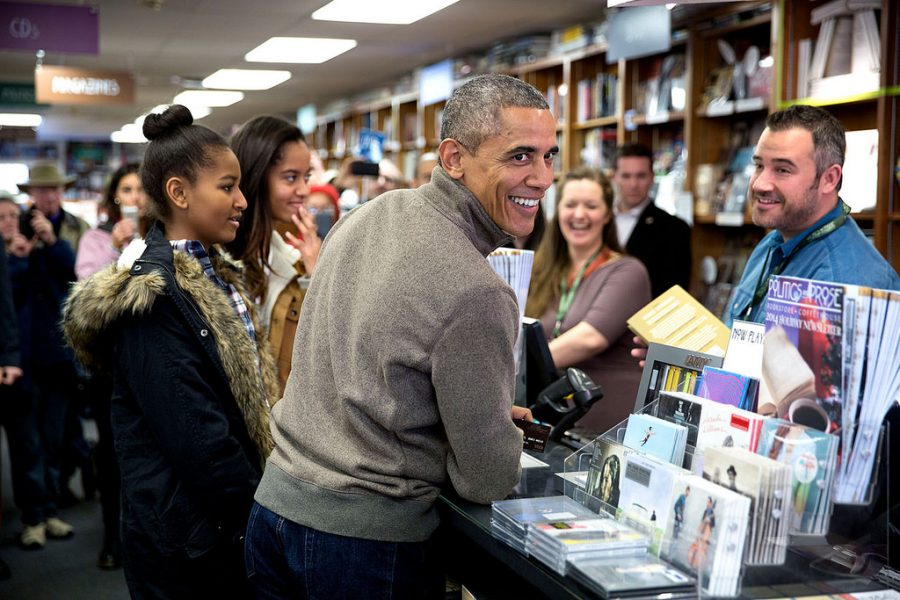
Whatever historians have to say about his political legacy, Barack Obama will be remembered as charming, diplomatic, thoughtful, and very well-read. He honed these personal qualities not only as a politician but as a scholar, writer, and teacher, roles that require intellectual curiosity and openness to other points of view. The former president was something of a dream come true for teachers and librarians, who could point to him as a shining example of a world leader who loves to read, talk about books, and share books with others. All kinds of books: from novels and poetry to biography, philosophy, sociology, and political and scientific nonfiction; books for children and books for young adults.
It is refreshing to look back at his tenure as a reliable recommender of quality books during his eight years in office. (See every book he recommended during his two terms here.) Reading gave him the ability to “slow down and get perspective,” he told Michiko Kakutani last year. He hoped to use his office, he said, “to widen the audience for good books. At a time when so much of our politics is trying to manage this clash of cultures brought about by globalization and technology and migration, the role of stories to unify—as opposed to divide, to engage rather than to marginalize—is more important than ever.”
While many people have been hoping he would weigh in on deeply disturbing current events, he “has been relatively quiet on social media of late,” notes Thu-Huong Ha at Quartz. But he has continued to use his platform to recommend good books, suggesting that the perspectives we gain from reading are as critical as ever. “In a Facebook post published on Saturday, Obama recommended some of the nonfiction he’s read recently, focused on government, inequality, and history, with one book that addresses immigration. Together the recommendations are an intellectual antidote to the current US president, who eschews reading,” says Ha.
The list below includes Obama’s brief commentary on each book and article.
Journalist Alex Wagner investigates a potential new twist in her family’s history. “What she came up with,” Obama writes, “is a thoughtful, beautiful meditation on what makes us who we are—the search for harmony between our own individual identities and the values and ideals that bind us together as Americans.”
Economist Enrico Moretti argues that there are three Americas: brain-hub cities like Austin and Boston; cities once dominated by traditional manufacturing; and the cities in between. “Still a timely and smart discussion of how different cities and regions have made a changing economy work for them,” writes Obama, “and how policymakers can learn from that to lift the circumstances of working Americans everywhere.”
Political scientist Patrick J. Deneen argues that liberalism is not the result of the natural state of politics and lays out the ideology’s inherent contradictions. “In a time of growing inequality, accelerating change, and increasing disillusionment with the liberal democratic order we’ve known for the past few centuries,” says the former president, “I found this book thought-provoking.”
In The Atlantic, Matthew Stewart, author of The Management Myth, defines a “cognitive elite,” a “9.9%” of Americans who value meritocracy and, he argues, are complicit in the erosion of democracy. “Another thought-provoking analysis, this one about how economic inequality in America isn’t just growing, but self-reinforcing,” says Obama.
Mitch Landrieu, the former mayor of New Orleans, Louisiana, writes in his memoir of the personal history and reckoning with race that led him to take down four Confederate statues in 2017. “It’s an ultimately optimistic take from someone who believes the South will rise again not by reasserting the past, but by transcending it,” writes Obama.
This report for the nonprofit RAND Corporation, available as a free ebook, attempts to study the erosion of fact-based policy making and discourse in the US. “A look at how a selective sorting of facts and evidence isn’t just dishonest, but self-defeating,” says Obama.
While the former president no longer has the power to sway policy, he can still inspire millions of people to read—essential for staying balanced, informed, and reflective in our perilous times.
We're hoping to rely on loyal readers, rather than erratic ads. Please click the Donate button and support Open Culture. You can use Paypal, Venmo, Patreon, even Crypto! We thank you!
Open Culture scours the web for the best educational media. We find the free courses and audio books you need, the language lessons & educational videos you want, and plenty of enlightenment in between.