Almost 35 years ago, sometime in the late 70s, the filmmakers Errol Morris and Werner Herzog made a bet. Correction: At the time, Herzog was a filmmaker, and already a star, but Errol Morris was just a guy obsessed with the idea of making a film about a pet cemetery. ‘I don’t believe you have the guts,’ Herzog told Morris. ‘But if you do, I’ll eat my shoe.’
Morris rolled up his sleeves and got to work. The result is his stunning debut, Gates of Heaven (1978). In response, Herzog rolled up his sleeves, and got to work as well — in the kitchen, where he and uber-chef Alice Waters tried their mightiest to concoct a decent recipe for leather footwear.
Just to complete the documentarian trifecta, the 20-minute short film, Werner Herzog Eats his Shoe(1980), was directed by the great Berkeley filmmaker, Les Blanc. You can watch a shortened version above, or the full version here. The film is also now added to our big collection of Free Movies Online.
Sheerly Avni is a San Francisco-based arts and culture writer. Her work has appeared in Salon, LA Weekly, Mother Jones, and many other publications. You can follow her on twitter at @sheerly.
Canadian “geek rapper” Baba Brinkman first garnered popular attention with a well-received, well-reviewed rap adaptation of Chaucer’s Canterbury Tales at the Edinburgh Fringe Festival. (To get a sense of the project, check out this brief scene from “The Pardoner’s Tale.”) And we also previously featured his brilliant work on Macmillan’s What’s Your English? campaign.
Brinkman has brought his follow-up show, a fascinating homage to Charles Darwin called “The Rap Guide to Evolution,” to New York City, where it’s getting rave reviews. In the video above, he explains how he went about putting the project together, and how evolutionary science enriched his understanding of the violence and anger so prevalent in the music he loves. The whole talk is great, but if you want to start off with a taste of the rap itself, skip forward to minute 9:03.
Sheerly Avni is a San Francisco-based arts and culture writer. Her work has appeared in Salon, LA Weekly, Mother Jones, and many other publications. You can follow her on twitter at @sheerly.
The Dziga Vertov Group (1968–1972) was a film collective co-founded by Jean-Luc Godard and Jean-Pierre Gorin, named after the pioneering documentary filmmaker Dziga Vertov. Anti-auteur, anti-verité, anti-bourgeois and anti-capitalist, the DVG was also the most radical of the French film collectives, and so, of course, it managed to land a great advertising gig.
But don’t call it a sellout. According to at least one account, Godard and Gorin managed to stick it to their ad agency. Furthermore, they delivered full-throttle irony: Their Schick commercial features a young man and woman arguing over a news broadcast about Palestine … and Palestine was also the subject of an ill-fated 1970 DGV project called “Until Victory.” You can read the fascinating back-story of that film here.
And for the movie geeks: Yes, the actress is Godard regular Juliet Berto.
Sheerly Avni is a San Francisco-based arts and culture writer. Her work has appeared in Salon, LA Weekly, Mother Jones, and many other publications. You can follow her on twitter at @sheerly.
Stephen B. Smith, a political science professor at Yale University since 1984, has made available a 24-lecture course, Introduction to Political Philosophy, which covers Plato, Aristotle, Machiavelli, Hobbes, Locke, Rousseau, and Tocqueville.
His approach is highly literary. In his Republic lectures, for instance, he spends a good chunk of the time discussing the metaphors and characters involved. One of Smith’s major concerns is what citizenship amounts to. The lecture above is on Plato’s “Apology,” and while this may be Plato’s most famous work (with its dictum that “The unexamined life is not worth living”), it’s less about political philosophy than about the virtuous life. Smith sees these topics as intimately related, and in his closing lecture, he gives a defense of patriotism, saying that in the ivy league environment, expressing an interest in patriotism is like confessing an interest in child pornography.
What can I say? I’m a sucker for these feel-good moments. This past weekend, Adam Bevell, who lost his sight more than two decades ago, attended his 20th U2 concert in Nashville. Throughout the show, he held up a sign that read “Blind Guitar Player: Bring Me Up!” And eventually Bono took him up on the offer, inviting him on stage to strum along to “All I Want is You” and then letting him leave with a little party favor — Bono’s green guitar. A class act.
You know George Lucas’ classic, The Empire Strikes Back. Now roll it back a good 60 years and imagine the silent version. It works unexpectedly well.
H/T to @wesalwan. And don’t miss many landmark silent films in our collection of Free Movies Online. Chaplin, early Hitchcock, Fritz Lang, the first sci-fi and western films — they’re all there. Find them at the bottom of the page…
If you would like to support the mission of Open Culture, consider making a donation to our site. It’s hard to rely 100% on ads, and your contributions will help us continue providing the best free cultural and educational materials to learners everywhere. You can contribute through PayPal, Patreon, and Venmo (@openculture). Thanks!
What you’re watching is the trailer for the documentary Alice Dancing Under the Gallowsby Nick Reed, to be released later this year. At 110, Alice Herz-Sommer is the oldest Holocaust survivor. Her story is both touching and inspiring.
Alice was born in Prague — then part of the Austro-Hungarian Empire — in 1903. She started playing the piano as a child and took lessons with Conrad Ansorge, a student of Liszt. At 16, she attended the master class at Prague’s prestigious German musical academy. Later, Alice became a respected concert pianist in Prague. Through her family, she also knew Franz Kafka. All of this changed when the Nazis occupied Czechoslovakia in March 1939. Along with other Jews living in Prague, Alice was initially forced to live in Prague’s ghetto before being deported to the Theresienstadt concentration camp in 1943, along with her five-year-old son Raphael. Eventually her whole family, including her husband, cellist Leopold Sommer, and her mother, were sent to Auschwitz, Treblinka and Dachau, where they were killed.
Alice and her son survived Theresienstadt because the Nazis used this particular concentration camp to show the world how “well” the inmates were treated. A propaganda film by the Nazis was shot and a delegation from the Danish and International Red Cross was shown around in 1943. To boost morale, Alice and many other imprisoned musicians regularly performed for the inmates. Despite the unimaginable living conditions, Alice and her son survived. They moved to Israel after the war, where she taught music. In 1986, she moved to London, where she still lives. Her son died in 2001 (obituary here).
The way Alice dealt with those horrible times is particularly inspiring. She says about the role of music: “I felt that this is the only thing which helps me to have hope … it’s a sort of religion actually. Music is … is God. In difficult times you feel it, especially when you are suffering.” When asked by German journalists if she hated Germans, she replied: “I never hate, and I will never hate. Hatred brings only hatred.”
Extra material: Art Therapy Blog has a transcript of the trailer, memorable quotes by Alice and two BBC Radio interviews with her. Alice’s life story is told in the bookA Garden of Eden in Hell.
By profession, Matthias Rascher teaches English and History at a High School in northern Bavaria, Germany. In his free time he scours the web for good links and posts the best finds on Twitter.
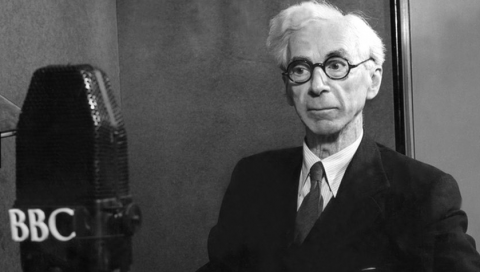
Back in 1948, Britain was making another difficult transition, moving from the trauma of World War II to the chill of the Cold War. Hoping to give radio listeners some clarity on contemporary affairs, the BBC began airing an annual series of lectures — the Reith Lectures — that featured leading thinkers of the day. 60 years later, the tradition continues, and during this long stretch, some legendary figures have graced the BBC’s airwaves: Michael Sandel, Edward Said, John Searle, John Kenneth Galbraith, George Kennan, and Robert Oppenheimer, just to name a few. (And, yes, the list unfortunately skews heavily male.)
Late last month, the BBC put the complete audio archive online, which gives you access to 240 lectures in total. Where’s the best place to start? How about at the beginning, with the inaugural lectures presented by philosopher Bertrand Russell in 1948. His lecture series, Authority and the Individual, delved into an age old question in political philosophy — the individual and his/her relationship with communities and states. The head of the BBC later groused that Russell spoke “too quickly and had a bad voice.” But the real complaints came from the Soviets, who interpreted Russell’s lectures as an attack on Communism. You can find the lectures here; the first lecture appears at the bottom of the page.
Note: Our Twitter friends around the world said that they could almost universally access the lectures. If you experience any geo-restricting, we apologize in advance.
Hot on the heels of Independence Day, here’s a chance to listen to one of America’s best writers declaring his own form of Independence — a freedom from some of the more troubling assumptions embedded in the English language. Starting with a dry, mild questioning of phrases like “black as night,” “black-hearted,” and “black as sin,” Baldwin turns quickly to a critique of the name of the civil rights movement itself, which he suggests would be more accurately described as a slave rebellion.
The logic and eloquence with which Baldwin makes his case is much better savored than explained. Enjoy the clip, and especially make sure not to miss his remarks on Huck Finn at minute 3:00, or the lovely description of Malcolm X at about minute 5:00. And, to be sure, we’ll add this to our collection of Cultural Icons.
Sheerly Avni is a San Francisco-based arts and culture writer. Her work has appeared in Salon, LA Weekly, Mother Jones, and many other publications. You can follow her on twitter at @sheerly.
The world’s first video game, OXO, was invented in 1952. As the title suggests, it was simple tic-tac-toe, and you could only play it on the EDSAC computer at the University of Cambridge. (Watch it in action here.) The fun didn’t really get started until the late 1960’s, when Robert Baer, Bill Harrison and Bill Rusch developed a ping pong game you could play on your television. The above video shows Baer and Harrison playing the game on the “brown box” — the prototype for the computer consoles that would make the 70s and 80s such wonderful, sedentary decades to be a child.
Sheerly Avni is a San Francisco-based arts and culture writer. Her work has appeared in Salon, LA Weekly, Mother Jones, and many other publications. You can follow her on twitter at @sheerly.
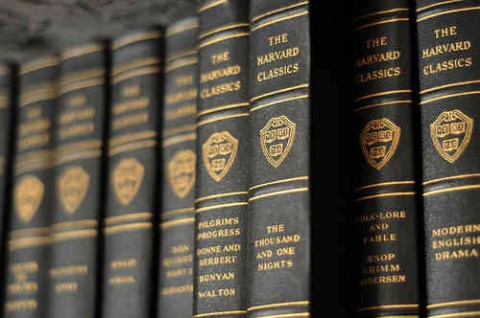
During his days as Harvard’s influential president, Charles W. Eliot made a frequent assertion: If you were to spend just 15 minutes a day reading the right books, a quantity that could fit on a five foot shelf, you could give yourself a proper liberal education. The publisher P. F. Collier and Son loved the idea and asked Eliot to assemble the right collection of works. The result wasa 51-volume series published in 1909 called Dr. Eliot’s Five Foot Shelf. Later it would simply be called The Harvard Classics.
Texts in the Harvard Classics collection (courtesy of Wikipedia):
Vol. 1: FRANKLIN, WOOLMAN, PENN
His Autobiography, by Benjamin Franklin
The Journal of John Woolman, by John Woolman (1774 and subsequent editions)
Fruits of Solitude, by William Penn
Vol. 2. PLATO, EPICTETUS, MARCUS AURELIUS
The Apology, Phaedo, and Crito, by Plato
The Golden Sayings, by Epictetus
The Meditations, by Marcus Aurelius
Vol. 3. BACON, MILTON’S PROSE, THOS. BROWNE
Essays, Civil and Moral, and New Atlantis, by Francis Bacon
Areopagitica and Tractate of Education, by John Milton
Religio Medici, by Sir Thomas Browne
Vol. 4. COMPLETE POEMS IN ENGLISH, MILTON
Complete poems written in English, by John Milton
Vol. 5. ESSAYS AND ENGLISH TRAITS, EMERSON
Essays and English Traits, by Ralph Waldo Emerson
Vol. 6. POEMS AND SONGS, BURNS
Poems and songs, by Robert Burns
Vol. 7. CONFESSIONS OF ST. AUGUSTINE, IMITATIONS OF CHRIST
The Confessions, by Saint Augustine
The Imitation of Christ, by Thomas á Kempis
Vol. 8. NINE GREEK DRAMAS
Agamemnon, The Libation Bearers, The Furies, and Prometheus Bound, by Aeschylus
Oedipus the King and Antigone, by Sophocles
Hippolytus and The Bacchae, by Euripides
The Frogs, by Aristophanes
Vol. 9. LETTERS AND TREATISES OF CICERO AND PLINY
On Friendship, On Old Age, and letters, by Cicero
Letters, by Pliny the Younger
Vol. 10. WEALTH OF NATIONS, ADAM SMITH
The Wealth of Nations, by Adam Smith
Vol. 11. ORIGIN OF SPECIES, DARWIN
The Origin of Species, by Charles Darwin
Vol. 12. PLUTARCH’S LIVES
Lives, by Plutarch
Vol. 13. AENEID, VIRGIL
Aeneid, by Virgil
Vol. 14. DON QUIXOTE, PART 1, CERVANTES
Don Quixote, part 1, by Cervantes
Vol. 15. PILGRIM’S PROGRESS, DONNE & HERBERT, BUNYAN, WALTON
The Pilgrim’s Progress, by John Bunyan
The Lives of Donne and Herbert, by Izaak Walton
Vol. 16. THE THOUSAND AND ONE NIGHTS
Stories from the Thousand and One Nights
Vol. 17. FOLKLORE AND FABLE, AESOP, GRIMM, ANDERSON
Fables, by Aesop
Children’s and Household Tales, by Jacob and Wilhelm Grimm
Tales, by Hans Christian Andersen
Vol. 18. MODERN ENGLISH DRAMA
All for Love, by John Dryden
The School for Scandal, by Richard Brinsley Sheridan
She Stoops to Conquer, by Oliver Goldsmith
The Cenci, by Percy Bysshe Shelley
A Blot in the ‘Scutcheon, by Robert Browning
Manfred, by Lord Byron
Vol. 19. FAUST, EGMONT, ETC. DOCTOR FAUSTUS, GOETHE, MARLOWE
Faust, part 1, Egmont, and Hermann and Dorothea, by Johann Wolfgang von Goethe
Dr. Faustus, by Christopher Marlowe
Vol. 20. THE DIVINE COMEDY, DANTE
The Divine Comedy, by Dante Alighieri
Vol. 21. I PROMESSI SPOSI, MANZONI
I Promessi Sposi, by Alessandro Manzoni
Vol. 22. THE ODYSSEY, HOMER
The Odyssey, by Homer
Vol. 23. TWO YEARS BEFORE THE MAST, DANA
Two Years Before the Mast, by Richard Henry Dana, Jr.
Vol. 24. ON THE SUBLIME, FRENCH REVOLUTION, ETC., BURKE
On Taste, On the Sublime and Beautiful, Reflections on the French Revolution, and A Letter to a Noble Lord, by Edmund Burke
Vol. 25. AUTOBIOGRAPHY, ETC., ESSAYS AND ADDRESSES, J.S. MILL, T. CARLYLE
Autobiography and On Liberty, by John Stuart Mill
Characteristics, Inaugural Address at Edinburgh, and Sir Walter Scott, by Thomas Carlyle
Vol. 26. CONTINENTAL DRAMA
Life is a Dream, by Pedro Calderón de la Barca
Polyeucte, by Pierre Corneille
Phèdre, by Jean Racine
Tartuffe, by Molière
Minna von Barnhelm, by Gotthold Ephraim Lessing
William Tell, by Friedrich von Schiller
Vol. 27. ENGLISH ESSAYS: SIDNEY TO MACAULAY
Vol. 28. ESSAYS: ENGLISH AND AMERICAN
Vol. 29. VOYAGE OF THE BEAGLE, DARWIN
The Voyage of the Beagle, by Charles Darwin
Vol. 30. FARADAY, HELMHOLTZ, KELVIN, NEWCOMB, ETC
The Forces of Matter and The Chemical History of a Candle, by Michael Faraday
On the Conservation of Force and Ice and Glaciers, by Hermann von Helmholtz
The Wave Theory of Light and The Tides, by Lord Kelvin
The Extent of the Universe, by Simon Newcomb
Geographical Evolution, by Sir Archibald Geikie
Vol. 31. AUTOBIOGRAPHY, BENVENUTO CELLINI
The Autobiography of Benvenuto Cellini
Vol. 32. LITERARY AND PHILOSOPHICAL ESSAYS
Essays, by Michel Eyquem de Montaigne
Montaigne and What is a Classic?, by Charles Augustin Sainte-Beuve
The Poetry of the Celtic Races, by Ernest Renan
The Education of the Human Race, by Gotthold Ephraim Lessing
Letters upon the Aesthetic Education of Man, by Friedrich von Schiller
Fundamental Principles of the Metaphysic of Morals, by Immanuel Kant
Byron and Goethe, by Giuseppe Mazzini
Vol. 33. VOYAGES AND TRAVELS
An account of Egypt from The Histories, by Herodotus
Germany, by Tacitus
Sir Francis Drake Revived, by Philip Nichols
Sir Francis Drake’s Famous Voyage Round the World, by Francis Pretty
Drake’s Great Armada, by Captain Walter Bigges
Sir Humphrey Gilbert’s Voyage to Newfoundland, by Edward Haies
The Discovery of Guiana, by Sir Walter Raleigh
Vol. 34. FRENCH AND ENGLISH PHILOSOPHERS, DESCARTES, VOLTAIRE, ROUSSEAU, HOBBES
Discourse on Method, by René Descartes
Letters on the English, by Voltaire
On the Inequality among Mankind and Profession of Faith of a Savoyard Vicar, by Jean Jacques Rousseau
Of Man, Being the First Part of Leviathan, by Thomas Hobbes
Vol. 35. CHRONICLE AND ROMANCE, FROISSART, MALORY, HOLINSHEAD
Chronicles, by Jean Froissart
The Holy Grail, by Sir Thomas Malory
A Description of Elizabethan England, by William Harrison
Vol. 36. MACHIAVELLI, MORE, LUTHER
The Prince, by Niccolò Machiavelli
The Life of Sir Thomas More, by William Roper
Utopia, by Sir Thomas More
The Ninety-Five Theses, To the Christian Nobility of the German Nation, and On the Freedom of a Christian, by Martin Luther
Vol. 37. LOCKE, BERKELEY, HUME
Some Thoughts Concerning Education, by John Locke
Three Dialogues Between Hylas and Philonous in Opposition to Sceptics and Atheists, by George Berkeley
An Enquiry Concerning Human Understanding, by David Hume
Vol. 38. HARVEY, JENNER, LISTER, PASTEUR
The Oath of Hippocrates
Journeys in Diverse Places, by Ambroise Paré
On the Motion of the Heart and Blood in Animals, by William Harvey
The Three Original Publications on Vaccination Against Smallpox, by Edward Jenner
The Contagiousness of Puerperal Fever, by Oliver Wendell Holmes
On the Antiseptic Principle of the Practice of Surgery, by Joseph Lister
Scientific papers, by Louis Pasteur
Scientific papers, by Charles Lyell
Vol. 39. FAMOUS PREFACES
Vol. 40. ENGLISH POETRY 1: CHAUCER TO GRAY
Vol. 41. ENGLISH POETRY 2: COLLINS TO FITZGERALD
Vol. 42. ENGLISH POETRY 3: TENNYSON TO WHITMAN
Vol. 43. AMERICAN HISTORICAL DOCUMENTS
Vol. 44. SACRED WRITINGS 1
Confucian: The sayings of Confucius
Hebrew: Job, Psalms, and Ecclesiastes
Christian I: Luke and Acts
Vol. 45. SACRED WRITINGS 2
Christian II: Corinthians I and II and hymns
Buddhist: Writings
Hindu: The Bhagavad-Gita
Mohammedan: Chapters from the Koran
Vol. 46. ELIZABETHAN DRAMA 1
Edward the Second, by Christopher Marlowe
Hamlet, King Lear, Macbeth, and The Tempest, by William Shakespeare
Vol. 47. ELIZABETHAN DRAMA 2
The Shoemaker’s Holiday, by Thomas Dekker
The Alchemist, by Ben Jonson
Philaster, by Beaumont and Fletcher
The Duchess of Malfi, by John Webster
A New Way to Pay Old Debts, by Philip Massinger
Vol. 48. THOUGHTS AND MINOR WORKS, PASCAL
Thoughts, letters, and minor works, by Blaise Pascal
Vol. 49. EPIC AND SAGA
Beowulf
The Song of Roland
The Destruction of Dá Derga’s Hostel
The Story of the Volsungs and Niblungs
Vol. 50. INTRODUCTION, READER’S GUIDE, INDEXES
Vol. 51. LECTURES
The last volume contains sixty lectures introducing and summarizing the covered fields: history, poetry, natural science, philosophy, biography, prose fiction, criticism and the essay, education, political science, drama, travelogues, and religion.
We're hoping to rely on loyal readers, rather than erratic ads. Please click the Donate button and support Open Culture. You can use Paypal, Venmo, Patreon, even Crypto! We thank you!
Open Culture scours the web for the best educational media. We find the free courses and audio books you need, the language lessons & educational videos you want, and plenty of enlightenment in between.