A hundred years ago, the organizers of the Tour de France took riders high into mountains for the very first time. And, from there, the mystique of the Tour de France grew and grew. To commemorate this occasion, a group of modern day riders retraced the same route through the Pyrenees, which includes some legendary climbs: the Col de Peyresourde, the Col d’Aspin, the Col du Tourmalet, the Col du Soulor, etc. The weather conditions are slightly tough for these riders, but their bikes are light and modern, and the gearing much more forgiving than what their forebears had. Meanwhile the film documenting their ride is a pleasure to watch. The runtime is about 15 minutes.
Running from 1968 to 1982, “The Dick Cavett Show” sometimes brought heady culture to the American airwaves. In this particular case, Cavett gave Americans a close up view of Ingmar Bergman, the influential Swedish director so admired by Woody Allen. (Allen once called Bergman “probably the greatest film artist, all things considered, since the invention of the motion picture camera.”) Cavett’s wide-ranging, 60 minute interview appears above. Thanks Roberta for the lead on this one.
If you would like to sign up for Open Culture’s free email newsletter, please find it here. It’s a great way to see our new posts, all bundled in one email, each day.
If you would like to support the mission of Open Culture, consider making a donation to our site. It’s hard to rely 100% on ads, and your contributions will help us continue providing the best free cultural and educational materials to learners everywhere. You can contribute through PayPal, Patreon, and Venmo (@openculture). Thanks!
Take The Who’s “Won’t Get Fooled Again” from 1971. Now break it down, separating out the tracks instrument by instrument, and you get some insight into how rock ‘n roll anthems come together. Above, we have Keith Moon’s driving drum track. Then Pete Townshend playing the power chords on guitar (plus some synthesizer); John Entwistle thumping out the bass; and Roger Daltrey on vocals. Put them back together and the whole becomes greater than the sum of the parts.
In July 1945, J. Robert Oppenheimer, a theoretical physicist from UC Berkeley, saw his work on the Manhattan Project culminate with the test of the first nuclear bomb. The genie was let out of the bottle, and, ever since then, world leaders have been trying to put the genie back in … with great difficulty. The new documentary Countdown to Zero, which premiered at Sundance earlier this year, traces the history of the atomic bomb and makes the case for worldwide nuclear disarmament – a timely issue given that the US Senate has been debating the New Strategic Arms Reduction Treaty (aka New START). The “featurette” above, excerpted from the film, gives you a quick and somewhat haunting introduction to Oppenheimer, the man behind the bomb.
If you would like to sign up for Open Culture’s free email newsletter, please find it here. It’s a great way to see our new posts, all bundled in one email, each day.
If you would like to support the mission of Open Culture, consider making a donation to our site. It’s hard to rely 100% on ads, and your contributions will help us continue providing the best free cultural and educational materials to learners everywhere. You can contribute through PayPal, Patreon, and Venmo (@openculture). Thanks!
Every now and then, we like to present vintage clips of great authors reading classic literary works – works they have often written themselves. These clips can be fairly revealing. Through them, you can recapture the voices of literary greats, most long since passed. And you can hear how they give character and expression to their own works … or those of others. In response to a reader’s request, we have pulled together some of the finest examples previously featured here. And, for good measure, we’ve added prime clips of famous celebrities giving literary readings too. Hope you enjoy (and share):
First published in The Atlantic Monthly in February 1940, “A Worn Path” is perhaps Eudora Welty’s most prized piece of short fiction. In this video, Welty talks with dramatist Beth Henley about the writing of the famous short story. The two women, it’s worth noting, share a good deal in common. Both are Pulitzer Prize winners who have their common roots in Jackson, Mississippi. Thanks to Mike S. for sending our way…
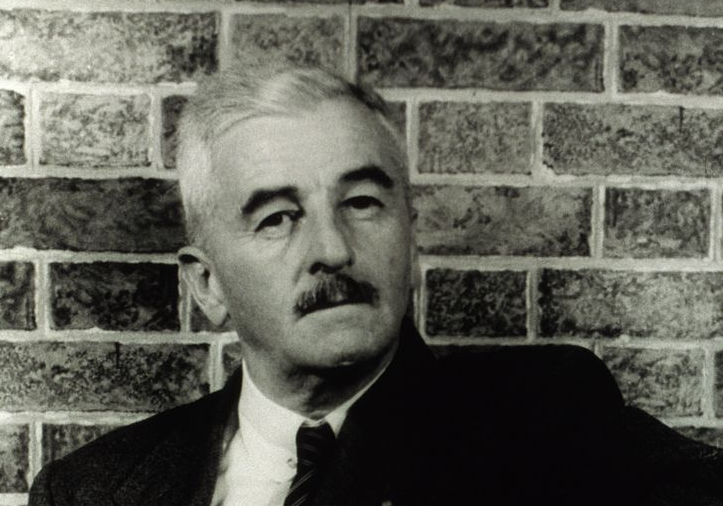
In 1957 and 1958, the great American writer William Faulkner spent two years as Writer-in-Residence at the University of Virginia. During this stint, he presented several public speeches, gave many readings from his literary works, spoke at countless public events, and answered questions from hundreds of students. The talks were originally recorded on reel-to-reel tapes, and now UVA has digitized the audio collection and made it available through a new web site: Faulkner at Virginia: An Audio Archive. In total, the archive presents 1690 minutes (over 28 hours) of Faulkner recordings. It also includes an archive of photos and newspaper items, as well as an audio recording of a press conference the English department gave when Faulkner died on July 6, 1962. A real treasure. You can dive into the audio trove right here.
Note: To access the audio, you will need a QuickTime player. If your browser doesn’t already support QuickTime, you can download a free QuickTime plug-in here.
When playing a concert in San Francisco in July 2010, Paul McCartney recalled for his audience how the Beatles released Sgt. Pepper’s Lonely Hearts Club Band in June, 1967. The album came out on a Friday, and by Sunday night, Jimi Hendrix learned the songs and opened his own show with a cover of the title track. It would have looked something like this. Watch above. And watch out for your ears!
Yesterday, we told you where to find Andrei Tarkovsky’s great films online. Meanwhile, over at Brain Pickings, we wrote a guest piece highlighting where you can watch 15 films (all free, of course) directed by Alfred Hitchcock and Fritz Lang, two great directors whose careers moved in parallel from the silent era, to sound movies, and from Europe to Hollywood. Along the way you will encounter some landmark films – Metropolis, The 39 Steps, The Lodger, and M, to name a few. These movies (all in the public domain) and nearly 200 others reside in our collection of Free Movies.
The Civil War was a watershed moment in US history, and it figures centrally in any American history curriculum. If you missed this course during high school or college, not to worry. Now, thanks to Yale University, you can revisit this historical moment with Prof. David Blight, one of the nation’s leading Civil War scholars. The Civil War and Reconstruction “explores the causes, course, and consequences of the American Civil War, from the 1840s to 1877,” looking at how the United States was transformed on multiple levels: racially, socially, politically, constitutionally and morally. You can access the 27 free lectures, presented in audio and video, via YouTube, iTunes, and the Yale web site (plus a syllabus). We also have it on the list of our Free History Courses, a subset of our collection 1,700 Free Online Courses from Top Universities.
If you would like to sign up for Open Culture’s free email newsletter, please find it here. It’s a great way to see our new posts, all bundled in one email, each day.
If you would like to support the mission of Open Culture, consider making a donation to our site. It’s hard to rely 100% on ads, and your contributions will help us continue providing the best free cultural and educational materials to learners everywhere. You can contribute through PayPal, Patreon, and Venmo (@openculture). Thanks!
We're hoping to rely on loyal readers, rather than erratic ads. Please click the Donate button and support Open Culture. You can use Paypal, Venmo, Patreon, even Crypto! We thank you!
Open Culture scours the web for the best educational media. We find the free courses and audio books you need, the language lessons & educational videos you want, and plenty of enlightenment in between.