This short film is best watched in full screen mode. Just click here to expand.
Thanks to Yoni for sending this one along. If you have a great piece of open culture to share with your fellow readers, feel free to contact us any time.
This short film is best watched in full screen mode. Just click here to expand.
Thanks to Yoni for sending this one along. If you have a great piece of open culture to share with your fellow readers, feel free to contact us any time.
Recently a friend of John Meroney at The Atlantic discovered this 1954 episode of General Electric Theater featuring Ronald Reagan and James Dean.
Dean’s performance is superb, and the episode (edited to 6 minutes) is a parable of the cultural tensions of the time — with drugged up, beatnik delinquents invading the home of a decent couple to subject them at gunpoint to jazz and slang: “man,” “fake it, Dad,” “you dig me,” “that’s crazy,” “don’t goof on me now.” It’s a quite fitting scene, especially given that Reagan went on to be the icon of the conservative movement, while Dean became emblematic of the rebellious youth culture to which Reagan’s movement was a reaction. But while the overt moral lesson of this episode is anti-rebel, there’s no doubt that powerful depictions like these–in which Dean’s expressiveness is as charismatic as it is frightening–only contributed to making rebellion cool.
Wes Alwan lives in Boston, Massachusetts, where he works as a writer and researcher and attends the Institute for the Study of Psychoanalysis and Culture. He also participates in The Partially Examined Life, a podcast consisting of informal discussions about philosophical texts by three philosophy graduate school dropouts.
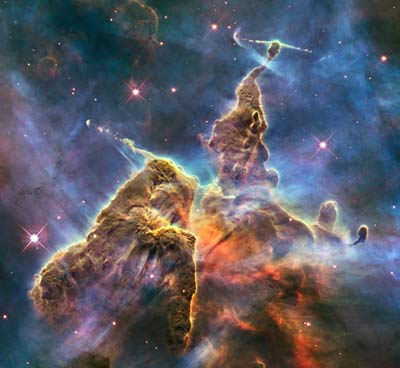 20 years ago (April 24, 1990) the Hubble Space Telescope was launched, beginning a long period of discovery. Today, NASA is celebrating the Hubble’s 20th anniversary by releasing one of the many brilliant photos taken by the space telescope. The image shows us a small portion of one of the largest star-birth regions in the galaxy, the Carina Nebula. As NASA goes on to describe it:
“Towers of cool hydrogen laced with dust rise from the wall of the nebula. The scene is reminiscent of Hubble’s classic “Pillars of Creation” photo from 1995, but is even more striking in appearance. The image captures the top of a three-light-year-tall pillar of gas and dust that is being eaten away by the brilliant light from nearby bright stars. The pillar is also being pushed apart from within, as infant stars buried inside it fire off jets of gas that can be seen streaming from towering peaks like arrows sailing through the air.”
You can download NASA’s featured photo in various sizes and resolutions here. You can also look through an amazing gallery of Hubble photos sponsored by NASA, plus a beautiful collection by National Geographic’s here. Lastly, NPR has a nice audio slideshow that features astronomers talking about their favorite Hubble images. Thanks @lauraehall for the heads up on that.
Discovery Channel’s Life series has been receiving a lot of rave reviews for its stunning footage of plants and animals. This excerpt showing creeper plants climbing trees lives up to the hype. Leave it to a little time-lapse video–not to mention a voice-over by Oprah Winfrey–to blur the line between plant and animal.
UPDATE: A reader in Europe informed me that this video is apparently being blocked outside of the US. It’s extremely rare that this happens with YouTube videos (I’ve only seen it happen with full movies), but for some reason, it happened here. My apologies. [Dan]
Wes Alwan lives in Boston, Massachusetts, where he works as a writer and researcher and attends the Institute for the Study of Psychoanalysis and Culture. He also participates in The Partially Examined Life, a podcast consisting of informal discussions about philosophical texts by three philosophy graduate school dropouts.
Note: strong language in this video.
You have probably all seen them — the countless parodies of the now famous scene from the 2004 German film, Downfall, which records the last days of Hitler and the Third Reich. Earlier this week, the fun started coming to an end when Constantin Film, holder of the movie’s copyright, asked YouTube to remove the clips for reasons enumerated here. But almost as quickly as YouTube took them down, new ones started to pop up. Above, we have one parody showing Hitler responding violently to the takedown request. And, then, taking an entirely different stance, we see him being the mastermind behind the controversial purging of videos. The meme lives on … for now. Thanks to @wesalwan for the tip here.
For 100+ free movies, including many great classics, see our collection of Free Movies Online.
Great little find by Doug. At an April 19th concert in San Francisco, the Chinese pianist Lang Lang threw his audience a bit of a curveball when he started playing Nikolai Rimsky-Korsakov’s Flight of the Bumblebee on … yup … an iPad. According to The Wall Street Journal, this performance comes preloaded on the Magic Piano App that retails for 99 cents. Thanks Doug for sending this one our way!
via 9to5mac
If you’re looking for some quick insight into Michael Pollan’s bestselling work on food and “our national eating disorder” (The Omnivore’s Dilemma, In Defense of Food, Food Rules, etc.), then you’ll want to spend some time with his 15 minute talk presented at Pop! Tech 2009. The talk gets down to a timely set of questions. How can we, as individuals, eat better? How can we improve our health? And how can we make our food supply more “green” and sustainable. Pollan gives you a quick taste of his thinking here and offers five takeaway tips. Watch above, or download his talk in video or audio from this page.
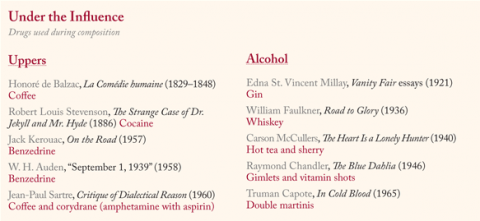 It’s no secret. Many writers have written their masterpieces under the influence of various liquids and chemicals, ranging from fairly innocuous to not. This month, Lapham’s Quarterly has pulled together a list that correlates great works with contributing substances. Here’s a quick sample:
via @kirstinbutler
Google and the Russian Railways recently joined forces to create a virtual tour of the historic Trans-Siberian railroad. It’s the longest railway in the world, moving from Moscow to Vladivostok, cutting across two continents, 12 regions and 87 cities. Now, you can take the six-day journey from the comfort of your own home. Through a special page on Google Maps, you can watch video of the trip unfold, as if you were a passenger, and also enjoy classic Russian literature, music and photos along the way. As you roll out of Moscow, start listening to a free audio version of Tolstoy’s War & Peace (in Russian, of course) and ease into the 150 hour trip. How’s that for an epic virtual journey?
via @6oz
David Remnick won a Pulitzer in 1994 for Lenin’s Tomb: The Last Days of the Soviet Empire. Then, in 1998, he began his successful run as editor-in-chief of the New Yorker magazine. Now, he gives you a long biography (672 pages) of Barack Obama, the first African-American president of the United States. Obama’s personal story is well known, thanks in part to Obama’s own autobiographical account. But, Remnick’s work (which debuted as the #3 bestseller on The New York Times non-fiction list) nonetheless has something new to say. It is exhaustively researched and densely detailed, and adds color in areas missing from other accounts. It also places Obama a bit more squarely within the context of America’s black freedom struggle.
To get a glimpse inside this new work, you’ll want to listen to this interview with David Remnick. It was conducted by Michael Krasny in San Francisco last week. Download the mp3 or grab the iTunes version here. Or simply stream it below. The book, by the way, is available in audio format via Audible.com, and if you try out their 14 day free trial, you can even download the audiobook for free. More info on that here.
Writing in The Guardian, Victor Keegan, a longtime journalist and poet, talks about his new iPhone app, City Poems. The newly released app will run you $2.99 on iTunes, which makes it less than open, I know. (Have you seen our free app, by the way?) But it’s admittedly a pretty nice concept for the cultural crowd, enough to justify giving it a quick mention here. About City Poems, Keegan says:
City Poems – published today – … uses satellite navigation to guide culture vultures and tourists alike through the streets of central London poem by poem. After weeks of researching poems about the city, I realised that you can learn more about the past life of a city from poems than from most guide books and histories. Wherever you are standing in London (or New York for that matter) with an iPhone (or iPod Touch or iPad) in your hand it will tell you how many metres you are away from places and events that poems have been written about.
They include the execution of the criminal Jonathan Wild (one of the inspirations for John Gay’s The Beggar’s Opera), public burnings in Smithfield (“His guts filled a barrel”) or the curious stories behind the statues in Trafalgar Square, which I had passed by in ignorance for many decades…
Like I said, an intriguing concept, and it seems as though Keegan has plans to bring this material to other mobile platforms. You can grab the app on iTunes here.


Open Culture scours the web for the best educational media. We find the free courses and audio books you need, the language lessons & educational videos you want, and plenty of enlightenment in between.

©2006-2026 Open Culture, LLC.
All rights reserved.
