At the Haymarket Bus Station in Newcastle (UK), commuters and passers-by were invited to contribute a note or two to a Beethoven Sonata. Men and women, young and old, people from different walks of life — they all lent a hand and shared in a centuries-old musical tradition. Compared to some of the elaborate flashmob performances we’ve seen, this presentation was rather simple. But, as you know, sometimes less is more.
On Thursday night, I finally understood it — how fans felt back in July 1965, when Bob Dylan strapped on an electric guitar and did sonic violence to the norms and expectations of the Newport Folk Festival. Fans wanted to hear the Bob Dylan they knew and loved — the folk Dylan who played a simple acoustic guitar, harmonica and not much more. But the times were-a-changin, and they got something different, very different. See here.
Almost 50 years later, Dylan keeps giving his fans a different Dylan. When the Never Ending Tour rolled through San Francisco this week, he played songs the fans came to hear — classics like Love Minus Zero/No Limit, Like A Rolling Stone, Tangled Up in Blue, and A Hard Rain’s A‑Gonna Fall. Except he set them to new melodies, and between his gravelly voice and the gravelly sound system, it took some fans minutes to realize what they were listening to. I cite one example above. In how many minutes can you name that tune?
(Note: The song above was originally recorded in Dresden in July. It was also played in SF this past week.)
A milquetoast cashier. A scheming prostitute. Her even harder-scheming boyfriend. The misrepresentation of art. A faked death. A sudden, very real, murder. All of these hard noir elements find their way into Scarlet Street, Fritz Lang’s initially dismissed but several times re-evaluated 1945 crime picture. We remember the Austrian auteur, and rightly so, for such immortal pieces of early 20th-century European cinema as Metropolis, M, and the Dr. Mabuse trilogy.
But from the mid-thirties onward, Lang directed English-language films prolifically, often using novels as source material. You can watch Scarlet Street, a work from that period which has drawn more and more cinephilic attention since its release, free online. Starring Edward G. Robinson as a clothing-store clerk and hapless part-time painter alongside Joan Bennett as his working-girl object of frustrated desire, the film appeared as the second adaptation of Georges de La Fouchardière’s book La Chienne, the first having come from Jean Renoir.
“An uncompromising subversive remake,” critic Dennis Schwartz calls Scarlet Street, “with a particularly acute American accent.” In Cinema Journal, Matthew Bernstein called it “dense, well-structured film noir.” But the picture came in for a critical drubbing at first: the New York Times’ Bosley Crowther called it “a sluggish and manufactured tale,” and Time bemoaned its “painfully obvious story.” But whatever the arguments about the movie’s artistic merit, it clearly touched a nerve with the New York State Censor Board, who banned it on grounds that it “would tend to corrupt morals.“ ‘ The city censor of Atlanta cited “the sordid life it portrayed, the treatment of illicit love, [and] the failure of the characters to receive orthodox punishment from the police,” calling it “licentious, profane, obscure and contrary to the good order of the community.” Does Scarlet Street retain its power to shock? Did Lang craft it with a complexity and elegance not obvious to American audiences of the mid-forties? Click play and find out for yourself.
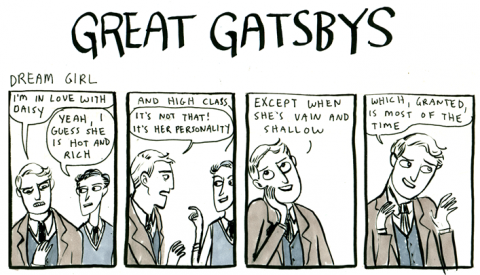
Listen, Old Sport, as far as that Leonardo DiCaprio Gatsby movie goes, I haven’t seen it. But I’ll bet a swimming pool of gin it’s nowhere near as funny as cartoonist Kate Beaton’s 3‑panel takes on F. Scott Fitzgerald’s classic novel.
Of course, F. Scott’s original wasn’t exactly what one would call a knee slapper — whereas Beaton’s comic collection, Hark! A Vagrant, merits a permanent spot in one’s bathroom library. Beaton’s take on The Great Gatsby is by no means a literal adaptation, but her mean-faced, venom-tongued creations get it spiritually right. They also do a number on Bronte, Jane Austen, Nietzsche and Shakespeare’s Julius Caesar, to name but a few of the author’s other literary targets. (See her archive here.) Not bad for a Canadian with degrees in History and Anthropology. Is it wrong to think Zelda would approve?
At any rate, it’s high time someone blew the lid off of what’s behind the eyes of Dr. T.J. Eckelberg. Gratifying, too, to see Tom and Daisy’s child getting some long past due consideration. Now that I think about it, our compulsion to keep beating on boats against the currentis kind of funny. Top drawer stuff, Old Sport, top drawer stuff.
Perhaps you remember the short animated film, I Met the Walrus. It revisits the moment when Jerry Levitan, a 14-year-old kid, slipped into John Lennon’s Toronto hotel room in 1969 and asked the Beatle for an interview. And he got one. The film provides all the proof you need.
Now here’s a nice companion story. It’s the summer of 1966, and 17-year-old Michael Aisner approaches Muhammad Ali, then the heavyweight champion of the world, and asks him to appear on his high school radio show. The kid persists and eventually lands the interview. The audio segment, rarely heard until now, reminds us what makes Ali so charismatic and endearing. The champ answers some of Aisner’s questions seriously. But he also launches into a hilarious riff about how he plans to take a spaceship to Mars, battle the Martian champ (named something like Winnekawanaka) and thereby win the “Universal Title.” Pretty priceless. The complete audio segment appears here.
Follow us on Facebook and Twitter, and share the cultural goodness with your friends!
I’ve seen Shakespeare performed all over the country, from Central Park to Golden Gate Park, and in every kind of adaptation imaginable. By far, the most memorable performance for me was a Noh staging of Othello, in Japanese, with masks and haunting chorus. I didn’t understand a word of it, but I spent the entire performance riveted by the culture shock of watching a play I knew so well transformed by a cultural vocabulary I didn’t. While I’ve sometimes bristled at best-selling literary critic Harold Bloom’s seemingly banal claims about Shakespeare’s “universal genius,” I cannot deny that the Bard’s work seems to translate across time and space without a loss of its incredible power and pathos.
Shakespeare-lovers in London this past spring were treated to a similar experience as mine, magnified by 37. As part of the massive World Shakespeare Festival, the Globe to Globe project presented an unprecedented opportunity for theatergoers to see all 37 of Shakespeare’s plays performed in 37 different languages at the bard’s own theater, the Globe. The plays (watch them here) were staged by some of the world’s top theater directors, with over six-hundred actors from “all nations” and attended by “audiences from every corner of our polyglot community.” In a time when various parts of Europe struggle to come to terms with increasingly multicultural demographics, this festival was an opportunity for a global theater fellowship of actors and audiences to come together in mutual appreciation and camaraderie.
The video above gives us a glimpse of several ceremonial, behind-the-scenes moments; before each performance, a member of the company sprinkled alcohol around the stage as an offering to the god of theater and wine, Dionysus. In a rapid montage, we see a dozen different actors from various plays sprint, skip, dance, and slide across the front of the stage, joyfully pouring libations. Afterward, another actor releases two balloons, one labeled The Globe, the other with the company’s name. The productions, all available to view online, are impressive not only for their linguistic range, but also for the range of costuming and stagecraft on display. Watch, for example, Troilus and Cressida in Maori, with a fierce band of Maori warriors stomping across the stage. Or see The Merry Wives of Windsor in Swahili by Nairobi’s Bitter Pill Company. To my delight, the Japanese production of Corolianus by the Chiten company features actors in Noh masks. As an added bonus, the Globe to Globe site has audio of actors from the various companies discussing their experiences of the festival in both their native languages and in English.
Josh Jones is a doctoral candidate in English at Fordham University and a co-founder and former managing editor of Guernica / A Magazine of Arts and Politics.
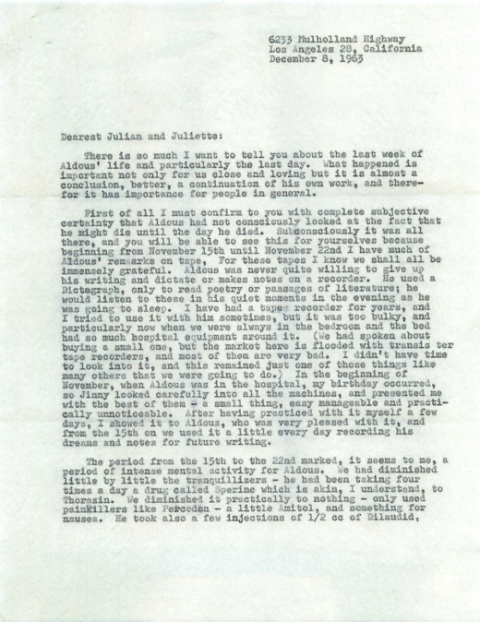
Just over a year ago, we featured a clip of an interview with Laura Archera Huxley, widow of British dystopian novelist and noted psychedelic drug enthusiast Aldous Huxley. When he approached death’s door in 1963, he asked her to give him a dose of “LSD, 100 µg, intramuscular.” If you’ve got to check out, this sounds, by Laura’s description, like one of the preferable ways to do it, or at least a way that aligned closely with Huxley’s convictions. “There was absolutely no jolt, no agitation,” she recalled on camera. “Nothing except this very quiet — like a music that becomes less and less audible. Like fading away. [ … ] There was a beautiful expression in the face. It was a very beautiful expression in the face.” Letters of Note added much detail onto this spare account by posting a letter sent from Laura to Huxley’s brother Julian not long after the writer’s death from laryngeal cancer. One page appears above, and at Letters of Note you can find scans of all of them plus a complete transcript.
“I had the feeling actually that the last hour of breathing was only the conditioned reflex of the body that had been used to doing this for 69 years, millions and millions of times,” wrote Laura. “There was not the feeling that with the last breath, the spirit left. It had just been gently leaving for the last four hours. [ … ] [Everyone attending Huxley] said that this was the most serene, the most beautiful death. Both doctors and nurse said they had never seen a person in similar physical condition going off so completely without pain and without struggle. [ … ] We will never know if all this is only our wishful thinking, or if it is real, but certainly all outward signs and the inner feeling gave indication that it was beautiful and peaceful and easy.” Just above, you’ll find the video we previously posted of Laura’s briefer description of the same events.
So much of what we experience as digital is intangible. The color and texture of the Internet exists only for the time we have that particular site loaded. With just a click of the mouse, the lushness disappears.
Except that it doesn’t, really.
Backstage, every email, photo, YouTube video and document we share lives in a very real place, which is weird when you think about it. These massive data centers are like vaults of ones and zeros, some of which could wreak havoc in the wrong hands but, honestly, most of which will never mean anything again to anybody.
Every time anyone uses a Google product, for example, like conducting a search or looking up directions, their computer talks to one of the world’s most powerful server networks, which are housed in huge data centers. Very few people actually get to see where Google’s servers live. These data centers are high security, for good reason.
The company recently launched Where the Internet Lives, part of a mini campaign to pull back the curtain on how the web works. They hired a photographer to capture eight of their data centers on, well, not really film, but you get the picture. Oh, and the data centers aren’t brick and mortar either. More like glass and drywall and pipes. Lots and lots of pipes.
And like Willie Wonka and his famous factory, Google invited Wired magazine reporter Stephen Levy to visit and write a story about the previously off-limits facilities.
Take a street view tour of the North Carolina data center (and see their “security team” at work). Photographer Connie Zhou’s images are lovely and the facilities are beautiful in an eerie, futuristic way. See how water is used to keep the processors cool, where data is backed up, failed drives destroyed to keep data safe and how workers get around.
It’s a peek behind the scenes, but it’s also marketing. And what’s interesting is that it’s a lot like the automobile industry’s marketing (think of Saturn’s ads in praise of the assembly-line worker) and campaigns by the Big Three to attract auto workers in the 1940s. Some of the photo captions recall the nostalgic, Utopian messaging of the post-War era, when efficient, modern suburban communities were sprouting up around industrial centers. This lunch room looks pretty nice, and the sauna is right outside.
Kate Rix writes about digital culture and education. Visit her work online at katerixwriter
Residents of Los Angeles had a once-in-a-lifetime opportunity last week to see the Space Shuttle Endeavor crawl through the streets of their city. It was a surreal sight. Some folks could even look out their living-room window and see a massive space ship rolling by.
The recently decommissioned shuttle arrived in Los Angeles on September 20, piggybacked on top of a Boeing 747. Last thursday it embarked on an arduous 12-mile journey to its new home at the California Science Center, where it will go on public display beginning October 30. It took three days to make the trip from the airport to Exposition Park as the 85-ton orbiter, with a wingspan of 78 feet, was guided though a number of extremely tight spots atop a computer-controlled transporter operated by NASA. The shuttle arrived at the science center without a scratch on Sunday. The whole operation cost about $10 million.
Ours is a culture driven by, and to, extremes, and by ours I mean Western Democratic Capitalism broadly—Euro-America, one might say. But much of the world also resembles this model. Extremes of wealth and poverty. Extreme amounts of work and extreme amounts of unemployment. Even the word most associated with the crisis of markets conjures an extremism of an earlier, medieval age: Austerities. To get away from it all, we take vacations (more often these days staycations). Vacations from our lives. Or as the Europeans call it, holiday. And who hasn’t once asked themselves, why isn’t life the holiday? And the painful “austerities” temporary inconveniences? I suppose it’s a naïve question, or just a thought experiment. Everyone seems to have some sophisticated answer or other. But everyone still feels the need to escape the exhaustion.
Gisbert, the man in the short film above, felt such a need. So 42 years ago he traveled to the town of Filicudi in the Aeolian Islands, Sicily. He dug a cave into the hillside with his bare hands, reinforced it with cement and lime, and he’s been living there ever since in what he calls, in his coinage, Paradisola, or, mostly just Paradiseland. Gisbert is a student of history, philosophy, physics… he’s no Rousseauean noble savage, ignorant of the ways of modern man. Maybe Thoreau in his Walden, but even Thoreau was an anxious character, always eager to explain himself. No, Gisbert has simply found peace where he is, and he offers no elaborate justification for it. In his own words: “When you start a career, you have to respect everything, because you are responsible. So I thought I could enjoy a vacation, to do whatever I like. And I keep doing so.” Is he “irresponsible” for choosing a life of whatever he likes over a career? This is one question film company We Cross the Line asks us to ponder. Gisbert: Paradisola makes no judgments and offers no answers. It simply shows us the life of a man who made his own choices and lives with them contentedly.
Josh Jones is a doctoral candidate in English at Fordham University and a co-founder and former managing editor of Guernica / A Magazine of Arts and Politics.
50 years ago, the Cuban Missile Crisis put the US and the USSR on a seemingly catastrophic collision course. As the crisis played out, both sides feared the worst — that the long-simmering Cold War might suddenly turn hot, nuclear hot. Mercifully, after 13 days, cooler heads prevailed.
Now, on the 50th anniversary of the crisis, the John F. Kennedy Presidential Library & Museum has released an interactive documentary called Clouds Over Cuba. Narrated by actor Matthew Modine, the film vividly explains the events before, during and after the historic crisis. As the story unfolds, the documentary prompts viewers to access an impressive amount of historical documents (photos, documents, audio recordings, etc.) that add real texture to the story. Clouds Over Cubaiseducational. It’s impressively put together. You can watch the trailer above, or start watching the complete film right here.
We're hoping to rely on loyal readers, rather than erratic ads. Please click the Donate button and support Open Culture. You can use Paypal, Venmo, Patreon, even Crypto! We thank you!
Open Culture scours the web for the best educational media. We find the free courses and audio books you need, the language lessons & educational videos you want, and plenty of enlightenment in between.