From MIT comes a free introductory undergraduate course on Microeconomics. Taught by Professor Jonathan Gruber, the 26-lecture course covers the fundamentals of microeconomics, including “supply and demand, market equilibrium, consumer theory, production and the behavior of firms, monopoly, oligopoly, welfare economics, public goods, and externalities.” Watch the lectures above (or on YouTube). Find the syllabus and lectures notes on MIT’s site. Coursera also offers a host of other econ courses.
If you would like to support the mission of Open Culture, consider making a donation to our site. It’s hard to rely 100% on ads, and your contributions will help us continue providing the best free cultural and educational materials to learners everywhere. You can contribute through PayPal, Patreon, and Venmo (@openculture). Thanks!
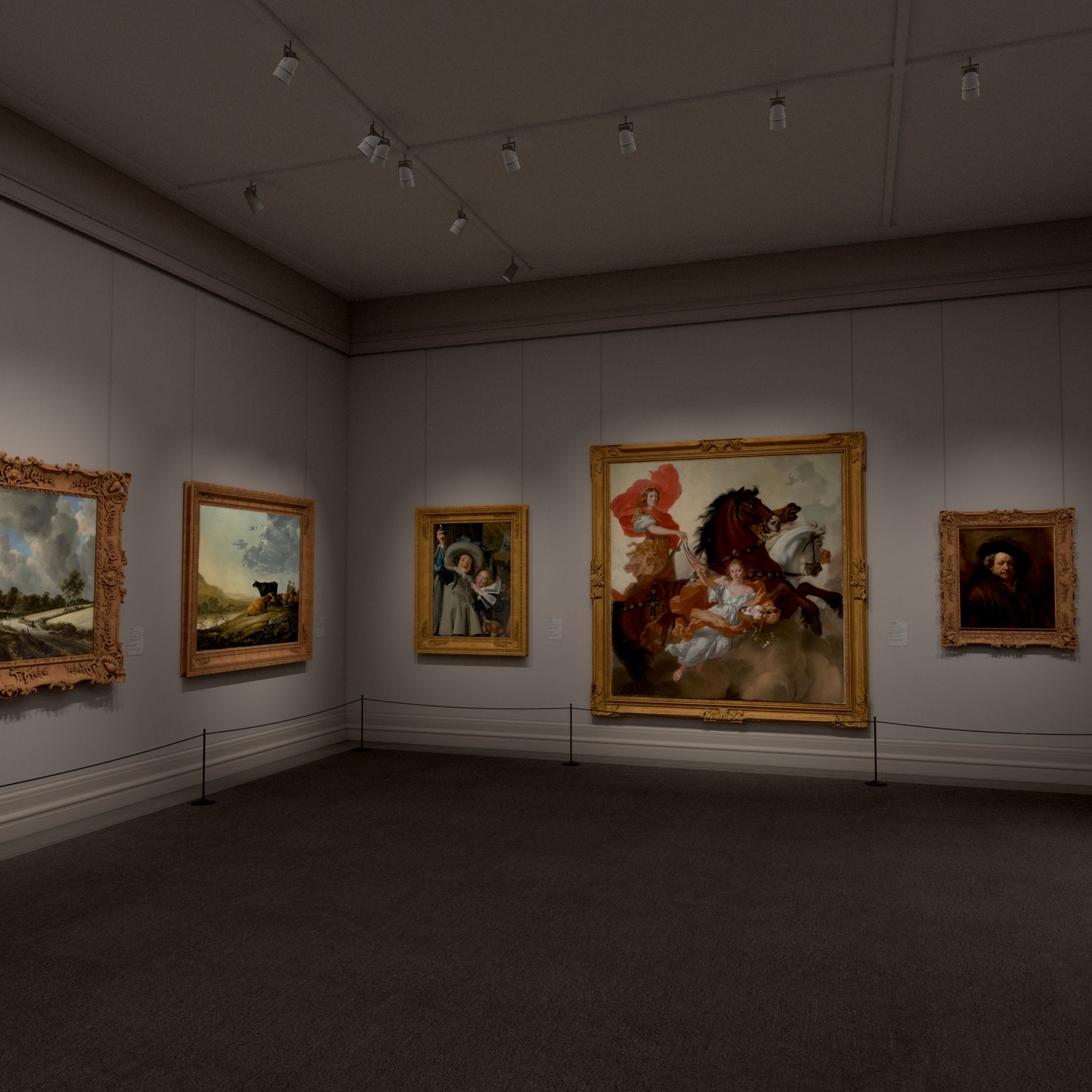
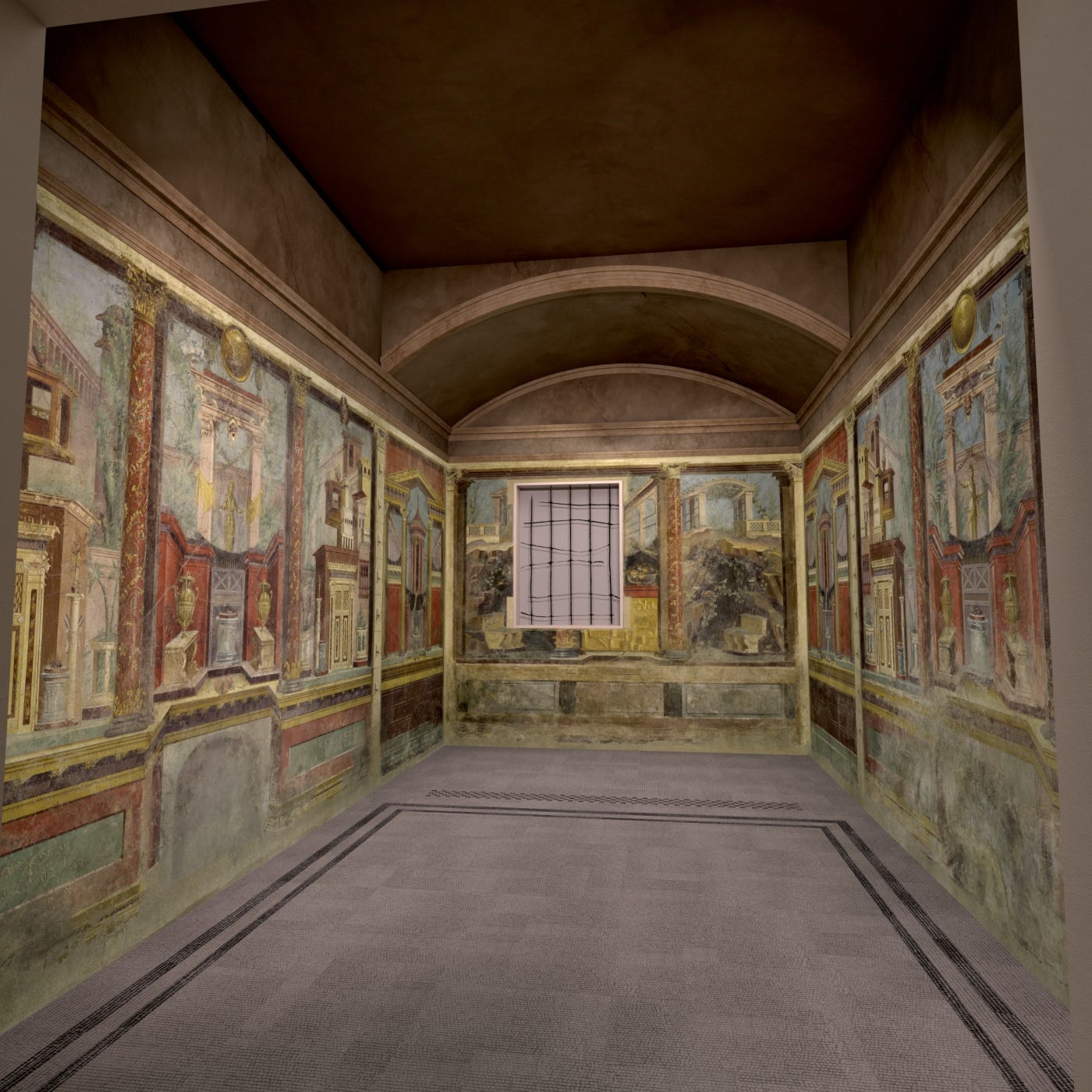
You can go to the Metropolitan Museum of Art today, and in real life at that. This isn’t true of all the world’s great art institutions, still shut down as many are by measures in response to the past year’s coronavirus pandemic. But then, none of them have offered a digital visiting experience quite like The Met Unframed, recently launched in partnership with cellphone service provider Verizon. For a period of five weeks, anyone can join and freely roam a virtual reconstruction, or rather reimagining, of the Met and its galleries. There they’ll encounter paintings by Pollock, Van Gogh, and Rembrandt, as well as work by current artists and majestic artifacts from antiquity.
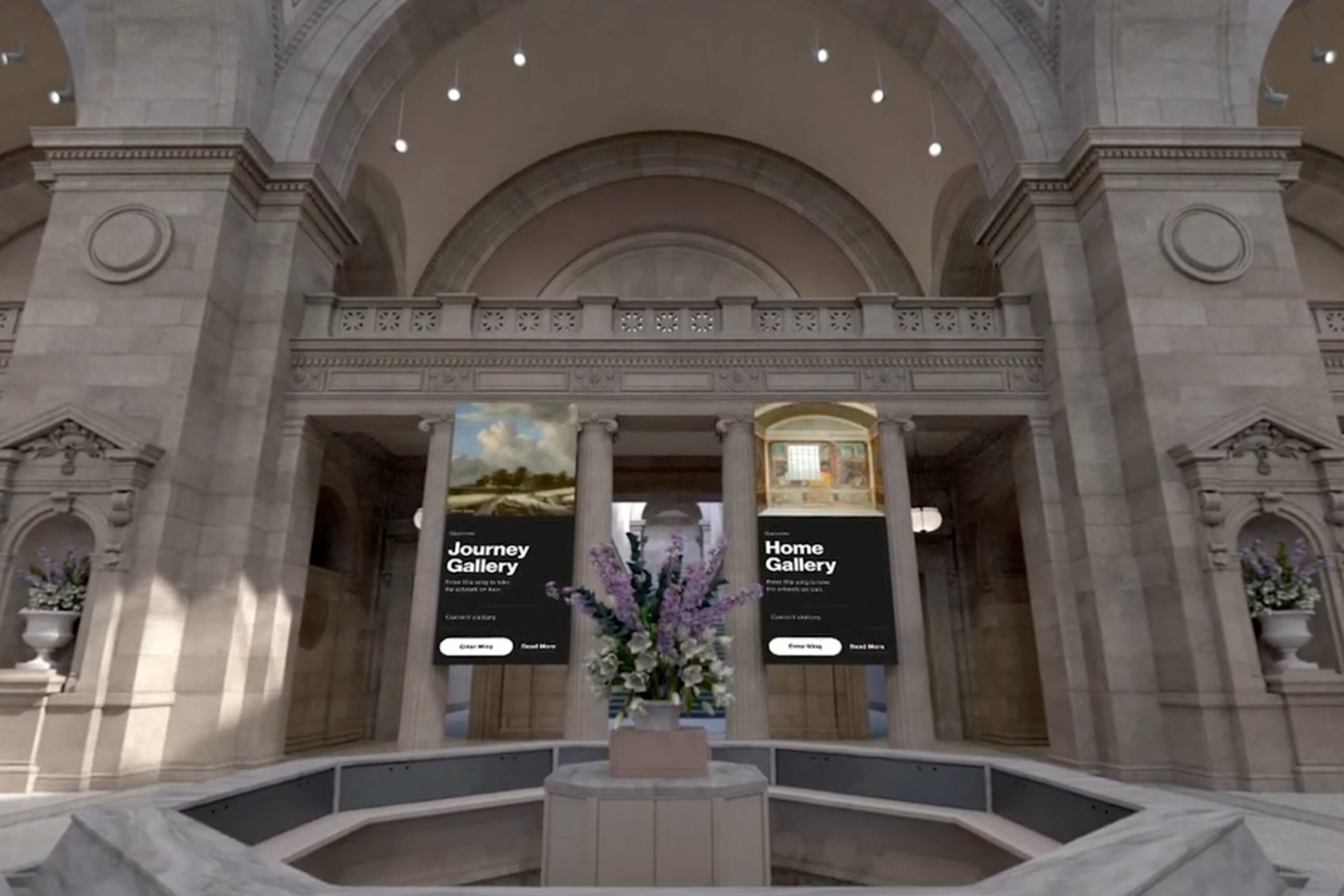
“Upon entering the website, visitors are welcomed to the museum’s Great Hall with a view of Kent Monkman’s diptych mistikôsiwak: Wooden Boat People (2019),” writes Hyperallergic’s Hakim Bishara. “From there, banners offer broad thematic concepts — Power, Home, Nature, and Journey — through which visitors can explore the galleries.”
Embedded in certain pieces of art, you’ll find not just historical details and audio-tour explanations but mini-games, which “include trivia questions and riddles that encourage close observation of the artworks and labels. A game called ‘Analysis’ uses the Met’s infrared and X‑ray conservation scans of paintings to reveal underdrawings and other hidden details of well-known paintings.”
Win enough such games, and you’ll get the chance to “borrow” the artwork you’ve clicked to display, through augmented reality, in your space of choice — for fifteen minutes, at least. At Artnet, critic Ben Davis writes of placing here and there around his apartment Frederic Edwin Church’s Heart of the Andes, Jacob Lawrence’s The Photographer, and a Baby Yoda-scaled version of Rembrandt’s Self-Portrait. He even makes a serious if ultimately frustrated effort to win digital borrowing rights to the ancient Egyptian Temple of Dendur, one of the Met’s pièces de résistance since the late 1970s.
To experience The Met Unframed for yourself, just head over to its web site and use your phone to scan the QR code that comes up (if you’re not browsing on your phone in the first place). You’ll then be taken straight to the virtual Great Hall, which you can navigate by swiping in any direction — or physically moving your phone around, if you’ve enabled gyroscope mode — and tapping the icons glowing along the ground or on the walls. The combination of high technology, historical reference, depopulated but elegantly designed settings, puzzle challenges, and a score in which synthesizers meet ambient noise will remind visitors of a certain age of nothing so much as the adventure games of the early 1990s, especially Myst and its clones. But then, what does a museum do if not unite the past and the present?
Based in Seoul, Colin Marshall writes and broadcasts on cities, language, and culture. His projects include the Substack newsletterBooks on Cities, the book The Stateless City: a Walk through 21st-Century Los Angeles and the video series The City in Cinema. Follow him on Twitter at @colinmarshall, on Facebook, or on Instagram.
Apparently, the Monastery of Alcobaça’s resident monks were eating plenty of other things, too.
Eventually their reputation for excessive plumpness became problematic.
A hefty physique may have signified prosperity and health in 1178 when construction began on the UNESCO World Heritage site, but by the 18th-century, those extra rolls of flesh were considered at odds with the Cistercian monks’ vows of obedience, poverty and chastity.
Its larders were well stocked, thanks in part to the rich farmland surrounding the monastery.
On one side, loads of game and venison were heaped up; on the other, vegetables and fruit in endless variety. Beyond a long line of stoves extended a row of ovens, and close to them hillocks of wheaten flour whiter than snow, rocks of sugar, jars of the purest oil, and pastry in vast abundance, which a numerous tribe of lay brothers and their attendants were rolling out and puffing up into a hundred different shapes, singing all the while as blithely as larks in a corn-field.
Later he has the opportunity to sample some of the dishes issuing from that kitchen:
The banquet itself consisted of not only the most excellent usual fare, but rarities and delicacies of past seasons and distant countries; exquisite sausages, potted lampreys, strange messes from the Brazils, and others still stranger from China (edible birds’ nests and sharks’ fins), dressed after the latest mode of Macao by a Chinese lay brother. Confectionery and fruits were out of the question here; they awaited us in an adjoining still more spacious and sumptuous apartment, to which we retired from the effluvia of viands and sauces.
Later in his travels, he is taken to meet a Spanish princess, who inquires, “How did you leave the fat waddling monks of Alcobaça? I hope you did not run races with them.”
Perhaps such tattle is what convinced the brass that something must be done.
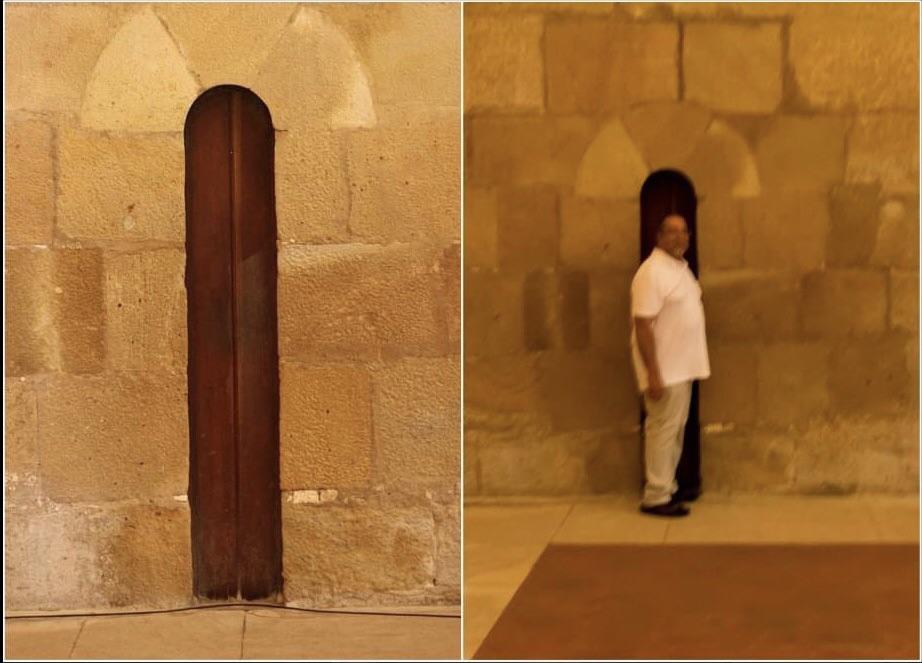
The remedy took the form of a porta pega-gordo (or “fat catcher door”), 6′ 6″ high, but only 12.5” wide.
Allegedly, each monk was required to pass through it from the refectory to the kitchen to fetch his own meal. Those who couldn’t squeeze through were out of luck.
Did they have to sit in the refectory with their faces to the walls, silently eating the sins of the people (respicite quia peccata populi comeditis) while their slimmer brethren filled their bellies, also silently, face-to-the-wall, as a reader read religious texts aloud from a pulpit?
History is a bit unclear on this point, though Beckford’s enthusiasm waned when he got to the refectory:
…a square of seventy or eighty feet, begloomed by dark-coloured painted windows, and disgraced by tables covered with not the cleanest or least unctuous linen in the world.
According to a German Wikipedia entry, the monks passed through the porta pega-gordo monthly, rather than daily, a more manageable mortification of the flesh for those with healthy appetites.
Image via Wikimedia Commons
If you are assembling a bucket list of destinations for when we can travel freely again, consider adding this beautiful Gothic monastery (and the celebrated pastry shop across the street). Your choice whether or not to suck it in for a photo in front of the porta pega-gordo.
Ayun Halliday is an author, illustrator, theater maker and Chief Primatologist of the East Village Inky zine. She most recently appeared as a French Canadian bear who travels to New York City in search of food and meaning in Greg Kotis’ short film, L’Ourse. Follow her @AyunHalliday.
David Lynch is known for being persnickety about delivering the correct viewing experience to his audience, as he considers the cinema a sacred place. In a documentary short a few years back, he explained, “It’s so magical, I don’t know why, to go into a theater and have the lights go down. It’s very quiet and then the curtains start to open. And then you go into a world.”
However, the cinematheque is also the space where directors have the least control. They can hope that each print that goes out has been printed correctly (especially during the days of film), or that the sound is clear and/or loud enough, but, in a wide release, hope is all directors can do most of the time. There are exceptions: Stanley Kubrick oversaw the rerelease prints of his films. And Alfred Hitchcock demanded that there would be no late seating for Psycho-—a tactic that worked to the film’s advantage.
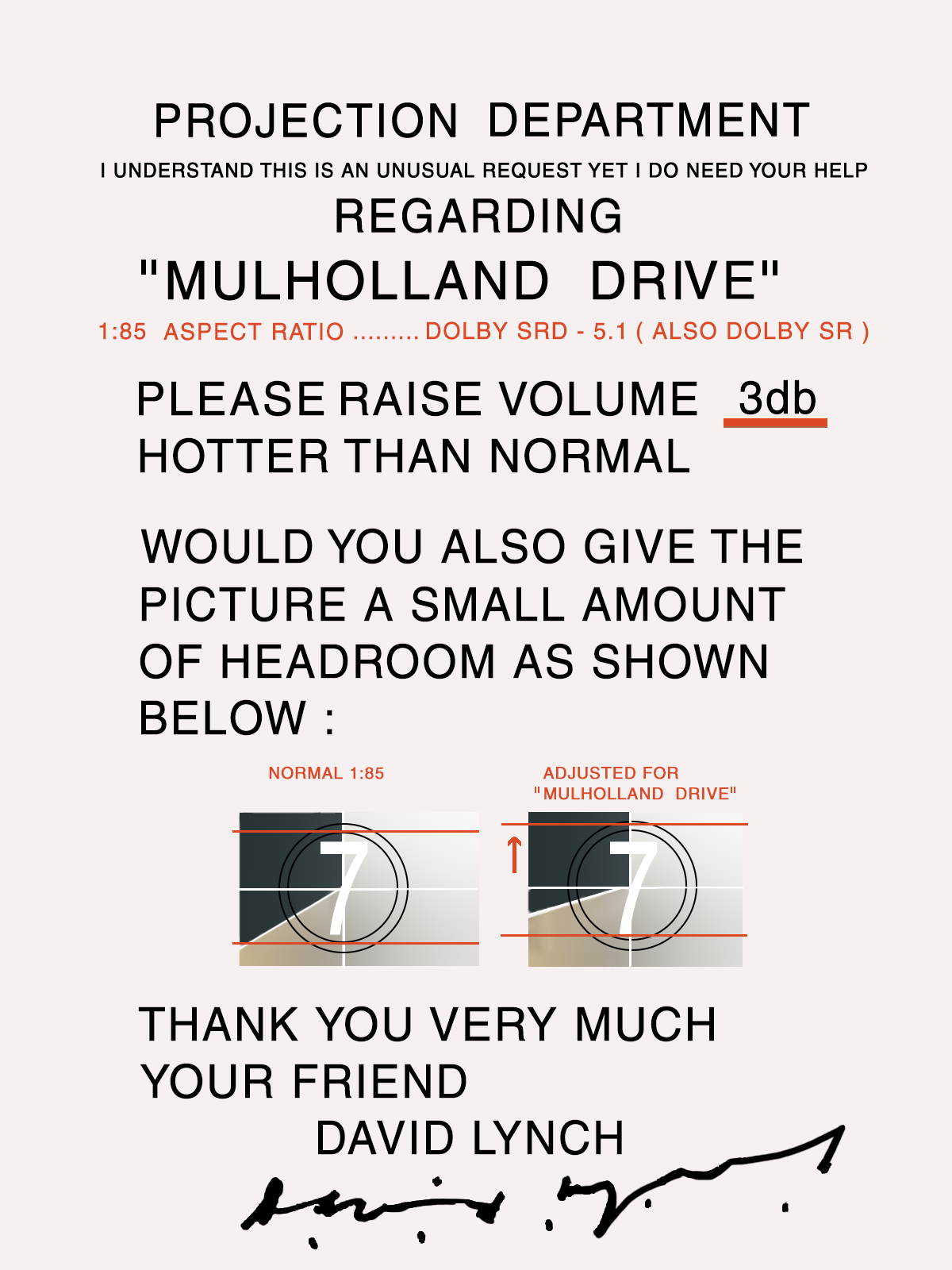
This card (above) from David Lynch came with every print of Mulholland Drive that was sent out to theaters. “I understand this is an unusual request yet I do need your help,” he writes. Lynch asks that the volume be raised 3db and that the image be given a tad more headroom.
John Neff, in a post on the Facebook Lynchland group, explained the card: “The volume request was because when we heard it in the Director’s Guild Theater for the cast and crew screening, David thought it was too quiet. The picture headroom request was because of the original TV aspect ratio. These concerns have been addressed in all format releases since the original DVD release.”
Mulholland Drive was originally shot, or rather, the first half of the film was shot as a television pilot for ABC, so a 16:9 (1.78:1) aspect ratio was expected. But when the studios passed on the pilot, Lynch finished the film as a standalone feature. Cinemas matt projections at 1.85:1, cutting down on the headroom. (None of this effects the original negative, which is standard 35mm.)
Lynch similarly cares about home viewers. The first director-approved box set of his short films came with a similar, Lynch-created calibration video so you could control the color and the white balance. And one of the reasons fans keep waiting for a proper Blu-Ray release of Lost Highway is that Lynch has yet to oversee a proper transfer. When Kino Lorber released theirs in 2019, Lynch took to Twitter to tell fans to skip it: “Dear Twitter Friends, A Blu-ray of LOST HIGHWAY will be released very soon. It was made from old elements and NOT from a restoration of the original negative. I hope that a version from the restoration of the original negative will happen as soon as possible.”
Ted Mills is a freelance writer on the arts who currently hosts the Notes from the Shed podcast and is the producer of KCRW’s Curious Coast. You can also follow him on Twitter at @tedmills, and/or watch his films here.
“Tell me,” said Beloved, smiling a wide happy smile. “Tell me your diamonds.”
The unforgettable portrayal of Beloved, the mysterious, 20-year-old woman (Thandie Newton)—who appears in Sethe’s (Oprah Winfrey) home mysteriously just as the infant ghost haunting the family disappears—leaves an indelible image in the mind’s eye in Jonathan Demme’s 1998 film. We may learn about the history of slavery in the U.S. through a wealth of recovered data and historical sources. But to understand its psychological horrors, and the lingering trauma of its survivors, we must turn to works of the imagination like Beloved.
So why not just watch the movie? It’s excellent, granted, but nothing can take the place of Toni Morrison’s prose. Her “versatility and technical and emotional range appear to know no bounds,” wrote Margaret Atwood in her 1987 review of the novel. “If there were any doubts about her stature as a pre-eminent American novelist, of her own or any other generation, Beloved will put them to rest.” The novel’s American gothic narrative recalls the “magnificent practicality” of haunting in Wuthering Heights. “All the main characters in the book believe in ghosts, so it’s merely natural for this one to be there.”
“Everyone at 124 Bluestone Road,” the Ted-Ed video lesson by Yen Pham begins, “knows their house is haunted. But there’s no mystery about the spirit tormenting them. This ghost is the product of an unspeakable trauma.” Demme’s film dramatizes the horrors Sethe endured, and committed, and tells the story of the Sweet Home plantation and its aftermath upon her family. What it cannot convey is the novel’s treatment of “a barbaric history that hangs over much more than this homestead.”
For this greater resonance, we must turn to Morrison’s book, written, Atwood says, “in an antiminimalist prose that is by turns rich, graceful, eccentric, rough, lyrical, sinuous, colloquial and very much to the point.” The novel brings us into contact with the human experience of enslavement:
Through the different voices and memories of the book, including that of Sethe’s mother, a survivor of the infamous slave-ship crossing, we experience American slavery as it was lived by those who were its objects of exchange, both at its best—which wasn’t very good—and at its worst, which was as bad as can be imagined. Above all, it is seen as one of the most viciously antifamily institutions humans ever devised…. It is a world in which people suddenly vanish and are never seen again, not through accident or covert operation or terrorism, but as a matter of everyday legal policy.”
Morrison’s fictionalizing of the true story of Margaret Garner, an enslaved mother who killed her child rather than let the infant become enslaved to such a future, “points to history on the largest scale, to the global and world-historical,” Pelagia Goulimari writes in a monograph on Morrison. Morrison uses “Garner’s 1856 infanticide—a cause célèbre—as point of access to the ‘Sixty Million and more’: the victims of the Middle Passage and of slavery.”
Perhaps only the novel, and especially the novels of Toni Morrison, can tell world-historical stories through the actions of a few characters: Sethe, Denver, Baby Suggs, Paul D., and Beloved, the angry ghost of a murdered daughter and a desperate mother’s trauma and the traumatic psychic wounds of slavery, returned. Learn more about why you should read Beloved in the animated lesson above, directed by Héloïse Dorsan Rachet, and discover more at the TED-Ed lesson’s additional resources page.
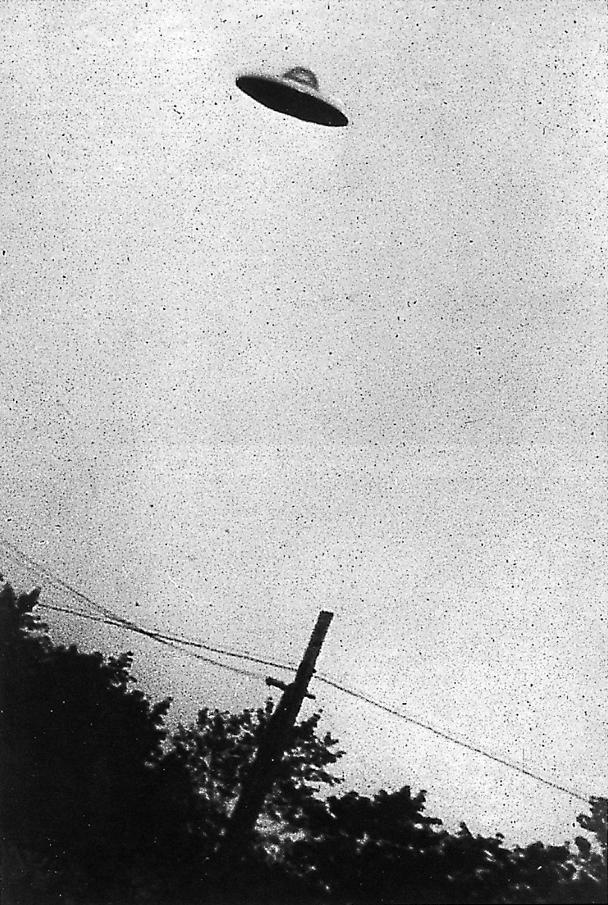
Everybody knows that UFO stands for “unidentified flying object.” Coined by the United States Air Force in 1953, the term has come to stand for a wide range of phenomena that suggest we’ve been contacted by alien civilizations — and in fact has even spawned the field of ufology, dedicated to the investigation of such phenomena. But times change, and with them the approved terminology. These days the U.S. government seems to prefer the abbreviation UAP, which stands for “unidentified aerial phenomenon.” Those three words may sound more precisely descriptive, but they also provide some distance from the decades of not entirely desirable cultural associations built up around the concept of the UFO.
Yet this is hardly a bad time to be a ufologist. “Buried in the latest federal omnibus spending bill signed into law on December 27, 2020 — notable for its inclusion of coronavirus relief — is a mandate that may bring UFO watchers one step closer to finding out whether the government has been watching the skies,” writes Mental Floss’ Jake Rossen.
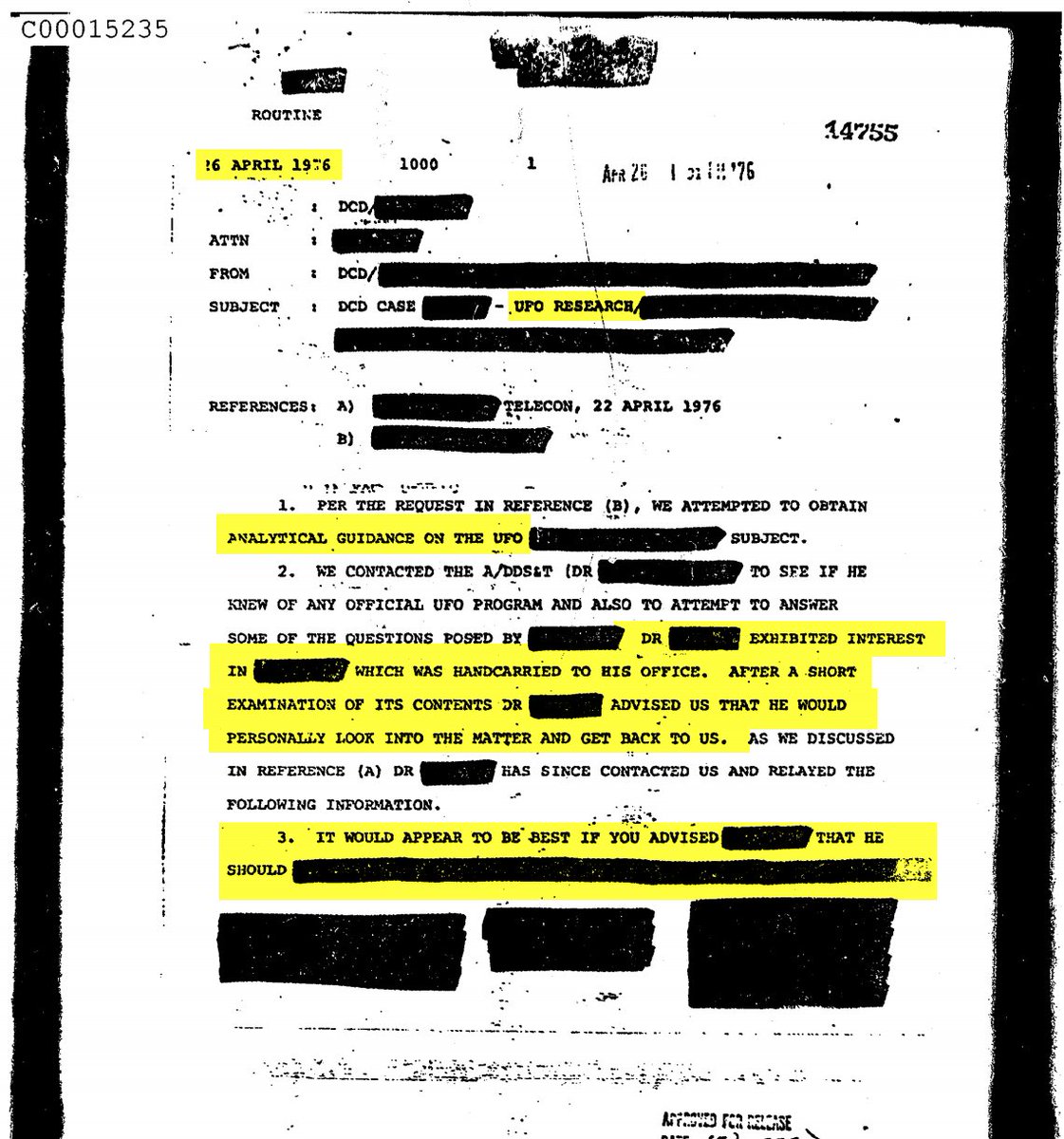
Samir Ferdowsi at Vice’s Motherboard quotes Greenewald describing the process as “like pulling teeth,” with results more impressive in quantity than quality. “The CIA has made it INCREDIBLY difficult to use their records in a reasonable manner,” Greenewals writes. “They offer a format that is very outdated (multi page .tif) and offer text file outputs, largely unusable,” all of which “makes it very difficult for people to see the documents, and use them, for any research purpose.” He’s thus also made available a version of the CIA’s declassified UFO documents converted into 713 PDFs. The Black Vault advises downloaders to bear in mind that “many of these documents are poorly photocopied, so the computer can only ‘see’ so much to convert for searching.”
But even with these difficulties, UFO enthusiasts have already turned up material of interest: “From a dispute with a Bosnian fugitive with alleged E.T. contact to mysterious midnight explosions in a small Russian town, the reports definitely take readers for a wild ride,” writes Ferdowsi. “One of the most interesting documents in the drop, Greenewald said, involved the Assistant Deputy Director for Science & Technology being hand-delivered some piece of information on a UFO in the 1970s.” This document, like most of the others, comes with many parts blacked out, but as Greenewald recently tweeted, “I have an open ‘Mandatory Declassification Review’ request to HOPEFULLY get some of these redactions lifted, so we can see what was hand delivered, and what his advice may be.” Ufology demands a great deal of curiosity, but an even greater deal of patience. Enter the Black Vault here.
Based in Seoul, Colin Marshall writes and broadcasts on cities, language, and culture. His projects include the Substack newsletterBooks on Cities, the book The Stateless City: a Walk through 21st-Century Los Angeles and the video series The City in Cinema. Follow him on Twitter at @colinmarshall, on Facebook, or on Instagram.
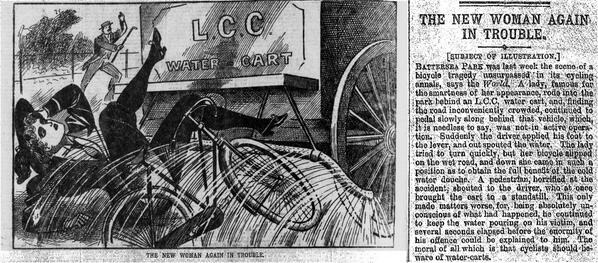
The early history of the bicycle did not promise great things—or anything, really—for women at the dawn of the 19th century. A two-wheeled bicycle-like invention, for example, built in 1820, “was more like an agricultural implement in construction than a bicycle,” one bicycle history notes. Made of wood, the “hobby horses” and velocipedes of cycling’s first decades rolled on iron wheels. Their near-total lack of suspension led to the epithet “boneshaker.” Some had steering mechanisms, some did not. Braking was generally accomplished with the feet, or a crowd of pedestrians, a tree, or horse-drawn cart.
Laddish clubs formed and raced around London, Paris, and New York. No girls allowed. The earliest bicycles for women were ridden side-saddle…. But despite all this, it is entirely fair to say that few technologies in history, ancient or modern, have done more to free women from domestic toilage and bring them careening into the public square, to the dismay of the Victorian establishment.
Bicycles “gave women a new level of transportation independence that perplexed newspaper columnists” and the general public, writes Adrienne LaFrance at The Atlantic, quoting a San Francisco journalist in 1895:
It really doesn’t matter much where this one individual young lady is going on her wheel. It may be that she’s going to the park on pleasure bent, or to the store for a dozen hairpins, or to call on a sick friend at the other side of town, or to get a doily pattern of somebody, or a recipe for removing tan and freckles. Let that be as it may. What the interested public wishes to know is, Where are all the women on wheels going? Is there a grand rendezvous somewhere toward which they are all headed and where they will some time hold a meet that will cause this wobbly old world to wake up and readjust itself?
Women cyclists were seen as the advanced guard of a coming war. “Squarely in the center of this battle was one tool,” notes the Vox video above, “that completely changed the game.” Both Susan B. Anthony and Elizabeth Cady Stanton are credited with declaring that ‘woman is riding to suffrage on the bicycle,’ a line that was printed and reprinted in newspapers at the turn of the century,” LaFrance writes. By the 1890s, everyone rode bicycles, the first Tour de France was only a few years away, and cycling technology had come so far that it would help create both the car—with its innovative pneumatic tires and spoked wheels—and the airplane, through the experiments of Ohio bicycle-makers the Wright Brothers.
The new bikes, originally called “safety bikes” to contrast them with giant-wheeled penny-farthings that were briefly the norm, may not have developed gearing systems yet, but they were far lighter, cheaper, and easier to ride (comparatively) than the bicycles that had come before, which began as playthings for wealthy young men-about-town. The National Women’s History Museum describes the scene:
At the turn of the century, trains, automobiles, and streetcars were growing in use in urban areas, but people still largely depended on horses for transportation. Horses, and especially carriages, were expensive and women often had to depend on men to hitch up the horses for travel…. Surrounded by inefficient and expensive forms of travel, bicycles arrived in cities with the promise of practicality and affordability. Bicycles were relatively inexpensive and provided men and women with individual transportation for business, sports, or recreation.
Not only did bicycles give women equal access to personal rapid transit, but they did so for women of many different social classes. The leveling effects were significant, as were the changes to women’s fashion. Exposed calves (though still encased in various cycling boots) prepared the way for trousers. Traditionalists were outraged, ceaselessly mocked women on bikes, as they mocked the suffragists, and pushed for restrictions on full freedom of movement. “Whilst the 1890s saw discourses of middle-class femininity become reconciled with the notion of women on bicycles,” The Victorian Cyclist points out, “learning to ride a bicycle required middle-class women to carefully navigate their way through a set of highly conservative and rigid gender norms.”
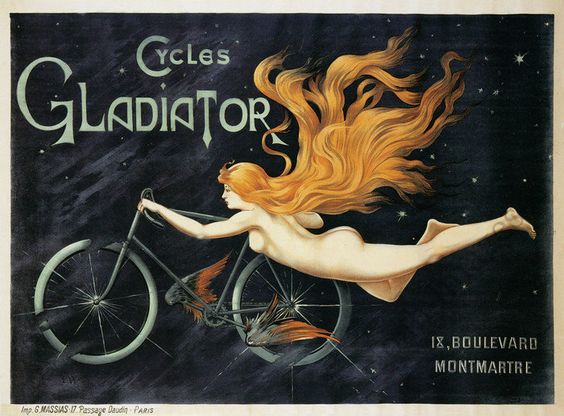
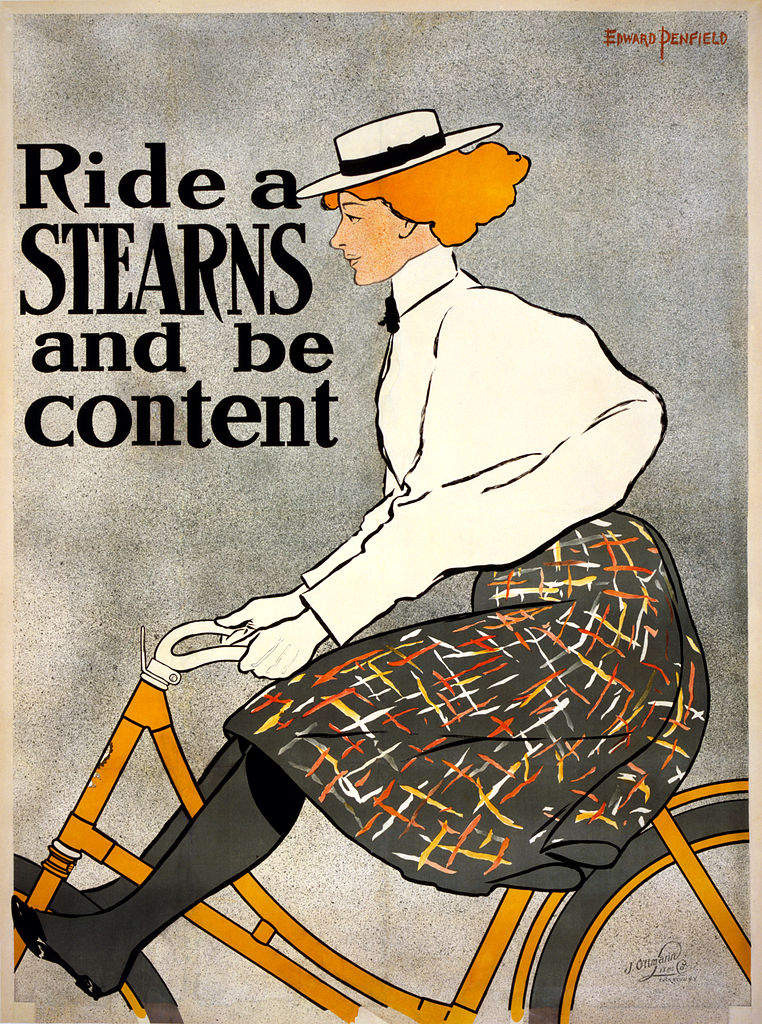
Despite media efforts to tamp down or tame the revolutionary potential of the bicycle for women, the market that made the machines saw no problem with increasing sales. Bicycle poster art and advertising from the turn of the 20th century is dominated by women cyclists, who are portrayed as ordinary ramblers about town, hip adventurers, ultra-modern “New Women,” and, perhaps less progressively, nude goddesses. Whether we call it Gilded Age, Belle Epoque, or Fin de siècle, the end of the 19th century produced a transportation revolution that was also, through no particularly conscious design of the makers of the bicycle, a revolution in women’s rights and thus human freedom writ large.
The pandemic has kept us out of the movie theaters, forcing new streaming practices so that films can be released at all, but as these restrictions end in 2021, do we want things to go back just to the way they were?
Your hosts Mark Linsenmayer, Erica Spyres, and Brian Hirt reviewed many articles where filmmakers fretted about the future of cinema. Even before the pandemic, concerns about falling movie house attendance and the increased use of streaming have had the industry worried about films being viewed in the manner their creators intended, or even made at all.
For at least the first half our of this discussion, we largely ignored all that in favor of musing on our own past theater-going habits and experiences. What has worked and hasn’t in the shift toward more spectacle and amenities? What do we like and loathe about being in an audience with others? Is the theater experience essential just for big special effects films, or does it make any film more effective? How would we improve moviegoing and home viewing? We consider the list of films that were supposed to come out this year and were either delayed or moved to streaming, like Tenet, Soul, In the Heights, etc.
Here are those articles, in case you’re curious:
Why do people pledge allegiance to views that seem fundamentally hostile to reality? Maybe believers in shadowy, evil forces and secret cabals fall prey to motivated reasoning. Truth for them is what they need to believe in order to get what they want. Their certainty in the justness of a cause can feel as comforting as a warm blanket on a winter’s night. But conspiracy theories go farther than private delusions of grandeur. They have spilled into the streets, into the halls of the U.S. Capitol building and various statehouses. Conspiracy theories about a “stolen” 2020 election are out for blood.
As distressing as such recent public spectacles seem at present, they hardly come near the harm accomplished by propaganda like Plandemic—a short film that claims the COVID-19 crisis is a sinister plot—part of a wave of disinformation that has sent infection and death rates soaring into the hundreds of thousands.
We may never know the numbers of people who have infected others by refusing to take precautions for themselves, but we do know that the number of people in the U.S. who believe conspiracy theories is alarmingly high.
So how do we distinguish between reality-based views and conspiracy theories if we’re all so prone to the latter? Standards of logical reasoning and evidence still help separate truth from falsehood in laboratories. When it comes to the human mind, emotions are just as important as data. “Conspiracy theories make people feel as though they have some sort of control over the world,” says Daniel Romer, a psychologist and research director at the University of Pennsylvania’s Annenberg Public Policy Center. They’re airtight, as Wired shows below, and it can be useless to argue.
Basu spoke with experts like Romer and the moderators of Reddit’s r/ChangeMyView community to find out how to approach others who hold beliefs that cause harm and have no basis in fact. The consensus recommends proceeding with kindness, finding some common ground, and applying a degree of restraint, which includes dropping or pausing the conversation if things get heated. We need to recognize competing motivations: “some people don’t want to change, no matter the facts.”
Unregulated emotions can and do undermine our ability to reason all the time. We cannot ignore or dismiss them; they can be clear indications something has gone wrong with our thinking and perhaps with our mental and physical health. We are all subjected, though not equally, to incredible amounts of heightened stress under our current conditions, which allows bad actors like the still-current U.S. President to more easily exploit universal human vulnerabilities and “weaponize motivated reasoning,” as University of California, Irvine social psychologist Peter Ditto observes.
To help counter these tendencies in some small way, we present the resources above. In Bill Nye’s Big Think answer to a video question from a viewer named Daniel, the longtime science communicator talks about the discomfort of cognitive dissonance. “The way to overcome that,” he says, is with the attitude, “we’re all in this together. Let’s learn about this together.”
We can perhaps best approach those who embrace harmful conspiracy theories by not immediately telling them that we know more than they do. It’s a conversation that requires some intellectual humility and acknowledgement that change is hard and it feels really scary not to know what’s going on. Below, see an abridged version of MIT Technology Review’s ten tips for reasoning with a conspiracy theorist, and read Basu’s full articlehere.
Always, always speak respectfully: “Without respect, compassion, and empathy, no one will open their mind or heart to you. No one will listen.”
Go private: Using direct messages when online “prevents discussion from getting embarrassing for the poster, and it implies a genuine compassion and interest in conversation rather than a desire for public shaming.”
Test the waters first: “You can ask what it would take to change their mind, and if they say they will never change their mind, then you should take them at their word and not bother engaging.”
Agree: “Conspiracy theories often feature elements that everyone can agree on.”
Try the “truth sandwich”: “Use the fact-fallacy-fact approach, a method first proposed by linguist George Lakoff.”
Or use the Socratic method: This “challenges people to come up with sources and defend their position themselves.”
Be very careful with loved ones: “Biting your tongue and picking your battles can help your mental health.”
Realize that some people don’t want to change, no matter the facts.
If it gets bad, stop: “One r/ChangeMyView moderator suggested ‘IRL calming down’: shutting off your phone or computer and going for a walk.”
Every little bit helps. “One conversation will probably not change a person’s mind, and that’s okay.”
Did your college math textbooks have moving parts? From 1524 on, a famous German cosmography book came with 5 volvelles! Peter Apian (later knighted for a different book), opted for a novel, tactile-visual teaching style for all earthly and heavenly measurements. pic.twitter.com/XgskoGb0Ss
If you want to learn how the planets move, you’ll almost certainly go to one place first: Youtube. Yes, there have been plenty of worthwhile books written on the subject, and reading them will prove essential to further deepening your understanding. But videos have the capacity of motion, an undeniable benefit when motion itself is the concept under discussion. Less than twenty years into the Youtube age, we’ve already seen a good deal of innovation in the art of audiovisual explanation. But we’re also well over half a millennium into the age of the book as we know it, a time that even in its early phases saw impressive attempts to go beyond text on a page.
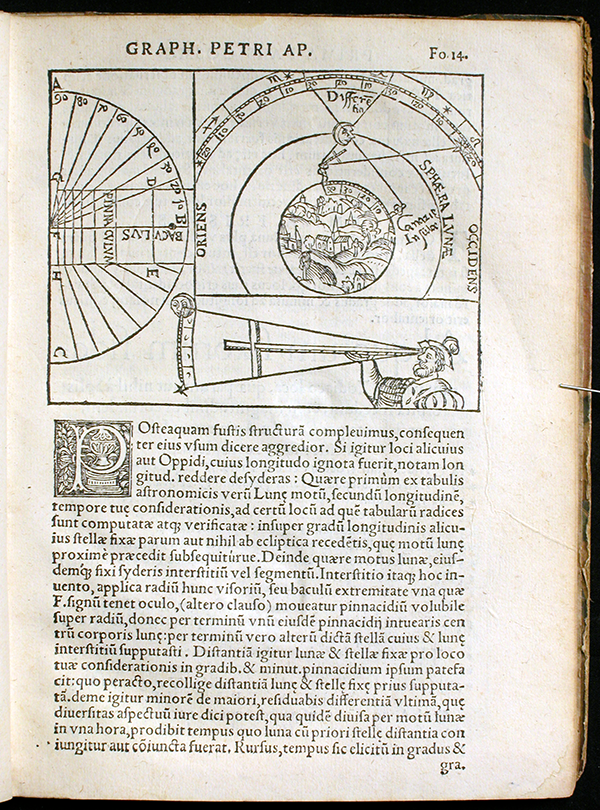
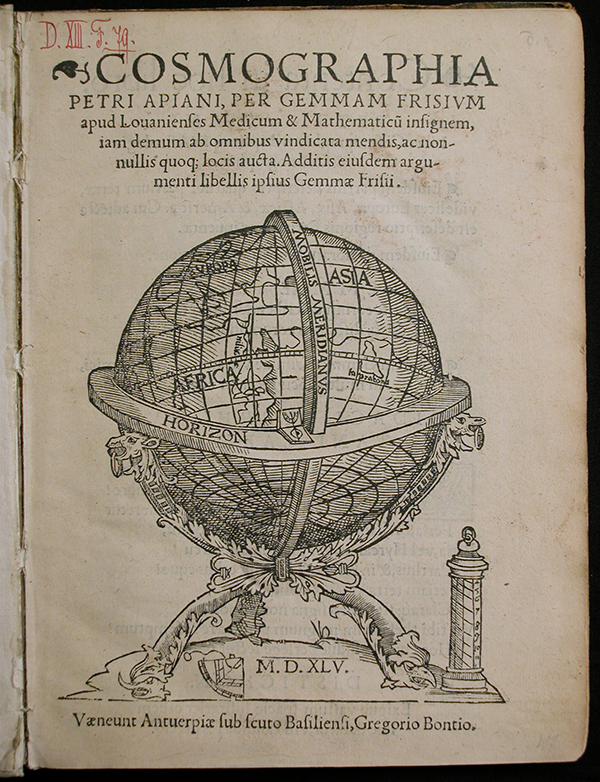
Take, for example, Peter Apian’s Cosmographia, first published in 1524. A 16th-century German polymath, Apian (also known as Petrus Apianus, and born Peter Bienewitz) had a professional interest in mathematics, astronomy and cartography. At their intersection stood the subject of “cosmography” from which this impressive book takes its name, and its project of mapping the then-known universe.
“The treatise provided instruction in astronomy, geography, cartography, navigation, and instrument-making,” writes Frank Swetz at the Mathematical Association of America. “It was one of the first European books to depict and discuss North America and included movable volvelles allowing the readers to interact with and use some of the charts and instrument layouts presented.”
The terrestrial and lunar dials are the most visually complex. The lunar one shows the changing shape of the moon through a cut-out window, but its content had already been preceded in table format by Regiomontanus in 1474. Still, its effect on farming remained vital knowledge. pic.twitter.com/MUuyJYUysQ
Pop-up book enthusiasts like Ellen Rubin will know what volvelles are; you and I may not, but if you’ve ever moved a paper wheel or slider on a page, you’ve used one. The volvelle first emerged in the medieval era, not as an amusement to liven up children’s books but as a kind of “analog computer” embedded in serious scientific works. “The volvelles make the practical nature of cosmography clear,” writes Katie Taylor at Cambridge’s Whipple Library, which holds a copy of Cosmographia. “Readers could manipulate these devices to solve problems: finding the time at different places and or one’s latitude, given the height of the Sun above the horizon.”
Apian originally included three such volvelles in Cosmographia. Later, his disciple Gemma Frisius, a Dutch physician, instrument maker and mathematician, produced expanded editions that included another. “In all its forms,” writes Swetz, “the book was extremely popular in the 16th century, going through 30 printings in 14 languages.” Despite the book’s success, it’s not so easy to come by a copy in good (indeed working) condition nearly 500 years later. If these descriptions of its pages and their volvelles have piqued your curiosity, you can see these ingenious paper devices in action in these videos tweeted out by Atlas Obscura. As with planets themselves, you can’t fully appreciate them until you see them move for yourself.
Based in Seoul, Colin Marshall writes and broadcasts on cities, language, and culture. His projects include the Substack newsletterBooks on Cities, the book The Stateless City: a Walk through 21st-Century Los Angeles and the video series The City in Cinema. Follow him on Twitter at @colinmarshall, on Facebook, or on Instagram.
Modern man still is anxious and tempted to surrender his freedom to dictators of all kinds, or to lose it by transforming himself into a small cog in the machine. —Erich Fromm
There are more think pieces published every day than any one person can read about our current moment of social disintegration. But we seem to have lost touch with the insights of social psychology, a field that dominated popular intellectual discourse in the post-war 20th century, largely due to the influential work of German exiles like Erich Fromm. The humanist philosopher and psychologist’s “prescient 1941 treasure Escape from Freedom,” writes Maria Popova, serves as what he called “‘a diagnosis rather than a prognosis,’ written during humanity’s grimmest descent into madness in WWII, laying out the foundational ideas on which Fromm would later draw in considering the basis of a sane society,” the title of his 1955 study of alienation, conformity, and authoritarianism.
Fromm “is an unjustly neglected figure,” Kieran Durkin argues at Jacobin, “certainly when compared with his erstwhile Frankfurt School colleagues, such as Max Horkheimer and Theodor Adorno.” But he has much to offer as a “grounded alternative” to their critical theory, and his work “reveals a distinctly more optimistic and hopeful engagement with the question of radical social change.” Nonetheless, Fromm well understood that social diseases must be identified before they can be treated, and he did not sugarcoat his diagnoses. Had society become more “sane” thirty-plus years after the war? Fromm didn’t think so.
In the 1977 interview clip above, Fromm defends his claim that “We live in a society of notoriously unhappy people,” which the interviewer calls an “incredible statement.” Fromm replies:
For me it isn’t incredible at all, but if you just open your eyes, you see it. That is, most people pretend that they are happy, even to themselves, because if you are unhappy, you are considered a failure, so you must wear the mask of being satisfied, of happy.
Contrast this observation with Albert Camus’ 1959 statement, “Today happiness is like a crime—never admit it. Don’t say ‘I’m happy’ otherwise you will hear condemnation all around.” Were Fromm and Camus observing vastly different cultural worlds? Or is it possible that in the intervening years, forced happiness—akin to the socially coerced emotions Camus depicted in The Stranger—had become normalized, a screen of denial stretched over existential dread, economic exploitation, and social decay?
Fromm’s diagnosis of forced happiness resonates strongly with The Stranger (and Billie Holiday), and with the image-obsessed society in which we live most of our lives now, presenting various curated personae on social media and videoconferencing apps. Unhappiness may be a byproduct of depression, violence, poverty, physical illness, social alienation… but its manifestations produce even more of the same: “Them that’s got shall get / Them that’s not shall lose.” If you’re unhappy, says Fromm, “you lose credit on the market, you’re no longer a normal person or a capable person. But you just have to look at people. You only have to see how behind the mask there is unrest.”
Have we learned how to look at people behind the mask? Is it possible to do so when we mostly interact with them from behind a screen? These are the kinds of questions Fromm’s work can help us grapple with, if we’re willing to accept his diagnosis and truly reckon with our unhappiness.
We're hoping to rely on loyal readers, rather than erratic ads. Please click the Donate button and support Open Culture. You can use Paypal, Venmo, Patreon, even Crypto! We thank you!
Open Culture scours the web for the best educational media. We find the free courses and audio books you need, the language lessons & educational videos you want, and plenty of enlightenment in between.