Jonathan Barnbrook, the British graphic designer who created the cover art for several of David Bowie’s more recent albums, had his creative studio issue an announcement on Facebook today, one which will surely please many:
Barnbrook loved working with David Bowie, he was simply one of the most inspirational, kind people we have met. So in the spirit of openness and in remembrance of David we are releasing the artwork elements of his last album ★ (Blackstar) to download here free under a Creative Commons NonCommercial-ShareAlike licence. That means you can make t‑shirts for yourself, use them for tattoos, put them up in your house to remember David by and adapt them too, but we would ask that you do not in any way create or sell commercial products with them or based on them.
If you would like to support the mission of Open Culture, consider making a donation to our site. It’s hard to rely 100% on ads, and your contributions will help us continue providing the best free cultural and educational materials to learners everywhere. You can contribute through PayPal, Patreon, and Venmo (@openculture). Thanks!
We all know the name Goethe — some of us even know the full name, Johann Wolfgang von Goethe. I’ve never lived in the renowned 18th- and 19th-century writer, politician, and cultural polymath’s homeland of Germany, but even when I lived in Los Angeles, I regularly went to my local branch of the Goethe-Institute for German cultural events. Even in Korea, where I live now, Goethe has left a wide if shallow mark: you can see The Sorrows of Young Wertherin the form of an elaborate stage musical, for instance, and buy almost all the goods you need in life from the enormous conglomerate named after the young lady on whom Werther concentrates his doomed affections, Lotte.
But why, more than 180 years after Goethe’s death, does his name still come up in so many different contexts? And given that, why do so many of us know so little about his long, varied, colorful, and highly productive life and career? This sounds like a job for the video wing of Alain de Botton’s School of Life, whose short primers continue to bring us up to speed on why the legacies of so many cultural figures (with one section given over to the literary) have endured, or should endure. “Goethe is one of the great minds of European civilisation, though his work is largely unknown outside of the German speaking countries,” says de Botton in their video on Goethe: “He deserves our renewed attention.”
To fill out the details provided in the School of Life’s video, you can read an overview of Goethe’s career (including details on the proper pronunciation of his name) in the accompanying Book of Life entry online. It tells the story of not just Young Werther’s creator, but “one of Europe’s big cultural heroes – comparable to the likes of Shakespeare, Dante and Homer,” skilled in letters, of course, but also in “physiology, geology, botany and optics,” who also spent stretches of his career as “a diplomat, fashion guru, a senior civil servant, a pornographer, the head of a university, a fine artist, an adventurous traveller, the director of a theatre company and the head of a mining company.”
We might call Goethe, insofar as he developed his own mastery, spanning so much of the human experience, a Renaissance man out of time — but one who, in his way, outdid even the actual men of the Renaissance. “We have so much to learn from him,” adds the Book of Life. “We don’t often hear people declaring a wish to be a little more like ‘Goethe.’ But if we did, the world would be a more vibrant and humane place.”
The Institute for Quantum Information and Matter (IQIM) at Caltech posted on its YouTube channel today a fun little video called “Anyone Can Quantum”–the “Anyone” probably referring to actor Paul Rudd, who takes on Stephen Hawking in a game of Quantum Chess, narrated by Keanu Reeves. Quantum Chess, a made-up thing, a gimmick, you say? Not so apparently. It’s a thing.
Sometimes it’s hard to believe that certain entertainers did not arrive fully formed with their famous look already part of the act. It’s still weird to me, for example, to see very early George Carlin, looking like a nephew to the button-down comedy of Bob Newhart. You might get the same shock seeing this very early—possibly the first, but not verified—televised appearance of master tenor Luciano Pavarotti.
In this archived clip from Soviet television, the future opera superstar looks more like comedian Jackie Gleason than the bearded, iconic figure he would become. Those eyebrows are working overtime, though.
The year is 1964, only three years after his professional debut in a regional Italian opera house, where he played the lead, Rodolfo, in a production of La Boheme. It was also a year after his first major accomplishment, supporting and singing with Joan Sutherland on an Australian tour. He was yet to have an American premiere, and was still trying to make a name for himself.
This above clip, a jaunty and confident take on Verdi’s “La Donna e Mobile” from Rigoletto, shows all the youthful promise in his 29-year-old voice. Compare and contrast below his 1982 version from Jean-Pierre Ponnelle’s film version of the opera. It’s sweeter and Pavarotti has less to prove, firmly established in the firmament of singing stars. The song remains the same, but this early glimpse into Pavarotti’s career shows he knew he was going places, but just needed that chance to prove it.
Ted Mills is a freelance writer on the arts who currently hosts the FunkZone Podcast. You can also follow him on Twitter at @tedmills, read his other arts writing at tedmills.com and/or watch his films here.
You can now hear in full on the BBC’s website the first part of Stephen Hawking’s 2016 Reith Lecture—“Do Black Holes Have No Hair?” Just above, listen to Hawking’s lecture while you follow along with an animated chalkboard on which artist Andrew Park sketches out the key points in helpful images and diagrams. We alerted you to the coming lecture this past Tuesday, and we also pointed you toward the paper Hawking recently posted online, “Soft Hair on Black Holes,” co-authored with Malcolm J. Perry and Andrew Strominger. There, Hawking argues that black holes may indeed have “hair,” or waves of zero-energy particles that store information previously thought lost.
The article is tough going for anyone without a background in theoretical physics, but Hawking’s talk above makes these ideas approachable, without dumbing them down. He has a winning way of communicating with everyday examples and witticisms, and Park’s illustrations further help make sense of things. Hawking begins with a brief history of black hole theory, then builds slowly to his thesis: as the BBC puts it, rather than see black holes as “scary, destructive and dark he says if properly understood, they could unlock the deepest secrets of the cosmos.”
Hawking is introduced by BBC broadcaster Sue Lawley, who also chairs a question-and-answer session (in the full lecture audio) with a few select Radio 4 listeners whose questions Hawking chose from hundreds submitted to the BBC. Stay tuned for Part Two, which should come online shortly after Tuesday’s broadcast.
The short animated video above gives us a tantalizing excerpt from Hawking’s second talk. “If you feel you are in a black hole,” he says reassuringly, “don’t give up. There’s a way out.” That nice little aside is but one of many colorful ways Hawking has of expressing himself when discussing the theoretical physics of black holes, a subject that could turn deadly serious, and—speaking for myself—incomprehensible. As far as I know, black holes work in the real universe just like they do in Interstellar.
I kid, but there is, however, at least one way in which Christopher Nolan’s apocalyptic space fantasy with its improbably happy ending may not be total hokum: as Hawking theorizes above, certain particles (or anti-particles) may escape from a black hole, “to infinity,” he says, or “possibly to another universe.” The main idea, says Hawking, is that black holes “are not the eternal prisons they were once thought.” Or, in other words, “black holes ain’t as black as they are painted,” which also happens to be the title of his next talk. Stay tuned: we’ll bring you more of Hawking’s fascinating black hole theory soon.
“Where is the wisdom we have lost in knowledge? Where is the knowledge we have lost in information?,” asked T.S. Eliot in lines from his play “The Rock.”His prescient description of the dawning information age has inspired data scientists and their dissenters for decades. Thirty-six years after Eliot’s prophetic lament over “Endless invention, endless experiment,” futurist Alvin Toffler described the effects of information overload in his book Future Shock, and though many of his predictions haven’t aged well, his “prognosis,” writes Fast Company, “was more accurate than not.” Among his many “Tofflerisms” is one I believe Eliot would appreciate: “The illiterate of the future will not be the person who cannot read. It will be the person who does not know how to learn.”
Indeed, the exponential accumulation of data and information, and the incredible amount of ready access would make both men’s heads spin. Internet archives grow vaster and vaster, their contents an embarrassing richness of the world’s treasures, and a perhaps even greater store of its obscurities. Each week, it seems, we bring you news of one or two more open access databases filled with images, texts, films, recorded music. It can indeed be dizzying. And of all the archives I’ve surveyed, used in my own research, and presented to Open Culture readers, none has seemed to me vaster than Europeana Collections, a portal of “48,796,394 artworks, artefacts, books, videos and sounds from across Europe,” sourced from well over 100 institutions such as The European Library, Europhoto, the National Library of Finland, University College Dublin, Museo Galileo, and many, many more, including contributions from the public at large. Where does one begin?
The possibilities may literally be endless, as the collection continues to expand at a rate far beyond the ability of any one person, or team of people, or entire research institute of people to match. It is easy to feel adrift in such a database as this, which stretches on like a Borgesian library, offering room after endless room of visual splendor, documentation, and interpretation. It is also easy to make discoveries, to meet people, stumble upon art, hear music, see photographs, learn histories you would never have encountered if you knew what you were looking for and knew exactly how to find it. Eliot warned us—and rightly so—of the dangers of information overload. But he neglected, in his puritanical way, to describe the pleasures, the minor epiphanies, the happy chance occurrences afforded us by the ever-expanding sea of information in which we swim. One can learn to navigate it, one can drift aimlessly, and one can, simultaneously, feel immensely overwhelmed.
This past weekend, Marvin Minksy, one of the founding fathers of computer science, passed away at the age of 88. Educated at Harvard and Princeton, The MIT Technology Reviewrecalls, “Minsky believed that the human mind was fundamentally no different than a computer, and he chose to focus on engineering intelligent machines, first at Lincoln Lab, and then later as a professor at MIT, where he cofounded the Artificial Intelligence Lab in 1959 with another pioneer of the field, John McCarthy.” During the 1980s, Minsky published The Society of Mind, a seminal work which posited that there’s no essential difference between humans and machines, because humans are “actually machines of a kind whose brains are made up of many semiautonomous but unintelligent ‘agents’.” (Quote comes from this NYTimes obit, not Minsky directly).
Above, you can watch The Society of Mind taught as a free online course. Presented at MIT in 2011, Minsky takes you through his theories about how the human mind works, emphasizing “aspects of thinking that are so poorly understood that they are still considered to be more philosophical than scientific.” The goal, however, is to “replace ill-defined folk theories of ‘consciousness’, ‘self’ and ’emotion’ with more concrete computational concepts.” Lectures in the course include ones intriguingly called “Falling in Love,”“From Panic to Suffering,” and “Common Sense.” In addition to The Society of Mind, the course also centers around another book by Minsky, The Emotion Machine, which you can purchase online here.
In 1968, Mick Jagger and Michael Lindsay-Hogg—director of the Let It Be film and several promo music videos for the Beatles and the Rolling Stones—sat down to brainstorm ideas for a full-length television production that would be unlike typical concert films. Lindsay-Hogg drew a circle on a piece of paper, and an idea was born for a rock and roll circus: two shows featuring the Stones, the Who, Marianne Faithfull, Taj Mahal, Jethro Tull, and John Lennon’s supergroup Dirty Mac, with Yoko, Eric Clapton, Jimi Hendrix’s drummer Mitch Mitchell, and Keith Richards on bass. That December, the bands played on a circus set in a London TV studio to a live audience.
Unhappy with the resulting footage, Jagger shelved the project, feeling like the Stones’ performance wasn’t up to snuff. (They went on early in the morning, and some say Jagger felt upstaged by the Who.) Some film of the concert made it into the 1979 documentary The Kids Are Alright, but much of it was lost until 1989, when it turned up in the Who’s private archive. The full concert film eventually premiered in 1996 at the New York Film Festival (and it’s now out on BluRay-see trailer below), where it appeared, wrote Janet Maslin, “straight out of its time capsule,” bringing back “the sleek young Stones in all their insolent glory, recalling a time when they ruled the roost.” Despite Jagger’s misgivings, they really did dominate that circus stage, but the event is notable for a number of other reasons.
Of course, there’s the Lennon supergroup, whose performance of his “Yer Blues,” sans Yoko (top) is “indispensable,” writes Allmusic. That’s no overstatement. Clapton’s sinuous leads and Mitch Mitchell’s busy fills sit beautifully with Lennon’s confident delivery. Rock and RollCircus also features the only filmed performance of soon-to-be Black Sabbath guitarist Tony Iommi in his tenure with Jethro Tull (“arguably,” Maslin says, “the most unbearable band of their day.”)
As amazing as so many of these performances are (Taj Mahal’s “Ain’t That a Lot of Love” seriously rocks), as Maslin pointed out, the Stones “ruled the roost,” and they knew it, even if they had to go on at five in the morning to accommodate difficult setups between acts.
It just so happens that Rock and Roll Circus represents Brian Jones very last gig with the band. (It was not, as Ultimate Classic Rock reports, an earlier show at Empire Pool that May.) He looks particularly unenthused above playing “You Can’t Always Get What You Want,” and the rest of the band looks exhausted as well—all except Jagger whose “fabulous performance,” Maslin writes, “nearly turns this into a one-man show.” Just above, see them do “Jumpin’ Jack Flash,” introduced by Lennon in sign language (“one of two live renditions it ever got with Brian Jones in the lineup,” writes Allmusic). You can also see the barroom blues tune “Parachute Woman” here and below, a jumpy, funky “Sympathy for the Devil” (with Spanish subtitles).
To see the full concert—including the Who’s quick appearance, more Dirty Mac (with Yoko), and a bunch of sideshow extras—pick up a copy of the Rock and Roll Circus on BluRay.
The long-looming 2016 United States presidential election has already got many of us, even (or maybe especially) non-Americans, instinctively flinching at anything that smacks of political campaigning. Given that the noise has nothing to do but intensify, how do we stay sane for the duration of the year, not to mention able to tell the credible claims from the incredible?
I recommend getting some perspective with a visit to the Internet Archive’s newly opened Political TV Ad Archive. Its creators have, “after sifting through more than 100,000 hours of broadcast television coverage and counting,” organized “more than 30,000 ad airings” into a site meant to, in the words of Internet Archive’s Television Archive Managing Editor Nancy Watzman, “bring journalists, researchers, and the public resources to help hold politicians accountable for the messages they deliver in TV ads.” A formidable task, given that the current storm of political ads in which we find ourselves comes as only the latest visit of the larger blizzard of political ads that has swirled around us since Eisenhower answered America 55 years ago.
At this point, even the most well-informed and media-literate among us face a difficult search for clarity amid all the slantedly aggressive “messaging,” and so the Political TV Ad Archive has accompanied its data with links to “fact-checking and follow-the-money journalism by the project’s partners,” which include the American Press Institute, the Center for Public Integrity, FactCheck.org, and The Washington Post’s Fact Checker. “Before the primaries are over, the public in key primary states will be buried in campaign ads generating more heat than light,” Watzman quotes Television Archive director Roger Macdonald as saying, highlighting the ease with which it lets us “have a better chance at separating lies from truths and learn who is paying for the ads.”
What has the project found so far? To take examples just from its scrutiny of the candidates drawing the most media attention, partner Politifact “rated a claim in this Donald Trump campaign ad as ‘Pants on Fire’ because it proclaimed that Trump would ‘stop illegal immigration by building a wall on our southern border that Mexico will pay for,’ while showing footage not of Mexican immigrants, but rather of refugees streaming into Morocco that had been pulled from an Italian news network.”
On the other side of the great divide, partner FactCheck.org “reported that a Hillary Clinton TV ad that claimed that drug prices had doubled in the last seven years was inaccurate,” claiming that “brand-name drug prices on average have more than doubled” when “more than 80 percent of filled prescriptions are generic drugs, and those prices have declined by nearly 63 percent, that same report says.”
The lesson to take away so far: ads are ads, and political ads are even more so. We have no defense against them but what facts we learn and what degree of hair-trigger skepticism we bring to the table, both of which tools like the Political TV Ad Archive can only increase. Evaluate these flurries of claims from all sides as best you can without getting too obsessive about it, and you’ll surely survive 2016 with your reason intact, and even a thing or two learned about the dark arts of political advertisement. Stay smart out there, ladies and gentlemen — especially if you live in a swing state.
In high school, I had a history teacher who was, in his spare time, a millionaire owner of several marinas. He taught, he told us, because he loved it. Was he a good teacher? Not by the lights of most pedagogical standards, but he did intend, amidst all his lassitude and total lack of organization, to leave us all with something more important than history: the secret of his success. What was it, you ask? Naps. Each day he touted the power of power naps with a proselytizer’s relentless enthusiasm: 15 minutes a few times a day, the key to wealth and happiness.
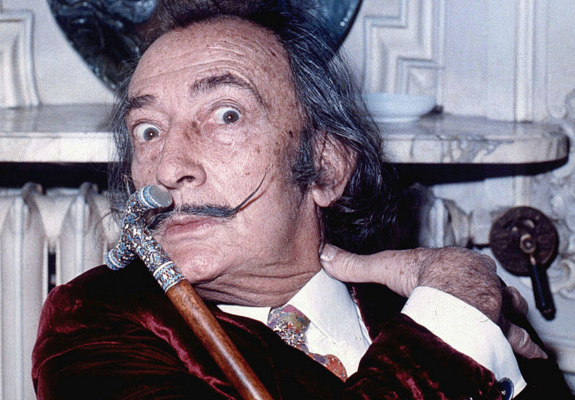
We all thought he was benignly nuts, but maybe he was on to something after all. It seems that many very wise, productive people—such as Albert Einstein, Aristotle, and Salvador Dali—have used power naps as sources of refreshment and inspiration. Except that while my history teacher recommended no less than ten minutes, at least one of these famous gents preferred less than one. Dali used a method of timing his naps that ensured his sleep would not last long. He outlined it thus, according to Lifehacker:
1. Sleep sitting upright (Dali recommends a Spanish-style bony armchair)
2. Hold a key in your hand, between your fingers (for the bohemian, use a skeleton key)
3. Relax and fall asleep (but not for too long…)
4. As you fall asleep, you’ll drop the key. Clang bang clang!
5. Wake up inspired!
Dali called it, fittingly, “Slumber with a key,” and to “accomplish this micro nap,” writes The Art of Manliness, he “placed an upside-down plate on the floor directly below the key.” As soon as he fell asleep, “the key would slip through his fingers, clang the plate, and awaken him from his nascent slumber.” He claimed to have learned this trick from Capuchin monks and recommended it to anyone who worked with ideas, claiming that the micro nap “revivified” the “physical and psychic being.”
Dali included “Slumber with a key” in his book for aspiring painters, 50 Secrets of Magic Craftsmanship, along with such nostrums as “the secret of the reason why a great draughtsman should draw while completely naked” and “the secret of the periods of carnal abstinence and indulgence to be observed by the painter.” We might be inclined to dismiss his nap technique as a surrealist practical joke. Yet The Art of Manliness goes on to explain the creative potential in the kind of nap I used to take in history class—dozing off, then jerking awake just before my head hit the desk:
The experience of this transitional state between wakefulness and sleep is called hypnagogia. You’re floating at the very threshold of consciousness; your mind is sliding into slumber, but still has threads of awareness dangling in the world…. While you’re in this state, you may see visions and hallucinations (often of shapes, patterns, and symbolic imagery), hear noises (including your own name or imagined speech), and feel almost physical sensations…. The experience can essentially be described as “dreaming while awake.”
The benefits for a surrealist painter—or any creative person in need of a jolt out of the ordinary—seem obvious. Many visionaries such as William Blake, John Keats, and Samuel Taylor Coleridge have made use of waking dream states as wellsprings of inspiration. Both Beethoven and Wagner composed while half asleep.
Scientists have found waking dream states useful as well. We’ve already mentioned Einstein. Brilliant mathematician, engineer, philosopher, and theoretical physicist Henri Poincare also found inspiration in micro naps. He pointed out that the important thing is to make ready use of any insights you glean during your few seconds of sleep by writing them down immediately (have pen and paper ready). Then, the conscious mind must take over: “It is necessary,” wrote Poincare, “to put in shape the results of this inspiration, to deduce from them the immediate consequences, to arrange them,” and so forth. He also suggests that “verification” of one’s hypnagogic insights is needed above all, but this step, while critical for the mathematician, seems superfluous for the artist.
So the micro nap comes to us with a very respectable pedigree, but does it really work or is it a psychological placebo? The author of the Almost Bohemian blog writes that he has practiced the technique for several weeks and found it “relatively successful” in restoring energy, though he has yet to harness it for inspiration. If you asked empirical sleep researchers, they might tend to agree with my history teacher: “Sleep laboratory studies show,” writes Lynne Lamberg in her book Bodyrhythms, “that a nap must last at least ten minutes to affect mood and performance.” This says nothing at all, however, about how long it takes to open a doorway to the unconscious and steal a bit of a dream to put to use in one’s waking work.
Aside from the very specific use of the micro nap, the longer power nap—anywhere from 10–40 minutes—can work wonders in improving “mood, alertness and performance,” writes the National Sleep Foundation. Short naps seem to work best as they leave one feeling refreshed but not groggy, and do not interfere with your regular sleep cycle. The Sleep Foundation cites a NASA study “on sleepy military pilots and astronauts” which found that “a 40-minute nap improved performance by 34% and alertness by 100%.” Lifehacker points to studies showing that “power naps, short 10 to 15 minute naps, improve mental efficiency and productivity,” which is why companies like Google and Apple allow their employees to doze off for a bit when drowsy.
One stress management site observes that the 10–15 minute power nap does not even require a pillow or blanket; “you don’t even need to go to sleep! You just need a comfortable place to lie on your back, put your feet up, and breathe comfortably.” Such a practice will not likely turn you into a world famous artist, poet, or scientist (or millionaire marina-owning, altruistic high school teacher). It will likely rejuvenate your mind and body so that you can make much better use of the time you spend not sleeping.
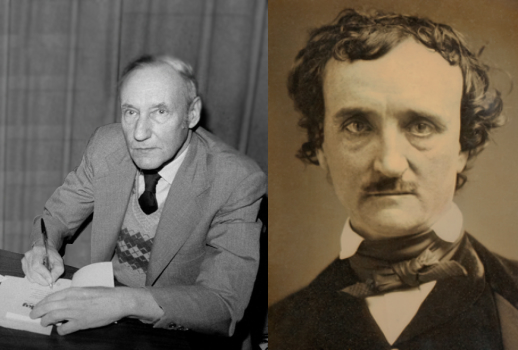
The label “American original” gets slapped onto a lot of different people, but it seems to me that, especially in the realm of letters, we could find no two luminaries who merit it more in the 19th century than psychological horror pioneer Edgar Allan Poe, and in the 20th century William S. Burroughs, sui generis even within the Beat Generation. So how could we resist featuring the recording just below, free to hear on Spotify (whose software, if you don’t have it yet, you can download here), of Burroughs reading Poe’s tale — because, as you know if you read him, he wrote not stories but tales — “The Masque of the Read Death”?
The 1842 tale itself, still haunting today more than 170 years after its publication, tells of a prince and his coterie of a thousand aristocrats who, in order to protect themselves from a Black Plague-like disease—the titular Red Death—sweeping through common society, take refuge in an abbey and weld the doors shut. In need of amusements (this all takes place about century and a half before Netflix, remember), the prince throws a masquerade ball. What, then, should interrupt this good time but the inexplicable arrival of an uninvited guest in a costume reminiscent of the corpse of a Red Death victim — possibly an embodiment of the Red Death itself?
Poe could tell a seriously resonant tale, and so could Burroughs. Though completely different in form, aesthetic, setting, and psychology, both writers’ works strike just the right ominous tone and leave just enough unexplained to seep into our subconscious in vivid and sometimes even unwanted ways. And so it makes perfect sense for Burroughs and his voice of a jaded but still amused ancient to join the formidable lineup of Poe’s interpreters, which includes Christopher Walken, Vincent Price, Christopher Lee, James Earl Jones, Iggy Pop, Lou Reed, and Stan Lee. But among them all, who better than Burroughs to articulate “The Masque of the Red Death’s” final line: “And Darkness and Decay and the Red Death held illimitable dominion over all.”
You can hear more of Burroughs reading Poe, in performances recorded for the computer game The Dark Eye, in Ted Mills’ previous post here.
We're hoping to rely on loyal readers, rather than erratic ads. Please click the Donate button and support Open Culture. You can use Paypal, Venmo, Patreon, even Crypto! We thank you!
Open Culture scours the web for the best educational media. We find the free courses and audio books you need, the language lessons & educational videos you want, and plenty of enlightenment in between.