Taught by Kevin Desmond, a graduate student in MIT’s Sloan School of Management, Poker Theory and Analytics introduces “students to poker strategy, psychology, and decision-making in eleven lectures.” Along with giving students the chance to play endless rounds of poker, the class–according to MIT News–featured guest speakers “Bill Chen, a professional player best known for his appearances on the Game Show Network’s High Stakes Poker television show, Matt Hawrilenko, a Princeton graduate who won more than $1 million at the World Series of Poker in 2009, and Aaron Brown, chief risk manager at AQR Capital Management.” And it culminated with a live tournament.
Movie audiences love dinosaurs. Ask the makers of Jurassic World, a reboot of Steven Spielberg’s venerable franchise that raked in over $1.5 billion this year. There is something about seeing humanity’s ambitions crumble in the face of a massive, toothy lizard (or are they supposed to be a giant featherless bird now?) that just captures the imagination of the inner 5 year-old in all of us.
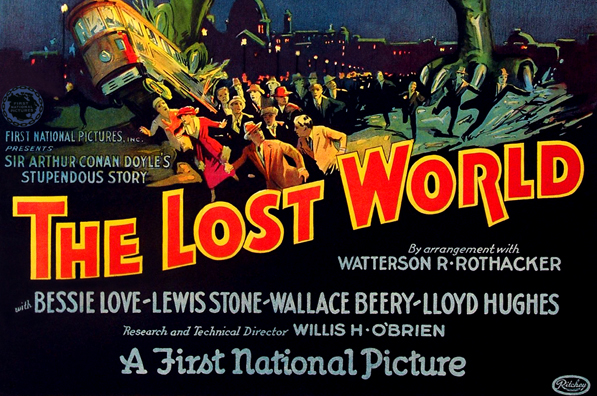
So if you enjoyed Jurassic World, you will dig TheLost World (1925), the granddaddy of giant monster movies. Adapted from Arthur Conan Doyle’s 1912 novel, the story of The Lost World should be familiar to anyone who has watched King Kong or The Lost World: Jurassic Park. The film is about an eccentric scientist, Professor Challenger (played by Wallace Beery in a Karl Marx beard), who ventures to a South American plateau deep in the heart of the Amazonian jungle where dinosaurs still exist. When he captures a Brontosaurus and lugs it back to London, the beast escapes and runs wild in the streets, smashing buildings, stomping on people and trashing cherished national landmarks. Exotic locations filled with equally exotic creatures? Check. Implicit critique of man’s hubristic ambition? Check. Way cool special effects? Check. Lost World has all the hallmarks of the genre even though it came out 90 years ago.
Audiences at the time were blown away by footage of triceratops, allosauruses and stegosauruses. Though they might seem about as terrifying to today’s jaded audiences as a Gumby cartoon, they were nothing short of a revelation in the 1920s. In 1922, Conan Doyle showed clips of the movie without revealing its origins to The Society of American Magicians, an audience that included none other than Harry Houdini. The next day, TheNew York Times breathlessly wrote that Conan Doyle’s “monsters of the ancient world, or of the new world which he has discovered in the ether, were extraordinarily lifelike. If fakes, they were masterpieces.” In fact, the dinosaurs were the handy work of Willis O’Brien who would take his experience on this film and make the 1933 masterpiece King Kong.
Jonathan Crow is a Los Angeles-based writer and filmmaker whose work has appeared in Yahoo!, The Hollywood Reporter, and other publications. You can follow him at @jonccrow. And check out his blog Veeptopus, featuring lots of pictures of vice presidents with octopuses on their heads. The Veeptopus store is here.
A couple of years ago we published a post on “what Shakespeare sounded like to Shakespeare” which highlighted some prominent linguists’ attempts to recreate the Elizabethan speech patterns and accents of the playwright’s day. There may be some small debate about whether or not they succeeded, but we’ll never know for certain since his day is long behind us.
In some ways, the nature of Shakespeare’s language may have been more French, or more Latinate, or more Saxon, than the English we speak today—depending on the proportion of regionalisms commingling in any given play, like characters in a national bazaar.
Our current version of the language may have absorbed another four hundred years of global influence, but in the process it has also become more homogenized and standardized. Shakespeare’s language was both more provincial and more riotously diverse–in spelling and pronunciation–than many kinds of English we speak today.
Perhaps this is one reason we think of Shakespeare as a universal poet—the heterodoxy of his speech, and hence a variability of characters found in few other literatures. Even his stock types seem to have individual voices. The degree of interplay between high and low speech—city and country, comic and tragic, lyric and prosaic—may be why nearly every world language has found a way to adapt his work, accenting some qualities and muting others. You don’t have to take my word for it. You can see for yourself at the MIT Global Shakespeare’s Video & Performance Archive, which hosts dozens of Shakespeare stagings in dozens of languages, like the mesmerizing Japanese Lear above, or the heartracingly intense one-woman clip from the Argentine Hamlet la metamorphosis at the top, a melodramatic production that would thrill David Lynch. Additionally, the database aggregates “essays and metadata provided by scholars and educators in the field” of international Shakespeare studies.
Even among the thousands of English-language adaptations of Shakespeare’s work we find an international diversity of speech. The Spotify playlist above, brought to us by Ulysses Classical (makers of the Stanley Kubrick Playlist), presents a huge collection of recorded Shakespeare plays and poems, as well as the scores and incidental music for English-language productions. The actors represented–Sirs Gielgud, Olivier, and McKellen, Derek Jacobi, Edith Evans–are mostly English stage royalty, but we also have Welsh poet Dylan Thomas and actor Richard Burton, and Americans Paul Robeson, Rosalind Russell, and Orson Welles. The value of such a collection is inestimable–68 hours of Shakespeare read and performed by some of the world’s finest actors. But it is indeed a specific slice of the world. Even in English it feels (forgive the puns) that all the world could be represented here, doing Shakespeare in every kind of English around the globe. Perhaps such a global approach to teaching Shakespeare in English would add nuance to debates about whether his work is still relevant in American high school and college classrooms. In any case, there seem to be few barriers to actors and directors for approaching Shakespeare with new translations and with fresh eyes, ears, and costumes, again and again.
Here at Open Culture, the 150th anniversary celebration of Lewis Carroll’s Alice’s Adventures in Wonderland keeps going and going, because, well, who knows what form the internet will have taken by the time of the 200th? It might well bear more of a resemblance to the logical-yet-illogical reality in which the story’s title character finds herself than any of the things we’ve yet used, or imagined. You may laugh, but Lewis Carroll’s ideas have long drawn the fascination of programmers, computer scientists, and the other architects of the infoscape through which we navigate today.
They’ve also, of course, attracted the fascination of other artists, from Brave New World author Aldous Huxley, who wrote an early script for Disney’s film, to Fear and Loathing in Las Vegas illustrator Ralph Steadman, who did his own illustrated edition of the book. Today, we give you Alice’s Adventures in Wonderland in the medium of sand animation, as practiced by sand animator Magdalena Bak. At just under eight minutes and thirty seconds, it will only take you a fraction as long to watch as most of Alice’s other cinematic adaptations (though not the very first, made in 1903, which clocks in at twenty seconds shorter).
It may also introduce you to an animation medium you’ve never seen before. If you’d like to watch more of what an animator can do with sand, have a look at the wide variety of sand animations we’ve previously featured: Vivaldi’s Four Seasons animated in sand, Kafka’s Metamorphosis animated in sand, Goethe’s “Der Erlkönig” animated in sand, modern desert warfare animated in sand, and even a Spanish-language music video animated in sand. Sand may strike you as an unusual storytelling medium, but surely Alice’s Adventures in Wonderland, even 150 years after its first publication, remains an unusual story.
Abiding by the strong rules he established for the characters in the Looney Tunes stable was critical to his comic approach, as Jones explains in the above video essay, a bit of a departure for Tony Zhou’s celebrated cinema series, Every Frame a Picture. Rather than examine the framing and timing of “one of the all-time masters of visual comedy,” this time Zhou delves into the evolution of his subject’s artistic sensibilities.
Jones teased out the desires that became the primary engines for those characters’ physicality as well as their behavior. Daffy comes off as an unhinged lunatic in his early appearances. His comic potential grew once Jones reframed him as a conniver who’d do anything in pursuit of wealth and glory.
Once the characters’ motivations were clear, Jones could mess around with the ol’ one-two punch. It’s a classic comic structure, wherein reality wreaks havoc on the audience’s expectations about how things should unfold. Then again, a child can tell you what drives Jones’ creation, the passionate French skunk, Pepé Le Pew, as well as how those amorous ambitions of his are likely to work out. Funny! Dependably so!
Zhou also draws attention to the evolution of the characters’ expressions, from the antic to the economical. John Belushi was not the only comic genius to understand the power of a raised eyebrow.
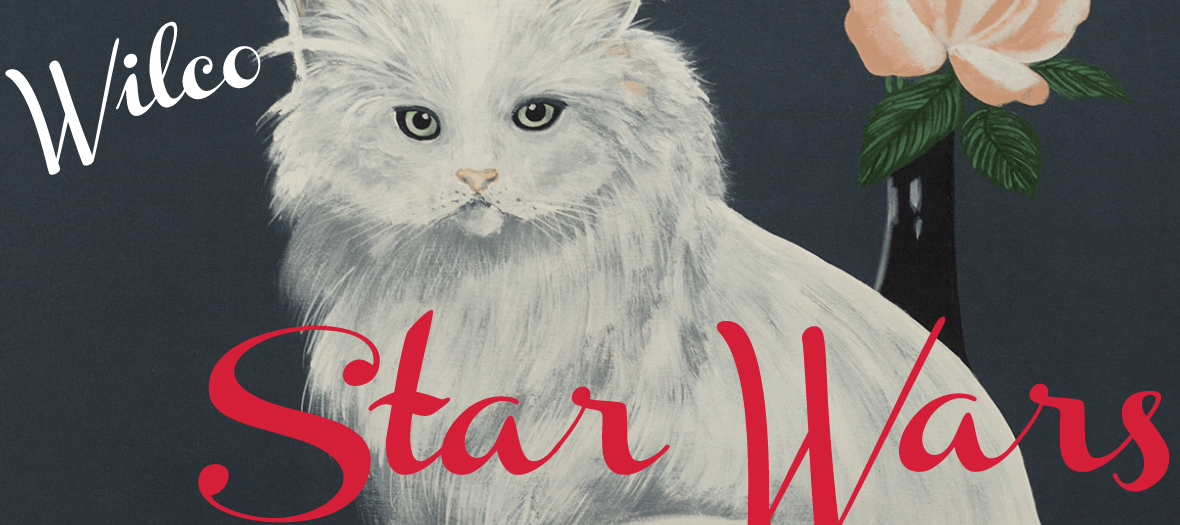
A quick heads up, Wilco just released its ninth studio album, Star Wars. And right now you can download it for free via Wilco’s website. But don’t dilly dally, the free download will only be available for 30 days. On the band’s Instagram account, Jeff Tweedy gave a simple explanation for the unexpected giveaway: “Well, the biggest reason, and I’m not sure we even need any others, is that it felt like it would be fun.” Indeed.
Last week: we highlighted a couple more downloads that will be free for a limited time. Find them below.
Fans of Twin Peaks, the early-1990s television series co-created and in large part directed by David Lynch, have had a lot to get excited about recently. Most prominently, we’ve heard a lot of will-he-or-won’t-he talk about whether Lynch will participate in the show’s much-discussed 21st-century reboot. That has no doubt stoked public interest in Twin Peaks (available on Hulu here), which in some sense has never really died away, even though it went off the air 24 years ago (and by all accounts got pretty lackluster in its second season); some of us, while we wait for the new series, have even engaged in all manner of Twin Peaks-themed writing, art, and even music projects.
Many Australian Twin Peaks fans, while they wait for the new series, made it over to Queensland’s Gallery of Modern Art earlier this year for the exhibitionDavid Lynch: Between Two Worlds. If they went on April 18th, they saw experimental post-punk band Xiu Xiu perform their own interpretation of the Twin Peaks score. “The music of Twin Peaks is everything that we aspire to as musicians and is everything that we want to listen to as music fans,” says Xiu Xiu leader Jamie Stewart. “It is romantic, it is terrifying, it is beautiful, it is unnervingly sexual. The idea of holding the ‘purity’ of the 1950s up to the cold light of a violent moon and exposing the skull beneath the frozen, worried smile has been a stunning influence on us.”
Xiu Xiu, since Stewart formed it in San Jose in 2002, has steadily gained a reputation as, in the words of Vice, “the weirdest band you know.” Part of that has to do with the formal adventurousness of their music itself, and part to do with their invariably disturbing music videos. No wonder, then, that they would feel such an affinity with David Lynch, no stranger to getting called “weird” by audiences and the maker of some unsettling music and music videos himself. Given the potential overlap in their followings, and given that nobody seems to know how many production decisions the new Twin Peaks has yet made, perhaps someone can check and see whether Xiu Xiu might have the time to record its score?
Les Paul, known primarily for the iconic guitar that bears his name, also invented most of the recording technology we still use today, including the use of reverb as a studio effect. But of course he didn’t invent reverberation anymore than he invented the guitar; he just turned both of them electric. Reverb has existed as long as there have been soundwaves, obstacles for them to hit, and ears to hear what happens when they do. In every possible space—landscape, cityscape, and architectural formation—the effect announces itself differently, though we’re seldom aware of it unless we’re in grand, cavernous spaces like a cathedral or mountain gorge.
But musicians and audio engineers like Les Paul have always paid special attention to the way sound manifests in space, as have singers like the gent above, who calls himself the Wikisinger, real name Joachim Müllner. With “no artificial reverb added,” Müllner demonstrates how much environment contributes to the quality of what we hear with a montage of sound and video clips from several—very aesthetically pleasing—locations.
In each place, Müllner sings the same strange song: in a tunnel, an attic, a field before an oil derricks, the nave of a cathedral, and an anechoic chamber—which resembles the interior of an alien spacecraft and produces no reflections whatsoever. Sometimes the effect is subtle, inviting you to lean in and listen more closely; sometimes it’s outsized and operatic.
The filmmaker’s claim to “no artificial reverb” sounds a little slippery after viewing the Wikisinger’s performance since one of the most dramatic clips features his voice, and person, reduplicated several times. And we should keep in mind that no recording technology is perfectly transparent. Microphones and other equipment always add, or subtract, something to the sound. As slick as an advertisement, the short video uses a heavily mediated form to convey the simple idea of natural reverberation. You may, in fact, have seen something just like this not long ago. Before the Wikisinger, there was the Wikidrummer. In another “no reverb added” video above, he snaps, cracks, booms, and crashes through the same beat in garages, open fields, and underpasses. With each abrupt shift in location comes an abrupt shift in the frequency and duration of the sounds, as the full spectrum collides with metal, concrete, asphalt, and open air.
The ways in which sound and space interact can determine the shape of a musical form. This subject has given musician, artist, and theorist of music and art, David Byrne much to think about. As he puts in in a TED talk above, the “nature of the room”—the quality of its reverb—guides the evolution of musical genres and styles. Beginning with the example of CBGBs and like dive bars around the country, he describes how the art punk pioneered by his band the Talking Heads depended on such spaces and “didn’t sound all that great” in places strictly designed for music, like Carnegie Hall. His talk then takes us to some fascinating architectural environments, such as the kinds of rooms Mozart composed and played in. Byrne speaks to the neophytes as well as to the audiophiles among us, and his talk works as a perfect intellectual complement to the sonic and visual adventure on offer in the Wikisinger and –drummer’s videos. Both approaches equally persuade us of the prime significance of that intangible wonder called reverb.
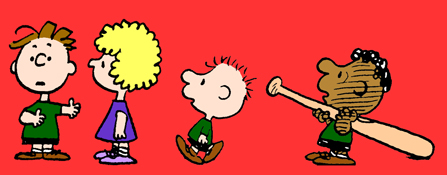
Like many children of the 70s, I was wild for Charles Schulz’s Peanuts, and had the merchandise to prove it. I was a Snoopy girl, for the most part, but not averse to receiving items featuring other characters—Linus, Schroeder, the caustic Lucy, PigPen, and, of course, Charlie Brown. My father was a sucker for the comparatively butch Peppermint Patty, and Marcie, the bespectacled hanger-on who referred to Patty as “Sir.”
But there was one character I don’t remember seeing on any Peanuts swag in 1970s Indiana…. Actually, that’s not accurate. I don’t remember any Shermy sweatshirts. Female second bananas like Violet, the original, i.e. non-Peppermint Patty, and Frieda were also underrepresented, despite the latter’s oft-mentioned naturally curly hair.
The character I’m thinking of never became a major player, but he was notable. Ground-breaking even. Can you guess?
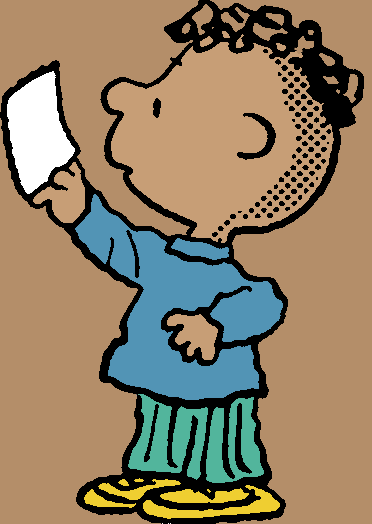
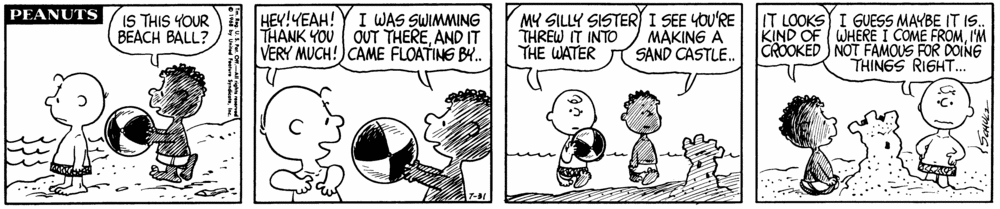
Thats right: Franklin, the only African-American member of the Peanuts gang.
(An African-American toddler, Milo, below, had a 17-strip run in 1977 when Charlie Brown had to skip town after exacting his revenge on the kite-eating tree… That’s it. Poor Franklin.)
Franklin owes his existence, in large part, to Harriet Glickman, a white teacher from LA, who found letter writing one of the few forms of activism in which a mother of three children—all squarely within the Peanuts demographic—could fully participate. Raised by liberal parents to consider herself a global citizen, and to speak out against injustice, she wrote the authors of several leading comic strips in the wake of Dr. Martin Luther King’s assassination in April, 1968. Would the creators of Peanuts and Mary Worth consider introducing a black character into the mix, as a first step on what Glickman foresaw as a “long and tortuous road” toward a future climate of “open friendship, trust and mobility” between the races?
Mary Worth’sAllen Saunders declined, apparently saying that he shared Glickman’s sentiments but feared the syndicate would drop his strip if he followed her suggestion.
Schulz didn’t exactly leap at the chance, either, saying that he was in the same boat as the other sympathetic cartoonists who’d begged off. What he feared wasn’t so much the syndicate’s response, as the suspicion that he might be seen as “patronizing our Negro friends.”
Glickman persisted, asking his permission to share his letter with some of her “Negro friends,” all parents. Perhaps they could offer some thoughts that might induce the cartoonist to say yes.
I’d like to express an opinion as a Negro father of two young boys. We have a situation in America in which racial enmity is constantly portrayed.
Like Glickman, he felt that a “casual day-to-day scene” featuring a non-white character would give his sons and other children of color a chance to see themselves reflected in the strip, while promoting “racial amity” to readers of all races.
Glickman expressed hope that Peanuts would eventually grow to include more than one black child:
Let them be as adorable as the others…but please…allow them a Lucy!
Within weeks of receiving Kelly’s letter, and just over two months into Glickman’s letter-writing campaign, Schulz reached a decision. He wrote Glickman that she should check the paper the week of July 29, 1968.
Franklin, his skin tone indicated by closely set diagonal lines, made his debut in a bathing suit, returning Charlie Brown’s runaway beach ball. The encounter took three days to play out, during which Franklin and Charlie Brown form an alliance of vacationing children whose usual playmates are elsewhere. It would seem that the major difference between them is that Franklin’s dad is in Vietnam. Obviously, a lot of thought went into their casual dialogue.
Benign as Franklin was, his presence sparked outrage. Some Southern readers cried foul when he showed up in the same classroom as Marcie and Peppermint Patty. Others felt Franklin wasn’t black enough.
Ultimately Franklin never achieved A‑list status, but he did resonate with certain readers, notably William Bell, a diversity officer working with the Cincinnati Police Department.
Visit Mashable to see reproductions of Glickman and Schulz’s correspondence. And watch the video above to hear more about her upbringing and another comic that featured black characters, Dateline: Danger!, a collaboration between Saunders’ son John and artist Al McWilliams.
After the great director F.W. Murnau died in a car crash in California at the young age of 42, his body was flown back to his native Germany to be buried, and that’s where he has rested since 1931.
Until this week, that is, when somebody made off with the director’s skull.
Reports are sketchy and rely on this report from German news outlet BZ, but, according to police, somebody opened up Murnau’s metal coffin and removed the head from the embalmed corpse. Wax and a candle were found at the scene, suggesting to some that the theft had occult ties.
Murnau is best known for the spookiest Dracula tale ever told in celluloid, 1922’s Nosferatu, which had coffins aplenty. It is also, by the way, free to view above. He also delved into the Satanic with his version of Faust (1926), which features a marching band of skeletons, among other apparitions:
Murnau’s filmography contains a 1920 version of Dr. Jekyll and Mr. Hyde, and The Hunchback and the Dancer from the same year, though both films are lost. The director did tend towards horror, but two of his finest films did not.
The Last Laugh (1924) is a poignant tale about a hotel doorman who can’t bear the shame of being fired, and contains one of cinema’s finest “director ex machina” with an improbable but happy ending. Once Murnau moved to Hollywood, he directed Sunrise (1927), which blended the director’s expressionistic style with a Tinsel Town budget, a tale of a love nearly lost then resurrected. Four years and another three films later, Murnau’s career would be over. He died in a Santa Barbara hospital after a traffic accident by the Rincon–now a famous surfing location–just a few miles from where I now write these words, 84 years later.
Ted Mills is a freelance writer on the arts who currently hosts the FunkZone Podcast. You can also follow him on Twitter at @tedmills, read his other arts writing at tedmills.com and/or watch his films here.
We're hoping to rely on loyal readers, rather than erratic ads. Please click the Donate button and support Open Culture. You can use Paypal, Venmo, Patreon, even Crypto! We thank you!
Open Culture scours the web for the best educational media. We find the free courses and audio books you need, the language lessons & educational videos you want, and plenty of enlightenment in between.