Put a bunch of Stanford graduate students together. Give them 10 weeks to build a model airplaine, and what do you get? A world record at 7,000 feet — something it might cost NASA millions to do.
Put a bunch of Stanford graduate students together. Give them 10 weeks to build a model airplaine, and what do you get? A world record at 7,000 feet — something it might cost NASA millions to do.
The Berlin Wall and the Iron Curtain collapsed a little more than 20 years ago (August 1989). And even though I watched the events on TV, my memory of it all has already started to fade. But that’s where YouTube comes in. Above, a quick refresher that makes my day. This clip comes from a larger collection called 101 Historical Moments You Can Relive on YouTube. Thanks for the heads up on this one.
Harvard has rolled out Week 2 of Michael Sandel’s course on Justice. Courtesy of the course web site, here’s a synopsis of what you can expect from Episode 2. New lectures are getting rolled out weekly. Check the Harvard web site for new additions.
Part 1 — PUTTING A PRICE TAG ON LIFE: Sandel presents some contemporary cases in which cost-benefit analysis was used to put a dollar value on human life. The cases give rise to several objections to the utilitarian logic of seeking “the greatest good for the greatest number.” Is it possible to sum up and compare all values using a common measure like money?
Part 2 — HOW TO MEASURE PLEASURE: Sandel introduces J. S. Mill, a utilitarian philosopher who argues that seeking “the greatest good for the greatest number” is compatible with protecting individual rights, and that utilitarianism can make room for a distinction between higher and lower pleasures. Sandel tests this theory by playing video clips from three very different forms of entertainment: Shakespeare’s Hamlet, the reality show Fear Factor, and The Simpsons.
Earlier this year, Amazon rolled out the Kindle DX. This new, supersized e‑book reader had one basic goal: to give readers digital access to textbooks, newspapers and other larger format publications. This fall, the rubber has started to hit the road, and the Kindle DX has been getting tepid reviews, at least at Princeton University. There, students in three classes (Civil Society and Public Policy, U.S. Policy and Diplomacy in the Middle East, and Religion and Magic in Ancient Rome) were given free Kindles, and then started working with them. According to the Daily Princetonian, many of the 50 students participating in the pilot program said that “they were dissatisfied and uncomfortable with the devices.” One student had this to say:
I hate to sound like a Luddite, but this technology is a poor excuse of an academic tool. It’s clunky, slow and a real pain to operate. … Much of my learning comes from a physical interaction with the text: bookmarks, highlights, page-tearing, sticky notes and other marks representing the importance of certain passages — not to mention margin notes, where most of my paper ideas come from and interaction with the material occurs… All these things have been lost, and if not lost they’re too slow to keep up with my thinking, and the ‘features’ have been rendered useless.
These feelings were shared not just by students, but by professors as well. For more, I’d encourage you to give the Daily Princetonian piece a read.
Thanks to Bob for the tip, which comes via a mention in Engadget. We love tips. Keep them coming.
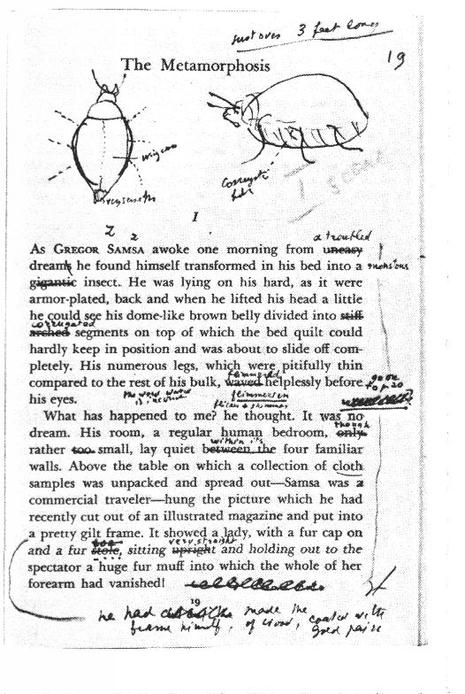
Vladimir Nabokov admired Franz Kafka’s novella, “The Metamorphosis.” Hence the lecture that Nabokov dedicated to the work here. But he also saw some small ways to improve the story, or at least the English translation of it. Above, we have some edits that Nabokov penned himself. And, just as an fyi, you can download a free versions of Kafka’s work in our collections of Free Audio Books and Free eBooks.
A little bit of breaking news coming out of Zurich, Switzerland. More coverage in The New York Times here.
It’s rare that a video trending on YouTube actually fits the mission of this blog. But here you have one. As the producer of this video writes, this is a “musical tribute to two great men of science. Carl Sagan and his cosmologist companion Stephen Hawking present: A Glorious Dawn — Cosmos remixed. Almost all samples and footage are taken from Carl Sagan’s Cosmos and Stephen Hawking’s Universe series.” You can download the track here. And, meanwhile, I’ve added this clip to our YouTube Favorites.
Harvard University and WGBH Boston have posted online Michael Sandel’s very popular course, “Justice: What’s the Right Thing to Do?” How popular is it? Over 14,000 Harvard students have taken this course over the past 30 years. The course takes a close look at our understanding of justice by exploring important, contemporary moral dilemmas. Is it wrong to torture? Is it always wrong to steal? Is it sometimes wrong to tell the truth? We have posted the complete playlist of lectures above.
You can watch the video lectures on YouTube and iTunes and get more information on this course at this Harvard Web Site. The lectures have also been added to our collection: 1,700 Free Online Courses from Top Universities, where you can also find more than 200+ Free Online Philosophy Courses.
If you would like to support the mission of Open Culture, consider making a donation to our site. It’s hard to rely 100% on ads, and your contributions will help us continue providing the best free cultural and educational materials to learners everywhere. You can contribute through PayPal, Patreon, and Venmo (@openculture). Thanks!
Related Content:
Oxford’s Free Course Critical Reasoning For Beginners Teaches You to Think Like a Philosopher
Introduction to Political Philosophy: A Free Online Course from Yale University
Free Online Philosophy Courses
Learn to Code with Harvard’s Popular Intro to Computer Science Course: A Free Online Course


Open Culture scours the web for the best educational media. We find the free courses and audio books you need, the language lessons & educational videos you want, and plenty of enlightenment in between.

©2006-2026 Open Culture, LLC.
All rights reserved.
