Critics of Google Book Search (and its class-action settlement with publishers) are popping up everywhere. European governments have voiced their displeasure. The US Justice Department has placed the settlement under review. Amazon is protesting. Yahoo and Microsoft have piled on too. And now you can add academics to the list. Writing in The Chronicle of Higher Education, Geoffrey Nunberg, a prominent UC Berkeley linguist (who also often appears on NPR), wonders what will happen to scholarship if Google Book Search becomes the world’s largest digital library (something the class action settlement would virtually guarantee). The problem comes down to this: The average person will be able to “google” the digital library (“When was the Franco-Prussian War?”) and find useful information. But scholars will run into problems when they try to ask more finely tuned questions. (“When did the word happiness start to replace the word felicity in the English language?) And that’s because Google’s metadata is a “train wreck: a mishmash wrapped in a muddle wrapped in a mess.” For example, according to Nunberg, Google metadata says that all of the following texts were published in 1899. Raymond Chandler’s Killer in the Rain, The Portable Dorothy Parker, André Malraux’s La Condition Humaine, Stephen King’s Christine, The Complete Shorter Fiction of Virginia Woolf, Raymond Williams’s Culture and Society 1780–1950, and Robert Shelton’s biography of Bob Dylan. And it dates Tom Wolfe’s Bonfire of the Vanities back to 1888. You don’t really need to be an academic to get the gist. Google has some kinks to work out, especially if it’s going to be the only major online library in town. For more, you can read Nunberg’s longer piece here.
Beethoven’s 5th: The Animated Score
On Friday, we gave you this animated piece that shows the genius of Bach. Now, we give you an animated score of Beethoven’s 5th, and here you can find a chart that explains what the colors in the score mean. Essentially each color represents a particular instrument. Get the chart here, and don’t forget that you can find more free classical music in our Music Podcast Collection. (We’ve added this clip to our YouTube Favorites.)
via The Daily Dish
James Watson on Jesus as Scientist
Speaking Wednesday night at Harvard, James Watson, the co-discoverer of DNA, was asked by NPR’s Robert Krulwich: “Can a gentle person do well in science?” His response: “Jesus would not have succeeded.” Sad commentary, and it’s the type of comment that you’d expect from Watson. But it’s also somewhat disproved by the career of E.O. Wilson, who shared the stage with Watson that night. You can get more coverage of this conversation over at the NewScientist.
In the meantime, check out our Science Podcast Collection, which includes Krulwich’s program, Radio Lab. These podcasts are also available on our free iPhone app.
Related Content:
The Digital Encyclopedia of Life
E.O. Wilson’s Olive Branch: The Creation
The Edgar Allan Poe Digital Collection
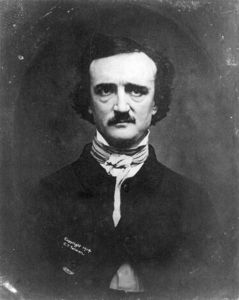 A quick note: The Harry Ransom Center, a humanities research library and museum at The University of Texas at Austin, is commemorating the 2009 bicentennial of Edgar Allan Poe, American poet, critic and inventor of the detective story, with the exhibition “From Out That Shadow: The Life and Legacy of Edgar Allan Poe.” To mark the occasion, the Center’s web site has launched The Edgar Allan Poe Digital Collection, and it nicely features Poe’s manuscripts, his letters and documents, photographs and even cryptographs that Poe liked to solve. (You can try to solve them too.) Have a look, and then feel free to download readings of Poe’s work in our collection of Free Audio Books.
Get Smart with Your iPhone
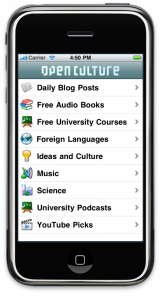 During the lazy days of summer, we quietly launched a new, free iPhone app. Now summer is fading, people are getting back to work, students back to school, and it’s time to get the word out. This app takes our intelligent media collections and let’s you listen to them on the go. Once you download the app, you can listen to free audio books, university courses, foreign language lessons, science podcasts and other intelligent content on the iPhone.
The app opens all media files in native iPhone software — iTunes, Safari, the YouTube player, etc. You will need WI-FI (Apple says so) to download the content. This app, which was very generously developed by Fred Hsu, is a work in progress. Don’t hesitate to give us feedback. And, if you don’t mind, please leave a nice review/rating in the App Store and spread the word.
Lastly, let me leave you with some praise that we received today. “I love this application. Been using it a lot for the Biology – Human Anatomy Courses available. Thank you so much for developing this app. Absolutely Brilliant!!!” Does this intrigue you enough to check it out?
Be a 2010 TED Fellow!
 Want to attend the 2010 TED Conference and hang with some of the world’s greatest minds? Here’s your chance. Apply to the TED Fellows program. Organizers of the TED Conference are looking for 25 promising Fellows from around the world to participate in TED 2010, and they’re accepting applications through September 25, 2009. Fellowships include conference admission, round-trip transportation, housing and all meals. Fellows will also participate in a pre-conference with the opportunity to present a short talk for consideration for TED.com. Applicants should generally between 21–40 years of age, though anyone over 18 and over 40 may apply. They must also be fluent in English. Click here and get started with your application today!
Related Content:
The Obama School Nontroversy
Anyone looking for controversy in President Obama’s school speech will be disappointed. No “socialist indoctrination” here. Just a good ol’ red, white & blue pep talk to students. The talk gets started at 2:10
In case you’re wondering what ground school talks covered in 1988, here’s a look back.
Every TED Talk Under the Sun
If you regularly visit Open Culture, then you’re probably familiar with TED Talks — the series of 15 minute “riveting talks by remarkable people” that TED produces and makes free to the world. We’ve included TED in our collection, Intelligent Video: The Top Cultural & Educational Video Sites, and it’s one of the best sources of intelligent video out there. Having said that, I was pleased to find this Google spreadsheet of every TED Talk ever posted online. Although TED hosts many videos on its web site (and on its iTunes and YouTube channels), these platforms don’t give you clean access to the entire TED catalogue. Meanwhile, this simple and sortable spreadsheet does. So enjoy, and use it well.
via BoingBoing
Related Content:
Support Us
We're hoping to rely on loyal readers, rather than erratic ads. Please click the Donate button and support Open Culture. You can use Paypal, Venmo, Patreon, even Crypto! We thank you!

Receive our Daily Email
About Us

Open Culture scours the web for the best educational media. We find the free courses and audio books you need, the language lessons & educational videos you want, and plenty of enlightenment in between.
Advertise With Us

