Last week, Craig Ferguson probably made a little television history when he invited a philosophy professor to appear on The Late Late Show. The guest is Jonathan Dancy, a prof at UT-Austin, who also happens to be the father of actor Hugh Dancy, and the father-in-law of actress Claire Danes. And the unlikely topic of discussion? Moral particularism, which argues that morality is contextual, not objectively defined. The conversation runs 11 minutes, and it’s intriguing to see how Ferguson and Dancy navigate the interview, trying to bring philosophy and comedy together. Meanwhile, if you’re a regular Open Culture reader, you’ll note that Dancy’s thinking stands in sharp contrast to the controversial vision of moral philosophy outlined by Sam Harris at the recent TED Conference.
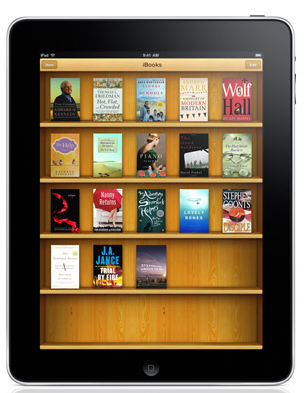
Yesterday morning, I headed to the Palo Alto Apple Store, spent an hour waiting in line, then finally gained entrance to the store. And who entered alongside me? Steve Jobs! An auspicious beginning. I left with a 32 gig iPad, took it home, and started playing particularly with the eBook reader. Here are my very early impressions:
15 months ago, I bought a Kindle and returned it. I just couldn’t read with it at night (a non-starter for me), and figured that Apple would eventually get it right. Well, they largely have. The iPad initially feels a little heavy. But, it’s actually no heavier than your average hardback book. Plus it’s fairly easy to hold. Score one for the iPad.
Then, when you fire up the eBook reader, you instantly like what you see. The fonts are crisp, and the images are in color, which means that you can read children’s books, comics and other graphic intensive texts. Plus, you can change the size and kind of the font. You can adjust the brightness of the screen. And, in some cases, you can even alter the background color of the screen. (Most of this you can’t do with the Kindle.) All of this contributes to a reader-friendly screen that’s easy on the eyes. And, yes, I can read with this device at night. (Readers make other good observations in the comments below.)
How about buying books for the iPad? Well, it’s pretty easy. Both Apple and Amazon sell books for the device, with prices generally ranging between $9.99 and $12.99. Rather notably, they also offer access to a sizable collection of free books in the public domain. (You can get more freebies here, too.) Overall, Amazon has a much larger inventory, and their books tend to be cheaper. But otherwise these are pretty similar services. And, because Apple now has a far superior device, you have to wonder whether this is the beginning of a big shift in the book market. In five years, Amazon might not be quite the behemoth it is today — something that’s probably letting Steve Jobs sleep easier than Jeff Bezos at night.
A final point worth mentioning here: Neither company will let you have true ownership over the books you buy. Both vendors lock down their books, dictate the operating environments in which you can read them, and control the user interfaces that shape the reading experience. (PC World has more on that here.) You don’t have much ultimate control over the underlying file. So the upshot is that you had better like the iPad (or Kindle) reading experience before deciding to amass a large and costly library.
Now for a few random observations:
1) The video generally looks great (unless, of course, it’s produced in Flash). I was really impressed with the quality of YouTube videos, and Netflix movies (free app here) stream over the iPad rather brilliantly.
2) On the downside, I found typing on the iPad to be rather difficult — even more so than typing on an iPhone. The device is large enough that it’s hard to stretch your fingers to reach various keys. Maybe I will get a hang of it. But, for now, it’s unwieldy.
3) The New York Times and Wall Street Journal have developed new apps for the iPad, and they deliver a pleasant reading experience, to be sure. But I don’t see this suddenly making consumers any more (or less) willing to pay. The concept of the iPad saving the newspaper industry seems fairly overplayed, I’m sorry to say.
4) Is this a must-have device? Or just nice-to-have? Right now, I’m inclined toward the latter (and so is Slate). Aside from the eBook reader, your home computer or smart phone can accomplish most of what the iPad can. However, the iPad will rapidly differentiate itself. It will become a nice low-cost, portable computer — one that lets you store data in the cloud, and provides access to a large volume of cheap or free software (at least more than your average consumer normally gets). Give it a year. Wait for the flood of apps to come. Wait for innovative software developers to extract the potential of this machine, and wait for Apple to make the iPad lighter, cheaper, and even faster. Right now, it’s not a game changer. But it will be down the line.
Are you a new iPad owner? Have any thoughts in general? Or particularly about the eBook reader? Add them to the comments below, or send them our way. We look forward to hearing what you have to say …
T.S. Eliot reads from The Wasteland, one of the great poems of the last century. It begins famously:
APRIL is the cruellest month, breeding
Lilacs out of the dead land, mixing
Memory and desire, stirring
Dull roots with spring rain.
Winter kept us warm, covering
Earth in forgetful snow, feeding
A little life with dried tubers.
Summer surprised us, coming over the Starnbergersee
With a shower of rain; we stopped in the colonnade,
And went on in sunlight, into the Hofgarten,
And drank coffee, and talked for an hour.
Bin gar keine Russin, stamm’ aus Litauen, echt deutsch.
And when we were children, staying at the archduke’s,
My cousin’s, he took me out on a sled,
And I was frightened. He said, Marie,
Marie, hold on tight. And down we went.
In the mountains, there you feel free.
I read, much of the night, and go south in the winter.
The details are still hazy. But we know this: Google will be launching a “collaborative research program to explore the digital humanities” using Google Books. Scholars will get up to $50,000 per year, and they’ll come from eight potential disciplines (archaeology, history, anthropology, linguistics, literature, classics, philosophy & sociology). And what’s the point of their research? Essentially to make Google’s online digital library more effective and friendly for researchers. Just last year, a prominent academic called Google Books a “Disaster for Scholars” in a high profile forum. The new grants should begin to address these concerns in some meaningful ways. For more information, head over to The Chronicle of Higher Education, which has the full story.
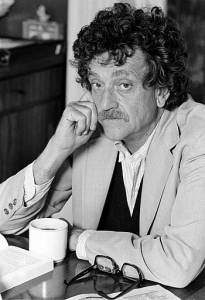
Kurt Vonnegut’s Slaughterhouse-Five was published back in 1969, and the anti-war sci fi novel quickly became a classic. (The book now appears, for example, on Time Magazine’s list of All Time 100 Novels.) Whether you’ve read the novel or not, you’ll want to check this out. HarperCollins has posted online a recording of Vonnegut himself reading a lengthy passage from the work. And he does it with the “casual irony that complements the novel’s wonderfully eccentric tone.” You can stream Vonnegut’s reading in the following formats: .au format (4.5 Mb), .gsm format (900 Kb), .ra format ( Mb). (Sorry a straightforward mp3 is not available.) Also, if you want some more Vonnegut, feel free to download his 1962 sci fi short story, 2BR02B, which is otherwise listed in our collection of Free Audio Books.
Note: Audible.com offers a version of Slaughterhouse-Five narrated by actor/writer Ethan Hawke. You can download it (or any another other book) for free if you start a free 14 day trial. It has no strings attached. Get some more basic details here.
In the early days of cinema, censorship was commonplace in America, and even slightly suggestive film clips wound up on the cutting room floor. Now, at long last, some clips are finally reaching the silver screen. In 2007, a filmmaker found cut scenes in an old theater somewhere in Pennsylvania, and, with them, produced a short film. Above, you can revisit the legacy of censorship in early American film. And, what’s more, you can watch lots of great vintage films with our collection of Free Online Movies.
There’s big news coming out of Europe today. After 16 years and $10 billion, the Large Hadron Collider (LHC) is finally beginning to collide subatomic particles. If you’re wondering what this all means, let me turn your attention to a yearlong course that we’re offering in Stanford’s Continuing Studies program (my day job). New Revolutions in Particle Physics is taught by Leonard Susskind, one of the world leading physicists, and it takes a deep look at new theories in particle physics that emerged during the 1970s, and how they’re now being tested by the LHC. The first course overviews the basic concepts, and you can watch it on YouTube or iTunes. (The first lecture appears above.) The second course will be soon made available online. The third course is just getting underway in the classroom (you can enroll here if you live near Stanford), and we’ll eventually post that course online as well. You can find more physics courses in the Physics section of our large collection of Free Online Courses.
UPDATE: As Maria, aka @brainpicker notes in the comments, CERN (which runs the LHC) hosts an archive of lectures, movies and collision videos, including some of this morning’s successful tests. More here.
We're hoping to rely on loyal readers, rather than erratic ads. Please click the Donate button and support Open Culture. You can use Paypal, Venmo, Patreon, even Crypto! We thank you!
Open Culture scours the web for the best educational media. We find the free courses and audio books you need, the language lessons & educational videos you want, and plenty of enlightenment in between.