The town of Cloquet lies in northern Minnesota along the St. Louis River. It has a population of roughly 11,000 residents, and several of its most famous residents play for the NHL. The town also happens to be home to the R.W. Lindholm Service Station – a gas station designed by none other than Frank Lloyd Wright.
In the early 1930s, Wright began developing concepts for Broadacre City, a city spread out to the point where it would be ‘everywhere and nowhere,’ kind of like what we would eventually call ‘suburbia.’ The design for the Lindholm gas station came directly from this conceptual project, and it was built in 1956. The station remains open and fully operational today, and it’s currently getting restored to its original condition. The video above gives you the best outside view of the Wright creation, and this second one gives you a closer look at some of the finer details.
In February 2010, the Paris-based band Hold Your Horses! released a music video to go with their song “70 Million,” which became an immediate success. In the video, the band members recreated famous paintings, taking the viewer on an entertaining tour through art history. Try to identify as many paintings as possible, then compare your results with the list of the actual paintings below the jump. Enjoy — and let us know your scores! And, of course, Happy Bastille Day.
We reached deep into our archives and pulled out a list of our greatest hits — our favorite science videos from the past five years. 125 videos in total, and the list will grow from here. Right now, it covers everything from Astronomy and Space Travel, to Physics and Biology, and then Psychology and Neuroscience. Our recommendation? Just jump right in here. But if you want a little preview, then let’s start you off with ten slam-dunk videos from the collection:
(Note: In the future, you can access this collection by clicking the “Great Science Videos” link under “Essentials.” Top of the center column.)
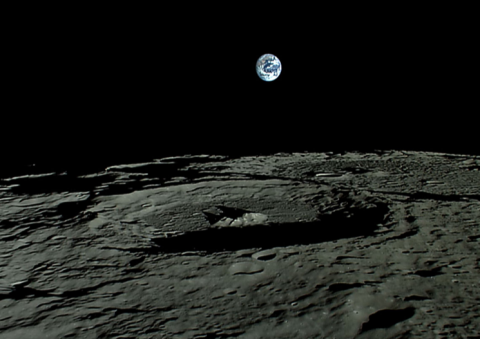
Earthrise in HD – Video — In November 2007, Japan’s Kaguya spacecraft orbited the moon and captured the first HD footage of an “earthrise” and “earthset.”
Touring the Earth from Space (in HD) – Video — Give NASA 7 minutes, and they’ll show you the Earth’s most impressive landscapes — as seen from space.
“First Orbit”: Celebrating 50th Anniversary of Yuri Gagaran’s Space Flight - Video — 99-minute documentary recreates the Soviet cosmonaut’s historic launch into space on April 12, 1961.
Arthur C. Clarke Presents the Colors of Infinity – Video – The futurist brings us inside Mandelbrot’s world of fractal geometry.
Physics from Hell: How Dante’s Inferno Inspired Galileo’s Physics – Video – Fascinating presentation by Mark Peterson, physics professor at Mount Holyoke College.
Lawrence Krauss: Every Atom in Your Body Comes From a Star- Video – Theoretical physicist talks about his work at the World Economic Forum in Davos.
What It Feels Like To Have a Stroke - Video — Harvard neuroanatomist Jill Bolte Taylor recounts her experience having a stroke. One of the most popular TED Talks of all time.
Nature by Numbers- Video — Well-known geometrical and mathematical formulas (The Fibonacci Series and Spiral, The Golden and Angle Ratios, The Delauney Triangulation and Voronoi Tessellations) present themselves in nature.
Tsunami Ripples Across Globe: Animated Video — Video — The National Oceanic and Atmospheric Administration shows Japanese tsunami rippling across the Pacific.
Daniel Pink: The Surprising Truth About What Motivates Us - Video — Research reveals what really, truly motivates us. And it’s all shown with animation.
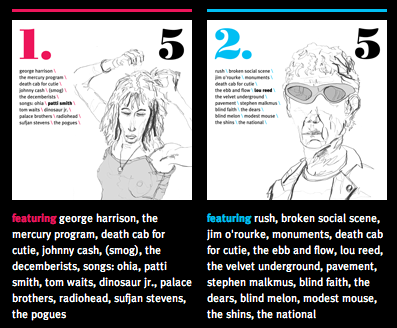
We love the design and overall layout of The Illuminated Playlists by Brooklyn-based designer Adam Parks, but the real delight of the website is its sound, not its look. Parks has grouped 21 music collections into four categories, from slow to very fast (or rather, Adagio to Presto), so you can choose a playlist depending on the pace of your current activity or mood.
As a DJ, Parks has made consistently solid choices, culling from both the classics (Bob Dylan, Neal Young, Rolling Stones, Curtis Mayfield) and more recent artists (TV on the Radio, The Decemberists, Arcade Fire, etc.). These aren’t the lists you would use to impress the cool kids with your eclecticism, ironic tastes, or love of the obscure, but if you’re just looking for great soundtracks for the shifting rhythms of the day, they’re a perfect fit. Dive in here.
We’d love to see similar collections for jazz and classical — we might just need to make a few of our own.
Sheerly Avni is a San Francisco-based arts and culture writer. Her work has appeared in Salon, LA Weekly, Mother Jones, and many other publications. You can follow her on twitter at @sheerly.
We want to be excited about the latest film version of Franz Kafka’s 1915 novella The Metamorphosis (get free etext here), especially because it’s an indie production, and we just can’t see the existential drama of Gregor Samsa’s journey from human to insect surviving a major studio adaptation. Furthermore, we love Nick Searcy in the F/X drama, Justified, and we’re happy to see him on the big screen.
We can accept the marketing twist of turning Samsa into a 17-year-old boy, but after seeing the concept art in the filmmakers’ trailer, we’re wondering if the proposed feature’s biggest star might be the special effects. Give it a watch and let us know what you think.
Sheerly Avni is a San Francisco-based arts and culture writer. Her work has appeared in Salon, LA Weekly, Mother Jones, and many other publications. You can follow her on twitter at @sheerly.
You’ve seen buildings magically transformed into artistic canvases before — the Astronomical Clock Tower in Prague; the iconic buildings at Cambridge University; and then this facade in Ukraine. But have you seen the audience take control of the architectural painting? That’s what happened in Lyon, France during the “Fête des lumières,” held last December. Throw an audio analysis algorithm and a microphone into the mix, and the audience now drives the surreal architectural show…
You’ve heard him read Lady Gaga, you’ve seen him reminisce with his fellow lov-ahs on Saturday Night Live, and you’ve heard him sub in for Leonard Lopate on the radio. But we’re not sure if any of Christopher Walken’s appearances can beat his demented spin on “The Three Little Pigs.” Mr. Walken’s reading of the potentially terrifying story is uncharacteristically jolly (he’s going for laughs, not chills), and we freely recommend it for children. Especially children from Brooklyn.
Sheerly Avni is a San Francisco-based arts and culture writer. Her work has appeared in Salon, LA Weekly, Mother Jones, and many other publications. You can follow her on twitter at @sheerly.
In 1932, as America slipped deeper into the Great Depression, Raymond Chandler lost his job as an oil company executive. Drinking and absenteeism didn’t help. So it was time to improvise. Soon enough, the 45 year old reinvented himself, becoming America’s foremost writer of hard-boiled detective fiction. During the 30s, he wrote 20 stories for pulp magazines and published his first novel, The Big Sleep(1939). Then, it was off to Hollywood, where Chandler co-wrote Double Indemnity (1944) with Billy Wilder and collaborated on Hitchcock’s Strangers on a Train(1951).
Hollywood may have buttered Chandler’s bread, but he never felt much affection for the film industry, and didn’t hesitate to say so. Writing for The Atlantic in November, 1945, he lamented how the Hollywood system bled anything you’d call “art” from the screenwriting process:
Hollywood is a showman’s paradise. But showmen make nothing; they exploit what someone else has made. The publisher and the play producer are showmen too; but they exploit what is already made. The showmen of Hollywood control the making – and thereby degrade it. For the basic art of motion pictures is the screenplay; it is fundamental, without it there is nothing. Everything derives from the screenplay, and most of that which derives is an applied skill which, however adept, is artistically not in the same class with the creation of a screenplay. But in Hollywood the screenplay in written by a salaried writer under the supervision of a producer — that is to say, by an employee without power or decision over the uses of his own craft, without ownership of it, and, however extravagantly paid, almost without honor for it.
We're hoping to rely on loyal readers, rather than erratic ads. Please click the Donate button and support Open Culture. You can use Paypal, Venmo, Patreon, even Crypto! We thank you!
Open Culture scours the web for the best educational media. We find the free courses and audio books you need, the language lessons & educational videos you want, and plenty of enlightenment in between.