The Wire as Great Victorian Novel

A while back, W. Daniel Hillis made the case that The Wire may rise to the lev­el of – if not sur­pass – Tol­stoy’s War & Peace. Writ­ing for the Edge.org, Hillis went so far as to say:

As much as I liked War and Peace, I prob­a­bly got more out of The Wire. And why should that be sur­pris­ing? More human effort can be put into a tele­vi­sion series than a nov­el and more time is spent con­sum­ing it. If both are exe­cut­ed to their high­est stan­dards, with equal care, skill and insight, we might well expect less from the book.

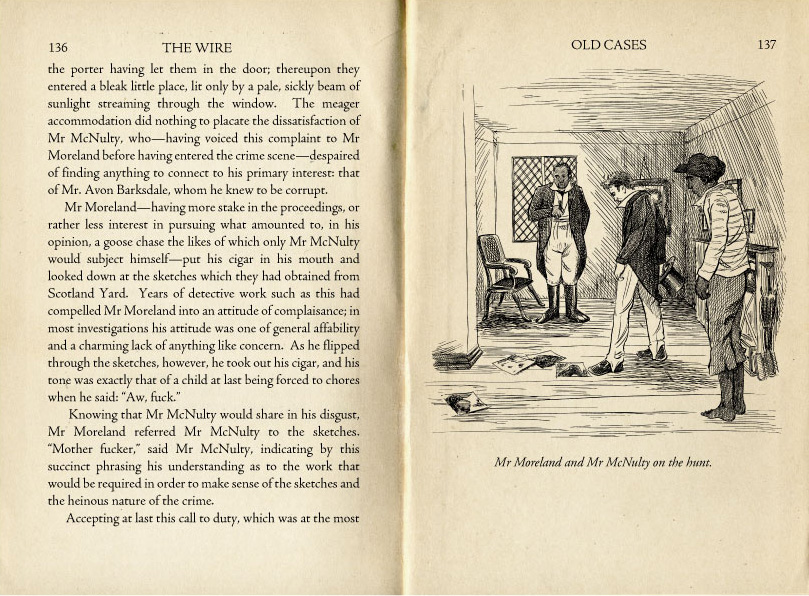
If we can men­tion The Wire in the same breath as Tol­stoy, then why not anoth­er giant of nine­teenth cen­tu­ry lit­er­a­ture, Charles Dick­ens? Yes, The Wire has been called “Dick­en­sian” too, and this week the Hood­ed Util­i­tar­i­an has re-imag­ined The Wire as a seri­al­ized Vic­to­ri­an nov­el. The premise? Imag­ine The Wire writ­ten in 60 install­ments over the course of six years, start­ing in 1846, by Hor­a­tio Buck­les­by Ogden, a Dick­ens con­tem­po­rary who wrote with a “nuance and atten­tion to detail that Dick­ens nev­er achieved.” Each install­ment ran 30 pages and sold for one shilling apiece.

The Hood­ed Util­i­tar­i­an has­n’t actu­al­ly print­ed these 60 install­ments (because they don’t actu­al­ly exist). But they have pro­duced a few won­der­ful mock pages, and writ­ten a faux piece of lit­er­ary crit­i­cism to accom­pa­ny them. A great job by Joy Delyr­ia and Sean Michael Robin­son.

via Boing­Bo­ing

by | Permalink | Make a Comment ( 6 ) |

The New York Philharmonic Opens Digital Archives to the Public

?si=cIQVBoJn2hFyBRHJ

The New York Phil­har­mon­ic recent­ly unveiled its dig­i­tal archives to the pub­lic. They haven’t fin­ished the archive quite yet, but they have com­plet­ed the Leonard Bern­stein years, also known as the  â€śInter­na­tion­al Era.” You can find busi­ness cor­re­spon­dence, hand­writ­ten notes, 3,200 pro­grams, and gems like this Mahler score, full of nota­tions and com­ments in Bern­stein’s hand. As a recent New York Times arti­cle points out, the Bern­stein years (1942–70) saw some of the most tumul­tuous events in Amer­i­can his­to­ry, and in no way was the Phil­har­mon­ic immune from its upheavals.

In the archives, one finds the orches­tra hir­ing women for the first time, scout­ing for African-Amer­i­can musi­cians (in 1969 they had just one), and even doing its bit to man­age U.S.-Soviet rela­tions with sev­er­al attempts to invite Shostakovich – unsuc­cess­ful­ly. Fans of Glenn Gould might par­tic­u­lar­ly enjoy read­ing the min­utes of a meet­ing in which mem­bers of the board, out­raged over Gould’s famous­ly con­tro­ver­sial Brahms per­for­mance just one month ear­li­er, argued to release him from his con­tract. Bern­stein him­self also hat­ed Gould’s inter­pre­ta­tion, but had nonethe­less defend­ed it before the audi­ence in an his­toric speech about the pianist’s artis­tic integri­ty and judge­ment. (The video above is of a hap­pi­er col­lab­o­ra­tion between the two mas­ters just two years ear­li­er.)

Also: On March 17, the NYPhil post­ed this video of a per­for­mance of Toru Takemit­su’s “Requiem for Strings,” to raise aware­ness of the plight in Japan and encour­age dona­tions.

Sheer­ly Avni is a San Fran­cis­co-based arts and cul­ture writer. Her work has appeared in Salon, LA Week­ly, Moth­er Jones, and many oth­er pub­li­ca­tions. You can fol­low her on twit­ter at @sheerly.

Evgeny Morozov Animated: The Dark Side of Internet Freedom

RSA has released its lat­est ani­mat­ed video, and this time it fea­tures Evge­ny Moro­zov, the Belarus-born researcher, who takes the con­trar­i­an posi­tion that the inter­net can often inhib­it (rather than pro­mote) democ­ra­cy, espe­cial­ly with­in author­i­tar­i­an con­texts like Chi­na and Iran. And what fol­lows (above) is a more sober­ing talk about how author­i­tar­i­an regimes use the web to sup­press civic engage­ment and fledg­ling democ­ra­cy move­ments. This clip is part of a longer 27 minute lec­ture (see full ver­sion here) that peers into “the dark side of inter­net free­dom,” a phrase that hap­pens to be the sub­ti­tle of Moro­zov’s new book.

Moro­zov is cur­rent­ly a vis­it­ing schol­ar in the Lib­er­a­tion Tech­nol­o­gy Pro­gram at Stan­ford, and if you’re won­der­ing how he looks at tech­nol­o­gy and the role it played in Egyp­t’s rev­o­lu­tion, you can watch a quick clip here.

Le Flaneur: Time Lapse Video of Paris Without the People

Luke Shep­ard, a stu­dent at the Amer­i­can Uni­ver­si­ty of Paris, began work­ing on Le Fla­neur as part of a project for school, but it quick­ly took on a life of its own. He used a Nikon D90 DSLR cam­era to take over 2,000 pho­tos of Paris at night, and then used Adobe After Effects and Pre­miere Pro to pro­duce this impres­sive tour of a world that most of us rarely see – Paris with­out Parisians. In Eng­lish, “fla­neur” trans­lates rough­ly as “stroller,” “loafer,”  or per­haps “aim­less walk­er,”  and, in an inter­view with Nation­al Geo­graph­ic Trav­el­er, Shep­ard explained that he was  inspired to shoot these images in part by late-night plea­sure rides on his bicy­cle.

(Note: Some view­ers may pre­fer to watch with the vol­ume off, as the chase scene-ready sound­track detracts a bit from the eerie sense of a vir­tu­al­ly desert­ed city.  For more time-lapse pho­tog­ra­phy, check out these videos of Mec­ca, New York City, and the Milky Way.)

Sheer­ly Avni is a San Fran­cis­co-based arts and cul­ture writer. Her work has appeared in Salon, LA Week­ly, Moth­er Jones, and many oth­er pub­li­ca­tions. You can fol­low her on twit­ter at @sheerly.

Elizabeth Taylor on “What’s My Line?” (1954)

Eliz­a­beth Tay­lor, a star for sev­en decades, died ear­li­er today of con­ges­tive heart fail­ure. She was 79 years old. To pay quick trib­ute, we’re high­light­ing Tay­lor’s 1954 appear­ance on “What’s My Line?,” the longest-run­ning game show in Amer­i­can tele­vi­sion his­to­ry (1950 — 1967). A good way to remem­ber Tay­lor – hav­ing a lit­tle fun in her prime.

The film men­tioned at the end of the scene – The Last Time I Saw Paris stars – also hap­pens to be avail­able at the Inter­net Archive for free. Enjoy

Relat­ed Con­tent:

Sal­vador Dali (and Oth­er VIPs) on “What’s My Line?”

by | Permalink | Make a Comment ( 4 ) |

Leonard Cohen Reads “The Future” (Not Safe for Work)

If you’ve been feel­ing the End Times’ icy breath a lit­tle close on your shoul­ders these past few weeks, we rec­om­mend a healthy dose of Leonard Cohen. You can start with this 20-minute inter­view from 1993, con­duct­ed by Bar­bara Gowdy of the Cana­di­an lit­er­ary series, Imprint. And click “play” with cau­tion — it starts with Cohen read­ing the very NSFW poem “The Future,” from his epony­mous 1992 album.

The sec­ond you hear that famous blue bari­tone say “Give me absolute con­trol over every liv­ing soul,” you know the apoc­a­lypse can cer­tain­ly wait till the poem’s over. Or maybe it can’t, but at least you’ll have spent your last few moments lis­ten­ing to Leonard Cohen.

Sheer­ly Avni is a San Fran­cis­co-based arts and cul­ture writer. Her work has appeared in Salon, LA Week­ly, Vari­ety, Moth­er Jones, and many oth­er pub­li­ca­tions. You can fol­low her on twit­ter at @sheerly.

Kutiman’s Trip to Jerusalem

The Israeli artist Ophir Kutiel, oth­er­wise known as Kuti­man, returns to YouTube with a rather dif­fer­ent project. No Moth­er of All Funk Chords. No Kuti­man-Thru-You. No new take on the remix, but rather a three-day stroll through Jerusalem with a Canon T21. An ancient, holy city seen through a mod­ern lens. The back­ground music is a Kuti­man orig­i­nal with Ita­mar Duari on per­cus­sion…

Lawrence Krauss: Every Atom in Your Body Comes From a Star

Lawrence Maxwell Krauss, author of the best-sell­ing book The Physics of Star Trek, is a the­o­ret­i­cal physi­cist and Pro­fes­sor of Physics at Ari­zona State Uni­ver­si­ty. His research focus­es on the begin­ning and the end of the uni­verse.

This past Jan­u­ary, Krauss attend­ed the World Eco­nom­ic Forum in Davos and was asked by 99 Faces TV to talk about his work. In a rel­a­tive­ly short 381 sec­onds, he speaks about the scale of the uni­verse, the con­cept of dark ener­gy and explains how “you real­ly are star­dust.” That is to say, every lit­tle atom in your body comes from a super­no­va (or explod­ing star). Krauss elab­o­rates on this poet­ic thought in this 2009 video (def­i­nite­ly rec­om­mend­ed), and he’ll have more to say in his new book, A Uni­verse from Noth­ing.

If you would like to sign up for Open Culture’s free email newslet­ter, please find it here. It’s a great way to see our new posts, all bun­dled in one email, each day.

If you would like to sup­port the mis­sion of Open Cul­ture, con­sid­er mak­ing a dona­tion to our site. It’s hard to rely 100% on ads, and your con­tri­bu­tions will help us con­tin­ue pro­vid­ing the best free cul­tur­al and edu­ca­tion­al mate­ri­als to learn­ers every­where. You can con­tribute through Pay­Pal, Patre­on, and Ven­mo (@openculture). Thanks!

By pro­fes­sion, Matthias Rasch­er teach­es Eng­lish and His­to­ry at a High School in north­ern Bavaria, Ger­many. In his free time he scours the web for good links and posts the best finds on Twit­ter.

« Go BackMore in this category... »
Quantcast

