In a world of accelerating obsolescence, of plastic products and digital information, a few old-school craftsman are still hanging on. But they’re getting harder and harder to find. In this pair of short films we meet a few craftsmen on both sides of the Atlantic who are stubbornly persisting while the world changes around them. Above is Ink & Paper by Ben Proudfoot, a student at the University of Southern California School of Cinematic Arts. It tells the story of the men who run the last surviving letterpress printing company in downtown Los Angeles, and the oldest paper company. Below is Le Mer de Pianos (The Sea of Pianos) by Tom Wrigglesworth and Mathieu Cuvelier, about the man who has spent 28 years (the last 15 as owner) running the oldest piano repair shop in Paris.
The online bookseller Good Books donates 100 percent of its retail profit to Oxfam’s charity projects, which tells you the sense of moral “good” their name means to evoke. But what about the other sense, the sense of “good” you’d use when telling a friend about a thrilling literary experience? Good Books clearly have their own ideas about that as well, and if you’d call Fear and Loathing in Las Vegas and Metamorphosis “good books,” you’re of the same mind they are. Having commissioned a series of promotional videos on the theme of Great Writers, Good Books show us the kind of readers they are by beginning it with an intricately animated mash-up of the spirits of Franz Kafka and Hunter S. Thompson. Under a bucket hat, behind aviator sunglasses, and deep into an altered mental state, our narrator feels the sudden, urgent need for a copy of Kafka’s Metamorphosis. Unwilling to make the purchase in “the great river of mediocrity,” he instead makes the buy from “a bunch of rose-tinted, willfully delusional Pollyannas giving away all the money they make — every guilt-ridden cent.”
The animation, created by a studio called Buck, should easily meet the aesthetic demands of any viewer in their own altered state or looking to get into one. Its ever-shifting shapes both chase and anticipate the words of the narrator’s looping, staggering monologue, complementing the eerily Thompsonian voice with wave after wave of troublingly Kafkan imagery (at least, whenever it settles into recognizable figures). Animation enthusiasts can learn more about the painstaking work that went into all of this in Motionographer’s interview with Buck’s creative directors. What, you wonder, was the hardest shot to animate? Probably the one “with the tethered goat and hundreds of beetles,” they reply. Some fret about the increasing intermingling between commercials and the stranger, more raw, less salable arts, but if this at all represents the future of advertisements, for charity stores or otherwise, I say bring on the goats and beetles alike. via The Atlantic
The clip brings you back to the final interview and moments of the great filmmaker Orson Welles. On October 10, 1985, Welles appeared on The Merv Griffin Show. He had just turned 70 and, rather ominously, the conversation brought Welles to take stock of his life. Again and again, the conversation returned to aging and the decline of his lovers and friends. Just two hours later, Welles would die of a heart attack at his home in Los Angeles. And gone was the talent who gave us Citizen Kane, The Stranger (watch in full), and The Trial (ditto), not to mention the famous War of the Worlds radio broadcast and great narrations of works by Plato, Kafka and Melville…
If you would like to sign up for Open Culture’s free email newsletter, please find it here. It’s a great way to see our new posts, all bundled in one email, each day.
If you would like to support the mission of Open Culture, consider making a donation to our site. It’s hard to rely 100% on ads, and your contributions will help us continue providing the best free cultural and educational materials to learners everywhere. You can contribute through PayPal, Patreon, and Venmo (@openculture). Thanks!
The great bluegrass banjo player Earl Scruggs died Wednesday at the age of 88. Shortly afterward, Steve Martin sent out a tweet calling Scruggs the most important banjo player who ever lived. “Few players have changed the way we hear an instrument the way Earl has,” wrote Martin earlier this year in The New Yorker, “putting him in a category with Miles Davis, Louis Armstrong, Chet Atkins, and Jimi Hendrix.”
Martin writes of Scruggs:
Some nights he had the stars of North Carolina shooting from his fingertips. Before him, no one had ever played the banjo like he did. After him, everyone played the banjo like he did, or at least tried. In 1945, when he first stood on the stage at the Ryman Auditorium in Nashville and played banjo the way no one had heard before, the audience responded with shouts, whoops, and ovations. He performed tunes he wrote as well as songs they knew, with clarity and speed like no one could imagine, except him. When the singer came to the end of a phrase, he filled the theatre with sparkling runs of notes that became a signature for all bluegrass music since. He wore a suit and a Stetson hat, and when he played he smiled at the audience like what he was doing was effortless. There aren’t many earthquakes in Tennessee, but that night there was.
In November of 2001 Martin had the opportunity to play the banjo alongside his hero on the David Letterman show. (See above.) They played Scruggs’s classic, “Foggy Mountain Breakdown,” with Scruggs’s sons Randy on acoustic guitar and Gary on Harmonica, and a stellar group that included Vince Gill and Albert lee on electric guitar, Marty Stewart on mandolin, Glen Duncan on fiddle, Jerry Douglas on Dobro, Glenn Wolf on bass, Harry Stinson on drums, Leon Russell on organ and Paul Shaffer on piano.
Depending on which circles you run in, you might have first spotted singer-songwriter-actor Glen Hansard as the leader of the rock band The Frames, as an actor in Alan Parker’s film The Commitments, or, more recently, as one half of the folk-rock duo The Swell Season. But if the success of John Carney’s movie Once is anything to go by, you may well have become aware of Glen Hansard while watching it. Carney, The Frames’ former bassist, knew that Hansard had accumulated just the kind stories in his youth spent busking around Dublin to shape his film’s down-and-out musician protagonist. By shooting time, Hansard had taken on the role himself, ensuring that a whole new, large audience would soon learn of a second inimitable Irish voice to put on their playlists.
The first, of course, would have to be Van Morrison, whose artistic captivation of generations of listeners extends to Hansard himself. Invited to Morrison’s birthday party by a Guinness heiress whom he befriended while busking, Hansard seized the chance to get near his favorite singer. Like some brave fans, he found a way to approach the reputedly brusque and temperamental Morrison. Unlike most of those fans, Hansard’s experience turned into a uniquely close and personal one. Watch the clip from Kevin Pollak’s Chat Show below and hear him tell the story of how he inadvertently parlayed a brushed-off song request (“You don’t know me!” was Morrison’s devastating dismissal) into an entire night spent exchanging songs alone with his musical idol.
Hansard likens this memory to one of “jamming with a Beatle,” before correcting himself: “No, better than a Beatle — it’s Van Morrison!” Though Hansard hails from Dublin and Morrison from Belfast — the root of such innate difference, Hansard explains, that he can’t even imitate Morrison’s accent — it seems only to make good sense that the two artists could engage in such a brief yet intense connection. Despite coming from separate generations and subcultures, these two immediately recognizable Irish musicians sound possessed of, or possessed by, something unusual. In both cases, their peculiarly expressive vocal and rhythmic energies defy easy description. In his book When That Rough God Goes Riding: Listening to Van Morrison, critic Greil Marcus describes this quality in Morrison as “the yarragh.” Listen to the cover of Morrison’s “Astral Weeks” above and wonder: what to call it in Hansard? H/T Metafilter
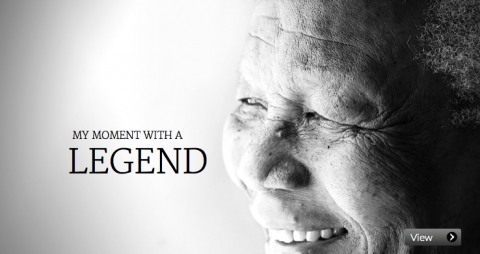
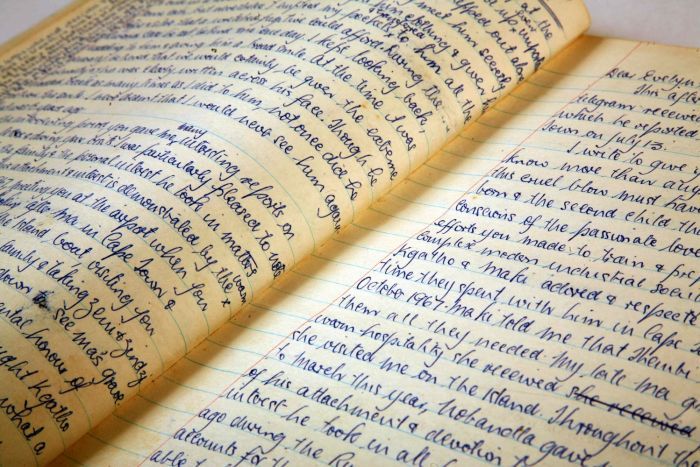
Last week, the Albert Einstein Archive went online, bringing thousands of the physicist’s papers and letters to the web. This week, we get the launch of the Nelson Mandela Digital Archive, which makes available thousands of papers belonging to the man who galvanized the anti-apartheid movement in South Africa, before eventually becoming the leader of the nation. (Don’t miss his first recorded TV interview from 1961 here.)
Made possible by a $1.25 million grant from Google, the archive organizes Mandela’s papers chronologically and thematically. You can jump into sections covering his Early Life, Prison Years, and Presidential Years, or explore his extensive book collections and work with youngsters. And, much like Einstein, you’ll get to know a different side of Mandela, the private side that was often hidden from public view.
We had to do it. We had to bring back a wonderful little animation of The Bayeux Tapestry — you know, the famous embroidery that offers a pictorial interpretation of the Norman Conquest of England (1066) and the events leading up to this pivotal moment in medieval history. Currently residing in France, the tapestry measures 20 inches by 230 feet, and you can now see an animated version of the story it narrates. The clip above starts roughly halfway through the historical narrative, with the appearance of Halley’s Comet, and it concludes with the Battle of Hastings in 1066. The video created by David Newton began as a student project at Goldsmiths College.
P.S. Don’t miss the many courses in the History section of our big collection of Free Online Courses. They’re all from top flight universities.
Follow us on Facebook, Twitter and now Google Plus and share intelligent media with your friends! They’ll thank you for it.
During the late 1990s, when the internet first boomed, we talked a lot about creative destruction — about how old businesses would collapse, making way for new ones to emerge. And, indeed, companies like Amazon, Dell.com, and eBay changed the way we buy our books, computers and everyday items. Years later, we’re seeing new internet technologies changing the arts world. Kickstarter, a platform that uses crowdsourcing to fund creative projects, may eventually bring more funding to the arts than the NEA, providing support for countless new artists. Creative Commons and its liberating copyright regime already lets artists distribute their creative works to the broadest audience possible. And The Creators Project, a global arts initiative created by Intel and Vice, is redefining our concept of the art studio and art exhibition. That’s the story told by Art in the Era of the Internet, a video created by PBS’ Off Book web series.
Speaking of Creative Commons, the California nonprofit (along with the U.S. Department of Education and the Open Society Institute) has launched the Why Open Education Matters Video Competition. The competition will award cash prizes for the best short videos explaining the use of Open Educational Resources and the opportunities these materials create for teachers, students and schools. Create a great video (by June 5th) and you can win $25,000. Get more details at WhyOpenEdMatters.org
We're hoping to rely on loyal readers, rather than erratic ads. Please click the Donate button and support Open Culture. You can use Paypal, Venmo, Patreon, even Crypto! We thank you!
Open Culture scours the web for the best educational media. We find the free courses and audio books you need, the language lessons & educational videos you want, and plenty of enlightenment in between.