Give the talented Alex Chadwick 12 minutes, and he’ll give you A Brief History of Rock ‘n’ Roll, with each defining moment represented by a famous guitar riff. Our journey starts in 1953, with “Mr. Sandman” by Chet Atkins. Pretty soon, and quite seamlessly, we get to The Beatles and The Rolling Stones, Hendrix and Led Zeppelin, Queen and The Ramones, and eventually some more contemporary pairings — Green Day and White Stripes. The video is sponsored by the Chicago Music Exchange, a store specializing in vintage gear, like the $32,995 1958 Fender Strat played in the clip. A full list of riffs appears below the jump.
If you would like to support the mission of Open Culture, consider making a donation to our site. It’s hard to rely 100% on ads, and your contributions will help us continue providing the best free cultural and educational materials to learners everywhere. You can contribute through PayPal, Patreon, and Venmo (@openculture). Thanks!
Looking for free, professionally-read audio books from Audible.com? Here’s a great, no-strings-attached deal. If you start a 30 day free trial with Audible.com, you can download two free audio books of your choice. Get more details on the offer here.
“They’re not the best at what they do,” said respected rock promoter Bill Graham of the Grateful Dead. “They’re the only ones that do what they do.” The band developed such an idiosyncratic musical style and personal sensibility that their legion of devoted fans, known as “Deadheads,” tended to follow them everywhere they toured. The Dead withstood more than their fair share of classic-rock turbulence in the thirty years from their formation in 1965, but didn’t dissolve until the 1995 death of founding member and unofficial frontman Jerry Garcia. The bereft Deadheads, still in need of a constant flow of their eclectic, improvisational, psychedelic-traditional, jam-intensive sound of choice, took a few different paths: some began following other, comparable groups; some would go on to rely on acts formed by ex-Dead members, like Bob Weir and Phil Lesh’s Furthur; some made it their life’s mission to collect everything in the band’s incomparably vast collection of demos, live recordings, and sonic miscellany.
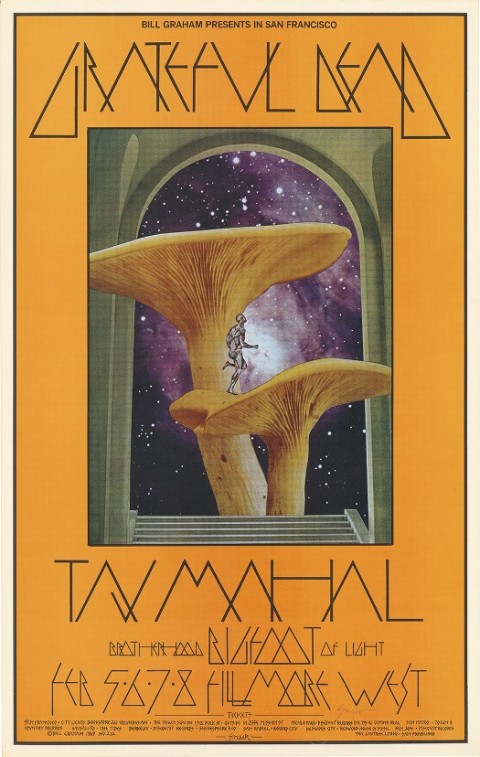
Grateful Dead completists now have another source of solace in the Grateful Dead Archive Online from the University of California, Santa Cruz. Lest you assume yourself Dead-savvy enough to have already seen and heard everything this archive could possibly contain, behold the newly added item featured on the front page as I type this: Jerry Garcia’s Egyptian tour laminate. According to the press release, the archive’s internet presence features “nearly 25,000 items and over 50,000 scans” from the university’s physical archive, including “works by some of the most famous rock photographers and artists of the era, including Herb Greene, Stanley Mouse, Wes Wilson and Susana Millman.” Rest assured that it offers plenty of non-obscurantist Dead-related pleasures, including television appearances, radio broadcasts, posters, and fan recordings of concerts. Like any rich subject, the Grateful Dead provides its enthusiasts a lifetime of material to study. UC Santa Cruz, a school often associated in the public imagination with the Dead’s greater San Francisco Bay Area origins as well as their penchant for laid-back good times, has just made it that much easier to plunge into.
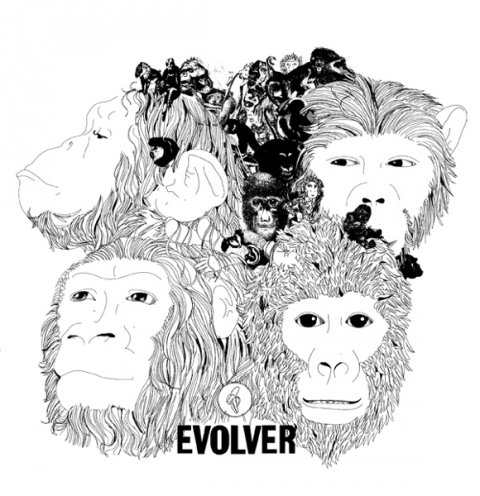
The Evolver T‑Shirt, it’s the perfect gift for the science believin’ Beatles fan. It’s obviously a play on The Beatles’ great 1966 album Revolver. And, over at BoingBoing, Mark Frauenfelder asked readers to rethink the titles of various songs on the album — to imagine them in evolutionary terms. Here are some of the creative suggestions:
Taxman = Macaques, Man
And Your Bird Can Sing = And Your Chimp Can Swing
I’m Only Sleeping = I’m Only Simian
Doctor Robert = Doctor Fossey
I Want to Tell You = I Want to Groom You
Tomorrow Never Knows = Too Many Bonobos
Personally, I think “Tomorrow Never Knows” could stay just as it is. Doesn’t it already capture the Darwinian spirit in its own way?
There’s something timeless about William Shatner. The man hardly looks his age — 81 — though synthetic enhancements probably have something to do with it. And he hasn’t lost his gift for shtick. Back in the 1960s, Shatner began talk-singing his way through various songs. Perhaps you’ll recall his rendition of “Lucy in the Sky with Diamonds” recorded in 1968, which we recently featured on our list of The 15 Worst Covers of Beatles Songs Ever. A good four decades later, the tradition continues. For Canada Day, eh, we have the Shat reciting the national anthem, O Canada, is his inimitable way. The clip was recorded in 2011 when Canada’s Governor General gave Shatner a Lifetime Achievement Award. Thanks to Denise for the tip.
We're hoping to rely on loyal readers, rather than erratic ads. Please click the Donate button and support Open Culture. You can use Paypal, Venmo, Patreon, even Crypto! We thank you!
Open Culture scours the web for the best educational media. We find the free courses and audio books you need, the language lessons & educational videos you want, and plenty of enlightenment in between.