Today is the birthday of Emily Dickinson, an extraordinarily shy woman who rarely left her house but whose poems have gone out to meet the world.
Dickinson’s poetry is widely celebrated for its beauty and originality. As her biographer at the Poetry Foundation Web site writes, “To make the abstract tangible, to define meaning without confining it, to inhabit a house that never became a prison, Dickinson created in her writing a distinctively elliptical language for expressing what was possible but not yet realized.”
To celebrate Dickinson’s birthday (she was born on December 10, 1830) we bring you this little film of her poem, “I Started Early–Took My Dog,” from the “Poetry Everywhere” series by PBS and the Poetry Foundation. The poem is animated by Maria Vasilkovsky and read by actress Blair Brown. You can also read the poem for yourself here.
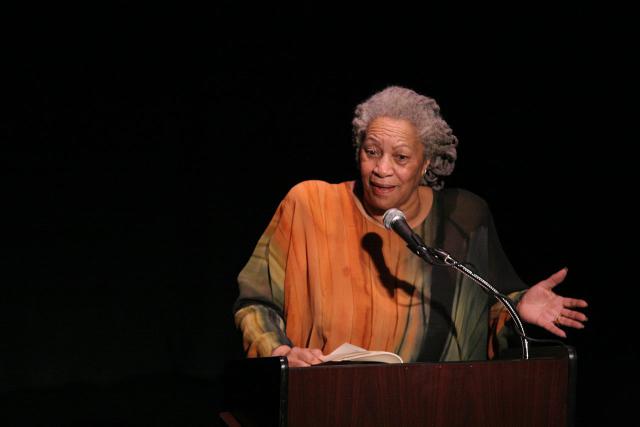
It is sometimes the case that a favorite writer isn’t terribly interesting when it comes to talking shop. This has never been so with the self-revealing Toni Morrison, whose public appearances and interviews often duplicate the experience of reading one of her novels—her voice draws you in, and before you know it, you’re part of a world all her own that she has given you the privilege of joining for a short time.
This is the experience of reading her interview with Elissa Schappell in the Paris Review. Morrison discourses on subjects ranging from her personal routine and history, to her identity as a writer and a woman, to the larger history of slavery and the black lives she writes about. Woven through it all are observations about her art that may or may not be of any use to budding writers, but which will certainly make lovers of Morrison read her work a little differently. Some of her observations are below:
Write when you know you’re at your best. For her, this happened to be the early morning, pre-dawn hours, before her children woke up, since she worked full-time and feels she is “not very bright or very witty or very inventive after the sun goes down.” Morrison describes her morning ritual this way:
I always get and make a cup of coffee while it is still dark—it must be dark—and then I drink the coffee and watch the light come.
“There’s a line between revising and fretting” It’s important for a writer to know when they are “fretting,” because if something isn’t working, “it needs to be scrapped,” although in answer to whether she goes back over published work and wishes she had fretted more, Morrison answers, “a lot. Everything.”
A good editor is “like a priest or a psychiatrist.” Morrison worked as an editor for Random House for 20 years before she published her first novel. She observes the relationship between writer and editor by saying that getting the wrong one means that “you are better off alone.” One of the marks of a good editor? She doesn’t “love you or your work,” therefore offers criticism, not compliments.
Don’t write with an audience in mind, write for the characters. Knowing how to read your own work—with the critical distance of a good reader—makes you a “better writer and editor.” For Morrison, this means writing not with an audience in mind, but with the characters to go to for advice, to tell you “if the rendition of their lives is authentic or not.”
Control your characters. Despite the ever-present and clichéd demand to “write what you know,” Morrison studiously tries to avoid taking character traits from people she knows. As she puts it: “making a little life for oneself by scavenging other people’s lives is a big question, and it does have moral and ethical implications.” And as for keeping control of her characters, Morrison says “They have nothing on their minds but themselves and aren’t interested in anything but themselves. So you can’t let them write your book for you.”
Plot is like melody; it doesn’t need to be complicated. Morrison sums up her approach to plot in Jazz and The Bluest Eye by saying “I put the whole plot on the first page.” Rather than constructing intricate plots with hidden twists, she prefers to think of the plot in musical terms as a “melody,” where the satisfaction lies in recognizing it and then hearing the “echoes and shades and turns and pivots” around it.
Style, like jazz, involves endless practice and restraint. Speaking of Jazz, Morrison tells she has always thought of herself like a jazz musician, “someone who practices and practices and practices in order to able to invent and to make his art look effortless and graceful.” A large part of her “jazz” style, she says, is “an exercise in restraint, in holding back.”
Be yourself, but be aware of tradition. Of the diversity of African-American jazz musicians and singers, Morrison says “I would like to write like that. I would like to write novels that were unmistakably mine, but nevertheless fit first into African American traditions and second of all, this whole thing called literature.”
If you would like to support the mission of Open Culture, consider making a donation to our site. It’s hard to rely 100% on ads, and your contributions will help us continue providing the best free cultural and educational materials to learners everywhere. You can contribute through PayPal, Patreon, and Venmo (@openculture). Thanks!
Josh Jones is a doctoral candidate in English at Fordham University and a co-founder and former managing editor of Guernica / A Magazine of Arts and Politics.
Even if you hate or fear statistics, you’ve surely become more than aware in recent months of one particular statistician: Nate Silver. The young professional number-cruncher has made the news in a big way for a legitimately impressive statistical feat: predicting the winner of all fifty states and the District of Columbia in this year’s United States presidential election. He came nearly as close back in 2008’s election, predicting the winner in 49 states. In between those coups, Time named Silver one of the world’s hundred most influential people, and the New York Times has given their official imprimatur by hosting his blog FiveThirtyEight. Now he’s received what some would consider an even higher honor: an invitation to sit down with Conan O’Brien for the better part of an hour on Serious Jibber-Jabber.
“Elections are probably the most dramatic moments in the history of our country,” O’Brien says to Silver. “These’s a danger,” he then deadpans, “that you’re taking the fun out of it.” We jumped on O’Brien’s new long-form interview web series last month, featuring his conversations with presidential historian Edmund Morris and “comedy mastermind” Judd Apatow. Silver, the program’s third guest, perfectly continues its short but strong tradition of personalities who bring both zeitgeist relevance and intellectual substance. The choice also taps into a well of public curiosity — a great many of us know of Nate Silver without quite understanding why we do — and finds a reserve of goofiness to match O’Brien’s own. (If you doubt this, behold Silver’s Cookie Monster t‑shirt.) So think hard when you watch this conversation about political echo chambers, media fragmentation, data’s relationship to instinct, and mathematical modeling. But do feel free to laugh at the jokes.
There’s no doubt that a single inspiring teacher can have a profound impact on a student’s life, but what about the duds? The apoplectic nun, the tapped out fossil, the bitter young man? If there’s deadwood in your educational history, you owe it to yourself to spend some time with John Green. The charismatic author and nerdfighter is following up his online video series Crash Course World History, with the new mini series, Crash Course English Literature.
Think Shakespeare is boring? It’s a position you’ll be hard pressed to maintain after hearing Green’s take on Romeo and Juliet, a veritable luge of facts, trivia, cute graphics, frank-ish sex talk, corny jokes and iambic lowdown. Extra credit for referencing Harley Granville-Barker, the turn of the century quintuple-threat who summarized the play as “a tragedy of youth as youth sees it”.
Having laid down a few ground rules in episode one, Green is preparing to take on Fitzgerald, Salinger, and Emily Dickinson. If any of these names dredge up unpleasant memories, relax. Green is not going to make you parse symbols and authorial intent. His schtick is proudly populist, a PeeWee’s Playhouse open to those who seek knowledge, as well as those whom experience has taught to resist.
“I want to be a director, and I’ve been told that there are enough artists in the world, and that’s not something I should pursue. Do you [agree with that]?”
Make your own art, meaning the art that reflects your individuality and personal vision.
Leave the world more interesting than it was before.
They’re wise tips, but they’re better taken in conjunction with suggestions 1, 2, 3, 4, 5, 7, 8, and 9. Watch them all here. And don’t miss our collection of Free Neil Gaiman Stories, available in text, audio and video.
It used to be that you couldn’t go into a bookstore this time of year without being literally surrounded by Gary Larson’s The Far Side. His calendars and books were massive best sellers and his single-panel comics seemed to be everywhere, taped to cubicle walls and pinned to bulletin boards. Larson’s hilariously subversive sense of empathy–his way of rendering people with the detachment of an entomologist while investing his animal characters with the most sympathetic of human traits–endeared him to millions.
But in 1995, after 15 years of struggle against grinding deadlines, Larson called it quits. Since then he’s been about as reclusive as Greta Garbo or J.D. Salinger. And while Larson’s calendars and books continued to appear for some years after his retirement, The Far Side is not much in evidence these days. Which is sad. You can’t buy your friends a 2013 Far Side desk calendar this holiday season, but perhaps you can share this: a few twisted scenes from Larson’s 1994 animated film, Tales From the Far Side. The film was originally aired as a Halloween special on CBS. The clip above begins on a fittingly nostalgic note.
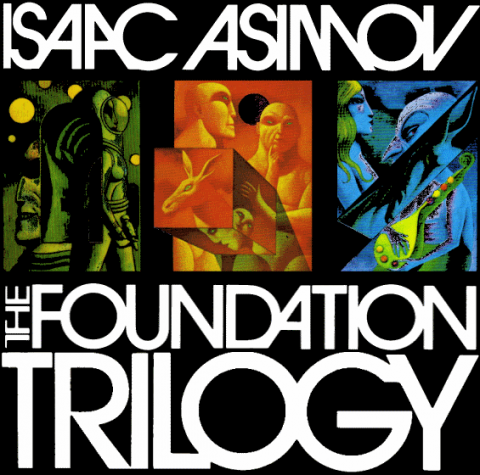
Tireless New York Times columnist and Nobel-prize winning Princeton economist Paul Krugman has long played the role of Cassandra, warning of disasters while the architects of policy look on, shake their heads, and ignore him. I’ve sometimes wondered how he stands it. Well, it turns out that, like many people, Krugman’s long view is informed by epic narrative. Only in his case, it’s neither ancient scripture nor Ayn Rand. It’s the Isaac Asimov-penned FoundationTrilogy, which Krugman, in a recent Guardian piece, dissects in detail as a series that informed his views as a teenager, and has stayed with him for four and a half decades.
The hero of the trilogy, Hari Seldon, is a mathematician, whose particular branch of mathematics, called psychohistory, allows him to make massive, large-scale predictions of the future. This science informs “The Seldon Plan” that silently guides the coming of a new Galactic Empire thousands of years into the future. If it sounds a bit arid in paraphrase, it isn’t, even though Asimov’s characters tend to be thin and his descriptions lack in poetry. “Tolstoy this isn’t,” Krugman tells us.
But the novels work as brilliant speculative fiction, tethered to the familiar history of Western civilization by resonances with ancient Rome, mercantile Europe, and old New York. Instead of space opera or fantasy, Krugman describes Asimov’s fiction as anti-action, anti-prophecy. The protagonist’s “prescience comes from his mathematics.” And this, believe it or not, is fascinating, at least for Krugman. Because for him they function as reminders that “it’s possible to have social science with the power to predict events and, maybe, to lead to a better future.” Krugman writes:
They remain, uniquely, a thrilling tale about how self-knowledge – an understanding of how our own society works – can change history for the better. And they’re every bit as inspirational now as they were when I first read them, three-quarters of my life ago.
He admits that the sentiments of Asimov’s fiction present us with a “very bourgeois version of prophecy,” but then, economics is a very bourgeois science, mostly concerned with one emotion, “greed.” Nonetheless, Krugman believes in the power of “good economics to make correct predictions that are very much at odds with popular prejudices.” And we could all do with fewer of those.
Asimov’s Hugo-winning trilogy was adapted for eight, one-hour radio-drama episodes in 1973. Listen to the first installment above, and download or stream the remaining episodes at the links below:
Part 1 |MP3| Part 2 |MP3| Part 3 |MP3| Part 4 |MP3| Part 5 |MP3| Part 6 |MP3| Part 7 |MP3| Part 8 |MP3|
Or listen to the Spotify version up top.
You can find this audio listed in our collection of Free Audio Books.
Josh Jones is a doctoral candidate in English at Fordham University and a co-founder and former managing editor of Guernica / A Magazine of Arts and Politics.
For an example of empathy that looks to him proto-outrospective, Krznaric cites George Orwell, author of 1984 and Animal Farm. His plunge into the world of urban poverty — the deepest kind of first-hand research — to write Down and Out in Paris and London, coming to know, befriend, and work alongside the down-and-out themselves, makes him “one of the great empathic adventurers of the 20th century.” This line of thought connects Orwell’s active social curiosity to empathy as a potentially collective force; we even hear a call for new, empathy-oriented social institutions like a “human library” with actual people available for illuminating conversations. Empathy, to Krznaric’s mind, will only become more important in the 21st century, and those of us who can master outrospection, the skill of “discovering who we are by stepping outside ourselves and exploring the lives of other people and cultures,” will fare best there. If after the video you still find yourself confused about how best to engage in outrospection, don’t worry: Krznaric writes an entire blog on the subject.
We're hoping to rely on loyal readers, rather than erratic ads. Please click the Donate button and support Open Culture. You can use Paypal, Venmo, Patreon, even Crypto! We thank you!
Open Culture scours the web for the best educational media. We find the free courses and audio books you need, the language lessons & educational videos you want, and plenty of enlightenment in between.