It’s a simple recipe for happiness. Eliminate all negative emotions, anything that creates bad feelings and distracts from the project at hand. Clear it all away, and what’s left? The space for creativity pure and simple. That’s happiness for Hitch. Watch 20 Free Hitchcock Films online here.
Follow us on Facebook, Twitter and now Google Plus and share intelligent media with your friends! They’ll thank you for it.
Last December, we featured the documentary Portrait of a Bookstore as an Old Man in tribute to its recently passed subject, noted bookseller and eccentric George Whitman. His store Shakespeare and Company has sent a beacon from Paris’ Left Bank to writers and bibliophiles the world over for sixty years, and it continues to do so under Whitman’s daughter, Sylvia Beach Whitman. While practically every bookstore in business today takes pains to set itself apart as something “more than just a bookstore,” Shakespeare and Company has been hip to that plan since its inception, offering a reading library, Sunday tea, a storied makeshift writers’ colony, and a taste of the early twentieth-century’s expatriate-filled Parisian literary scene. Readers well-versed in the history of that scene will notice a clever bit of attempted predestination on George Whitman’s part in naming his daughter after Sylvia Beach, the American founder of another famous bookstore called Shakespeare and Company, which operated from 1921 to 1941.
You can learn more about Sylvia Beach Whitman — much more than you’d expect to in under four minutes — from art-world documentarian Chiara Clemente’s profile of her on the Sundance Channel’s documentary series Beginnings. Whitman remembers her days as Shakespeare and Company’s official moppet, when its writers in residence — her “hundreds of brothers and sisters” — would tell her custom-made bedtime stories before flopping down on their own beds built atop the book piles. She’s since grown up and gone on to do big things with the store, including starting a biennial literary festival which has brought in the likes of Jung Chang, Paul Auster, David Hare, and Persepolis author Marjane Satrapi, who features in a Beginnings short of her own (see above). When not hard at work on a page of comic art, Satrapi lights up a cigarette and remembers how, due to the last forty years of constant political churn in her native Iran, no Iranian of her generation has lived anything like a “normal” life. The series also covers the early lives and first inspirations of creators including shoe designer Christian Louboutin, Blue Hill chef Dan Barber, and… well, you can’t describe Yoko Ono as anything but Yoko Ono. But you can watch her episode of Beginnings on NYTimes.com and hear about her struggle to find her way to the avant-garde after emerging from her family’s artistic traditionalism. H/T New Yorker
Yesterday we featured a video of Lynyrd Skynyrd’s “Sweet Home Alabama” being played on a pair of Tesla coils. Today we keep the music going with something perhaps even more amazing: a swarm of autonomous flying robots playing the theme from the James Bond movies.
The robots were developed at the University of Pennsylvania’s General Robotics, Automation, Sensing and Perception (GRASP) lab by graduate students Daniel Mellinger and Alex Kushleyev, founders of KMel Robotics, under the supervision of Professor Vijay Kumar. The researchers are working to develop agile, autonomous flying robots that can mimic the swarming behaviors of birds, fish and insects. In the video above, which was created specially for Kumar’s February 29 TED talk, a swarm of nine quadrotor helicopters play musical instruments. An article on the UPenn website explains:
In this demonstration, the “stage” is in a room fitted with infrared lights and cameras. The nano quads all have reflectors on their struts, which allows the camera system to plot their exact position and relay that information wirelessly to each unit.
Lab members can then assign each unit a series of waypoints in three-dimensional space that must be reached at an exact time. In this case, those times and places translate into notes on a keyboard or a strum of a guitar. Figuring out how to get from waypoint to waypoint most efficiently and without disturbing their neighbors is up to the robots.
The robots are remarkably agile, and may someday be useful for a wide variety of applications. To learn more, watch Kumar’s 17-minute TED talk, below, which includes several astonishing video demonstrations of the robots in action.
You can create music with Tesla coils if you know how to modulate their “break rate” with MIDI data and a control unit. Case in point. Here we have two solid state musical Tesla coils, using a combined 24KW of power, to play a version of Lynyrd Skynyrd’s 1974 classic “Sweet Home Alabama” (listen to the original here). Also enjoy electrified versions of House of The Rising Sun and Dueling Banjos. via @webacion
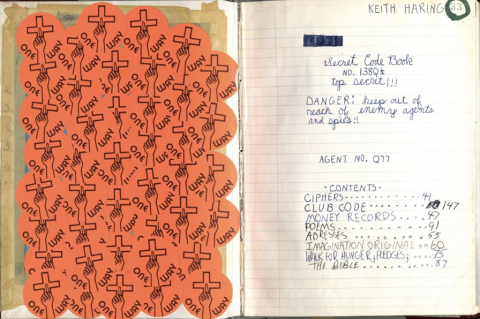
Tomorrow marks the opening of Keith Haring: 1978–1982, the first “large-scale exhibition to explore the early career of one of the best-known American artists of the twentieth century.” The exhibition, appearing at The Brooklyn Museum until July 8, traces the development of Haring’s visual vocabulary by showcasing “155 works on paper, numerous experimental videos, and over 150 archival objects, including rarely seen sketchbooks, journals, exhibition flyers, posters, subway drawings, and documentary photographs.” And, of course, the exhibition is accompanied by a Tumblr that will host online pages taken from Haring’s personal journals. The Tumblr will post one new entry per day (like the one above), throughout the duration of the exhibition. You can keep tabs on the entries right here. H/T Metafilter
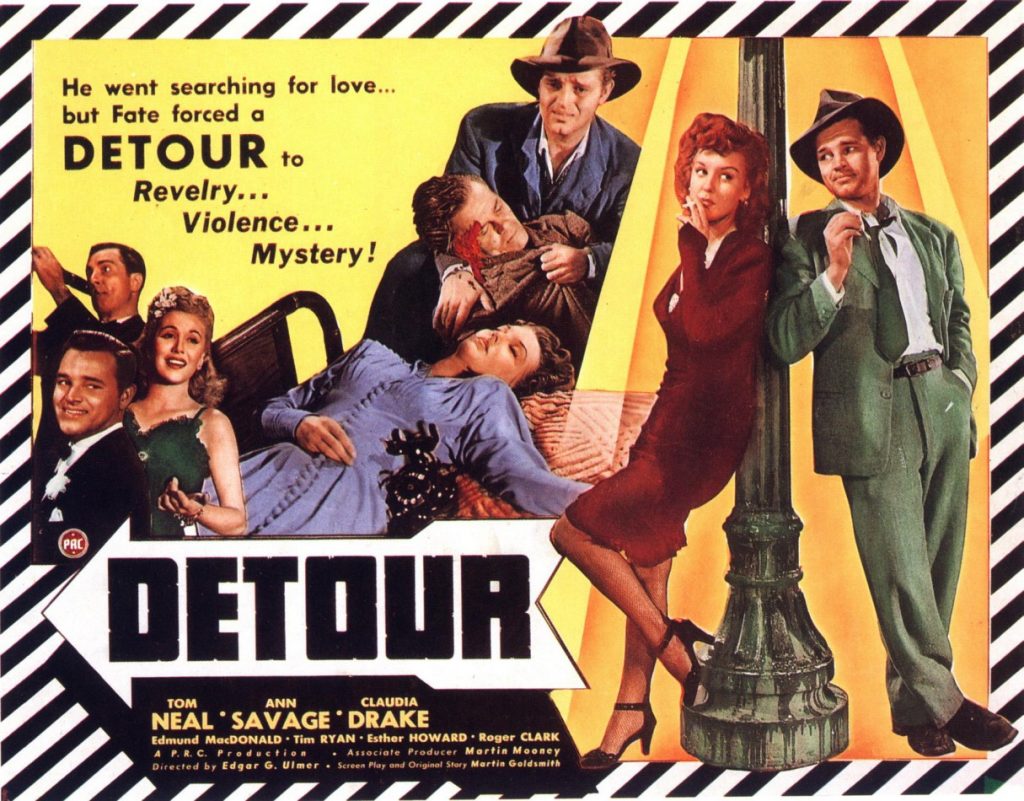
According to cinema lore, Edgar G. Ulmer’s Detour, a slapdash, unprofessional $20,000 melodrama shot in a mere mistake-filled six days, has somehow, over the past 66 years, accrued a sizable and appreciative following among film noir enthusiasts. Except it turns out that, in reality, its budget probably ran to some $117,000. And those six days might have actually been three six-day weeks. And the Austrian-born Ulmer, who had not only worked for such European luminaries as F.W. Murnau, Billy Wilder, and (so he claimed) Fritz Lang, but even made The Black Cat for Universal Pictures, hardly lacked professional bona fides. And the film’s careful use of sound and striking use of light set it apart even from its brethren in the genre.
And speaking of that genre, a hearty critical agreement now holds that Detour distills, in its brief 68 minutes, the most vital emotional and aesthetic elements of film noir in a way that none of its other exemplars have managed. And mistakes? What mistakes? As Roger Ebert wrote on ushering the film into his Great Movies canon, “Placing style above common sense is completely consistent with Ulmer’s approach throughout the film.”
To recount Detour’s story here — a piano-player down on his luck; a sudden death; a scheming, venomous dame — would be to miss the point. To cite out its many, er, unconventional production choices — nonexistent backgrounds concealed with fog, shots simply flipped over and re-used, stock footage meant to pad the runtime almost to feature length, unconvincing rear projection even by 1945’s standards — would be to miss the point from another direction. The film has fallen into the public domain, so watch it free online and experience for yourself the way that, for all its apparent bluntness, it stealthily lodges itself in your sense memory. To call a movie “dreamlike” reeks of cliché, but Detour presents the elements of film noir in such a pure, naked state that you have little choice but to accept them directly, the way you would accept the “facts” of a dream. Though seemingly incompetent on all the levels subject to conscious analysis, the film operates effectively on all the levels beneath, hence the lasting inspiration it offers to certain filmmakers today. Make Detour, if you can, a double-feature with David Lynch’s Lost Highway, which plays almost like a straight tribute to Ulmer’s picture. As a dedicated transcendental meditator with a fascination for the dark side of Los Angeles and a tendency to bend archetypal characters toward his often oblique but always vivid stylistic will, Lynch has internalized Detour’s legacy — intended or otherwise — more deeply than any other filmmaker alive today.
More noir classics can be found in our collection of 60+ Free Noir Films.
Earlier this week The New York Times published an interesting discussion between philosopher Michael Lynch and physicist Alan Sokal on epistemic first principles, or, as Lynch put it in an earlier essay, the “Reasons for Reason.” To illustrate the practical advantage of observation and inductive reasoning in the formation of beliefs, Sokal quotes a passage from James Robert Brown’s Who Rules in Science?:
Certain reasoning patterns tend to promote survival; others don’t. If Og reasoned: “In the past tigers have regularly eaten people, but I’m sure this one will be quite friendly,” then very likely Og is not your ancestor.
Beliefs are important. How we form them can have profound consequences for our own lives and–especially in a democracy–for the lives of the people around us. In this 15-minute video from the Richard Dawkins Foundation, Skeptic magazine founder and editor Michael Shermer gives practical advice on how to separate sense from nonsense when forming beliefs. The next time someone tries to convince you of a tiger’s friendliness, do yourself a favor and take heed of what Shermer has to say.
If you would like to support the mission of Open Culture, consider making a donation to our site. It’s hard to rely 100% on ads, and your contributions will help us continue providing the best free cultural and educational materials to learners everywhere. You can contribute through PayPal, Patreon, and Venmo (@openculture). Thanks!
Long before Robert Altman gave us MASH (1970), Nashville (1975), The Player (1992) and Gosford Park (2001), he paid his dues in the film industry, shooting 65 “industrial movies” during the 1950s. One such film recently surfaced in a Kansas City flea market, and it’s believed to be Altman’s first film. Gary Huggins, also a filmmaker, told SF Weekly, “I bought a stack of old instructional films for $10 and never got around to screening them.” “Modern Football [the title of the discovered footage] sounded really dull. But when I recently did, I glimpsed Altman, who cameos as a sports reporter, and knew I had something incredible.” Find the 26-minute film above, and the cameo at the 2:37 mark. Then consider catching up with Altman six years later when he c0-directed The James Dean Story at the start of his Hollywood career. Watch the Dean documentary online, or find it housed in our collection of 450 Free Movies Online.
We're hoping to rely on loyal readers, rather than erratic ads. Please click the Donate button and support Open Culture. You can use Paypal, Venmo, Patreon, even Crypto! We thank you!
Open Culture scours the web for the best educational media. We find the free courses and audio books you need, the language lessons & educational videos you want, and plenty of enlightenment in between.