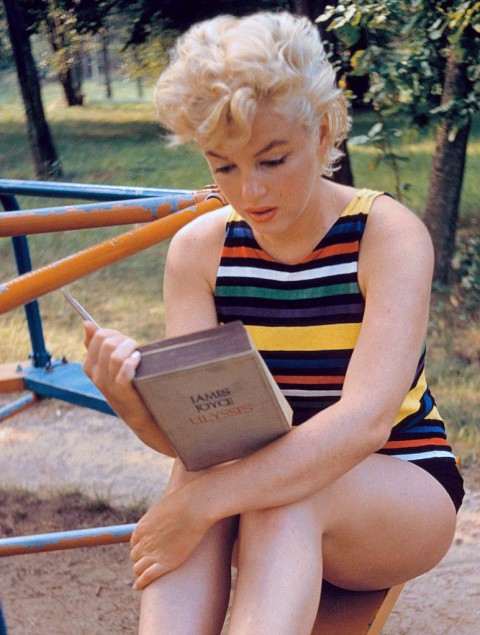
Marilyn Monroe Reads Joyce’s Ulysses at the Playground (1955)

Dur­ing the 1950s, the pio­neer­ing pho­to­jour­nal­ist Eve Arnold took a series of por­traits of Mar­i­lyn Mon­roe. The now icon­ic pho­tos gen­er­al­ly present Mon­roe as a larg­er-than-life celebri­ty and sex sym­bol. Except for one. In 1955, Arnold pho­tographed Mon­roe read­ing a worn copy of James Joyce’s mod­ernist clas­sic, Ulysses. It’s still debat­ed whether this was sim­ply an attempt to recast her image (she often played the “dumb blonde” char­ac­ter in her ’50s films), or whether she actu­al­ly had a pen­sive side. (Her per­son­al library, cat­a­logued at the time of her death, sug­gests the lat­ter.) But, either way, Arnold explained years lat­er how this mem­o­rable pho­to came about:

We worked on a beach on Long Island. She was vis­it­ing Nor­man Ros­ten the poet.… I asked her what she was read­ing when I went to pick her up (I was try­ing to get an idea of how she spent her time). She said she kept Ulysses in her car and had been read­ing it for a long time. She said she loved the sound of it and would read it aloud to her­self to try to make sense of it — but she found it hard going. She couldn’t read it con­sec­u­tive­ly. When we stopped at a local play­ground to pho­to­graph she got out the book and start­ed to read while I loaded the film. So, of course, I pho­tographed her. It was always a col­lab­o­ra­tive effort of pho­tog­ra­ph­er and sub­ject where she was con­cerned — but almost more her input.

You can find more images of Mar­i­lyn read­ing Joyce over at The Retro­naut. Of course, you can down­load your own copy of Ulysses from our Free Ebooks col­lec­tion. But we’d rec­om­mend spend­ing time with this fine­ly-read audio ver­sion, which oth­er­wise appears in our list of Free Audio Books.

Relat­ed Con­tent:

The 430 Books in Mar­i­lyn Monroe’s Library: How Many Have You Read?

Stephen Fry Explains His Love for James Joyce’s Ulysses

Hen­ri Matisse Illus­trates 1935 Edi­tion of James Joyce’s Ulysses

by | Permalink | Make a Comment ( 18 ) |

Jean Cocteau’s Avante-Garde Film From 1930, The Blood of a Poet

In a 1946 essay Jean Cocteau cau­tions against mak­ing a quick inter­pre­ta­tion of his first film, The Blood of a Poet, with a quote from Mon­taigne:

Most of Aesop’s fables have many dif­fer­ent lev­els and mean­ings. There are those who make myths of them by choos­ing some fea­ture that fits in well with the fable. But for most of the fables this is only the first and most super­fi­cial aspect. There are oth­ers that are more vital, more essen­tial and pro­found, that they have not been able to reach.

Cocteau con­ceived The Blood of a Poet (Le Sang d’un Poète) in late 1929, soon after the pub­li­ca­tion of his nov­el Les Enfants Ter­ri­bles. He had just kicked his opi­um habit and was enter­ing one of the most pro­lif­ic peri­ods of his career. The film is often called a sur­re­al­ist work, but Cocteau reject­ed the asso­ci­a­tion, say­ing that he had set out “to avoid the delib­er­ate man­i­fes­ta­tions of the uncon­scious in favor of a kind of half-sleep through which I wan­dered as though in a labyrinth.” He goes on:

The Blood of a Poet draws noth­ing from either dreams or sym­bols. As far as the for­mer are con­cerned, it ini­ti­ates their mech­a­nism, and by let­ting the mind relax, as in sleep, it lets mem­o­ries entwine, move and express them­selves freely. As for the lat­ter, it rejects them, and sub­sti­tutes acts, or alle­gories of these acts, that the spec­ta­tor can make sym­bols of if he wish­es.

Many of its first spec­ta­tors saw anti-Chris­t­ian sym­bol­ism in the film. Although pro­duc­tion end­ed in Sep­tem­ber of 1930, Cocteau was not able to get his film shown pub­licly until Jan­u­ary of 1932. The Blood of a Poet fea­tures the only film appear­ance by Lee Miller, a not­ed pho­tog­ra­ph­er and mod­el of Man Ray. (She plays a stat­ue.) The film is now con­sid­ered a clas­sic of exper­i­men­tal cin­e­ma and is the first in what came to be known as Cocteau’s “Orphic Tril­o­gy,” which includes Orphée (1950) and Tes­ta­ment of Orpheus (1959). The Blood of a Poet will be added to our col­lec­tion, 4,000+ Free Movies Online: Great Clas­sics, Indies, Noir, West­erns, Doc­u­men­taries & More.

Relat­ed con­tent:

Man Ray and the Ciné­ma Pur: Four Sur­re­al­ist Films From the 1920s

Anémic Ciné­ma: Mar­cel Ducham­p’s Whirling Avant-Garde Film (1926)

Bal­let Méchanique: The His­toric Cin­e­mat­ic Col­lab­o­ra­tion Between Fer­nand Legér and George Antheil

The History of Western Architecture: A Free Online Course Moving from Ancient Greece to Rococo

Image by Arild Vågen, via Wiki­me­dia Com­mons

If you have plans to vis­it the Old World any time soon, you should spend a few good min­utes — make that hours — with The His­to­ry of Archi­tec­ture, a free course that recent­ly debuted on YouTube. Taught by Jacque­line Gar­gus at Ohio State, the course fea­tures 39 video lec­tures that col­lec­tive­ly offer a clas­sic sur­vey of West­ern archi­tec­ture. We begin in Ancient Egypt, Greece and Rome, lay­ing the con­cep­tu­al foun­da­tions for what’s to come. Then we dive head­long into Islam­ic, Byzan­tine and Medieval archi­tec­ture, before spend­ing a good deal of time with Renais­sance, Baroque, and Roco­co styles. Of course, we encounter many great land­marks along the way: the pyra­mids of Egypt, the tem­ples of Ancient Greece, the Hagia Sophia in Con­stan­tino­ple, Chartres in France, Brunelleschi’s Duo­mo of Flo­rence, and the list goes on. The course appears on YouTube. Find the lec­tures below.

The His­to­ry of Archi­tec­ture has been added to our col­lec­tion, 1,700 Free Online Cours­es from Top Uni­ver­si­ties. And if/when Prof. Gar­gus posts a sequel that gets us into mod­ern times, we’ll be sure to let you know.

If you would like to sup­port the mis­sion of Open Cul­ture, con­sid­er mak­ing a dona­tion to our site. It’s hard to rely 100% on ads, and your con­tri­bu­tions will help us con­tin­ue pro­vid­ing the best free cul­tur­al and edu­ca­tion­al mate­ri­als to learn­ers every­where. You can con­tribute through Pay­Pal, Patre­on, and Ven­mo (@openculture). Thanks!

Relat­ed Con­tent:

Enroll in Harvard’s Free Online Archi­tec­ture Course: An Intro­duc­tion to the His­to­ry & The­o­ry of Archi­tec­ture

Roman Archi­tec­ture: A Free Online Course from Yale

Take an Online Course on Design & Archi­tec­ture with Frank Gehry

by | Permalink | Make a Comment ( 15 ) |

Rare Footage of Scott and Zelda Fitzgerald From the 1920s

The writer F. Scott Fitzger­ald and his flam­boy­ant wife Zel­da are often remem­bered as the embod­i­ment of the boom and bust that con­vulsed Amer­i­ca in the peri­od between the two world wars.

Like char­ac­ters in The Great Gats­by, Scott and Zel­da lived lives of wild aban­don in the Roar­ing Twen­ties, rid­ing on top of taxi cabs and splash­ing in the Plaza Hotel foun­tain. Scott was inspired and prod­ded along in his dis­si­pa­tion by the noto­ri­ous­ly eccen­tric Zel­da. As Ring Lard­ner once put it, “Mr. Fitzger­ald is a nov­el­ist and Mrs. Fitzger­ald is a nov­el­ty.”

But by the time the stock mar­ket crashed in 1929, so too had the Fitzger­alds. Scot­t’s drink­ing caught up with him, and Zel­da’s eccen­tric­i­ty evolved into schiz­o­phre­nia. Their sad down­fall is cap­tured in Fitzger­ald’s 1930 sto­ry, “Baby­lon Revis­it­ed.” Zel­da would live the rest of her life in men­tal insti­tu­tions while Scott spent his final years in Hol­ly­wood, strug­gling to pay for her treat­ment and try­ing to recap­ture his lost glo­ry. Their daugh­ter, Scot­tie, was raised by oth­er peo­ple.

In this video we catch a few glimpses of the Fitzger­alds in their hey­day, before the par­ty came to an end. The film clips are fun to watch but the YouTube video on which they are col­lect­ed should per­haps be tak­en with a grain of salt. We’re not sure, for exam­ple, that the clip pur­port­ing to show Zel­da being “very live­ly in a street” is actu­al­ly of her. It appears to show some­one else. And one of the cap­tions claims that Fitzger­ald is pic­tured writ­ing The Great Gats­by, but accord­ing to the Uni­ver­si­ty of South Car­oli­na’s Fitzger­ald Web site, the sen­tence he is writ­ing on paper is: “Every­body has been pre­dict­ing a bad end for the flap­per, but I don’t think there is any­thing to wor­ry about.”

Relat­ed con­tent:

Win­ter Dreams: F. Scott Fitzger­ald’s Life Remem­bered in a Fine Film

F. Scott Fitzger­ald Recites From Shake­speare’s Oth­el­lo and John Mase­field­’s ‘On Grow­ing Old’

Find F. Scott Fitzger­ald’s works in our col­lec­tions of Free eBooks and Free Audio Books

Carnegie Mellon Takes Online Courses to Another Level with Its Open Learning Initiative

Open online cours­es—mas­sive or otherwise—are rev­o­lu­tion­iz­ing high­er edu­ca­tion by mak­ing learn­ing more and more acces­si­ble.

Carnegie Mel­lon Uni­ver­si­ty has tak­en online cours­es to anoth­er lev­el, offer­ing vir­tu­al class­room envi­ron­ments based on deep research into how adults learn.

The cours­es are free. Carnegie Mellon’s Open Learn­ing Ini­tia­tive cur­rent­ly offers 15 cours­es through a plat­form that pro­vides tar­get­ed progress feed­back to stu­dents.

The pro­gram doesn’t offer course cred­it or cer­tifi­cates but the cours­es are sophis­ti­cat­ed. CMU spent any­where from $500,000 to $1 mil­lion for each course to write the soft­ware, which includes a course builder pro­gram for instruc­tors and a sys­tem of feed­back loops that send stu­dent learn­ing data to the instruc­tor, the stu­dent and the course design team.

More than 10,000 stu­dents enrolled in OLI cours­es last year. So far CMU pro­motes OLI cours­es as sup­ple­men­tary to tra­di­tion­al class­room instruc­tion. But the cours­es are cer­tain­ly rich enough to be enjoyed by any­one. They’re most­ly in the sci­ences but include a few lan­guage and social sci­ence class­es too.

The list of cur­rent­ly-avail­able cours­es appears below. We also have them list­ed in our com­plete list of Mas­sive Open Online Cours­es from Great Uni­ver­si­ties (many of which hap­pen to offer cer­tifi­cates too):

Kate Rix writes about dig­i­tal media and edu­ca­tion. Read more of her work on thenifty.blogspot.com and .

A Celebration of Retro Media: Vinyl, Cassettes, VHS, and Polaroid Too

In going dig­i­tal, we’ve gained some con­ve­nience. That’s unde­ni­able. But we’ve lost much when it comes to aes­thet­ics and qual­i­ty too. (Neil Young makes that point again and again.) Increas­ing­ly, we’re real­iz­ing what we’ve left behind, and there’s a move­ment afoot to recov­er old school media — things you can see, touch and feel and mar­vel over. Vinyl records. Tape cas­settes. VHS tapes. 8mm Film. Polaroid Pho­tos. All of that good stuff gets revis­it­ed in the lat­est short film pro­duced in the PBS Off Book series. Pre­vi­ous install­ments have cov­ered:

Art in the Era of the Inter­net

The Art of Film and TV Title Design

The Art of Glitch

The Cre­ativ­i­ty of Indie Video Games 

by | Permalink | Make a Comment ( 3 ) |

The Drinking Party, 1965 Film Adapts Plato’s Symposium to Modern Times

The word “sym­po­sium” tends to con­jure images of a for­mal, aca­d­e­m­ic gath­er­ing, which it most often is these days. It’s kind of a stuffy word, but it shouldn’t be. In Plato’s day, it was sim­ply a drink­ing par­ty, the kind you might have with a group of brainy acquain­tances when the last course is cleared, there’s no short­age of wine, and no one has to work the next day. (This being ancient Greece, these were all-male affairs). Plutarch defined a sym­po­sium as “a pass­ing of time over wine, which, guid­ed by gra­cious behav­ior, ends in friend­ship.” Plato’s Sym­po­sium, the best-known of his dia­logues, is much more in the lat­ter vein—a cel­e­bra­tion among accom­plished friends to mark the tri­umph of the poet Agathon’s first tragedy. The dia­logue con­tains sev­en speech­es on love, includ­ing of course, one from Plato’s pri­ma­ry mouth­piece Socrates. But the main draw is com­ic play­wright Aristo­phanes; no under­grad­u­ate who takes a phi­los­o­phy course for­gets his roman­tic ori­gin myth, in which love actu­al­ly is a yearn­ing for one’s miss­ing oth­er half.

When writer and direc­tor Jonathan Miller decid­ed to adapt Plato’s clas­sic text into a film in 1965, he evi­dent­ly decid­ed to com­bine both the mod­ern, aca­d­e­m­ic def­i­n­i­tion of “sym­po­sium” and its clas­si­cal prece­dent. His film is called The Drink­ing Par­ty, and involves its share of that in mod­er­a­tion (as in the orig­i­nal), but it also trans­pos­es Plato’s casu­al gath­er­ing to a group of stu­dents in for­mal attire din­ing on a neo-Clas­si­cal ter­race with an Oxford don, their clas­sics mas­ter. Each char­ac­ter adopts the role of one of Plato’s Sym­po­sium speak­ers. A few things to note here: the excerpt above is of rel­a­tive­ly high qual­i­ty, but the com­plete film itself (below) did not fare near­ly as well: trans­ferred from a well-worn 16mm print from a uni­ver­si­ty archive, the film is mud­dy, scratched and quite dim. This is too bad. Miller’s film, which was shown to col­lege phi­los­o­phy stu­dents in the 60s and 70s, sunk into cul­tur­al obliv­ion for a cou­ple decades, and copies of it are very rare. Nonethe­less, this is well worth watch­ing, par­tic­u­lar­ly for stu­dents of phi­los­o­phy. The Drink­ing Par­ty was pro­duced as part of a mid-60s arts doc­u­men­tary series called “Sun­day Night,” which ran from 1965–1968.

Relat­ed Con­tent:

Find The Sym­po­sium and oth­er great works in our col­lec­tion of 375 Free eBooks.

Josh Jones is a doc­tor­al can­di­date in Eng­lish at Ford­ham Uni­ver­si­ty and a co-founder and for­mer man­ag­ing edi­tor of Guer­ni­ca / A Mag­a­zine of Arts and Pol­i­tics.

Nicolas Cage, Paul Newman & Dennis Hopper Bring Their American Style to Japanese Commercials

West­ern­ers who grew inter­est­ed in Japan dur­ing the past 30 years will remem­ber one point of ear­ly con­tact with the cul­ture: Japan­ese com­mer­cials. Tele­vi­sion adver­tise­ments from the Land of the Ris­ing Sun have long offered the rest of the world a source of uncom­pre­hend­ing aston­ish­ment and mys­ti­fied laugh­ter. What a weird place Japan is, many must think to them­selves as they gaze upon spots involv­ing danc­ing dogs and salty snacks or brush fire and high blood-pres­sure tea. But as for­eign observers tend to dis­cov­er — and as I have had recon­firmed while vis­it­ing the coun­try for the past week — Japan may have many qual­i­ties, but pure weird­ness isn’t among them. Arti­facts that strike the rest of us as weird emerge accord­ing to log­ic, albeit a log­ic of their own. This goes dou­ble for the most prized Japan­ese com­mer­cials of the bunch: those star­ring Amer­i­can celebri­ties.

Here on Open Cul­ture, we’ve fea­tured Woody Allen for Seibu and James Brown for Nissin. Please enjoy, at the very top of this post, the eccen­tric Nico­las Cage play­ing his Amer­i­can-ness to the very hilt. When pachinko machine man­u­fac­tur­er Sankyo recruit­ed Cage, they went all-out, get­ting him square-danc­ing in the mid­dle of a lone­ly south­west­ern high­way with a pack of met­al ball-head­ed aliens. Right above, we have Paul New­man flash­ing a smile and point­ing his fin­ger not once, but two times, in a 1980 com­mer­cial for Maxwell House. And speak­ing of eccen­tric­i­ty, below you’ll find per­haps the most oblique exam­ple of the Amer­i­can actor-star­ring Japan­ese com­mer­cial I’ve ever come across: Den­nis Hop­per for Tsumu­ra. Sofia Cop­po­la sat­i­rized all of this, of course, in Lost in Trans­la­tion, but the exchange of Japan­ese cor­po­rate mon­ey for a dose of dev­il-may-care Amer­i­can panache could hard­ly make bet­ter busi­ness sense.

Relat­ed con­tent:

Jean-Luc Godard’s After-Shave Com­mer­cial for Schick

Ing­mar Bergman’s Soap Com­mer­cials Wash Away the Exis­ten­tial Despair

Fellini’s Fan­tas­tic TV Com­mer­cials

Wes Anderson’s New Com­mer­cials Sell the Hyundai Azera

Col­in Mar­shall hosts and pro­duces Note­book on Cities and Cul­ture. Fol­low him on Twit­ter at @colinmarshall.

« Go BackMore in this category... »
Quantcast