As we roll into the 4th of July holiday, let’s take a nostalgic look back at Andy Griffith as he tells the story of the American Revolution on his classic 1960s TV program, “The Andy Griffith Show.” Griffith died Tuesday at the age of 86. In the eight years “The Andy Griffith Show” was broadcast–from 1960 to 1968–Griffith was a humane and rational presence in American homes. His character, Sheriff Andy Taylor, was surrounded by eccentrics yet always managed to keep things in perspective, embodying what the show’s producer, Aaron Ruben, once described as “this Lincolnesque character.” It’s a fitting phrase, and a good way to remember Griffith as we enjoy the holiday.
One of the scariest things about air travel is the seating assignment. You never know who you’ll end up next to. This classic 1968 advertising campaign from Braniff International Airways lets you imagine what it would be like to find yourself elbow-to-elbow with Andy Warhol and Salvador Dalí.
In the commercial above, Warhol tries to explain the inherent beauty of Cambell’s Soup cans to heavyweight boxer Sonny Liston. Below, Dalí and major league baseball pitcher Whitey Ford compare notes on the knuckleball versus the screwball. The commercials were part of Braniff’s ambitious “End of the Plain Plane” rebranding campaign, which completely revamped the company’s stodgy image. Advertising executive Mary Wells Lawrence hired architect and textile designer Alexander Girard to redesign everything from airplane fuselages to ash trays. Italian fashion designer Emilio Pucci created flamboyant uniforms for the stewardesses, or “Braniff girls.” And in 1968 Lawrence brought in art director George Lois to oversee the “When You Got It, Flaunt It!” advertising campaign for print and television.
Lois later said he came up with the slogan before the celebrities were cast. In addition to the Warhol/Liston and Dalí/Ford pairings, the campaign included ads with another odd couple: pulp writer Mickey Spillane and poet Marianne Moore. In an interview with the New York Daily News earlier this year, Lois remembered that Warhol had trouble with his lines. “Andy had to say, ‘When you got it, flaunt it.’ But I ended up having to dub his voice. Later, after I sent him a copy of all the commercials, he told me that he said the line better than anybody.” The ads were a product of Lois’s gut-instinct approach to advertising. “Those ads,” he said in another interview, “would have totally bombed in ad tests. As things turned out, it tripled their business.”
When Ruth Finnegan published Oral Literature in Africa in 1970, she was awarded an Order of the British Empire for her exhaustive and pioneering research on the history of storytelling in Africa. Unfortunately, the book was so expensive that it was largely out of reach for African readers.
Now it’s out of print, but the book and many of the audio recordings Finnegan made in her research will soon be available through unglue.it, a kickstarter-style campaign to release out-of-print books.
Unglue.it raised $7,578 from 259 supporters—mostly in the library world—to make the book available “on any device, in any format, forever.” The money will help offset the costs of producing the e‑book and a digital archive of recordings and photographs taken during Finnegan’s fieldwork. In addition to the ebook, the publisher, Open Book Publishers, will produce free, downloadable pdf editions of the work.
Unglue.it has three other titles in fundraising mode: Love Like Gumbo by Nancy Rawles, a set of young reader books and the autobiography 6–321 by Michael Laser. Using the kickstarter-style model, Unglue.it is trying to raise an agreed-upon fair licensing fee to release the books under Creative Commons licensing, completely liberated from digital rights management technology.
Yesterday we featured UC Santa Cruz’s new Grateful Dead Archive Online. There you’ll find a wealth of materials about the band from their inception in 1965 until their disbandment in 1995. But over the past 17 years, the surviving members of the Dead have pursued all sorts of fascinating projects, musical and otherwise. Mickey Hart, the group’s drummer between 1967 and 1971 and again between 1974 to the end, has put out a particularly unusual new album that takes its basic materials from the heavens. As both a musician and musicologist, Hart has established a precedent for such sonic experiments. Crafting his 1989 album Music to Be Born By, he recorded his yet-unborn son’s heartbeat within the womb — the most natural of all percussion, you might say — and recorded tracks on top of it. For his latest record, Mysterium Tremendum, he listened not to the core of a human being but as far in the other direction from humanity as possible, collecting and composing with “cosmic sounds” made in outer space.
To make music like this, you need some unusual collaborators. Hart went to NASA, Penn State, and the Lawrence Berkeley National Laboratory, working with scientists like George Smoot, winner of the 2006 Nobel Prize in Physics with John C. Mather. They helped convert light, radio waves, and other electromatic radiation into sound waves that Hart and his band could put to musical use. After getting a sample of the resulting extraterrestrial grooves in the videosabove, you might consider listening to this recent interview with Hart on KQED’s Forum. Why go to all the trouble of sampling the billons-of-years-old sounds of the infinite universe? Because the Big Bang, Hart thinks, marked the very first beat. “Four words: it’s the rhythm, stupid,” he explains. “That’s what I always say to anyone, and myself as well. It all goes back to that. We are rhythm machines, embedded in a universe of rhythm.” Spoken like a true drummer.
It was 75 years ago today that Amelia Earhart vanished. The famous American flier and her navigator, Fred Noonan, took off on July 2, 1937 from Lae, Papua New Guinea in a custom-made Lockheed Electra 10E airplane on the most perilous leg of their attempted round-the-world journey.
Their goal was to reach tiny Howland Island in the central Pacific Ocean, more than 2,500 miles from Lae. As Earhart and Noonan neared the end of their 20-hour flight (it was still July 2–they had crossed the International Dateline) they planned to make contact with the U.S. Coast Guard cutter Itasca, stationed just off the island, and use radio signals to guide their way in. Howland Island is only a half mile wide and a mile and a half long. The communications crew of the Itasca heard several radio transmissions from Earhart, but for some reason she and Noonan were apparently unable to hear the ship’s responses. “We must be on you,” Earhart said, “but we cannot see you. Fuel is running low. Been unable to reach you by radio. We are flying at 1,000 feet.” They never made it.
The prevailing assumption is that Earhart and Noonan simply ran out of fuel and crashed into the Pacific. But there is some evidence to suggest they may have made it to Gardner Island (now called Nikumaroro), some 350 nautical miles southeast of Howland. Tomorrow an expedition to Nikumaroro will set out from Hawaii on a mission to explore the ocean floor around the small island, searching for evidence of Earhart’s plane. Expedition organizers hope to finally solve the mystery. In the meantime you can learn more about Earhart’s extraordinary achievements, including her triumphant 1932 solo trans-Atlantic flight, by listening to Earhart herself (above) in a fascinating newsreel. And below you can watch the very last footage of Earhart, made as she and Noonan took off from Papua New Guinea on that fateful day exactly 75 years ago.
Simon Raper at Drunks & Lampposts has composed a data visualization of the relations of influence among philosophers. This was put together to demonstrate Raper’s data extraction algorithm; he collected the contents of all the “influenced by” fields on Wikipedia, displaying each philosopher as a node connected to all other philosophers that he or she influenced. The more connections, the bigger the node. The result is visually fascinating and an interesting touchstone for philosophy fans.
Who was more important, Edmund Husserl or Jean-Paul Sartre? Well, you may not have heard of Husserl, but the size of his node is a bit bigger than Sartre’s, so according to the graph, he’s had more of an influence on the profession. The fact that Husserl’s heyday was thirty years earlier than Sartre’s may explain that fact, but as Mark De Silva at the New York Times Opinionater points out, it’s also unclear how well these “influenced by” relations in Wikipedia correlate with real influences in the history of philosophy. Raper’s graph seems to provide an excellent start for pondering the question. More graphs by historical period can be found here.
Give the talented Alex Chadwick 12 minutes, and he’ll give you A Brief History of Rock ‘n’ Roll, with each defining moment represented by a famous guitar riff. Our journey starts in 1953, with “Mr. Sandman” by Chet Atkins. Pretty soon, and quite seamlessly, we get to The Beatles and The Rolling Stones, Hendrix and Led Zeppelin, Queen and The Ramones, and eventually some more contemporary pairings — Green Day and White Stripes. The video is sponsored by the Chicago Music Exchange, a store specializing in vintage gear, like the $32,995 1958 Fender Strat played in the clip. A full list of riffs appears below the jump.
If you would like to sign up for Open Culture’s free email newsletter, please find it here. It’s a great way to see our new posts, all bundled in one email, each day.
If you would like to support the mission of Open Culture, consider making a donation to our site. It’s hard to rely 100% on ads, and your contributions will help us continue providing the best free cultural and educational materials to learners everywhere. You can contribute through PayPal, Patreon, and Venmo (@openculture). Thanks!
Looking for free, professionally-read audio books from Audible.com? Here’s a great, no-strings-attached deal. If you start a 30 day free trial with Audible.com, you can download two free audio books of your choice. Get more details on the offer here.
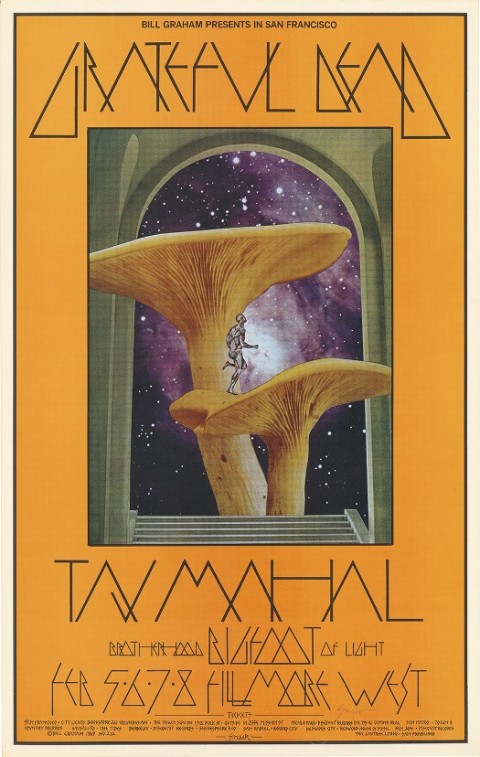
“They’re not the best at what they do,” said respected rock promoter Bill Graham of the Grateful Dead. “They’re the only ones that do what they do.” The band developed such an idiosyncratic musical style and personal sensibility that their legion of devoted fans, known as “Deadheads,” tended to follow them everywhere they toured. The Dead withstood more than their fair share of classic-rock turbulence in the thirty years from their formation in 1965, but didn’t dissolve until the 1995 death of founding member and unofficial frontman Jerry Garcia. The bereft Deadheads, still in need of a constant flow of their eclectic, improvisational, psychedelic-traditional, jam-intensive sound of choice, took a few different paths: some began following other, comparable groups; some would go on to rely on acts formed by ex-Dead members, like Bob Weir and Phil Lesh’s Furthur; some made it their life’s mission to collect everything in the band’s incomparably vast collection of demos, live recordings, and sonic miscellany.
Grateful Dead completists now have another source of solace in the Grateful Dead Archive Online from the University of California, Santa Cruz. Lest you assume yourself Dead-savvy enough to have already seen and heard everything this archive could possibly contain, behold the newly added item featured on the front page as I type this: Jerry Garcia’s Egyptian tour laminate. According to the press release, the archive’s internet presence features “nearly 25,000 items and over 50,000 scans” from the university’s physical archive, including “works by some of the most famous rock photographers and artists of the era, including Herb Greene, Stanley Mouse, Wes Wilson and Susana Millman.” Rest assured that it offers plenty of non-obscurantist Dead-related pleasures, including television appearances, radio broadcasts, posters, and fan recordings of concerts. Like any rich subject, the Grateful Dead provides its enthusiasts a lifetime of material to study. UC Santa Cruz, a school often associated in the public imagination with the Dead’s greater San Francisco Bay Area origins as well as their penchant for laid-back good times, has just made it that much easier to plunge into.
We're hoping to rely on loyal readers, rather than erratic ads. Please click the Donate button and support Open Culture. You can use Paypal, Venmo, Patreon, even Crypto! We thank you!
Open Culture scours the web for the best educational media. We find the free courses and audio books you need, the language lessons & educational videos you want, and plenty of enlightenment in between.