Here it is. A short history of the Moon. 4.5 billion years covered in a slick 2.6 minutes, all thanks to NASA’s Goddard Space Flight Center. The video, moving from the Moon’s hot creation to its pockmarked present, can be downloaded via NASA’s web site.
Now More Culture from Around the Web (all previously aired on our Twitter Stream):
We finally got the big announcement. After decades of work, physicists have pinned down the Higgs Boson. It’s a major milestone. But physicists at CERN won’t be left with nothing to do. The same folks at PhD Comics who gave us this helpful primer that uses animation to explain the Higgs Boson have also produced a companion video on Dark Matter, the mysterious stuff being researched by CERN scientists and their Large Hadron Collider.
In the clip above, physicists Daniel Whiteson and Jonathan Feng underscore how much of the universe remains dark to us. We understand about 5% of what makes up the cosmos. Another 75%, we call Dark Energy, the other 20%, Dark Matter, which are possibly manifestations of the same thing (or possibly not). Research on Higgs Boson will tell us something important about the origin of mass in the universe. But whether any of this will help explain Dark Matter (which accounts for most of the matter in the universe and behaves differently than the mass we understand — it neither emits nor absorbs light) — that’s another big question.
Recently, a video circulated—one of those weird Xtranormal creations that set text to stilted animation and robotic voices—entitled “So you want to get a Ph.D. in humanities.” It spawned a number of imitations, in other disciplines, of a similar scenario—a world-weary professor chipping away at a starry-eyed undergraduate’s naïve illusions about the world of academia. For a week or so, this meme had some of us wizened, grizzled doctoral students laughing through our tears while we hunched over keyboards and suffered through carpel tunnel syndrome and irrelevance. In his free and downloadable memoir, The Ph.D. Grind, author Philip J. Guo points out that such disparagement can serve a purpose—as commiseration for distressed insiders—but it hardly helps less jaded or experienced students and can be misleading and disingenuous.
In his preface, Guo promises to give clear-eyed advice, avoid too much geek-speak, and steer clear of “bitter whining.” Guo is an accomplished engineer at Google who received his Masters from MIT and his Ph.D. in Computer Science from Stanford. His memoir—written immediately after he finished his degree and therefore free, he claims, of what he calls “selective hindsight”—documents his experiences as a doctoral student over the course of six years. He offers the book as a practical manual for a variety of readers, including undergraduates, current Ph.D. students, professors and potential employers of Ph.D.s, and anyone genuinely curious about the nature of academic research.
The most immediately helpful part of the book is the Epilogue, which functions as a set of conclusions in which Guo lays out twenty of the most memorable lessons he learned during the years he narrates in the book. It’s all good advice and well worth reading his fuller explanation of each one. Here’s the short version of Guo’s “twenty lessons”:
Results trump intentions
Outputs trump inputs
Find relevant information
Create lucky opportunities
Play the game
Lead from below
Professors are human
Be well-liked
Pay some dues
Reject bad defaults
Know when to quit
Recover from failures
Ally with insiders
Give many talks
Sell, sell, sell
Generously provide help
Ask for help
Express true gratitude
Ideas beget ideas
Grind hard and smart
Notice that none of these relate directly to the arcana of Ph.D.-level computer science. While Guo certainly achieved a high degree of mastery in his field, his memoir demonstrates that, despite the intensive specialization of doctoral work and the precarious position of academic professionals in the current job market, completing a Ph.D. has many intangible benefits that well exceed the narrow goal of tenure-track employment. The full-text of Guo’s book is available in PDF here.
On September 3, 1968, William F. Buckley invited poet Allen Ginsberg onto his TV program, “Firing Line.” It was an odd encounter. “We’re here to talk about the avant-garde,” Buckley says grandiloquently. “I should like to begin by asking Mr. Ginsberg whether he considers that the hippies are an intimation of the new order.”
“Ah,” says Ginsberg, “why don’t I read a poem?”
Buckley smiles uncomfortably as Ginsberg reaches into his bag and pulls out a poem called “Wales Visitation,” written under the influence of LSD during a visit the previous year to the ancient ruins of Tintern Abbey, on the River Wye in Southeast Wales. It was the same place that inspired William Wordsworth to write his “Lines Composed a Few Miles above Tintern Abbey” in 1798 and Alfred, Lord Tennyson to write “Tears, Idle Tears” in 1847. Buckley settles back in his chair as Ginsberg reads three of nine stanzas from “Wales Visitation,” beginning with the first:
White fog lifting & falling on mountain-brow Trees moving in rivers of wind The clouds arise as on a wave, gigantic eddy lifting mist above teeming ferns exquisitely swayed along a green crag glimpsed thru mullioned glass in valley raine–
Over forty years after its release, Stanley Kubrick’s film adaptation of Anthony Burgess’ novel A Clockwork Orange retains all its aesthetic and visceral impact. Cinephiles would expect this of anything by a perfectionist auteur like Kubrick, but as it usually goes, works of popular art that grow instantly famous for their shock value tend not to hold their artistic value. How this particular picture managed that trick makes up the implicit subject of the 30-minute documentary Making A Clockwork Orange, available to watch on YouTube. Here was a film controversial enough, and allegedly inspirational of enough real-life crime, that Kubrick himself pulled it from distribution in the United Kingdom. What did the director and his many collaborators have to do to make a film whose own tagline calls “the adventures of a young man whose principal interests are rape, ultra-violence and Beethoven” obscurity-proof? Making A Clockwork Orange’s answer: they had to think hard and work long at every single aspect of the cinematic craft.
Offered a comparatively low budget of $2.2 million, Kubrick and his team had to construct an ambiguously futuristic dystopian London and an entire wayward youth culture within it. Former members of this team describe the director as a “sponge,” hearing every last idea anyone could offer him and adapting them to his and Burgess’ hybrid vision. He worked not from a script but straight from the novel, exhaustively attacking each page from every possible visual approach. He and his designers sat down with stacks of architectural magazines to find the ugliest possible midcentury buildings in which to shoot. Applying to protagonist Alex deLarge a single set of false eyelashes came from a hunch by the makeup specialist. And Alex belts out “Singin’ in the Rain” during he and his gang of hoods’ fateful assault on the home of an elderly writer — a scene that assures you’ll never quite hear Gene Kelly the same way again — because it’s the only song star Malcolm McDowell happened to know. Violence, crime, punishment, and even the Beethoven: A Clockwork Orange presents them all at the height of stylization. This assures a permanent purchase on our consciousness that gritty, effects-laden explicitness can never attain.
Ever since the Large Hadron Collider (LHC) went online in 2008, physicists have been conducting experiments, hoping to finally prove or disprove the existence of The God Particle, otherwise known as the Higgs Boson. Today, researchers working at CERN (which operates the LHC) announced that they think they’ve finally found it. In case you’re looking for a primer on The God Particle, we’re bringing back a video we first posted in April. Here we have Daniel Whiteson, a physics professor at UC Irvine, giving us a fuller explanation of the Higgs Boson, mercifully using animation to demystify the theory and the LHC experiments that were used to confirm it.
Looking to bone up on physics? Find 31 Free Physics Courses in our Collection of 500 Free Courses Online. They’re all from top universities — MIT, Stanford, Yale and the rest.
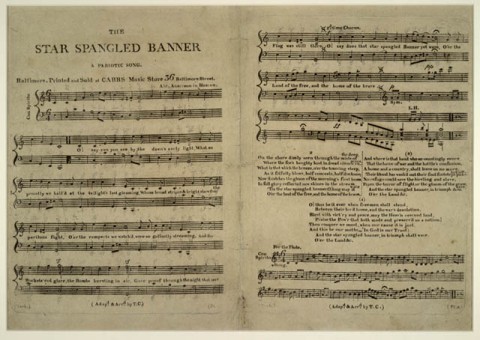
The Star-Spangled Banner became the national anthem of the United States in 1931, thanks to Herbert Hoover. And, ever since, the anthem has had its detractors. The Kennedy Center acknowledges on its website:
Some Americans complain that it celebrates war and should be reserved for military ceremonies. Others simply grumble that it is too hard to sing with a range that is out of reach for the average vocalist [anyone remember Carl Lewis giving it a try?]. Suggested replacements have included “America the Beautiful,” “God Bless America,” and “This Land is Your Land.”
And don’t forget that singers, amateur and professionals alike, often have difficulty remembering the complicated lyrics. Yes, The Star-Spangled Banner has its critics. But the great Isaac Asimov wasn’t one of them. In 1991, Asimov wrote a short piece called “All Four Stanzas” that staked out his position from the very start. It began:
I have a weakness–I am crazy, absolutely nuts, about our national anthem.
The words are difficult and the tune is almost impossible, but frequently when I’m taking a shower I sing it with as much power and emotion as I can. It shakes me up every time.
I was once asked to speak at a luncheon. Taking my life in my hands, I announced I was going to sing our national anthem–all four stanzas.
This was greeted with loud groans. One man closed the door to the kitchen, where the noise of dishes and cutlery was loud and distracting. “Thanks, Herb,” I said.
“That’s all right,” he said. “It was at the request of the kitchen staff.”
I explained the background of the anthem and then sang all four stanzas.
Let me tell you, those people had never heard it before–or had never really listened. I got a standing ovation. But it was not me; it was the anthem….
So now let me tell you how it came to be written.
And, with that, he takes you back to The War of 1812, which started 200 years ago. It’s largely a forgotten war. But it did leave us with our most enduring song. Perhaps you’ll find yourself singing it in the shower today too.
In 1984, Jon Stewart graduated from The College of William & Mary. In 1999, he began hosting Comedy Central’s news program The Daily Show. In 2004, he returned to his alma mater, immeasurably more influential than he’d left it, to give its commencement address. Despite a dated crack or two — this was the heyday of George W. Bush, the President who arguably gave Stewart’s Daily Show persona both its foil and raison d’être — the speech’s core remains sound. You, Stewart tells the massed graduates, have the power to become the next “greatest generation,” though the chance appears especially clear and present because of how the last generation “broke” the world. “It just kind of got away from us,” he half-jokes, his grin compressed by seriousness. That admission follows a stream of self-deprecation hitting everything from his tendency toward profanity to his unusually large head as an undergraduate to how his presence onstage devalues William & Mary’s very reputation.
Whether or not you find the world broken, or whether or not you believe that a generation could break or fix it, Stewart still packs a number of worthwhile observations about the place into fifteen minutes. He perhaps delivers his most valuable words to these excited, anxious school-leavers when he contrasts the world to the academic environment they’ve just left: “There is no core curriculum. The entire place is an elective.” Stewart communicates, as many commencement speakers try to but few do so clearly, that you can’t plan your way directly to success in life, whatever “success” might mean to you. He certainly didn’t. “If you had been to William and Mary while I was here and found out that I would be the commencement speaker 20 years later, you would be somewhat surprised,” he admits. “And probably somewhat angry.”
We're hoping to rely on loyal readers, rather than erratic ads. Please click the Donate button and support Open Culture. You can use Paypal, Venmo, Patreon, even Crypto! We thank you!
Open Culture scours the web for the best educational media. We find the free courses and audio books you need, the language lessons & educational videos you want, and plenty of enlightenment in between.