The 1939 World Series wasn’t much of a contest. The Yankees, led by Joltin’ Joe DiMaggio in center field, had won the last three championships. And they won this contest rather easily too, sweeping the Cincinnati Reds in four straight games. Yesterday, members of the Reddit community unearthed some rare color footage of the ’39 Series. In it, we catch glimpses of the Old Yankee Stadium, the actual House That Ruth Built; pitchers doing a different kind of windup; and a reminder that you could once buy five razors for 25 cents. Find more information on those at the Internet Museum of Safety Razors.
While an undergraduate at Vanderbilt University in Tennessee, writer Robert Penn Warren began writing about the south and its turbulent racial history. He traveled throughout the United States and interviewed men and women involved with the Civil Rights Movement, recording each conversation on a reel-to-reel tape recorder—a project that resulted in the 1965 book Who Speaks for the Negro? This month, Vanderbilt University’s Robert Penn Warren Center for the Humanities makes a full digital record available of Warren’s research for the book—an impressive and well-constructed collection of interviews with historical figures including Ralph Ellison, James Baldwin and Malcolm X. The richness of the site is its connective design. Each interview is tagged by topic, including a subject’s link to broader issues or to other interviewees, making evident through user experience the complex nature of the Civil Rights Movement. A search for the NAACP, for example, yields multiple interviews featuring different points of view on the organization’s formation along with PDFs of original letters and the searchable text of newspaper articles about early NAACP demonstrations. But the site’s audio offerings are its most powerful assets.
The material offers a potent portrait of a historical moment and is rich with references to politics, art and specific conflicts over integration. The group interviews with university students and protesters are worth a listen, both for the content and for the early 1960s group dynamics. When Warren interviews men and women together, men tend to speak first and at most length. But the views expressed are fascinating, as in one case when a female sit-in participant gives her opinion about assimilation.
“My first reaction of course would be, thinking of Socrates: Know thyself. We do face the problem of amalgamation into the whole of American life, being Americans first, say, or being what I would like to term Negro Americans or Black Americans. I think that we as black men have an obligation to know ourselves as black men and be proud of what we are, and contribute to America what we could actually offer to this culture.”
Kate Rix is an Oakland based writer. See more of her work at .
For most children the word “playing” brings to mind things like wiffleball or hide-and-seek. But for a very few talented and dedicated kids it means Mozart, or Mendelssohn. Today we bring you four videos of famous violinists playing when they were incredibly young.
Itzhak Perlman, age 13: “When I came to the United States, ” Itzhak Perlman told Pia Lindstrom of The New York Times in 1996, “I appeared on The Ed Sullivan Show as a 13-year-old and I played a Mendelssohn Concerto and it sounded like a talented 13-year-old with a lot of promise. But it did not sound like a finished product.” In the clip above, Perlman plays from the third movement of Felix Mendelssohn’s Concerto in E minor during his debut SullivanShow appearance in 1958. The young boy was an instant hit with the audience, and Sullivan invited him back. Encouraged by his sudden celebrity, Perlman’s parents decided to move from Israel to New York and enroll him in Julliard. But despite his precocity, Perlman modestly asserts that he was no child prodigy. “A child prodigy is somebody who can step up to the stage of Carnegie Hall and play with an orchestra one of the standard violin concertos with aplomb,” Perlman told Lindstrom. “I couldn’t do that! I can name you five people who could do that at the age of 10 or 11, and did. Not five, maybe three. But I couldn’t do that.”
Anne-Sophie Mutter, age 13:
One violinist who certainly was able to perform at a high level at a very early age was the German virtuoso Anne-Sophie Mutter, shown here performing the Méditation from the Jules Massenet opera Thaïs with Herbert von Karajan and the Berlin Philharmonic in 1976, when she was 13. Mutter began playing the violin at the age of five, and by nine she was performing Mozart’s Second Violin Concerto in public. Karajan took her under his wing when she was 13, calling her “the greatest musical prodigy since the young Menuhin.”
Jascha Heifetz, age 11:
Jascha Heifetz was indisputably one of the greatest violinists of the 20th century. His father, a music teacher, first put a violin into his hands when Heifetz was only two years old. He entered music school in his hometown of Vilnius, Lithuania, at the age of five, and by seven he was performing in public. At nine he entered the St. Petersburg Conservatory, where he studied with Leopold Auer. In this very rare audio recording from November 4, 1912, an 11-year-old Heifetz performs Auer’s transcription of Wolfgang Amadeus Mozart’s Gavotte in G from the opera Idomeneo. It was made by Julius Block on a wax-cylinder Edison phonograph in Grünewald, Germany. Heifetz is accompanied by Waldemar Liachowsky on piano. At the end of the performance the young boy’s voice can be heard speaking in German. Roughly translated, he says, “I, Jascha Heifetz of Petersburg, played with Herr Block, Grünewald, Gavotte Mozart-Auer on the fourth of November, nineteen hundred and ten.” A week earlier, Heifetz made his debut appearance with the Berlin Philharmonic. In a letter of introduction to the German manager Herman Fernow, Auer said of Heifetz: “He is only eleven years old, but I assure you that this little boy is already a great violinist. I marvel at his genius, and I expect him to become world-famous and make a great career. In all my fifty years of violin teaching, I have never known such precocity.”
Joshua Bell, age 12:
The American violinist Joshua Bell began playing when he was four years old, and made his debut as a soloist with the Philadelphia Orchestra when he was 14. The video above is different from the others, in that it doesn’t present a polished performance. Instead, we watch as the legendary violin teacher Ivan Galamian conducts a lesson in 1980, when Bell was 12. Bell spent two summers studying at Galamian’s Meadowmount School of Music in the Adirondack Mountains of upstate New York. In the video, the elderly teacher works with Bell as he plays from Pierre Rode’s Etude No. 1.
In 1961, Flannery O’Connor wrote an essay called “Living with a Peacock,” which begins like this:
When I was five, I had an experience that marked me for life. Pathé News sent a photographer from New York to Savannah to take a picture of a chicken of mine. This chicken, a buff Cochin Bantam, had the distinction of being able to walk either forward or backward. Her fame has spread through the press and by the time she reached the attention of Pathé News, I suppose there was nowhere left for her to go—forward or backward. Shortly after that she died, as now seems fitting.
If I put this information in the beginning of an article on peacocks, it is because I am always being asked why I raise them, and I have no short or reasonable answer.
From that day with the Pathé man I began to collect chickens. What had been only a mild interest became a passion, a quest. I had to have more and more chickens. I favored those with one green eye and one orange or with over-long necks and crooked combs. I wanted one with three legs or three wings but nothing in that line turned up. I pondered over the picture in Robert Ripley’s book, Believe It Or Not, of a rooster that had survived for thirty days without his head; but I did not have a scientific temperament . I could sew in a fashion and I began to make clothes for chickens. A gray bantam named Colonel Eggbert wore a white piqué coat with a lace collar and two buttons in the back. Apparently Pathé News never heard of any of these other chickens of mine; it never sent another photographer.
Now you have the backstory for the video above — the young girl caught on film, tending to her chickens, many years before she wrote “A Good Man is Hard to Find” (listen to her read it here) and other stories. Thanks goes to Josh for flagging this for us.…
Water. Coffee. Time. It’s those three special ingredients that went into making the traditional cup of American coffee. In case you missed that, let me remind you: It’s water, coffee, and time. Don Draper had nothing to do with this 13-minute, nostalgia-inducing infomercial from 1961. Rather, it’s the work of the Coffee Brewing Institute, which turned the art of making coffee into a dismal science — that is, until glorious Peet’s came around. This clip permanently resides in the Prelinger Archive, and comes to us via The Atlantic.
If you would like to support the mission of Open Culture, consider making a donation to our site. It’s hard to rely 100% on ads, and your contributions will help us continue providing the best free cultural and educational materials to learners everywhere. You can contribute through PayPal, Patreon, and Venmo (@openculture). Thanks!
Something extraordinary happens this week. The planet Venus will move across the face of the Sun for the last time in our lives.
Transits of Venus occur on a 243-year cycle, with pairs of transits eight years apart separated by gaps of 121.5 and 105.5 years. The last Venus transit happened in 2004. The next won’t occur until December of 2117. So if you want to see one, don’t put it off! “This is it, folks,” said Robert Naeye, Editor in Chief of Sky & Telescope magazine. “Unless modern medicine comes up with a miracle to extend human lifespans, this transit of Venus will be your final opportunity to watch our sister planet cross the Sun’s fiery disk as seen from Earth.”
The event will take place tomorrow, June 5, or the next day, June 6, depending on your location. In North America the transit will begin tomorrow, just after 6 p.m. Eastern Daylight Time. Because of the great distance between the Earth and Venus, the duration will be far longer than for a Solar eclipse: over six hours.
Here are six tips for making the most of this last-of-a-lifetime event:
1: Read up about it. For a quick and neatly organized overview your best bet is astronomer Chuck Bueter’s Transit Of Venus.org. The site includes all kinds of useful and interesting information, including the video above.
2: Find out when you can see it from your location. The international non-profit group Astronomers Without Borders has created an extremely handy Web page that will automatically generate a schedule of the transit for your location, based on your computer’s IP address. The site allows you to choose between a simple graphic representation (the default setting) or a more detailed data sheet. It even predicts the likelihood of cloud cover where you are.
3: Prepare for safe viewing. Looking directly into the sun can cause severe and permanent eye damage. There are a number of safe ways to view the transit of Venus, but it’s essential that you follow the advice of experts. Bueter has published an overview, “Six Ways to See the Transit.” Rick Fienberg of the American Astronomical Society has published a detailed article on how to build a “sun funnel.” And Doug Duncan, director of the University of Colorado’s Fiske Planetarium, has created a video explaining a very simple way to safely project an image of a solar event onto a two-dimensional surface using a pair of binoculars.
4: Check for events in your area. If you follow the links in step three you should be able to watch the transit on your own, but you might have more fun–and learn more–if you join a group. Astronomy clubs, planetariums and other science groups will be hosting transit-viewing events around the world. Check your local listings or go to the NASA Sun-Earth Day Web site for a comprehensive round-up of events across the globe. Just scroll the map on the NASA site over to your own geographic region and zoom in.
5:Download the app. If you have an Apple or Android device you can download a free Transit of Venus phone app that will allow you to send your own observations of the transit to a global experiment to measure the size of the Solar System. “In centuries past,” writes Steven van Roode of Astronomers Without Borders, which is organizing the project, “explorers traveled around the globe to time the transit of Venus to determine the size of the solar system. We invite you to inspire international collaboration during the 2012 transit of Venus by enabling a digital re-creation of those global expeditions. The phone app will allow citizens around the world to witness this rare phenomenon and to contribute their observation to a collective experiment to measure the sun’s distance.” Also, Sky & Telescope is helping people make the most of the transit by offering free use of its SkyWeek astronomy app through June 7. You can download it for iPhone or Android.
6: Watch the webcast. If you are unable to get a clear view of the transit from your location–or even if you are–you should check out either of a pair of live webcasts which will be held during the event. Astronomers Without Borders will transmit its webcast live from the Mount Wilson Observatory in California. The program will include interviews with experts and contributions from amateur astronomers, along with video tours of the historic observatory and its equipment, both antique and state-of-the-art. You can access the Astronomers Without Borders webcast here. Another major webcast will be broadcast by NASA from Mauna Kea, Hawaii beginning tomorrow at 9:45 p.m. UTC (Coordinated Universal Time) or 5:45 p.m. Eastern Time. You can access the NASA webcast here. For a schedule of the program, which will include many videos and interviews throughout the event, you can download a PDF.
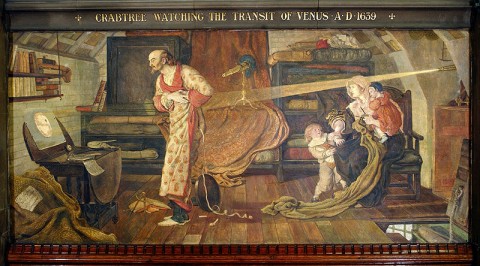
British astronomer William Crabtree, depicted observing the 1639 transit of Venus in a mural at Manchester Town Hall, painted in 1903 by Ford Madox Brown.
The surrealism of Salvador Dali knew no boundaries. It went straight from his paintings and into his personal life. Everything was a spectacle. The public loved Dali for it, but journalists always wrestled with his showmanship, wondering how to extract serious answers from the man. (Watch Dali toy with Mike Wallace here.) And, of course, someone like Dali posed challenges for biographers. Could you make Dali conform to the conventional biographical form? In 1970, the French director Jean-Christophe Averty traveled to Spain, to the little seaside village of Portlligat, where he shot a 52 minute documentary calledA Soft Self-Portrait of Salvador Dali. Orson Welles narrates the film and layers in some traditional biographical elements. But, otherwise, the film doesn’t bother trying to fit a round peg into a square hole. It embraces Dali’s schtick and goes along for the surrealist ride. In this separate video you can take a tour of Salvador Dali’s seaside home.
If you would like to support the mission of Open Culture, consider making a donation to our site. It’s hard to rely 100% on ads, and your contributions will help us continue providing the best free cultural and educational materials to learners everywhere. You can contribute through PayPal, Patreon, and Venmo (@openculture). Thanks!
Poor moon-landing conspiracy theorists. Lacking the historical and cultural gravitas of JFK assassination conspiracy theorists or the brazen pseudo-relevance of 9/11 conspiracy theorists, those who believe the Apollo 11 mission came out of a Hollywood backlot must toil in deepest obscurity. Imagine suffering from the aching conviction that the United States government, in league with a respected auteur or two, hoodwinked the entire world with a few minutes of blurry, amateurish video and garbled walkie-talkie speech — hoodwinked the entire world except you, that is. Now imagine a Truther and a second-gunman obsessive sharing a laugh about all your important revelations. If indeed you do hold that mankind has never visited the moon, make sure you don’t watch usually serious documentarian William Karel’s Dark Side of the Moon. In it, you’ll see your ideas further ridiculed, which would be unpleasant — or, even worse, you’ll see them vindicated.
These moon-landing conspiracy theorists offer many alternative historical narratives, and Karel picks a rich one. He proceeds from the question of how, exactly, filmmaker Stanley Kubrick came into possession of the advanced camera lenses he used to shoot 1975’s candle-lit Barry Lyndon. Perhaps NASA, who had the lenses in the first place, owed Kubrick for certain services rendered six years earlier? Cutting decontextualized file footage together with scripted lines delivered by actors, NASA staffers, and Kubrick’s actual widow, Karel tells an ominously earnest story of how the CIA recruited Kubrick and his 2001-tested cinematic craftsmanship to “win” the space race, at least on television. Though liberally peppered with small falsehoods and inside jokes for film buffs, Dark Side of the Moon has nonetheless inadvertently won its share of sincere adherents, including self-styled “Speaker of Truth” Wayne Green. It’s been said many times, many ways: humanity isn’t quite smart enough to effectively conspire, but we’re just smart enough to invent an infinitude of conspiracy theories.
We're hoping to rely on loyal readers, rather than erratic ads. Please click the Donate button and support Open Culture. You can use Paypal, Venmo, Patreon, even Crypto! We thank you!
Open Culture scours the web for the best educational media. We find the free courses and audio books you need, the language lessons & educational videos you want, and plenty of enlightenment in between.