W.H. Auden’s 1941 Literature Syllabus Asks Students to Read 32 Great Works, Covering 6000 Pages

Auden Syllabus

Accord­ing to Freud, neu­rotics nev­er know what they want, and so nev­er know when they’ve got it. So it is with the seek­er after flu­ent cul­tur­al lit­er­a­cy, who must always play catch-up to an impos­si­ble ide­al. William Grimes points this out in his New York Times review of Peter Boxall’s obnox­ious 1001 Books You Must Read Before You Die, which “plays on every read­er’s lin­ger­ing sense of inad­e­qua­cy. Page after page reveals a writer or a nov­el unread, and there­fore a demer­it on the great report card of one’s cul­tur­al life.” Then there are the less-ambi­tious peri­od­i­cal reminders of one’s lit­er­ary insuf­fi­cien­cy, such as The Tele­graph’s “100 nov­els every­one should read,” The Guardian’s “The 100 great­est nov­els of all time: The list,” the Mod­ern Library’s “Top 100,” and the occa­sion­al, pre­ten­tious Face­book quiz etc. based on the above.

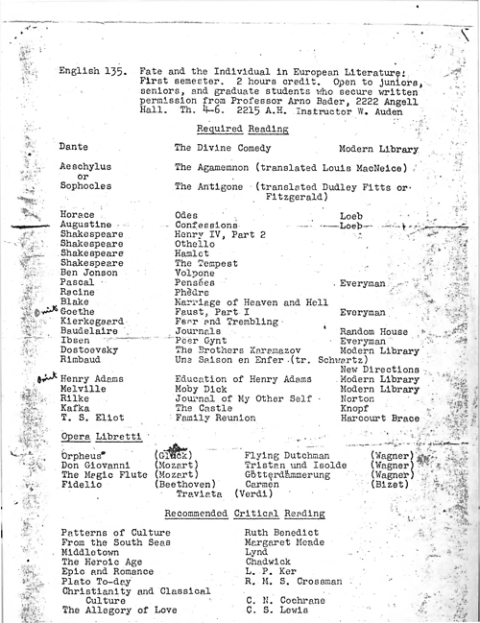
Grimes’ ref­er­ence to a report card is rel­e­vant, since what we’re dis­cussing today is the instruc­tion in grand themes and “great books” rep­re­sent­ed by W.H. Auden’s syl­labus above for his Eng­lish 135, “Fate and the Indi­vid­ual in Euro­pean Lit­er­a­ture.” Grant­ed, this is not an intro lit class (although I imag­ine that his intro class may have been pun­ish­ing as well), but a course for juniors, seniors, and grad­u­ate stu­dents. Taught dur­ing the 1941–42 school year when Auden was a pro­fes­sor at the Uni­ver­si­ty of Michi­gan, his syl­labus required over 6,000 pages of read­ing in just a sin­gle semes­ter (and for only two cred­its!). Find all of the books at the bot­tom of this post.

While a few days ago we post­ed a syl­labus David Fos­ter Wal­lace cre­at­ed around sev­er­al seem­ing easy reads—mass mar­ket paper­backs and such—Auden asks his stu­dents to read in a semes­ter the lit­er­ary equiv­a­lent of what many under­grad­u­ate majors cov­er in all four years. Four Shake­speare plays and one Ben Jon­son? That was my first col­lege Shake­speare class. All of Moby Dick? I spent over half a semes­ter with the whale in a Melville class. And then there’s all of Dante’s Divine Com­e­dy, a text so dense with obscure four­teenth cen­tu­ry Ital­ian allu­sions that in some edi­tions, foot­notes can take up half a page. And that’s bare­ly a quar­ter of the list, not to men­tion the opera libret­ti and rec­om­mend­ed crit­i­cism.

Was Auden a sadis­tic teacher or so com­plete­ly out of touch with his stu­dents that he asked of them the impos­si­ble? I do not know. But Pro­fes­sor Lisa Gold­farb of NYU, who is writ­ing a series of essays on Auden, thinks the syl­labus reflects as much on the poet’s own pre­oc­cu­pa­tions as on his stu­dents’ needs. Gold­farb writes:

“What I find fas­ci­nat­ing about the syl­labus is how much it reflects Auden’s own over­lap­ping inter­ests in lit­er­a­ture across gen­res — dra­ma, lyric poet­ry, fic­tion — phi­los­o­phy, and music.… He also includes so many of the fig­ures he wrote about in his own prose and those to whom he refers in his poet­ry…

“By includ­ing such texts across dis­ci­plines — clas­si­cal and mod­ern lit­er­a­ture, phi­los­o­phy, music, anthro­pol­o­gy, crit­i­cism — Auden seems to have aimed to edu­cate his stu­dents deeply and broad­ly.”

Such a broad edu­ca­tion seems out of reach for many peo­ple in a life­time, much less a sin­gle semes­ter. Now whether or not Auden actu­al­ly expect­ed stu­dents to read every­thing is anoth­er mat­ter entire­ly. Part of being a seri­ous stu­dent of lit­er­a­ture also involves learn­ing what to read, what to skim, and what to total­ly BS. Maybe anoth­er way to see this class is that since Auden knew these texts so well, his course gave stu­dents the chance to hear him lec­ture on his own jour­ney through Euro­pean lit­er­a­ture, to hear a poet from a priv­i­leged class and bygone age when “read­ing Eng­lish Lit­er­a­ture at Uni­ver­si­ty” meant, well, read­ing all of it, and near­ly every­thing else as well (usu­al­ly in orig­i­nal lan­guages).

If that’s the kind of eru­di­tion cer­tain anx­ious read­ers aspire to, then they’re sunk. Increas­ing­ly few have the leisure, and the claims on our atten­tion are too man­i­fold. At one time in his­to­ry being ful­ly lit­er­ate meant that one read both languages—Latin and Greek. Now it no longer even means mas­ter­ing only “Euro­pean lit­er­a­ture,” but all the world’s cul­tur­al pro­duc­tions, an impos­si­ble task even for a read­er like W.H. Auden. Who could retain it all? Instead of chas­ing van­ish­ing cul­tur­al ideals, I con­sole myself with a para­phrase from the dim mem­o­ry of my last read­ing of Moby Dick: why read wide­ly when you can read deeply?

Find all of the books on Auden’s syl­labus list­ed below:

Required Read­ing

Dante — The Divine Com­e­dy
Aeschy­lus — The Agamem­non (tr. Louis Mac­Ne­ice)
Sopho­cles — Antigone (tr. Dud­ley Fitts or Fitzger­ald)
Horace — Odes
Augus­tine — Con­fes­sions
Shake­speare — Hen­ry IV, Pt 2
Shake­speare — Oth­el­lo
Shake­speare — Ham­let
Shake­speare — The Tem­pest
Ben Jon­son — Volpone
Pas­cal — Pensees
Racine — Phe­dre
Blake — Mar­riage of Heav­en and Hell
Goethe — Faust, Part I
Kierkegaard — Fear and Trem­bling
Baude­laire — Jour­nals
Ibsen — Peer Gynt
Dos­to­evsky — The Broth­ers Kara­ma­zov
Rim­baud — A Sea­son in Hell
Hen­ry Adams — Edu­ca­tion of Hen­ry Adams
Melville — Moby Dick
Rilke — The Jour­nal of My Oth­er Self
Kaf­ka — The Cas­tle
TS Eliot — Fam­i­ly Reunion

OPERA LIBRETTI:
Orpheus (Gluck)
Don Gio­van­ni (Mozart)
The Mag­ic Flute (Mozart)
Fide­lio (Beethoven)
Fly­ing Dutch­man (Wag­n­er)
Tris­tan und Isol­de (Wag­n­er)
Göt­ter­däm­merung (Wag­n­er)
Car­men (Bizet)
Travi­a­ta (Ver­di)

RECOMMENDED CRITICAL READING:
Pat­terns of Cul­ture — Ruth Bene­dict
From the South Seas — Mar­garet Mead
Mid­dle­town — Robert Lynd
The Hero­ic Age — Hec­tor Chad­wick
Epic and Romance — W.P. Ker
Pla­to Today — R.H.S. Cross­man
Chris­tian­i­ty and Clas­si­cal Cul­ture — C.N. Cochrane
The Alle­go­ry of Love — C.S. Lewis

via New York Dai­ly News

Relat­ed Con­tent:

W.H. Auden Recites His 1937 Poem, ‘As I Walked Out One Evening’

David Fos­ter Wallace’s 1994 Syl­labus: How to Teach Seri­ous Lit­er­a­ture with Light­weight Books

Nabokov Reads Loli­ta, Names the Great Books of the 20th Cen­tu­ry

The Har­vard Clas­sics: A Free, Dig­i­tal Col­lec­tion

Josh Jones is a writer, edi­tor, musi­cian, and lit­er­ary neu­rot­ic based in Wash­ing­ton, DC. Fol­low him @jdmagness

Short Documentary, How Do You Solve a Problem Like Lolita?, Psychoanalyzes Vladimir Nabokov

Here’s a flawed but fas­ci­nat­ing lit­tle film about the life of Vladimir Nabokov, exam­ined through the prism of his most famous book.

How Do You Solve a Prob­lem Like Loli­ta? first aired on British tele­vi­sion in 2009. The host is Stephen Smith, a cul­ture cor­re­spon­dent for BBC News­night. We don’t know the rest of Smith’s resume, but in watch­ing the doc­u­men­tary we get the feel­ing he may have picked up a lit­tle of his jour­nal­is­tic sen­si­bil­i­ty from the British tabloids.

The prob­lem referred to in the title is the sense–at least among Smith’s friends–that there is some­thing “per­vy” about Nabokov’s 1955 nov­el, Loli­ta, and that this rais­es cer­tain ques­tions about the author’s own sex­u­al pen­chants. “Was it a moral­i­ty play,” Smith asks at the out­set, “or the fan­ta­sy of a dirty old man?”

It’s a con­temptible point of depar­ture. But How Do You Solve a Prob­lem Like Loli­ta? man­ages to be worth­while in spite of itself. It’s filled with inter­est­ing old footage of Nabokov talk­ing about him­self and his work, as well as con­tem­po­rary footage of the writer’s old haunts in Rus­sia, Amer­i­ca and Switzer­land. The film is a kind of trav­el­ogue. Watch­ing it is like tak­ing a one-hour tour through a fas­ci­nat­ing land­scape with an ami­able but slight­ly annoy­ing guide.

Relat­ed Con­tent: 

Vladimir Nabokov Mar­vels Over Dif­fer­ent “Loli­ta” Book Cov­ers

Vladimir Nabokov (Chan­nelled by Christo­pher Plum­mer) Teach­es Kaf­ka at Cor­nell

Nabokov Reads Loli­ta, Names the Great Books of the 20th Cen­tu­ry

Hunter S. Thompson Runs for Aspen, Colorado Sheriff on the “Freak Power” Platform (1970)

In 1970, Hunter S. Thomp­son was look­ing to become the new sher­iff in town — the town being Aspen, Col­orado. In a heat­ed elec­tion, Thomp­son ran against a tra­di­tion­al, con­ser­v­a­tive can­di­ate, Car­rol Whit­mire, on what he called the “freak pow­er” plat­form, which most­ly called for the legal­iza­tion of mar­i­jua­na and uncon­ven­tion­al envi­ron­men­tal pro­tec­tions.

As Thomp­son lat­er explained in his essay “Freak Pow­er in The Rock­ies,” hun­dreds of Haight-Ash­bury refugees moved to Aspen after the ill-fat­ed “Sum­mer of Love” in 1967, and they became part of the gen­er­al pop­u­la­tion. In the town, reg­is­tered Repub­li­cans his­tor­i­cal­ly out­weighed reg­is­tered Democ­rats by a two-to-one mar­gin.

But both camps were out­weighed by inde­pen­dents, which includ­ed “a jan­gled mix of Left/Crazies and Birchers; cheap big­ots, dope deal­ers, nazi ski instruc­tors and spaced off ‘psy­che­del­ic farm­ers’ with no pol­i­tics at all beyond self-preser­va­tion,” remem­bers Thomp­son. So, win­ning an elec­tion came down to reg­is­ter­ing indie vot­ers and get­ting them to the polls — some­thing that was eas­i­er said than done, it turns out.

In the short term, Hunter S. Thomp­son lost the “Bat­tle of Aspen” by 300–500 votes, depend­ing on whose accounts you read. In the long-term, he arguably won. 42 years after Thomp­son made the legal­iza­tion of mar­i­jua­na his cen­tral cam­paign promise, Col­orado vot­ers passed Amend­ment 64, legal­iz­ing mar­i­jua­na for recre­ation­al use. Some­where, the would-be gonzo politi­cian is smil­ing.

Relat­ed Con­tent:

Hunter S. Thomp­son Inter­views Kei­th Richards, and Very Lit­tle Makes Sense

Hunter S. Thomp­son Calls Tech Sup­port, Unleash­es a Tirade Full of Fear and Loathing (NSFW)

John­ny Depp Reads Let­ters from Hunter S. Thomp­son (NSFW)

by | Permalink | Make a Comment ( 3 ) |

See Jimi Hendrix’s First TV Appearance, and His Last as a Backing Musician (1965)

After Jimi Hendrix’s dis­charge from the army, he earned his liv­ing as a trav­el­ing musi­cian on the so-called Chitlin’ Cir­cuit—the cir­cuit of venues through­out the seg­re­gat­ed South that booked black musi­cians. Hen­drix backed such giants of R&B, soul, and elec­tric blues as Wil­son Pick­ett and Sam Cooke, and dur­ing those ear­ly years with his own band the King Casu­als, the Nashville scene he’d set­tled into, and the cir­cuit gigs, he per­fect­ed the styl­is­tic quirks and stunts that would make him world famous just a few years later—playing right-hand­ed gui­tars upside down as a lefty, play­ing solos with his teeth and behind his head—often to the irri­ta­tion of his band­mates and employ­ers. He want­ed to do his own thing, but he paid his dues, jam­ming with and learn­ing from some of the top acts in ear­ly rock & roll while Eric Clap­ton and Kei­th Richards were lis­ten­ing to those same groups on the radio, painstak­ing­ly copy­ing their sound.

After near­ly two years on the cir­cuit, the rest­less and flam­boy­ant young Hen­drix, chaf­ing under the direc­tion of strict band­lead­ers, final­ly had enough of Ten­nessee and moved to Harlem to strike out on his own, but he still worked as a side­man: he record­ed with the Isley Broth­ers, toured with Lit­tle Richard, and in 1965, he made his first ever TV appear­ance with a pair of Long Island singers named Bud­dy and Sta­cy on Nashville’s Chan­nel 5 pro­gram Night Train, doing the Junior Walk­er & the All Stars top-ten hit “Shot­gun.” In the video above you can see Hen­drix (to the right of the drum­mer), groov­ing behind the fop­pish­ly-dressed vocal duo. Note how his moves are out of sync with the rest of the band, all right-hand­ed play­ers. Note how his pom­padour is slight­ly unkempt. Note, if you watch close­ly, his right hand trav­el­ing up and down the neck of his gui­tar, pulling off some killer runs—in a song that stays on one note for the duration—even while stuck behind the action.


This per­for­mance marks one of the last times Hen­drix would stand in the shad­ows of oth­er band­lead­ers. After work­ing steadi­ly in the stu­dio as a ses­sion play­er in 1966, he formed his own band, the Blue Flame (as Jim­my James), and took up res­i­dence at the his­toric Café Wha? in Green­wich Vil­lage (where my father saw him play, he tells me, and was floored, hav­ing no idea who the guy was). ’66 is the year Hen­drix ful­ly crossed over (some said sold out; some said sold his soul) from the soul/R&B cir­cuit to main­stream rock & roll suc­cess. He wouldn’t crack the U.S. until his leg­endary appear­ance at the Mon­terey Pop Fes­ti­val in June of 1967, but after form­ing the Jimi Hen­drix Expe­ri­ence in late ’66, he wowed audi­ences in Europe with his first sin­gle “Hey Joe,” and appeared on UK TV shows Ready Steady Go! and Top of the Pops. Three months before Mon­terey, the band appeared on pop­u­lar Ger­man TV pro­gram Beat Club. Check out their per­for­mance above, doing “Hey Joe” and “Pur­ple Haze.” Hen­drix doesn’t set any fires, but he does get in a solo with his teeth.

Relat­ed Con­tent:

Pre­vi­ous­ly Unre­leased Jimi Hen­drix Record­ing, “Some­where,” with Bud­dy Miles and Stephen Stills

‘Elec­tric Church’: The Jimi Hen­drix Expe­ri­ence Live in Stock­holm, 1969

Hen­drix Plays Sgt. Pepper’s Lone­ly Hearts Club Band

Josh Jones is a writer, edi­tor, and musi­cian based in Wash­ing­ton, DC. Fol­low him @jdmagness

Physical Attraction: Marriage Proposal Comes in the Form of a Physics Paper

physics marriage proposal

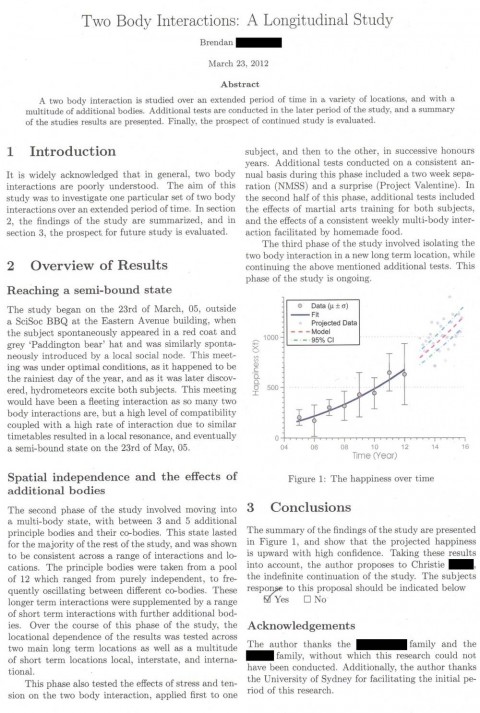
On red­dit, a user wrote yes­ter­day, “My boyfriend of 7 years and I are both physi­cists. Here’s how he pro­posed to me.” Yes, the mar­riage pro­pos­al is a physics paper of sorts, called “Two Body Inter­ac­tions: A Lon­gi­tu­di­nal Study,” that con­cludes:

The sum­ma­ry of the find­ings of the study are pre­sent­ed in Fig­ure 1 and that that the project hap­pi­ness is upward with high con­fi­dence. Tak­ing these results into account, the author pro­pos­es to Christie the indef­i­nite con­tin­u­a­tion of the study. The sub­jects response to their pro­pos­al should be indi­cat­ed below [by check­ing the “Yes” or “No” box].

Bren­dan McMoni­gal and Christie Nelan (pic­tured here) met at the Uni­ver­si­ty of Syd­ney sev­en years ago. They will tie the knot this com­ing May, and we hope you’ll wish them the best.…

via Boing­Bo­ing and @stevesilberman

by | Permalink | Make a Comment ( 2 ) |

Johnny Cash Stars as a Menacing, Musical Gangster in 1961 Film Five Minutes to Live

As every­one sure­ly knows by now, today would have been John­ny Cash’s 81st birth­day, and he’s been right­ly cel­e­brat­ed all around the inter­net for his one-of-a-kind coun­try per­sona as “The Man in Black.” Cash was so well-loved in part because, like only a hand­ful of oth­er coun­try stars (Hank Williams, Pat­sy Cline, Dol­ly Par­ton, Emmy­lou Har­ris), he tran­scend­ed the genre, win­ning fans from every con­ceiv­able cor­ner. The out­law singer was also no stranger to TV and film cam­eras, once host­ing his own talk show and appear­ing in sev­er­al dozen films and TV shows as him­self.

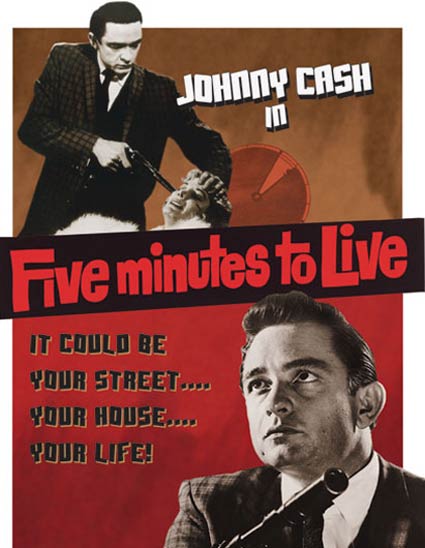
But did you know that Cash once had a star­ring fea­ture film role along­side Vic Tay­back and Ron Howard? That’s right, in the 1961 crime dra­ma above, Five Min­utes to Live, Cash plays John­ny Cabot, described by Rot­ten Toma­toes as “a blood­thirsty New Jer­sey gang­ster who is forced to hide out in a small Cal­i­for­nia sub­urb after killing a cop dur­ing a job gone wrong.”

Cabot is a musi­cal crook, who tricks his way into a bank pres­i­den­t’s home by con­vinc­ing the pres­i­den­t’s wife he’s a gui­tar sales­man. Once inside, he ter­ror­izes her and sings men­ac­ing songs in her direc­tion. Ron Howard plays the vic­tim­ized wom­an’s son Bob­by, and anoth­er coun­try great, gui­tarist Mer­le Travis, has a small role as a bowl­ing alley own­er. It’s all in keep­ing, I guess, with the John­ny Cash out­law leg­end (though he may have regret­ted the lurid, grind­house movie poster below).

Five Min­utes to Live was re-released in 1966 as Door-to-Door Mani­ac. What­ev­er you call it, you may hear more about this movie soon: Speed direc­tor Jan de Bont has been brought on to direct a remake in the near future. And yes, there’s been talk (if only tongue-in-cheek) of cast­ing Joaquin Phoenix in the Cash role.

Five Min­utes to Live is in the pub­lic domain, and we’ve added it to our col­lec­tion of 500 Free Movies Online.

5minutestolive

Relat­ed Con­tent: 

The 1969 Bob Dylan-John­ny Cash Ses­sions: Twelve Rare Record­ings

Two Prison Con­certs That Defined an Out­law Singer: John­ny Cash at San Quentin and Fol­som (1968–69)

John­ny Cash Sings “Man in Black” for the First Time, 1971

Josh Jones is a writer, edi­tor, and musi­cian based in Wash­ing­ton, DC. Fol­low him @jdmagness

Seven Tips From F. Scott Fitzgerald on How to Write Fiction

FScottF

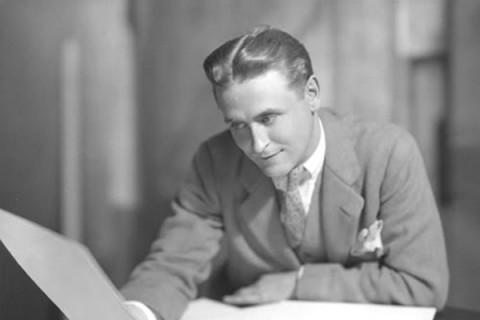
F. Scott Fitzger­ald is often por­trayed as a nat­ur­al-born writer. “His tal­ent,” says Ernest Hem­ing­way in A Move­able Feast, “was as nat­ur­al as the pat­tern that was made by the dust on a but­ter­fly­’s wings.” But Fitzger­ald saw him­self in a dif­fer­ent light. “What lit­tle I’ve accom­plished,” he said, “has been by the most labo­ri­ous and uphill work.”

Last week we brought you Sev­en Tips From Ernest Hem­ing­way on How to Write Fic­tion. Today we’re back with a sim­i­lar list of advice from Hem­ing­way’s friend and rival Fitzger­ald. We’ve select­ed sev­en quo­ta­tions from F. Scott Fitzger­ald on Writ­ing, which was edit­ed by Lar­ry W. Phillips and pub­lished in 1985 as a com­pan­ion to the Hem­ing­way book. As in the pre­vi­ous post, we’ve orga­nized the advice under our own head­ings and added some brief com­men­tary.

1: Start by tak­ing notes.

Fitzger­ald made a habit of record­ing his stray thoughts and obser­va­tions in note­books. He orga­nized the entries into cat­e­gories like “Feel­ings and emo­tions,” “Con­ver­sa­tions and things over­heard” and “Descrip­tions of girls.” When Fitzger­ald was giv­ing writ­ing advice to his mis­tress Sheilah Gra­ham in the late 1930s, he advised her to do the same. In her 1940 mem­oir, Beloved Infi­del, Gra­ham quotes Fitzger­ald as say­ing:

You must begin by mak­ing notes. You may have to make notes for years.… When you think of some­thing, when you recall some­thing, put it where it belongs. Put it down when you think of it. You may nev­er recap­ture it quite as vivid­ly the sec­ond time.

2: Make a detailed out­line of your sto­ry.

When Fitzger­ald was work­ing on a nov­el, he would sur­round him­self with charts out­lin­ing the var­i­ous move­ments and his­to­ries of his char­ac­ters. In a 1936 let­ter to nov­el­ist John O’Hara, he advis­es the younger nov­el­ist to start with a big out­line:

Invent a sys­tem Zolaesque…but buy a file. On the first page of the file put down an out­line of a nov­el of your times enor­mous in scale (don’t wor­ry, it will con­tract by itself) and work on the plan for two months. Take the cen­tral point of the file as your big cli­max and fol­low your plan back­ward and for­ward from that for anoth­er three months. Then draw up some­thing as com­pli­cat­ed as a con­ti­nu­ity from what you have and set your­self a sched­ule.

3: Don’t describe your work-in-progress to any­one.

Fitzger­ald’s pol­i­cy was nev­er to talk with oth­er peo­ple about the book he was work­ing on. In a 1940 let­ter to his daugh­ter Scot­tie, he says:

I think it’s a pret­ty good rule not to tell what a thing is about until it’s fin­ished. If you do you always seem to lose some of it. It nev­er quite belongs to you so much again.

4: Cre­ate peo­ple, not types.

Fitzger­ald was known for cre­at­ing emblem­at­ic char­ac­ters, but he said it was acci­den­tal. “I had no idea of orig­i­nat­ing an Amer­i­can flap­per when I first began to write,” he said in a 1923 inter­view for Met­ro­pol­i­tan mag­a­zine. “I sim­ply took girls who I knew very well and, because they inter­est­ed me as unique human beings, I used them for my hero­ines.” In the open­ing sen­tence of his 1926 short sto­ry, “The Rich Boy,” Fitzger­ald explains the prin­ci­ple:

Begin with an indi­vid­ual, and before you know it you find that you have cre­at­ed a type; begin with a type, and you find that you have created–nothing.

5: Use famil­iar words.

In a 1929 let­ter to his col­lege friend and fel­low writer John Peale Bish­op, Fitzger­ald says:

You ought nev­er to use an unfa­mil­iar word unless you’ve had to search for it to express a del­i­cate shade–where in effect you have recre­at­ed it. This is a damn good prose rule I think.… Excep­tions: (a) need to avoid rep­e­ti­tion (b) need of rhythm © etc.

6: Use verbs, not adjec­tives, to keep your sen­tences mov­ing.

In a 1938 let­ter to his daugh­ter, Fitzger­ald writes:

About adjec­tives: all fine prose is based on the verbs car­ry­ing the sen­tences. They make sen­tences move. Prob­a­bly the finest tech­ni­cal poem in Eng­lish is Keats’ “Eve of Saint Agnes.” A line like “The hare limped trem­bling through the frozen grass,” is so alive that you race through it, scarce­ly notic­ing it, yet it has col­ored the whole poem with its movement–the limp­ing, trem­bling and freez­ing is going on before your own eyes.

7: Be ruth­less.

A writer has to make some hard choic­es. Fitzger­ald warns about the dan­ger of becom­ing too attached to some­thing you’ve writ­ten. Keep an objec­tive eye on the whole piece, he says, and if some­thing isn’t work­ing get rid of it. In a 1933 Sat­ur­day Evening Post arti­cle titled “One Hun­dred False Starts,” he writes:

I am alone in the pri­va­cy of my fad­ed blue room with my sick cat, the bare Feb­ru­ary branch­es wav­ing at the win­dow, an iron­ic paper weight that says Busi­ness is Good, a New Eng­land conscience–developed in Minnesota–and my great­est prob­lem:

“Shall I run it out? Or shall I turn back?”

Shall I say:

“I know I had some­thing to prove, and it may devel­op far­ther along in the sto­ry?”

Or:

“This is just bull­head­ed­ness. Bet­ter throw it away and start over.”

The lat­ter is one of the most dif­fi­cult deci­sions that an author must make. To make it philo­soph­i­cal­ly, before he has exhaust­ed him­self in a hun­dred-hour effort to resus­ci­tate a corpse or dis­en­tan­gle innu­mer­able wet snarls, is a test of whether or not he is real­ly a pro­fes­sion­al. There are often occa­sions when such a deci­sion is dou­bly dif­fi­cult. In the last stages of a nov­el, for instance, where there is no ques­tion of junk­ing the whole, but when an entire favorite char­ac­ter has to be hauled out by the heels, screech­ing, and drag­ging half a dozen good scenes with him.

Relat­ed con­tent:

Sev­en Tips From Ernest Hem­ing­way on How to Write Fic­tion

Rare Footage of Scott and Zel­da Fitzger­ald From the 1920s

Win­ter Dreams: F.Scott Fitzger­ald’s Life Remem­bered in a Fine Film

F. Scott Fitzger­ald Reads From Shake­speare’s Oth­el­lo and John Mase­field­’s ‘On Grow­ing Old’ (c.1940)

The BBC’s Horrible Histories Videos Will Crack You Up and Teach You About WWI (and More)

My 12-year-old, home-schooled son recent­ly expressed an inter­est in study­ing World War I. This was encour­ag­ing, but also nerve-wrack­ing, giv­en the dis­dain that led me to spend most of World His­to­ry pass­ing notes and doo­dling (not in the Lyn­da Bar­ry col­lege course / this will help you absorb the infor­ma­tion bet­ter way). I retained noth­ing of what I’d been for­mal­ly taught. My most sol­id knowl­edge of the peri­od was gleaned from the sec­ond sea­son of Down­ton Abbey and an Audrey Tautou movie that was rat­ed R for sex and vio­lence. (There’s also a fam­i­ly pho­to­graph of us pos­ing on the Sara­je­vo street cor­ner where Franz Fer­di­nand was assas­si­nat­ed, but the sig­nif­i­cance of the spot had to be explained to me first.)

Some online scrab­bling led me to the BBC’s Hor­ri­ble His­to­ries’ brief overview of the “caus­es of World War I” (above). Wow. If only this series—and, ahem, the Internet—had exist­ed when I was the boy’s age! I think it’s safe to say my atten­tion would have been cap­tured. It’s sil­ly, yes, but that’s the whole point. The play­ers’ over-the-top comedic style ensures that even the dri­est of his­tor­i­cal facts will stick, as any­one who’s watched Michael Cera bring Alexan­der Hamil­ton to life in Drunk His­to­ry can attest. It’s the per­fect gate­way for fur­ther study.

Hor­ri­ble His­to­ries’ take on World War I proved  such a hit, the boy imme­di­ate­ly delved into oth­er peri­ods, often when he was sup­posed to be doing oth­er things, like play­ing Minecraft or watch­ing YouTube (tech­ni­cal­ly, I guess this sort of counts). Still it’s grat­i­fy­ing to hear him stud­ding his con­ver­sa­tion with casu­al ref­er­ences to the Bor­gias, the Tudors, and Mar­tin Luther. It makes me want to learn more, or at least bring myself up-to-speed on the videos. In the words of School­house Rock, knowl­edge is pow­er.

A WWI cen­ten­ni­al’s loom­ing, folks. Don’t get caught with your draw­ers down.

Relat­ed Con­tent:

Drunk His­to­ry: An Intox­i­cat­ed Look at the Famous Alexan­der Hamil­ton – Aaron Burr Duel

The Dead Authors Pod­cast: H.G. Wells Com­i­cal­ly Revives Lit­er­ary Greats with His Time Machine

School­house Rock at 40: Revis­it a Col­lec­tion of Nos­tal­gia-Induc­ing Edu­ca­tion­al Videos

200 Free Kids Edu­ca­tion­al Resources: Video Lessons, Apps, Books, Web­sites & More

Ayun Hal­l­i­day  grad­u­at­ed from North­west­ern Uni­ver­si­ty with a degree in the­ater and has been mak­ing up for it ever since. Fol­low her @AyunHalliday

« Go BackMore in this category... »
Quantcast