The Poetry of Abraham Lincoln

Lincoln

It should sur­prise few to learn that Abra­ham Lin­coln wrote poet­ry. But this fact about his life is dwarfed by those events that defined his polit­i­cal lega­cy, and this is also no sur­prise. Nev­er­the­less, in the midst of the cur­rent Lin­coln revival, the man and the states­man, I think it’s fit­ting to attend to Abra­ham Lin­coln the poet. Cer­tain­ly schol­ars have read his poet­ry in rela­tion to his skill­ful prose and ora­to­ry. But, on its own, this writ­ing gives us insight into the sen­si­tiv­i­ty of Lin­col­n’s less pub­lic modes of expres­sion.

Was he a great poet? Well, it appears that he had at least three phases—the first, a youth­ful one in his teens and ear­ly twen­ties when he pro­duced some sil­ly juvenelia, “a num­ber of crude and satir­i­cal vers­es.” The most pop­u­lar of these is called “Chron­i­cles of Reuben,” a local satire Lin­coln schol­ar Robert Bray describes as “a series of pseu­do-bib­li­cal prose and verse pieces that are, out of their local Indi­ana con­text, so top­i­cal as to be nei­ther fun­ny nor com­pre­hen­si­ble.” The piece, writ­ten in 1828 to avenge him­self upon a rival Indi­ana fam­i­ly, appar­ent­ly had great effect on the neigh­bors, how­ev­er. One of them, Joseph C. Richard­son, claimed that the poem was “remem­bered here in Indi­ana in scraps bet­ter than the Bible.”

We have to cred­it fron­tier oral tra­di­tion for our knowl­edge of some of Lincoln’s more seri­ous poems in his sec­ond phase, after he joined “a Kind of Poet­i­cal Soci­ety” in Illi­nois some­time between 1837–39. One neigh­bor, James Math­e­ny, remem­bered the fol­low­ing world­ly lines from a Lin­coln poem called “On Seduc­tion”:

What­ev­er Spite­ful fools may Say—

Each jeal­ous, rant­i­ng yelper—

No woman ever played the whore

Unless She had a man to help her.

If this is tru­ly a stan­za from Lincoln’s pen, the satirist is still very much in evidence—Swift could have writ­ten these lines—but the self-described “prairie lawyer” has grown philo­soph­i­cal and left the ado­les­cent bound­aries of local feuds and pranks.

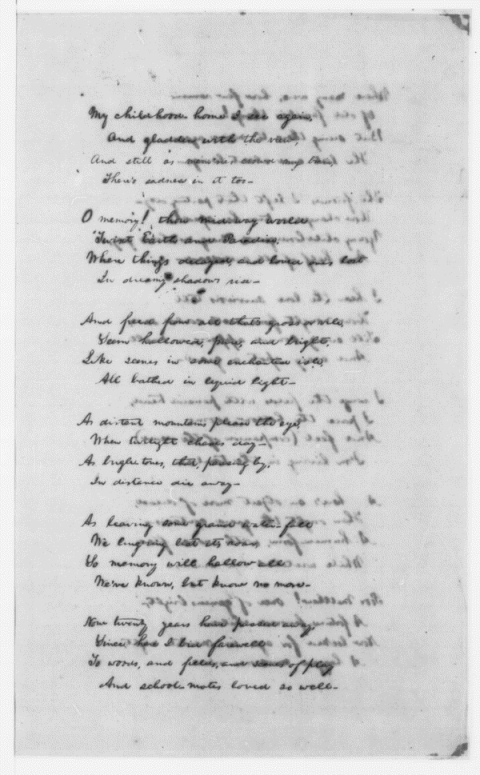
His third, most seri­ous phase begins when Lin­coln returned to Indi­ana, after leav­ing Illi­nois briefly in an attempt to help Hen­ry Clay’s failed pres­i­den­tial bid against James Polk. Lin­coln called Indi­ana “as unpo­et­i­cal as any spot of the earth,” and yet it serves as a sub­ject for a poem com­plet­ed in 1846 called “My Child­hood Home I See Again.” (The image above is of the first six stan­zas of this long poem in Lincoln’s hand­writ­ing. Click here to see the remain­ing pages). Here in the first two stan­zas (below), you can see the cut­ting wit of the younger, more con­fi­dent man give way to a kind of wist­ful nos­tal­gia wor­thy of Wordsworth:

My child-hood home I see again,

And glad­den with the view;

And still as mem’ries crowd my brain,

There’s sad­ness in it too–


O mem­o­ry! thou mid-way world

‘Twixt Earth and Par­adise;

Where things decayed, and loved ones lost

In dreamy shad­ows rise–

You can read a com­plete tran­script of the poem here, and the Library of Con­gress has a detailed descrip­tion of the poem’s stages of com­po­si­tion.

Lin­coln-as-poet con­tin­ued in this thought­ful, mature voice in the remain­ing years of his life, though nev­er equal­ing the poet­ic out­put of 1846. Some­what out of char­ac­ter, the final doc­u­ment­ed piece of poet­ry from Lin­coln comes from July 19, 1863. Writ­ten in response to the North’s vic­to­ry in Get­tys­burg, “Verse on Lee’s Inva­sion of the North” is a short piece of dog­ger­el that sees him return­ing to satire, writ­ing in the voice of “Gen. Lee”:

Gen. Lee’s inva­sion of the North writ­ten by him­self—

In eigh­teen six­ty three, with pomp,

and mighty swell,

Me and Jef­f’s Con­fed­er­a­cy, went

forth to sack Phil-del,

The Yan­kees they got arter us, and

giv us par­tic­u­lar hell,

And we skedad­dled back again,

And did­n’t sack Phil-del.

Sure­ly the poem was writ­ten in a hur­ry, and with jubi­lant, tri­umphal glee, but if this is the last we heard from Lin­coln the poet, it might be a shame, though it would not blot out the lit­er­ary skill of poems like “My Child­hood Home I See Again” and oth­ers like “The Bear Hunt” and “To Rosa,” which you can read here.

But there’s more to this sto­ry; in 2004, a his­to­ri­an dis­cov­ered an unsigned poem called “The Sui­cide’s Soliloquy”—published in the August 25, 1838 issue of the Sang­amo Jour­nal, a Spring­field newspaper—and believed the for­mer pres­i­dent to be the poet. In the video above, lis­ten to a moody, dra­mat­ic read­ing of the poem:

It is not known with cer­tain­ty if Lin­coln wrote this poem, but schol­ar­ly con­sen­sus inclines heav­i­ly in that direc­tion, giv­en its styl­is­tic sim­i­lar­i­ty to his oth­er work from this peri­od. “The Sui­cide’s Solil­o­quy” is as pas­sion­ate and mor­bid as any of Edgar Allen Poe’s verse, and betrays Lincoln’s char­ac­ter­is­tic melan­choly in its stormi­est and most Roman­tic guise. NPR has the full poem and the sto­ry of its dis­cov­ery.

Relat­ed Con­tent:

Res­ur­rect­ing the Sounds of Abra­ham Lin­coln in Steven Spielberg’s New Biopic

The Last Sur­viv­ing Wit­ness of the Lin­coln Assas­si­na­tion

Louis CK Plays Abra­ham Lin­coln, America’s 16th Pres­i­dent and (Yes) Stand-Up Come­di­an Too

Josh Jones is a writer, edi­tor, and musi­cian based in Wash­ing­ton, DC. Fol­low him @jdmagness

Arthur Conan Doyle Fills Out the Questionnaire Made Famous By Marcel Proust (1899)

DoyleQuizFinal.jpg.CROP.article920-large

Note: click on the image for a larg­er ver­sion

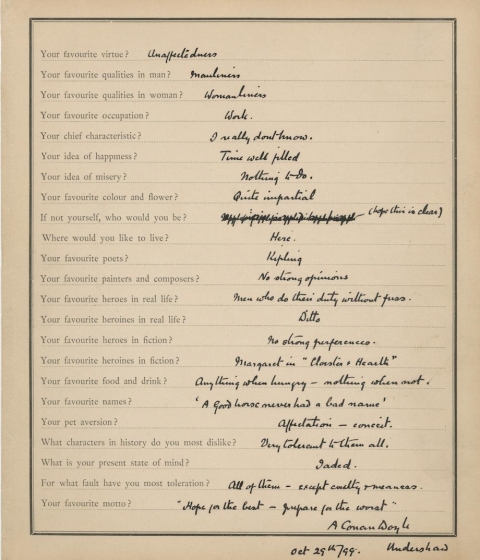
Ah, the Proust Ques­tion­naire: does it reveal every­thing about one’s per­son­al­i­ty, or noth­ing at all? Pre­sum­ably Mar­cel Proust, who gave the ques­tion­naire its name by fill­ing it out so whole­heart­ed­ly, would­n’t have cared either way. French inter­view­er Bernard Piv­ot must have seen some use­ful­ness in it, since he applied its ques­tions so reg­u­lar­ly to guests on his lit­er­ary tele­vi­sion pro­gram Apos­tro­phes that it gained the sec­ond name of “Piv­ot Ques­tion­naire.” Open Cul­ture read­ers know James Lip­ton also adapt­ed a ver­sion on Inside the Actors Stu­dio. (See our pre­vi­ous post here.) And now, thanks to archivists at the Uni­ver­si­ty of Texas at Austin’s Har­ry Ran­som Cen­ter, we have Proust Ques­tion­naire answers from one more lumi­nary: Sir Arthur Conan Doyle, cre­ator of Sher­lock Holmes.

Not that Conan Doyle responds with quite so much style as does Proust. His favorite qual­i­ties in a man? Man­li­ness. In a woman? Why, wom­an­li­ness. His favorite food and drink? Any­thing when hun­gry or thirsty — noth­ing when not. Favorite activ­i­ty? Work. This all has a cer­tain util­i­tar­i­an charm, but if you read the ques­tion­naire itself, you also find the par­tic­u­lar fla­vor of half-hid­den wit that Conan Doyle’s read­ers would expect. But we care about his respons­es, as we care about Proust’s, because of all the oth­er words they wrote. And lest we get caught up in ques­tion­naires, let us not for­get that Swan­n’s Way, the first vol­ume of Proust’s In Search of Lost Time, turns one hun­dred this year.

via Slate

Relat­ed con­tent:

Famous Actors & Actress­es Answer Reveal­ing Ques­tions on Inside the Actors Stu­dio: A Com­pi­la­tion

Arthur Conan Doyle Dis­cuss­es Sher­lock Holmes and Psy­chics in a Rare Filmed Inter­view (1927)

Arthur Conan Doyle & The Cot­tin­g­ley Fairies: How Two Young Girls Fooled Sher­lock Holmes’ Cre­ator

Col­in Mar­shall hosts and pro­duces Note­book on Cities and Cul­ture and writes essays on lit­er­a­ture, film, cities, Asia, and aes­thet­ics. He’s at work on a book about Los Ange­les, A Los Ange­les Primer. Fol­low him on Twit­ter at @colinmarshall.

The Making of John Mayer’s ‘Born & Raised’ Album Artwork, Captured in 18 Minute Short Film

This eigh­teen minute doc­u­men­tary takes you inside the work of David A. Smith, an Eng­lish artist who spe­cial­izes in “high-qual­i­ty orna­men­tal hand-craft­ed reverse glass signs and dec­o­ra­tive sil­vered and gild­ed mir­rors.” (Got that? You may want to read that last part again.) In some­thing of a depar­ture from ear­li­er projects, Smith designed an ornate “turn-of-the-cen­tu­ry, trade-card styled album cov­er” for John May­er’s album Born & Raised. His work is metic­u­lous and exact­ing. And this “Behind The Scenes” film, com­plete with com­men­tary from May­er and Smith, cap­tures the artist’s process in lov­ing detail. Now please sit back and enjoy.

Find us on Face­bookTwit­ter and Google Plus and we’ll make it easy to share intel­li­gent media with your friends!  

by | Permalink | Make a Comment ( 1 ) |

The Only Known Footage of George Orwell (Circa 1921)

?t=49s

Although he died in 1950, George Orwell seem­ing­ly escaped the reach of mod­ern media. Orwell’s voice was nev­er cap­tured on audio. And his image nev­er appeared on film. His­to­ri­ans and lit­er­a­ture schol­ars lament­ed this for decades.

But then, in 2003, on the hun­dredth anniver­sary of Orwell’s birth, two researchers stum­bled upon a tan­ta­liz­ing piece of footage in the The Pathay Film Library in Lon­don. The very brief footage — watch in full here, or at the 50 sec­ond mark in the video above — shows an 18-year-old Orwell, then named Eric Blair, march­ing across a sports field at Eton Col­lege, where he spent his for­ma­tive years and stud­ied French with Aldous Hux­ley. In the line of march­ing stu­dents, Orwell is the fourth stu­dent from the left.

Note: the video above comes from a British Pathe clip that fea­tures celebri­ties before they became famous. If you’re curi­ous who appears in the film, see the list below the jump.

(more…)

by | Permalink | Make a Comment ( 8 ) |

Visit the Museum of Endangered Sounds, and Experience a Blast from Technology’s Past

As gear­heads go, Bren­dan Chil­cut­t’s a pret­ty sen­ti­men­tal guy, and not just because he signs his cor­re­spon­dence with “love.” In Jan­u­ary, 2012, he found­ed the Muse­um of Endan­gered Sounds to keep out­mod­ed tech­nol­o­gy’s most icon­ic nois­es from van­ish­ing from the col­lec­tive mem­o­ry. Click on any image in the muse­um’s online col­lec­tion to be trans­port­ed in the Prous­t­ian sense.

Some of the exhibits—a man­u­al type­writer, a rotary phone—were already amply pre­served, thanks to a pro­lif­er­a­tion of cin­e­mat­ic appear­ances in their hey­day.

Oth­ers might well have slipped away unno­ticed, if not for Chil­cut­t’s cura­to­r­i­al efforts. Remem­ber that num­ber you could call to have a record­ed voice inform you of the cor­rect time? How about the sta­t­ic of an ana­log TV tuned to an emp­ty sta­tion? The hum of a mal­func­tion­ing Dis­c­man, the chirp of a Tamagotchi…wait, what’s that I hear? The dis­con­cert­ing whoosh of time speed­ing up?

Drown it out by acti­vat­ing all thir­ty exhibits at once. Let them sound their bar­bar­ic yaw­ps simul­ta­ne­ous­ly as the kids try to fig­ure out what that rack­et is.

h/t goes to @sheerly

Relat­ed Con­tent:

“Glitch” Artists Com­pose with Soft­ware Crash­es and Cor­rupt­ed Files

40 Great Film­mak­ers Go Old School, Shoot Short Films with 100 Year Old Cam­era

How Film Was Made: A Kodak Nos­tal­gia Moment

Ayun Hal­l­i­day is still try­ing to text on a cell phone from 2003

Drift: Passenger Shoots Striking Short Film Out of Airplane Window

Film­mak­er Tim Sessler got a lit­tle bored on his flight from San Fran­cis­co to Salt Lake City, to Philadel­phia. He says: “After read­ing through the in-flight mag­a­zine, the Sky Mall and the air­plane secu­ri­ty details from front to back, upside down and back­wards, I felt it was the right moment to pull out my cam­era” and start tak­ing aer­i­al footage of the cross-coun­try voy­age. The cam­era? It’s a Canon 5d mk3 with a 24–105mm and Nikon 50mm 1.2 lens (Tim tells us).  The chal­lenge? To keep the cam­era sta­ble, using his knee, the seat, the win­dow, etc., “while avoid­ing any vibra­tion that would cre­ate some nasty rolling-shut­ter-wob­ble.” A good deal more sta­bi­liza­tion took place in post-pro­duc­tion. When you’re done watch­ing Drift, you can check out Sessler’s pri­or attempt at shoot­ing aer­i­al art here.

via Mefi

by | Permalink | Make a Comment ( 8 ) |

Watch David Bowie’s New Video for ‘The Stars (Are Out Tonight)’ With Tilda Swinton

This week David Bowie released the sec­ond sin­gle from his upcom­ing album, The Next Day. It’s called “The Stars (Are Out Tonight),” and the accom­pa­ny­ing video (shown above) builds on Bowie’s life­long explo­ration of androg­y­ny.

Bowie is joined in the minia­ture film by actress Til­da Swin­ton, who plays his wife, and the mod­els Andrej Pejic and Sask­ia De Brauw, who play a pair of young celebri­ties who mock and tor­ment the aging cou­ple. Swin­ton looks like Bowie, and Pejic and DeBrauw look like Bowie and Swin­ton.

The sto­ry “cap­tures a twen­ty first cen­tu­ry moment in its con­ver­gence of age, gen­der and the normal/celebrity divide,” accord­ing to a state­ment post­ed ear­li­er this week on Bowie’s Face­book page. It was direct­ed by the Ital­ian-born film­mak­er Flo­ria Sigis­mon­di, a pro­lif­ic music video mak­er best known for her 2010 fea­ture film, The Run­aways.

The Next Day will be released on March 12. To learn more about it and to watch the first video from the album, see our post from last month, “David Bowie Cel­e­brates 66th Birth­day with First New Song in a Decade, Plus Vin­tage Videos.”

Relat­ed Con­tent:

The Sto­ry of Zig­gy Star­dust: How David Bowie Cre­at­ed the Char­ac­ter that Made Him Famous

How “Space Odd­i­ty” Launched David Bowie to Star­dom: Watch the Orig­i­nal Music Video From 1969

Backed by 157 Musi­cians, Beck Reimag­ines David Bowie’s 1977 Clas­sic, “Sound and Vision”

Take a Virtual Tour of the 1913 Exhibition That Introduced Avant-Garde Art to America

armory show

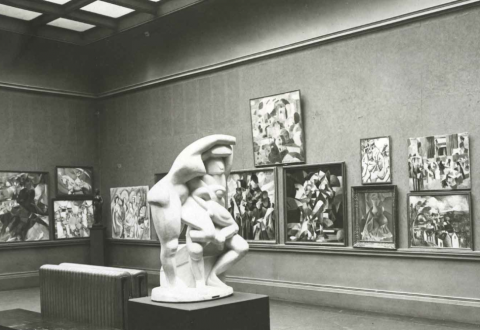
One hun­dred years ago, Amer­i­ca had only just begun talk­ing about “avant garde” art. Before the famous “Armory Show,” no one was even using the term; after it, Unit­ed States’ art-watch­ers had many rea­sons to. It’s what they saw on dis­play at the exhi­bi­tion, mount­ed by two dozen artists entire­ly with­out pub­lic fund­ing. Prop­er­ly called The Inter­na­tion­al Exhi­bi­tion of Mod­ern Art, the show got its pop­u­lar name by start­ing out in the 69th Reg­i­ment Armory on Lex­ing­ton Avenue in New York. It then moved to Chica­go and Boston, pro­vok­ing shock, dis­missal, and some­times even appre­ci­a­tion across the East Coast and Mid­west. A lit­tle Van Gogh, Gau­guin, Cezanne, Picas­so, Matisse, and Duchamp can do that to you.

Or at least, they do that to you if you live in 1913 and have nev­er seen such bold destruc­tion and rein­ven­tion of visu­al art’s estab­lished forms. To mark the Armory Show’s cen­ten­ni­al, the Art Insti­tute of Chica­go has recre­at­ed its view­ing expe­ri­ence on the web. There you can explore the gal­leries as Chicagoans actu­al­ly saw them a cen­tu­ry ago, albeit in black-and-white. The site also pro­vides much in the way of con­text, offer­ing arti­cles on the exhi­bi­tion’s gen­e­sis, pro­gram notes, lega­cy, and more. You can learn more about the impact of the Armory Show in this recent NPR piece, which quotes Muse­um of Mod­ern Art cura­tor Leah Dick­er­man on the sub­ject: “It’s this moment in time, 100 years ago, in which the foun­da­tions of cul­tur­al prac­tice were total­ly reordered in as great a way as we have seen. And that this marks a reorder­ing of the rules of art-mak­ing — it’s as big as we’ve seen since the Renais­sance.”

via @coudal

Relat­ed con­tent:

Watch Icon­ic Artists at Work: Rare Videos of Picas­so, Matisse, Kandin­sky, Renoir, Mon­et, Pol­lock & More

Free: The Guggen­heim Puts 65 Mod­ern Art Books Online

Down­load Hun­dreds of Free Art Cat­a­logs from The Met­ro­pol­i­tan Muse­um of Art

MoMA Puts Pol­lock, Rothko & de Koon­ing on Your iPad

Col­in Mar­shall hosts and pro­duces Note­book on Cities and Cul­ture and writes essays on lit­er­a­ture, film, cities, Asia, and aes­thet­ics. He’s at work on a book about Los Ange­les, A Los Ange­les Primer. Fol­low him on Twit­ter at @colinmarshall.

« Go BackMore in this category... »
Quantcast