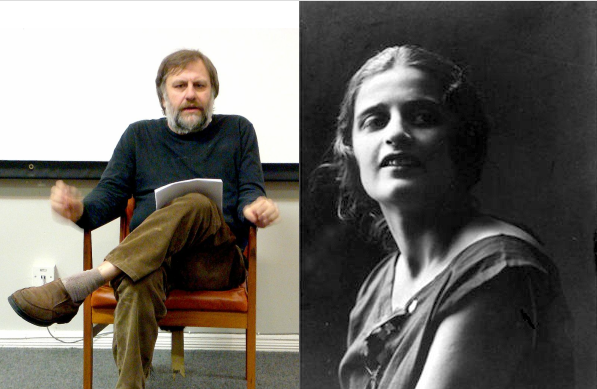
The government shutdown and the raising of the debt ceiling — such things are not usually grist for our cultural mill. But all of that changes when a cultural theorist pins the blame for Washington’s dysfunction on the acolytes of a pseudo-philosopher. Writing in The Guardian last Friday, in simple, straightforward prose, Slovenia’s favorite theorist Slavoj Žižek asks and answers a question in the title of his op-ed: “Who is responsible for the US shutdown? The same idiots responsible for the 2008 meltdown”. And who are those “idiots,” you might wonder? Let me spare you the suspense and jump you down to the last two paragraphs of his piece:
One of the weird consequences of the 2008 financial meltdown and the measures taken to counteract it (enormous sums of money to help banks) was the revival of the work of Ayn Rand, the closest one can get to an ideologist of the “greed is good” radical capitalism. The sales of her opus Atlas Shrugged exploded. According to some reports, there are already signs that the scenario described in Atlas Shrugged – the creative capitalists themselves going on strike – is coming to pass in the form of a populist right. However, this misreads the situation: what is effectively taking place today is almost the exact opposite. Most of the bailout money is going precisely to the Randian “titans”, the bankers who failed in their “creative” schemes and thereby brought about the financial meltdown. It is not the “creative geniuses” who are now helping ordinary people, it is the ordinary people who are helping the failed “creative geniuses”.
John Galt, the central character in Atlas Shrugged, is not named until near the end of the novel. Before his identity is revealed, the question is repeatedly asked, “Who is John Galt”. Now we know precisely who he is: John Galt is the idiot responsible for the 2008 financial meltdown, and for the ongoing federal government shutdown in the US.
We’re not saying it’s the most trenchant analysis, but we do like to take note of intellectual dustups. Speaking of, did you miss the Chomsky-Žižek spat from the summer? It went four rounds. Round 1. Round 2. Round 3. Round 4. And ended in a draw.
Two weeks ago we posted CDZA’s “Journey of the Guitar Solo,” an entertaining tour of 50 years of rock and roll guitar playing. Now we’re back with the group’s follow-up, a fast and fun introduction to drums. New York-based drummer Allan Mednard takes us on a quick tour of the instrument, demonstrating the basic differences between jazz and rock drumming and showing how they have evolved over time. CDZA, short for Collective Cadenza, is an experimental music video project of a group of highly skilled musicians in New York. For more examples of their work, visit the CDZA Web site.
In late September, the US military declared the hunger strikes at Guantánamo Bay over. “At its peak,” writes Charlie Savage in The New York Times, “106 of the 166 prisoners … were listed as participants” in the strike. That number has now dropped to 19, they say, and they’re all being given “the appropriate level of care.” What exactly does that mean? You can get an idea from this animated video created by The Guardian. In 6 minutes, you’ll get introduced to the world of people who have spent years in prison. They’ve never been charged with a crime nor given access to the legal system. Despite being cleared for release, many remain stuck in limbo year after year. When they lose hope and go on hunger strike, they have tubes and food crammed down their noses. Poignant as it may be, the colorful animation may dull your reaction to what’s actually happening in Guantánamo. Perhaps it’s better to look at these color photos to fully appreciate the Kafkaesque system the government has put in place.
What living director has drawn the descriptor “surreal” more often than David Lynch? If you’ve seen, or rather experienced, a few of his films — particularly Eraserhead, Lost Highway, Mulholland Dr., or Inland Empire, or even the first half of his television series Twin Peaks — you know he’s earned it. Like any surrealist worth his salt, Lynch creates his own version of reality, with its own set of often unfathomable and inexplicably but emotionally and psychologically resonant qualities. In 1987, the year after his breakthrough Blue Velvet opened in theaters, the BBC apparently thought him enough of an authority on the matter of cinematic surrealism to enlist him to present an episode of Arena on the subject.
And so we’ve highlighted, just above in two parts, the fruit of their collaboration, with apologies for the straight-from-the-VHS quality of the video. (I just think of the slight muddledness as adding another welcome layer of unreality to the proceedings.)
Lynch’s duties on the broadcast include providing facts about the films and filmmakers excerpted throughout to tell the history of surrealist film. (He also provides several choice opinions, as when he calls Philadelphia “one of the sickest, most corrupt, decadent, fear-ridden cities that exists.”) We see bits and pieces of pictures like Luis Buñuel and Salvador Dali’s 1929 Un Chien Andalou (above), Jean Cocteau’s 1932 Blood of a Poet, Fernand Léger’s 1947 The Girl with the Prefabricated Heart, and Chris Marker’s 1962 La Jetée. Not only does Lynch contextualize them, he discusses their influence on his own work. Casual filmgoers who’ve caught a Lynch movie or two and taken them as the imaginings of an entertaining weirdo will, after watching this episode, come to understand how long a tradition they fit into — and they’ll no doubt want to see not just more of Lynch’s work, but his sources of inspiration as well. (They may, however, after hearing all he has to say here, still regard him as a weirdo.)
If you would like to sign up for Open Culture’s free email newsletter, please find it here. It’s a great way to see our new posts, all bundled in one email, each day.
If you would like to support the mission of Open Culture, consider making a donation to our site. It’s hard to rely 100% on ads, and your contributions will help us continue providing the best free cultural and educational materials to learners everywhere. You can contribute through PayPal, Patreon, and Venmo (@openculture). Thanks!
In 1883, Antoni Gaudí, the great Catalan architect, began working on his magnum opus, the Sagrada Família, the church that has become one of the most popular tourist attractions in Barcelona. Before his death in 1925, Gaudí managed to complete the crypt, apse and part of the Nativity facade. Work on the basilica slowed during the 1930s and 40s, especially during the Spanish Civil War, but picked up again in the 1950s. A series of architects carried on Gaudí’s work, completing new towers and facades. In 2000, the central nave vaulting was completed, and, since then, modern technology has put architects on track to complete the church decades ahead of schedule. The new target date is 2026 — the centenary of Gaudí’s death. Thanks to a computer-generated video released by the Sagrada Familia Foundation, you can see what the basilica, almost 150 years in the making, will look like when it’s all done. You can also take a virtual tour of the interior of the UNESCO landmark here.
It seems only natural that Joseph Stalin, who presided over perhaps the most staggeringly vast erasure of human beings, their property, their documents and histories, should have also been a meticulous editor. Whether we know it or not, the invisible hand of an editor intrudes between us and nearly everything we read (even if it’s the writer as editor), making esoteric decisions, creating alternate outcomes and deleting the past. In Stalin’s day, and still in many editorial departments today, the editor wielded a colored pencil instead of a keyboard, and hovered over manuscripts, noting addenda, correcting minutia, slashing through sentences, and scribbling indecipherable comments in the margins. Stalin’s pencil was blue, a color that was not visible when photographed.
This color becomes a metaphor for Stalin’s invisibility in a fascinating article on Stalin as editor by Holly Case, associate professor of history at Cornell University. Before Stalin was Stalin, he was Joseph Djugashvili, revolutionary bolshevik and seminary dropout, “a ruthless person, and a serious editor.” Stalin rejected 47 of Lenin’s articles to Pravda (and suppressed Lenin’s warnings about his protégée after the former’s death). And once he assumed power as head of the Soviet state in the mid-twenties, Stalin continued in this capacity, heavily rewriting documents and manuscripts, and scrawling notes and revisions over hundreds of official party documents. “For Stalin,” Case writes, “editing was a passion that extended well beyond the realm of published texts.” She comments on the paradox of the dictator’s inescapable public presence and his intrusive, yet invisible, editorial tendencies:
Stalin always seemed to have a blue pencil on hand, and many of the ways he used it stand in direct contrast to common assumptions about his person and thoughts. He edited ideology out or played it down, cut references to himself and his achievements, and even exhibited flexibility of mind, reversing some of his own prior edits.
So while Stalin’s voice rang in every ear, his portrait hung in every office and factory, and bobbed in every choreographed parade, the Stalin behind the blue pencil remained invisible. What’s more, he allowed very few details of his private life to become public knowledge, leading the Stalin biographer Robert Service to comment on the remarkable “austerity” of the “Stalin cult.”
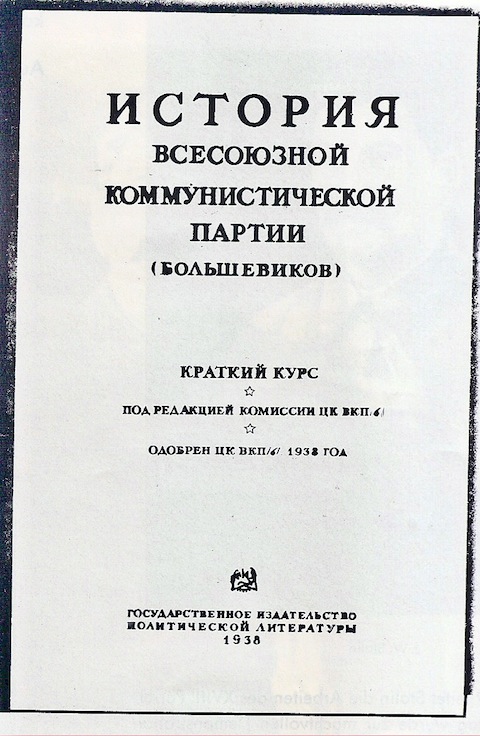
We should not mistake Stalin’s “self-effacement,” Case writes, for modesty. She quotes the enigmatic street artist Banksy to make the point: “invisibility is a superpower.” Stalin applied the power of his pencil to thousands of official documents and pieces of propaganda, even completely rewriting the 1938 Soviet bible, The Short Course on the History of the All-Union Communist Party (Bolsheviks). Commissioned for a team of authors in 12 chapters, Stalin found it necessary to “fundamentally revise 11 of them” (see the first edition title page above).
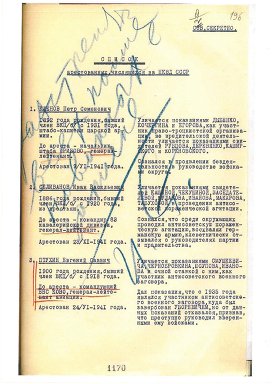
Stalin’s blue pencil also intervened in more direct, and chilling ways. The document at left shows a list of people held by the NKVD, forerunners to the KGB. The blue handwriting scrawled over the list is Stalin’s. It reads “Execute everyone.”
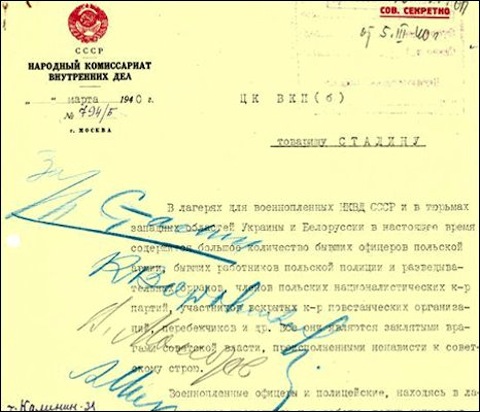
We have another execution order below, this time in the form of a 1940 letter written by Stalin’s secret police chief Beria and recommending “execution by shooting” for around 20,000 prisoners, most of them Polish officers, at a camp in Katyn, a massacre the Soviets blamed on the Nazis. Beria’s letter (below) bears the signatures, in blue pencil, of Stalin and several Politburo members.
In addition to heavily editing propaganda and signing mass death warrants, Stalin used his pencil to deface drawings by 19th century Russian painters, scrawling “crude and ominous captions” beneath them in red or blue. He left his mark on 19 pictures, all of them nudes, most of them male. He slashed through their torsos and other body parts with the pencil (below) and wrote on one of the drawings, “Radek, you ginger bastard, if you hadn’t pissed into the wind, if you hadn’t been so bad, you’d still be alive.” Karl Radeck was a revolutionary activist in the 20s that historians believe Stalin had killed in 1939. Historian Nikita Petrov—who believes Stalin defaced the drawings between 1939 and 1946—says of them: “These captions show Stalin wasn’t just malicious and primitive, but that he was also very dangerous.” It is indeed deeply unsettling for an editor to see Stalin’s ruthless hand move freely from the violence of his slash-and-burn textual changes to that of his mass execution orders and crude, “loutish” debasement of human forms.
I believe some movies are so classic, they should be considered untouchable, an opinion I wish more Broadway producers shared.
Brace yourself. Rocky, Sylvester Stallone’s heartwarming tale about a small-potatoes boxer in 1970s Philadelphia, has been turned into a musical.
It’s likely not as bad as I fear. Stallone himself is co-producing, young director Alex Timbers is deservedly hot, and lyricist Lynn Ahrens is responsible, in large degree, for Schoolhouse Rock.
All the same, prank collective Improv Everywhere’s take on one of Rocky’s most iconic scenes falls more squarely within my comfort zone. The first installment in the group’s weekly Movies in Real Life series, this Rocky features lookalike comedian Dan Black running through the streets of Philly, a crowd of kids tailing him on the final leg. (“So, uh, you have parents?” he gasps, atop the art museum steps.)
As with the annual No-Pants Subway Ride and many other Improv Everywhere stunts, a great deal of fun comes from the reactions of unsuspecting passersby. Some of my favorites are viewable in the prank’s Mission Report, a follow up with less need to stick to the script. Still in character, Black demands royalty checks from street vendors selling Rocky t‑shirts and screws with tourists posing in front of the famed Rocky statue. Small wonder Improv Everywhere’s motto is “we cause scenes.”
For those in need of refreshment, here is the original:
Silent films had a respectable showing, as it were, on Sight & Sound magazine’s last big critics poll. The votes, cast to determine the greatest motion pictures of all time, placed three silents among the top ten overall: F.W. Murnau’s Sunrise, Dziga Vertov’s Man with a Movie Camera, and Carl Theodor Dreyer’s The Passion of Joan of Arc. These, of course, also rank at the top of Sight & Sound’s separate list of the ten greatest silent films of all time, which came out as follows:
Though all of these pictures came out within the seemingly short 15-year span between 1916 and 1921, they represent a wide cinematic diversity: in form, in theme, in genre, in place of origin (of both the films and the filmmakers), in sensibility, in aesthetics. You probably recognize all of their names, especially if you’ve taken a film studies course, and you may think of them all as familiar, but how many have you watched? Even we avowed cinephiles have a way of tricking ourselves into believing we’ve seen all the most important movies in their entirety, when in reality we know only about, albeit sometimes a lot about, their place in the history of cinema and their currents of influence that flow into films made today.
But thanks to the internet, we can catch up with ease. Given the age of works from the silent era, most of them have passed into the public domain. You can therefore watch almost all of the top ten greatest silent films of all time, as selected by the 2012 Sight & Sound critics poll, for free, online, right now. Some you can even watch right here, without leaving Open Culture: at the top of the post, you’ll find Sunrise. Just above, we’ve featured Man with a Movie Camera. Below, The Passion of Joan of Arc. To watch the others, simply click their linked titles on the list. After you’ve enjoyed everything from Murnau’s German-Expressionist-by-way-of-Hollywood romance to Keaton’s epic comedy to Buñuel’s surrealist procession of still-troubling visions, you’ll not just know where many modern cinematic techniques came from, you’ll feel how they’ve evolved over the decades. All of the films listed above appear on our list of Great Silent Films, part of our larger collection, 4,000+ Free Movies Online: Great Classics, Indies, Noir, Westerns, Documentaries & More.
We're hoping to rely on loyal readers, rather than erratic ads. Please click the Donate button and support Open Culture. You can use Paypal, Venmo, Patreon, even Crypto! We thank you!
Open Culture scours the web for the best educational media. We find the free courses and audio books you need, the language lessons & educational videos you want, and plenty of enlightenment in between.