Welcome to the New York city apartment of Graham Hill, a Canadian-born architect committed to bringing sustainability into the mainstream. His apartment does more with less. It has a footprint of only 420 square feet. Yet it’s elegantly-designed and completely functional. What initially looks like a simple studio unfolds into much more, a Soho apartment that features no less than eight rooms — a bedroom, guest room, kitchen, office and the rest. We’ll let Graham, the founder of treehugger.com, take you on the grand tour, and we’ll leave you to wonder what a designer could do with this Parisian apartment measuring only 17 square feet.…
Five years ago, a 30-something music producer from Houston, Texas got a big idea. Why not take his two favorite things — Bob Dylan and Dr. Seuss, of course — and mash them up into one original creation. Hence came Dylan Hears a Who, a mock album that took seven Dr. Seuss classics and put them to the melodies and imitated voice of Mr. Dylan. The cuts went viral, giving Dylan-Seuss fans worldwide the chance to enjoy creative takes on Green Eggs and Ham (above); The Cat in the Hat;Oh, The Thinks You Can Think! (below); Too Many Daves; and The Zax. Soon enough, the songs faded into YouTube oblivion, awaiting the day when a digital archaeologist would come along and do an excavation. Well, today’s the day. Enjoy!
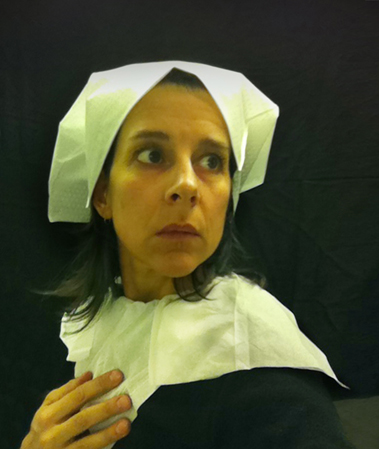
The work of artist Nina Katchadourian is highly accessible. So much so that it’s likely her fault if the line for the bathroom on your next flight stretches all the way from tail to the cockpit. Such is the power of Lavatory Self-portraits in the Flemish Style, the best known segment of her ongoing Seat Assignment project. How can passengers pass up the opportunity to recreate Katchadourian’s widely disseminated images, knowing that the originals were shot in the mirror on an iPhone, using props like disposable seat covers and an inflatable neck pillow?
Shy and/or civic-minded types who don’t relish the implications of tying up the johnny at high altitudes should have a go at restaging the other aspects to Katchadourian’s inflight work, on display above.
(Hint: book a window seat and exercise restraint when the fight attendant hands you your complimentary bag of mini pretzels.)
Honestly, much of what you’ll see, from the unnervingly named Disasters to the genius of Sweater Gorillas, can be accomplished without leaving the ground. Though it may prove more creatively rewarding to delay until the only palatable alternative is an unregulated amount of reality TV screening on the seat back ahead of you.
Think Newport Folk Festival and what comes to mind? Pete Seeger, right? Johnny Cash, Muddy Waters, Joan Baez? Or, more recently, The Avett Brothers, Alison Krauss, Lucinda Williams? You’re definitely thinking Dylan, freaking out the folkies in ’65 by plugging in his Strat. Are you thinking of the Pixies? No? Me neither. Probably one of the last bands I’d think of. And yet, the Pixies played the Newport Folk Festival, or—as Pixies frontman Frank Black jokes above—they went “reverse Dylan,” swapping their big amps and electric guitars for acoustics and a whole lot of low-key charm. Yes, it’s true, as Spin points out, that the festival has “a rich history of uniting disparate genres of music,” but to be honest, I wouldn’t have imagined an acoustic Pixies set, wouldn’t have thought such a thing were possible, had I not seen it in the “Acoustic Sessions” film above.
Yep, the band best known for quiet/LOUD dynamics and mutilating walls of sound rose to the folk challenge in 2005. Above, we get to see them rehearse in Hartford and take the stage in Albany for a dress rehearsal (where Black goes around and asks each member of the band if they are “scared”). They had only just reformed the previous year, after an eleven year hiatus during which it seemed we’d never hear from them again. Throughout the nineties, Singer Frank Black (or “Black Francis” in the Pixies heyday) had plenty to do with his Frank Black and the Catholics. Bassist/singer Kim Deal hit a rich vein of success with The Breeders and their massive hit “Cannonball.” While everyone pined for a Pixies reunion, few people expected it to happen (and when it did, for them to rock as hard and loud as they did). And maybe the last thing on anyone’s mind was what’s happening above. The band seems pretty shocked themselves, especially Deal. In one exchange, Black says, “You know what acoustic means? Not too loud.” She responds drily, “I’d rather get shot in the face.”
But it’s fantastic! The songs come through crystal clear, just as tuneful, melodic, and strange as the first time you heard them blasting from your car stereo cassette deck (especially “Wave of Mutilation” at 14:00). And their off-the-cuff banter is priceless. Enjoy it, and Happy Friday.
I missed Disney’s Wreck-It Ralph in its main theatrical run. I now consider that a shame, as friends have since since informed me that the movie presses all the right cultural buttons for a twentysomething American male who, like me, grew up playing and loving video games. I feel doubly sorry not to have seen it now that Paperman has come available on the net. Pushing another, more distant cultural button by preceding a feature with a short, Wreck-It Ralph’s screenings opened with this six-minute tale by Disney Animation of a seemingly frustrated romance conducted by paper airplane between two office towers. The place looks to be a major city rumbling with American commercial energy, and the time looks to be the black-and-white middle of the twentieth century — a cultural moment, in other words, that produced some animation enthusiasts’ very favorite work. Look at almost any of Paperman’s individual frames, in fact, and you could mistake it for a production of that golden era.
But in motion, something feels very different indeed. We’ve grown used to Pixar-style computer generated imagery making up our animated movies, and while Paperman looks much more like a classic hand-drawn Disney picture, it actually comes as a product of the sort of technology that drives the likes of Wreck-It Ralph. But it benefits from innovation that enables the kind of weight, smoothness, and physicality of which the hand animators of yore could only dream. Wired’s Graeme McMillan reports that “Paperman‘s seemingly seamless way of blending the personality of hand-drawn animation with CGI in the physical space of the story is the result of new in-house software called Meander, a vector-based drawing program that allows for manipulation of the line after the fact — something that [director John] Kahrs described as ‘just like painting on the surface of the CG.’ ” Does that way lay the future of animation? Perhaps it depends on how well Paperman performs at this year’s Academy Awards. Keep your eye on the Best Animated Short Film category, cartoon buffs — even more than you usually do.
We're hoping to rely on loyal readers, rather than erratic ads. Please click the Donate button and support Open Culture. You can use Paypal, Venmo, Patreon, even Crypto! We thank you!
Open Culture scours the web for the best educational media. We find the free courses and audio books you need, the language lessons & educational videos you want, and plenty of enlightenment in between.