In the late 1990s, Neil deGrasse Tyson and his colleagues redesigned the Hayden Planetarium and, without much comment, they created a model of the solar system that banished Pluto from the list of planets. During the following year, no one said very much. But then The New York Times published an article (January 22, 2001) called “Pluto’s Not a Planet? Only in New York,” and all hell broke loose, particularly in the elementary schools. School kids were incensed, and the letters of complaint rolled in. You can find one such example from “Emerson” above. Five other letters can be found over at Mental Floss.
A quick note: If you’re not already familiar with it, Tor.com is a web site dedicated to “science fiction, fantasy, and all the things that interest SF and fantasy readers.” And, among other things, the site regularly publishes original sci-fi stories. To celebrate its 5th birthday, Tor has decided to assemble the last five years of its original fiction and make it available as downloadable ebook files. You will need to register with the site beforehand, and then you can download the texts in various formats — PDF, Mobi, and ePub — all of which can be loaded onto ebook readers. And, yes, it’s all free.
If you’re a sci-fan, we’d encourage you to see our post from earlier this week, 100 Great Sci-Fi Stories by Women Writers and then some of the great related material below.
Let’s set the scene: The Brooklyn Dodgers are playing the Philadelphia Phillies at Ebbets Field on July 1, 1941, and the game is being aired on WNBT-TV (later to become WNBC). Before the game begins, TV viewers see this: a 10-second advertisement for Bulova clocks and watches. The ad shows a clock and a map of the United States, with a voice-over that says, “America runs on Bulova time.” This litte spot (which ran at 2:29 pm, if you’re keeping Bulova time) marked the advent of something much bigger — commercialized television. Earlier in 1941, the FCC had approved a plan to turn TV into big business. When Bulova paid $9 dollars to plug its brand, the plan was actualized. Every advertisement seen since (for better or worse) has a common lineage in this moment.
If you would like to support the mission of Open Culture, consider making a donation to our site. It’s hard to rely 100% on ads, and your contributions will help us continue providing the best free cultural and educational materials to learners everywhere. You can contribute through PayPal, Patreon, and Venmo (@openculture). Thanks!
It comes as no shock that Ingmar Bergman makes the list, given Allen’s well-documented and openly admitted enthusiasm for (and, in cases like Interiors, direct imitation of) the man who made The Seventh Seal. If that vote represents Allen’s contemplative, morally serious side, then the vote for Luis Buñuel’s enduringly funny surrealist farce The Discreet Charm of the Bourgeoisie represents his well-known predilection for humor, often class-based, which occasionally melts into silliness.
Like Scorsese, Allen includes Kubrick, though for his early Paths of Glory rather than the more widely-seen 2001. Like both Scorsese and Kubrick, he picks a Fellini — two, in fact — and all three of their lists illustrate that it would take a contrarian filmgoer indeed to deny Orson Welles’ Citizen Kane a vote. Kubrick, you’ll recall, also had great praise for Vittorio de Sica and François Truffaut, and their early pictures show up among Allen’s selections. Take Kubrick, Scorsese, and Allen’s lists together, and you have a few principles to guide your viewing: concentrate on the midcentury masters. Citizen Kane really does merit all those accolades. And above all, make sure you watch your Fellini. But which films did Fellini love?
A quick heads up: The Lollapalooza 2013 music festival is getting going in Chicago. And it’s streaming live (for free) all this weekend on YouTube. Right now, you can catch The Killers on stage. Nine Inch Nails will be performing later tonight (Friday). You can find the lineup for Saturday and Sunday here. Enjoy the shows.
It’s a reality of big city living that one occasionally stumbles upon some famous person behaving like a mere civilian, out walking the dog, buying a latte, or taking the kids to some child-centric event. I’m bad at recognizing these luminaries out of context, which may be why I’m great at mistakenly believing some random citizen standing beside me at an intersection is in fact a noted author or beloved character actor. I have thus far never labored under the delusion that the guy across the aisle on the F train to Brooklyn is a one-eared Dutch post-Impressionist who died over a hundred years ago, but that could change.
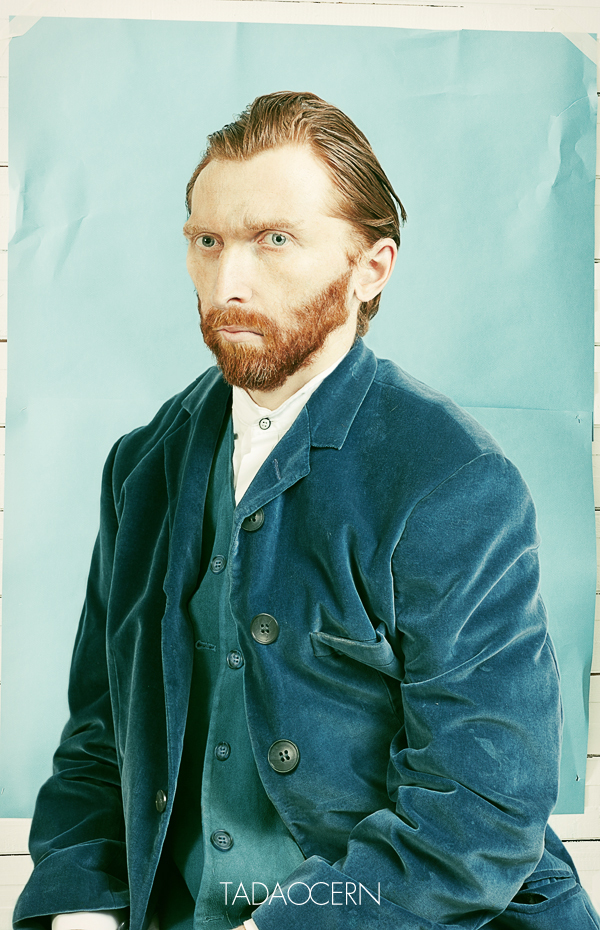
Or not. According to Lithuanian architect and photographer Tadao Cern, the friend who served as the model for his digital recreation of Vincent Van Gogh’s iconic self-portrait doesn’t resemble the painter all that much beyond his ginger hair and beard. After taking his picture, Cern devoted a day to adjusting colors and exposure in Lightroom and fine tuning a host of details in Photoshop. Suddenly, the similarities were uncanny.
And since every Frankenstein needs a bride, Cern has cobbled together a Mona Lisa to keep Van Gogh company.
Ayun Halliday is posting from the wilds of Cape Cod, where she once spotted John Waters riding his bicycle to Safeway in a yellow slicker and matching all-weather pants. Follow her @AyunHalliday
Full disclosure: I love George Saunders. Can I say that? Can I say that George Saunders rekindled my faith in contemporary fiction? Is that too fawning? Obsequious, but true! Oh, how bored I had become with fourth-hand derivative Carver, cheapened Cheever, sometimes the sad approximations of Chuck Palahniuk. So boring. It had gotten so all I could read was Philip K. Dick, over and over and over. And Alice Walker. And Wuthering Heights. And Thomas Hardy. Do you see the pass I’d come to? Then Saunders. In a writing class I took, with one of Gordon Lish’s acolytes (no names), I read Saunders. I read Wells Towers, Padgett Powell, Aimee Bender—a host of modern writers who were doing something new, in short, sometimes very short, forms, but explosive!
What is it about George Saunders that grips? He has mastered frivolity, turned it into an art of diamond-like compression. And for this, he gets a MacArthur Fellowship? Well, yes. Because what he does is brilliant, in its shockingly unaffected observations of humanity. George Saunders is an accomplished writer who puts little store in his accomplishments. Instead, he values kindness most of all, and generosity. These are the qualities he extols, in his typically droll manner, in a graduation speech he delivered to the 2013 graduating class at Syracuse University. Kindness: a little virtue, you might say. The New York Timeshas published his speech, and I urge you to read it in full. I’m going to give you half, below, and challenge you to find George Saunders wanting.
Down through the ages, a traditional form has evolved for this type of speech, which is: Some old fart, his best years behind him, who, over the course of his life, has made a series of dreadful mistakes (that would be me), gives heartfelt advice to a group of shining, energetic young people, with all of their best years ahead of them (that would be you).
And I intend to respect that tradition.
Now, one useful thing you can do with an old person, in addition to borrowing money from them, or asking them to do one of their old-time “dances,” so you can watch, while laughing, is ask: “Looking back, what do you regret?” And they’ll tell you. Sometimes, as you know, they’ll tell you even if you haven’t asked. Sometimes, even when you’ve specifically requested they not tell you, they’ll tell you.
So: What do I regret? Being poor from time to time? Not really. Working terrible jobs, like “knuckle-puller in a slaughterhouse?” (And don’t even ASK what that entails.) No. I don’t regret that. Skinny-dipping in a river in Sumatra, a little buzzed, and looking up and seeing like 300 monkeys sitting on a pipeline, pooping down into the river, the river in which I was swimming, with my mouth open, naked? And getting deathly ill afterwards, and staying sick for the next seven months? Not so much. Do I regret the occasional humiliation? Like once, playing hockey in front of a big crowd, including this girl I really liked, I somehow managed, while falling and emitting this weird whooping noise, to score on my own goalie, while also sending my stick flying into the crowd, nearly hitting that girl? No. I don’t even regret that.
But here’s something I do regret:
In seventh grade, this new kid joined our class. In the interest of confidentiality, her Convocation Speech name will be “ELLEN.” ELLEN was small, shy. She wore these blue cat’s‑eye glasses that, at the time, only old ladies wore. When nervous, which was pretty much always, she had a habit of taking a strand of hair into her mouth and chewing on it.
So she came to our school and our neighborhood, and was mostly ignored, occasionally teased (“Your hair taste good?” – that sort of thing). I could see this hurt her. I still remember the way she’d look after such an insult: eyes cast down, a little gut-kicked, as if, having just been reminded of her place in things, she was trying, as much as possible, to disappear. After awhile she’d drift away, hair-strand still in her mouth. At home, I imagined, after school, her mother would say, you know: “How was your day, sweetie?” and she’d say, “Oh, fine.” And her mother would say, “Making any friends?” and she’d go, “Sure, lots.”
Sometimes I’d see her hanging around alone in her front yard, as if afraid to leave it.
And then – they moved. That was it. No tragedy, no big final hazing.
One day she was there, next day she wasn’t.
End of story.
Now, why do I regret that? Why, forty-two years later, am I still thinking about it? Relative to most of the other kids, I was actually pretty nice to her. I never said an unkind word to her. In fact, I sometimes even (mildly) defended her.
But still. It bothers me. So here’s something I know to be true, although it’s a little corny, and I don’t quite know what to do with it:
What I regret most in my life are failures of kindness.
Those moments when another human being was there, in front of me, suffering, and I responded…sensibly. Reservedly. Mildly.
Or, to look at it from the other end of the telescope: Who, in your life, do you remember most fondly, with the most undeniable feelings of warmth?
Those who were kindest to you, I bet.
It’s a little facile, maybe, and certainly hard to implement, but I’d say, as a goal in life, you could do worse than: Try to be kinder.
We're hoping to rely on loyal readers, rather than erratic ads. Please click the Donate button and support Open Culture. You can use Paypal, Venmo, Patreon, even Crypto! We thank you!
Open Culture scours the web for the best educational media. We find the free courses and audio books you need, the language lessons & educational videos you want, and plenty of enlightenment in between.
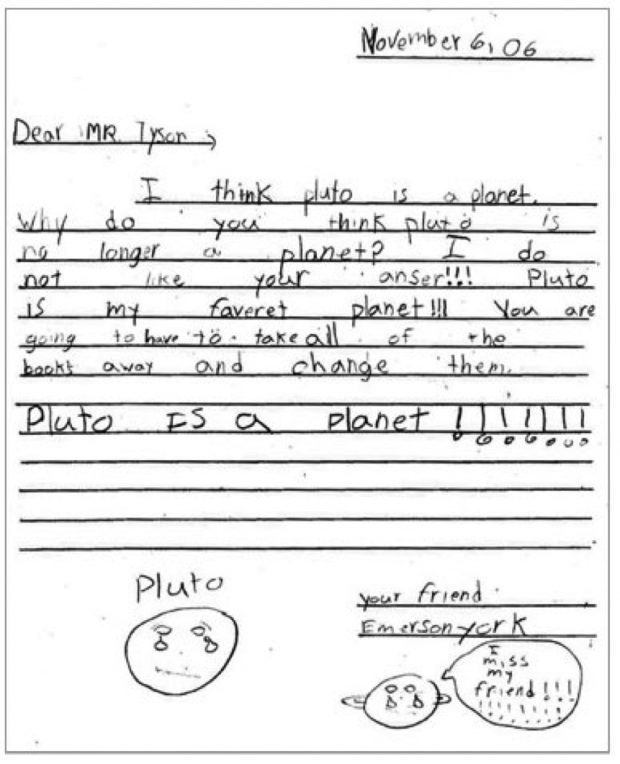 In the late 1990s, Neil deGrasse Tyson and his colleagues redesigned the Hayden Planetarium and, without much comment, they created a model of the solar system that banished Pluto from the list of planets. During the following year, no one said very much. But then The New York Times published an article (January 22, 2001) called “Pluto’s Not a Planet? Only in New York,” and all hell broke loose, particularly in the elementary schools. School kids were incensed, and the letters of complaint rolled in. You can find one such example from “Emerson” above. Five other letters can be found over at Mental Floss.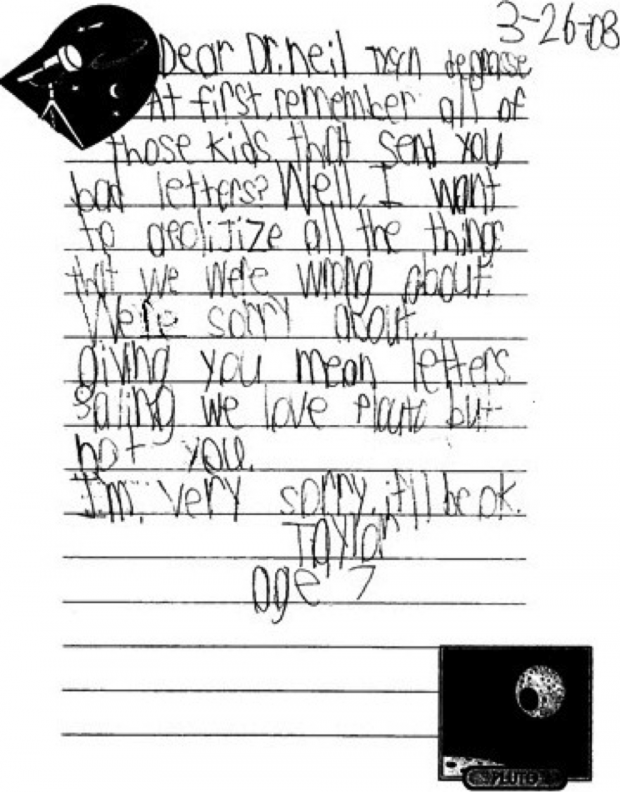








_2.jpg)
