The 10 Greatest Films of All Time According to 846 Film Critics

citizen kane best

We’ve recent­ly fea­tured the all-time-great­est-film-selec­tions from such cel­e­brat­ed direc­tors as Stan­ley Kubrick, Mar­tin Scors­ese, Woody Allen, and Quentin Taran­ti­no. Some of these lists came from the grand poll put on last year by Sight & Sound, the British Film Insti­tute’s well-respect­ed cin­e­ma jour­nal. While scru­ti­niz­ing the vot­ing records in the direc­tors’ divi­sion yields no small plea­sure for the cinephile, to focus too close­ly on that would ignore the big pic­ture. By that, I mean the over­all stand­ings in this most painstak­ing crit­i­cal effort to deter­mine “the Great­est Films of All Time”:

  1. Ver­ti­go (Alfred Hitch­cock, 1958)
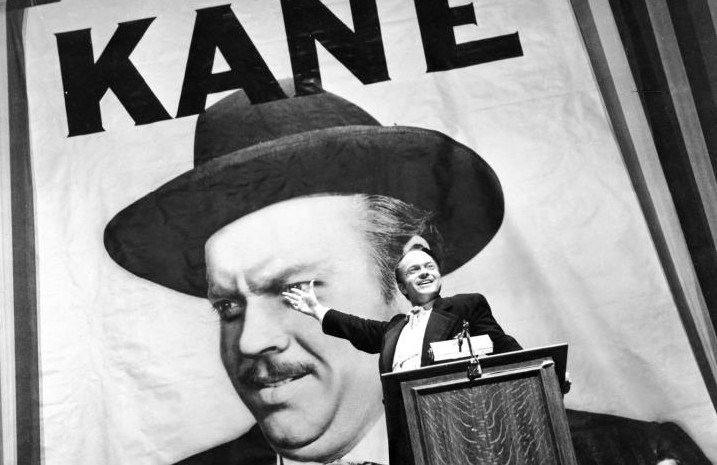
  2. Cit­i­zen Kane (Orson Welles, 1941)
  3. Tokyo Sto­ry (Yasu­jirô Ozu, 1953)
  4. La Règle du jeu (Jean Renoir, 1939)
  5. Sun­rise (F.W. Mur­nau, 1927)
  6. 2001: A Space Odyssey (Stan­ley Kubrick, 1968)
  7. The Searchers (John Ford, 1956)
  8. Man with a Movie Cam­era (Dzi­ga Ver­tov, 1929)
  9. The Pas­sion of Joan of Arc (Carl Theodor Drey­er, 1928)
  10. (Fed­eri­co Felli­ni, 1963)

These results came out with a bang — the sound, of course, of Ver­ti­go dis­plac­ing Cit­i­zen Kane. How many who watched the young Orson Welles’ debut dur­ing its finan­cial­ly inaus­pi­cious orig­i­nal run could have guessed it would one day stand as a byword for the height of cin­e­mat­ic crafts­man­ship?

But Cit­i­zen Kane just flopped, draw­ing a good deal of crit­i­cal acclaim even as it did so, where­as, sev­en­teen years lat­er, Hitch­cock­’s Ver­ti­go not only flopped, but did so into a fog of mixed reviews, tum­bling uncer­e­mo­ni­ous­ly from there into obscu­ri­ty. Prints became scarce, and the ones Hitch­cock afi­ciona­dos could lat­er track down had seen bet­ter days. It would take a kind of obses­sion — not to men­tion a thor­ough restora­tion — to return Ver­ti­go to the zeit­geist.

We ignored Ver­ti­go at our per­il, and if we now ignore Cit­i­zen Kane because of its new sec­ond-chair sta­tus, we do that at our per­il as well. The 90-minute doc­u­men­tary, The Com­plete Cit­i­zen Kane, orig­i­nal­ly aired in 1991 as an episode of the BBC’s Are­na. It looks at Welles’ mas­ter­piece from every pos­si­ble angle, even bring­ing in New York­er crit­ic Pauline Kael, whose essay “Rais­ing Kane” took a con­tro­ver­sial anti-auteurist posi­tion about this most seem­ing­ly auteur-dri­ven of all Amer­i­can films.

Fol­low us on Face­book, Twit­ter, Google Plus and LinkedIn and share intel­li­gent media with your friends. And if you want to make sure that our posts def­i­nite­ly appear in your Face­book news­feed, just fol­low these sim­ple steps.

Relat­ed Con­tent:

Quentin Taran­ti­no Lists the 12 Great­est Films of All Time: From Taxi Dri­ver to The Bad News Bears

Woody Allen Lists the Great­est Films of All Time: Includes Clas­sics by Bergman, Truf­faut & Felli­ni

Mar­tin Scors­ese Reveals His 12 Favorite Movies (and Writes a New Essay on Film Preser­va­tion)

Stan­ley Kubrick’s List of Top 10 Films (The First and Only List He Ever Cre­at­ed)

Philoso­pher Slavoj Zizek Inter­prets Hitchcock’s Ver­ti­go in The Pervert’s Guide to Cin­e­ma (2006)

Orson Welles Explains Why Igno­rance Was the Genius Behind Cit­i­zen Kane

Col­in Mar­shall hosts and pro­duces Note­book on Cities and Cul­ture and writes essays on lit­er­a­ture, film, cities, Asia, and aes­thet­ics. He’s at work on a book about Los Ange­lesA Los Ange­les Primer. Fol­low him on Twit­ter at @colinmarshall.

Don’t miss any­thing from Open Cul­ture in 2014. Sign up for our Dai­ly Email or RSS Feed. And we’ll send cul­tur­al curiosi­ties your way, every day.

18 (Free) Books Ernest Hemingway Wished He Could Read Again for the First Time

hemingway list free

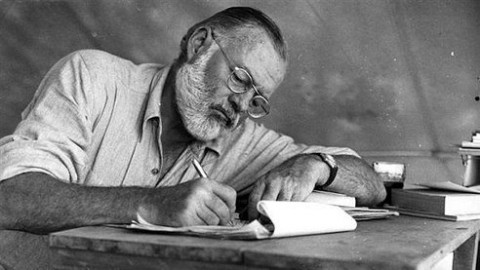
In the 1930s, Ernest Hem­ing­way wrote a series of short pieces for Esquire mag­a­zine called the “Key West Let­ters.” One of those pieces, the 1935 “Remem­ber­ing Shoot­ing-Fly­ing” has an inter­est­ing premise—Hemingway claims that remem­ber­ing and writ­ing about shoot­ing are more plea­sur­able than shoot­ing itself. Or at least that he’d rather remem­ber shoot­ing pheas­ant than actu­al­ly shoot clay pigeons. In the next para­graph, this nos­tal­gia for good shoot­ing gets tied up with good books, such that the essay betrays its true desire—to be a med­i­ta­tion on read­ing. Before he catch­es him­self and gets back on top­ic, Hem­ing­way launch­es into a long par­en­thet­i­cal:

I would rather read again for the first time Anna Karen­i­na, Far Away and Long Ago, Bud­den­brooks, Wuther­ing Heights, Madame Bovary, War and Peace, A Sportsman’s Sketch­es, The Broth­ers Kara­ma­zov, Hail and Farewell, Huck­le­ber­ry Finn, Wines­burg, Ohio, La Reine Mar­got, La Mai­son Tel­li­er, Le Rouge et le Noire, La Char­treuse de Parme, Dublin­ers, Yeat’s Auto­bi­ogra­phies and a few oth­ers than have an assured income of a mil­lion dol­lars a year.

Is this hyper­bole? Lit­er­ary blus­ter? The gen­uine desire to encounter again “for the first time” the lit­er­a­ture that trans­formed and widened his world? Maybe all of the above. Bet­ter to stay home and remem­ber the greats—write about them and hope for a time when they’re new again—than to fill one’s time with mediocre and for­get­table books. At least that seems to be his argu­ment. And while I’m sure you have your own lists (feel free to add them to the com­ments sec­tion below!), some of you may wish to take a shot at Hemingway’s and savor those works that for him over­shad­owed near­ly every oth­er.

To that end, we’ve com­piled a list of the books he names, with links to online texts and audio, where avail­able. Enjoy them for the first time, or read (and lis­ten) to them once again. And remem­ber that the texts are per­ma­nent­ly housed in our col­lec­tions of Free Book Audio Books and Free eBooks.

Anna Karen­i­na by Leo Tol­stoy (eBookAudio Book)

Far Away and Long Ago by W.H. Hud­son (eBookAudio Book)

Bud­den­brooks by Thomas Mann (eBook)

Wuther­ing Heights by Emi­ly Bron­të (eBookAudio Book)

Madame Bovary by Gus­tave Flaubert (eBookAudio Book)

War and Peace by Leo Tol­stoy (eBookAudio Book)

A Sportsman’s Sketch­es by Ivan Tur­genev (eBook)

The Broth­ers Kara­ma­zov by Fyo­dor Dos­to­evsky (eBookAudio Book)

Hail and Farewell by George Moore (eBook)

Adven­tures of Huck­le­ber­ry Finn by Mark Twain (eBookAudio Book)

Wines­burg, Ohio by Sher­wood Ander­son (eBookAudio)

Queen Mar­got by Alexan­dre Dumas (eBook)

La Mai­son Tel­li­er by Guy de Mau­pas­sant (eBook)

The Red and the Black by Stend­hal (eBookAudio Book)

La Char­treuse de Parme by Stend­hal (eBook)

Dublin­ers by James Joyce (eBookAudio Book)

Rever­ies over Child­hood and Youth by William But­ler Yeats (eBook)

The Trem­bling of the Veil by William But­ler Yeats (eBook)

Relat­ed Con­tent:

Ernest Hem­ing­way Cre­ates a Read­ing List for a Young Writer, 1934

Ernest Hem­ing­way Writes of His Fas­cist Friend Ezra Pound: “He Deserves Pun­ish­ment and Dis­grace” (1943)

Ernest Hem­ing­way to F. Scott Fitzger­ald: “Kiss My Ass”

Neil deGrasse Tyson Lists 8 (Free) Books Every Intel­li­gent Per­son Should Read

via Lists of Note

Josh Jones is a writer and musi­cian based in Durham, NC. Fol­low him at @jdmagness

Psychedelic Scenes of Pink Floyd’s Early Days with Syd Barrett, 1967

Roger Waters of Pink Floyd turns 70 years old today. Waters was the prin­ci­pal song­writer and dom­i­nant cre­ative force dur­ing the band’s famous 1970s peri­od, when it released a string of pop­u­lar and influ­en­tial con­cept albums such as Dark Side of the Moon, Wish You Were Here and The Wall. But today we thought it would be inter­est­ing to take you all the way back to 1967, when Waters was 23 years old and the band was led by his child­hood friend Syd Bar­rett.

The video above is from a May 14, 1967 broad­cast of the BBC pro­gram The Look of the Week. Pink Floyd had­n’t released an album yet. Only two nights ear­li­er the band had staged its atten­tion-get­ting “Games for May” con­cert at the Queen Eliz­a­beth Hall. In the TV broad­cast, Pink Floyd plays its ear­ly favorite “Astron­o­my Domine” before Waters and Bar­rett sit down for a rather tense inter­view with the clas­si­cal­ly trained musi­cian and crit­ic Hans Keller. It’s amus­ing to watch Keller’s face as he express­es his extreme irri­ta­tion at the band’s loud, strange music. “My ver­dict is that its a lit­tle bit of a regres­sion to child­hood,” he says with a gri­mace. “But after all, why not?”

Waters and Bar­rett man­age to hold their own dur­ing the inter­view. Bar­rett comes across as lucid and well-spo­ken, despite the fact that his heavy LSD use and men­tal insta­bil­i­ty would soon make him unable to func­tion with­in the band. By Decem­ber of 1967, Pink Floyd would add gui­tarist David Gilmour to the line­up to com­pen­sate for Bar­ret­t’s errat­ic behav­ior. By March of 1968 — only 10 months after the BBC broad­cast — Bar­rett would quit the group.

We’ll close with an even ear­li­er video of Pink Floyd onstage. Filmed on Jan­u­ary 27, 1967 at the leg­endary UFO club in Lon­don, the clip is from the Feb­ru­ary 7, 1967 Grana­da TV doc­u­men­tary So Far Out It’s Straight Down. It shows the band play­ing anoth­er major song from its psy­che­del­ic era, “Inter­stel­lar Over­drive.”

Relat­ed Con­tent:

Pink Floyd’s David Gilmour Sings Shakespeare’s Son­net 18

Watch Pink Floyd Plays Live in the Ruins of Pom­peii (1972)

Pink Floyd’s Roger Waters Per­forms The Wall at the Berlin Wall (1990)

On the 10th Anniversary of His Death, Watch Warren Zevon’s First & Last Appearances on Letterman

Singer/songwriter War­ren Zevon died of lung can­cer ten years ago tomor­row. I remem­ber the day of his pass­ing well, but at the time I was a lit­tle baf­fled by the enor­mous num­ber of trib­utes to the musi­cian, who I vague­ly thought of (stu­pid­ly) as a nov­el­ty song­writer vague­ly asso­ci­at­ed with the L.A. soft rock scene. How wrong I was. I arrived at the Zevon par­ty late, but I final­ly showed up, and came to under­stand why almost every musi­cian from the sev­en­ties and eight­ies that I admire deeply admires War­ren Zevon and his hard­bit­ten, wit­ty, and unsen­ti­men­tal nar­ra­tive style. There’s so much Zevon in so many trou­ba­dours I love: Joe Jack­son, Tom Waits, Spring­steen. Always on the cusp of star­dom but nev­er quite a star like peers and for­mer room­mates Lind­sey Buck­ing­ham, Ste­vie Nicks, and Jack­son Browne, Zevon was nev­er­the­less one of the most well-regard­ed writ­ers of the L.A. rock scene. Whether it was his mis­an­throp­ic com­mit­ment to his cynicism—as All­mu­sic describes his per­son­al­i­ty—that side­lined him or his strug­gles with acute alco­holism isn’t entire­ly clear, but he always had his cham­pi­ons among crit­ics and peers alike.

In addi­tion to the afore­men­tioned lumi­nar­ies, Zevon’s career was boost­ed by mem­bers of R.E.M., with whom he record­ed under the name Hin­du Love Gods, and—most vis­i­bly and consistently—by David Let­ter­man, who had a twen­ty year rela­tion­ship with Zevon as his guest and some­time sub­sti­tute band leader. At the top of the post, you can see Zevon’s final appear­ance on Letterman’s show. The two attempt light ban­ter but lapse occa­sion­al­ly into awk­ward paus­es as they dis­cuss Zevon’s diag­no­sis. The talk is frank and filled with mor­dant wit, as was Zevon’s way, and Let­ter­man con­fess­es he’s astound­ed at his long­time friend’s abil­i­ty to keep his sense of humor. When Let­ter­man asks Zevon if he’s learned some­thing Dave doesn’t know about life and death, Zevon responds with the end­less­ly quotable line, “not unless I know how much you’re sup­posed to enjoy every sand­wich.” In the clip above, watch one of Zevon’s final per­for­mances on the same show. He plays the pow­er­ful bal­lad “Muti­neer,” a song with a fit­ting epi­taph for Zevon’s life: “ain’t no room on board for the insin­cere.”

And in the clip above, see Zevon’s first appear­ance on Let­ter­man in 1982, play­ing “Excitable Boy” and “The Over­draft.” Watch­ing these ear­ly and late per­for­mances, I’m baf­fled again—this time by why War­ren Zevon wasn’t a major star. But it doesn’t mat­ter. Those who know his work, includ­ing near­ly every major singer/songwriter of the last forty years, know how amaz­ing he was. For more of Zevon’s amaz­ing­ness, check out this full 1982 con­cert film from an appear­ance in Pas­sa­ic, New Jer­sey. And please, remem­ber to enjoy every sand­wich.

Relat­ed Con­tent:

Tom Waits and David Let­ter­man: An Amer­i­can Tele­vi­sion Tra­di­tion

Josh Jones is a writer and musi­cian based in Durham, NC. Fol­low him at @jdmagness

Watch The Amazing 1912 Animation of Stop-Motion Pioneer Ladislas Starevich, Starring Dead Bugs


Last week we fea­tured 1937’s The Tale of the Fox, the crown­ing glo­ry of inven­tive Russ­ian film­mak­er Ladis­las Stare­vich’s work in pup­pet ani­ma­tion. But he did­n’t always shoot pup­pets as we know them; at the dawn of his career — and thus the dawn of Russ­ian ani­ma­tion — he had to make use of what lay close at hand. Today we go back a cou­ple decades fur­ther, to the time when Stare­vich (then known, before his immi­gra­tion to Paris, as Władysław Starewicz) worked not as an ani­ma­tor but as the direc­tor of Kovno, Lithua­ni­a’s Muse­um of Nat­ur­al His­to­ry. Inter­est­ed in film­ing noc­tur­nal stag bee­tles but unable to get a per­for­mance out of them under film lights, he hit upon the idea of shoot­ing not liv­ing insects but dead ones, their legs replaced with wire which he could repo­si­tion frame-by-frame. The result? Stare­vich’s ear­ly, still-enter­tain­ing shorts like 1911’s The Ant and the Grasshop­per (also known as The Drag­on­fly and the Ant) at the top.


But you haven’t tru­ly expe­ri­enced dead-bug ani­ma­tion until you’ve seen The Cam­era­man’s Revenge, just above. Stare­vich made it in 1912, by which time his ani­ma­tion skills had devel­oped to the point that each play­er moves in a man­ner both real­is­ti­cal­ly bug­like (some con­tem­po­rary view­ers mis­took them for trained insects mov­ing in real time) and par­o­d­i­cal­ly evoca­tive of human char­ac­ters. Slate’s Joan New­berg­er describes the plot of this “com­ic melo­dra­ma in metic­u­lous­ly detailed minia­ture sets” as fol­lows: “We meet a bee­tle cou­ple, Mr. and Mrs. Zhukov (zhuk means bee­tle in Russ­ian), both of whom are car­ry­ing on extra­mar­i­tal affairs. Zhukov wins the affec­tions of a drag­on­fly cabaret dancer, but flies into a rage when he comes home to dis­cov­er his wife in the ‘arms’ of an artist (also played by a bee­tle).” But the plot thick­ens, and this seem­ing­ly sim­ple (if obvi­ous­ly com­plex in craft, espe­cial­ly for the time) tale even uses a bit of cin­e­ma-with­in-cin­e­ma at its denoue­ment. Starewicz made ear­ly stop-motion for sure, but he did­n’t make the ear­li­est. Smithsonian.com has a post on that, cit­ing the 1902 Thomas Edi­son-pro­duced Fun in a Bak­ery Shop as the first sur­viv­ing exam­ple — but, alas, a bug­less one.

Stare­vich’s films can be found in our col­lec­tion, 4,000+ Free Movies Online: Great Clas­sics, Indies, Noir, West­erns, Doc­u­men­taries & More. Look under Ani­ma­tion.

via Slate’s Vault Blog

Relat­ed Con­tent:

The Tale of the Fox: Watch Ladis­las Starevich’s Ani­ma­tion of Goethe’s Great Ger­man Folk­tale (1937)

The Mas­cot, Pio­neer­ing Stop Ani­ma­tion from Wla­dys­law Starow­icz

Col­in Mar­shall hosts and pro­duces Note­book on Cities and Cul­ture and writes essays on lit­er­a­ture, film, cities, Asia, and aes­thet­ics. He’s at work on a book about Los Ange­lesA Los Ange­les Primer. Fol­low him on Twit­ter at @colinmarshall.

Salvador “Dalí is the Biggest ‘Prick’ of the 20th Century,” Says the Quotable Henry Miller

henry miller dali

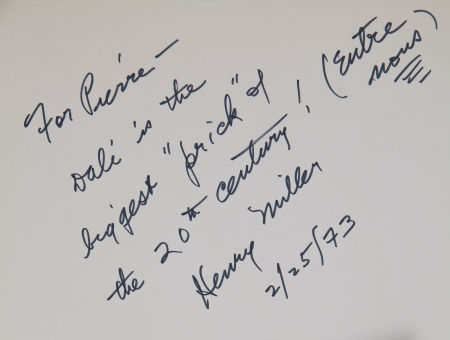
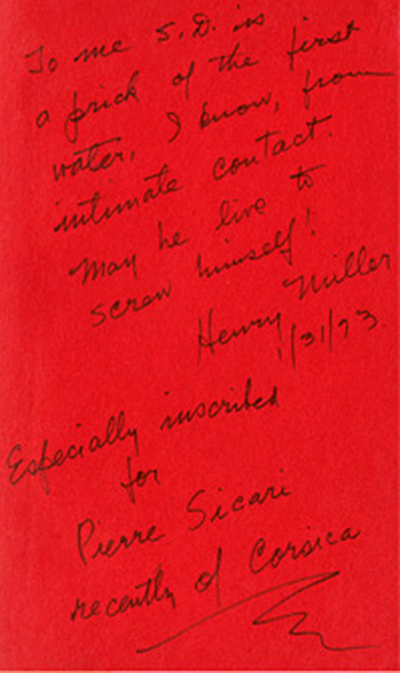
There’s no two ways about it. Hen­ry Miller had a way with words. He could be blunt, lewd, cut­ting, all in one short sen­tence. You want a lit­tle case study? Ok, how about the notes Miller scrawled back in 1973, when he called Sal­vador Dalí “the biggest ‘prick” of the 20th cen­tu­ry” (or, in anoth­er instance a “prick of the first water”). What was his beef with the Span­ish sur­re­al­ist? It all start­ed in 1940, when Miller and his lover, the incom­pa­ra­ble Anaïs Nin, spent some time cooped up in the same house with Dalí, who turned out to be an insuf­fer­able pri­ma don­na. Their time togeth­er end­ed in a wild shout­ing match, with Miller and Nin storm­ing out of the home and hold­ing a grudge for decades to come. The sto­ry is nice­ly recount­ed by Book Tryst, a site that has recent­ly become a new favorite of ours.

Relat­ed Con­tent:

Alice’s Adventures in Wonderland, Illustrated by Salvador Dalí in 1969, Finally Gets Reissued

Des­ti­no: The Sal­vador Dalí – Dis­ney Col­lab­o­ra­tion 57 Years in the Mak­ing

Tom Schiller’s 1975 Jour­ney Through Hen­ry Miller’s Bath­room (NSFW)

Hen­ry Miller Talks Writ­ing and the Expat Life with Anaïs Nin, Lawrence Dur­rell, and Oth­ers (1969)

by | Permalink | Make a Comment ( 2 ) |

Hear the Isolated Vocal Tracks for The Beatles’ Climactic 16-Minute Medley on Abbey Road

I have many mem­o­ries grow­ing up of gin­ger­ly plac­ing my father’s Abbey Road LP on the turntable and spend­ing the after­noon lying on the floor and peer­ing at the pho­tos inside the album cover’s gatefold—trying to wrap my head around what kind of hairy genius­es could make music like this. I had no inkling that this was their final record­ing togeth­er, that the band was about to come apart. None of that mat­tered to me. I didn’t quite grasp how this band evolved from the teen pop sen­sa­tions in iden­ti­cal suits and hair­cuts with their legions of flail­ing school­girl fans and goofy com­e­dy troupe ban­ter. This seemed like an entire­ly dif­fer­ent entity—and the par­tic­u­lar sub­lim­i­ty of the med­ley on side 2 (lis­ten to it here) had me lift­ing up the nee­dle and drop­ping it back at the intro to “You Nev­er Give Me Your Mon­ey” over and over.

That med­ley is such an impres­sive demon­stra­tion of The Bea­t­les’ range of voice and sen­si­bil­i­ty that it almost func­tions as a cap­sule for the sound of their whole lat­er career—all the weird nar­ra­tives, blues, bal­lads, and gor­geous­ly lush hymns and lul­la­bies. What remains con­stant through­out every Bea­t­les’ record—even before George and Ringo’s song­writ­ing contributions—is the vocal and lyri­cal inter­play of Lennon/McCartney, and it’s all on fine dis­play in the med­ley.

George Har­ri­son described side 2 in 1969 as “a big med­ley of Paul and John’s songs all shoved togeth­er.” Lennon gave George and Ringo more cred­it for the med­ley in an inter­view that same year:

We always have tons of bits and pieces lying around. I’ve got stuff I wrote around Pep­per, because you lose inter­est after you’ve had it for years. It was a good way of get­ting rid of bits of songs. In fact, George and Ringo wrote bits of it… lit­er­al­ly in between bits and breaks. Paul would say, ‘We’ve got twelve bars here– fill it in,’ and we’d fill it in on the spot. As far as we’re con­cerned, this album is more ‘Beat­ley’ than the dou­ble (White) album.

How­ev­er it all came about, it’s the med­ley’s strange lyri­cal twists, mélange of vocal styles, and pow­er­ful har­monies that stay with me, and that I find myself singing soft­ly, even after hav­ing gone sev­er­al years with­out hear­ing the album in full. Per­haps you do this too. Now we can hear what The Bea­t­les’ them­selves sound­ed like in the stu­dio sans instru­ments with the iso­lat­ed vocal tracks for the side 2 med­ley at the top of the post. Hear the full album ver­sion here and see the Med­ley track­list below.

You Nev­er Give Me Your Mon­ey

Sun King

Mean Mr. Mus­tard

Poly­thene Pam

She Came in Through the Bath­room Win­dow

Gold­en Slum­bers

Car­ry That Weight

The End

via Eric Alper

Relat­ed Con­tent:

A Short Film on the Famous Cross­walk From the Bea­t­les’ Abbey Road Album Cov­er

John Lennon’s Raw, Soul-Bar­ing Vocals From the Bea­t­les’ ‘Don’t Let Me Down’ (1969)

The 10-Minute, Nev­er-Released, Exper­i­men­tal Demo of The Bea­t­les’ “Rev­o­lu­tion” (1968)

Josh Jones is a writer and musi­cian based in Durham, NC. Fol­low him at @jdmagness

Jacques Lacan’s Confrontation with a Young Rebel: Classic Moment, 1972

This is fas­ci­nat­ing to watch.

On Octo­ber 13, 1972, the charis­mat­ic and con­tro­ver­sial French the­o­rist and psy­cho­an­a­lyst Jacques Lacan is giv­ing a lec­ture at the Catholic Uni­ver­si­ty of Lou­vain, Bel­gium, when a young man with long hair and a chip on his shoul­der walks up to the front of the lec­ture hall and begins mak­ing trou­ble. He spills water and what appears to be flour all over Lacan’s lec­ture notes and then stam­mers his way into a strange speech that sounds as if it were tak­en straight out of Guy Debor­d’s The Soci­ety of the Spec­ta­cle:

“The com­pos­ite body which up to fifty years ago could be called ‘cul­ture’– that is, peo­ple express­ing in frag­ment­ed ways what they feel — is now a lie, and can only be called a ‘spec­ta­cle,’ the back­drop of which is tied to, and serves as, a link between all alien­at­ed indi­vid­ual activ­i­ties. If all the peo­ple here now were to join togeth­er and, freely and authen­ti­cal­ly, want­ed to com­mu­ni­cate, it’d be on a dif­fer­ent basis, with a dif­fer­ent per­spec­tive. Of course this can’t be expect­ed of stu­dents who by def­i­n­i­tion will one day become the man­agers of our sys­tem, with their jus­ti­fi­ca­tions, and who are also the pub­lic who with a guilty con­science will pick up the remains of the avant-garde and the decay­ing ‘spec­ta­cle.’ ”

The 71-year-old Lacan nev­er los­es his com­po­sure. (His cig­ar appears bent out of shape, but it was that way from the begin­ning.) The audi­ence, too, retains a cer­tain Gal­lic non­cha­lance. Dan­ger­ous Minds sums it up in the head­line “The Sin­gle Most ‘French’ Moment in all of 1972: Jacques Lacan Accost­ed, But No One Stops Smok­ing.” The scene is from Jacques Lacan Speaks, a one-hour doc­u­men­tary by Bel­gian film­mak­er Françoise Wolff. You can watch the com­plete film, which includes Lacan’s extend­ed and rather cryp­tic response to the inci­dent and oth­er excerpts from the lec­ture, fol­lowed by Wolf­f’s inter­view with Lacan the fol­low­ing day, in our post: “Charis­mat­ic Psy­cho­an­a­lyst Jacques Lacan Gives Pub­lic Lec­ture (1972).”

If you would like to sign up for Open Culture’s free email newslet­ter, please find it here. It’s a great way to see our new posts, all bun­dled in one email, each day.

If you would like to sup­port the mis­sion of Open Cul­ture, con­sid­er mak­ing a dona­tion to our site. It’s hard to rely 100% on ads, and your con­tri­bu­tions will help us con­tin­ue pro­vid­ing the best free cul­tur­al and edu­ca­tion­al mate­ri­als to learn­ers every­where. You can con­tribute through Pay­Pal, Patre­on, and Ven­mo (@openculture). Thanks!

via Lit­er­ary Kicks

Relat­ed Con­tent:

Free Online Phi­los­o­phy Cours­es

Michel Fou­cault: Free Lec­tures on Truth, Dis­course & The Self

John Sear­le on Fou­cault and the Obscu­ran­tism in French Phi­los­o­phy

Phi­los­o­phy with a South­ern Drawl: Rick Rod­er­ick Teach­es Der­ri­da, Fou­cault, Sartre and Oth­ers

Der­ri­da: A 2002 Doc­u­men­tary on the Abstract Philoso­pher and the Every­day Man

« Go BackMore in this category... »
Quantcast