Here’s a strikingly unconventional interpretation of Ludwig van Beethoven’s 1806 composition, 32 Variations on an Original Theme in C minor, by the Canadian virtuoso pianist Glenn Gould. It was recorded in Toronto in March of 1966 for a special program, “Conversations with Glenn Gould,” which featured an in-depth discussion between Gould and the BBC arts reporter Humphrey Burton. You can find the complete program broken up into pieces at the CBC Web site. And for an especially interesting 35-minute segment, in which Gould explains and demonstrates his idiosyncratic approach to interpreting Beethoven, see below:
Danish philosopher Søren Kierkegaard—often considered the first existentialist—was born 200 years ago this past Sunday in Copenhagen. Writing under pseudonyms like Johannes Climacus and Johannes de Silentio, Kierkegaard attacked both the idealism of contemporary philosophers Hegel and Schelling and the bourgeois complacency of European Christendom. A highly skilled rhetorician, Kierkegaard preferred the indirect approach, deploying irony, ridicule, parody and satire in a paradoxical search for individual authenticity within a European culture he saw as beset by self-important puffery and unthinking mass movements.
While millions of readers have embraced Kierkegaard’s probing method, as many have also rejected his faith-based conclusions. Nevertheless, his strikingly eccentric skewering of the tepidly faithful and overly optimistic breathed light and heat into the nineteenth century debates among modern Christians as they confronted the findings of science and the challenges posed by world religions and materialist philosophers like Karl Marx.
Marx and Kierkegaard’s many contrasts and contradictions are well represented in Episode 4 of the BBC documentary series Sea of Faith, “Prometheus Unbound” (part one at top, part two immediately above). The 1984 six-part series—named in reference to Matthew Arnold’s famous poem “Dover Beach” and hosted by radical theologian Don Cupitt—examines the ways in which the Copernican and Darwinian scientific revolutions and the work of critics of religious doctrine like Freud, Marx, Nietzsche, Strauss, and Schweitzer shook the foundations of orthodox Christianity. Here, Kierkegaard is played in reenactments with appropriate intensity by British actor Colin Jeavons.
You can learn more about the documentary series (and purchase DVDs) here. And for more on Kierkegaard, you would be well-served by listening to Walter Kaufmann’s lecture above. For a lighter-hearted but still rigorous take on the philosopher, be sure to catch the well-read, irreverent gents at the Partially Examined Life podcast in a discussion of Kierkegaard’s earnest and often disturbing defense of existential Christianity, The Sickness Unto Death.
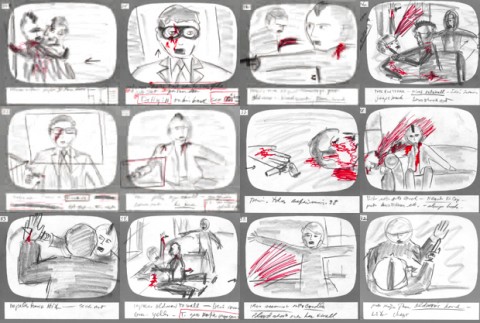
Anyone who’s watched Martin Scorsese’s Taxi Driver surely remembers, or has remained haunted by, many images from the film, most of which — if not all— began as humble pencil drawings. Like many major motion pictures, Taxi Driver began not just as a script but also as a storyboard, the piece of comic book-like sequential art filmmakers use to plan shots, camera movements, and character placements. Some directors, like Ridley Scott, spend time crafting detailed storyboards, while others, like the thoroughly improvisational Werner Herzog, don’t use them at all. Scorsese falls somewhere in between, sketching out storyboard panels that feel more like brief notes to himself and his closest collaborators. You can see them alongside the Taxi Driver scenes they produced in the video above.
“Storyboards express what I want to communicate,” Scorsese told Phaidon in 2011 for an article on the exhibition “Between Film and Art: Storyboards from Hitchcock to Spielberg.” “They show how I would imagine a scene and how it should move to the next.” And the effect on his process of using as seemingly flimsy a tool as a pencil? “The pencil line leaves little impression on the paper, so if the storyboard is photocopied it loses something. I refer back to my original drawings in order for me to conjure up the idea I had when I saw the pencil line made.” Every filmmaker has their own way of doing things, and as you can see when the video lines up these pencil drawings with (millions of dollars later) the finished sequences, Scorsese’s method gets results. “These storyboards are not the only means of communication for what I imagine,” the director adds at the article’s end, “but they are the point where I begin.”
From Gutenberg’s inky, monk-inspired Blacklister font to the ever-controversial Comic Sans, Barrett-Forrest employs stop motion to spell out the quantifiable reasons that certain serifs and stroke types are easy on the eye. Let’s not tell the creators of Llama Font or Mr. Twiggy, but legibility is the mother of survival in this arena.
If you would like to support the mission of Open Culture, consider making a donation to our site. It’s hard to rely 100% on ads, and your contributions will help us continue providing the best free cultural and educational materials to learners everywhere. You can contribute through PayPal, Patreon, and Venmo (@openculture). Thanks!
Ayun Halliday has devoted the last 15 years to producing The East Village Inky, an entirely handwritten zine whose aging readers complain that they can no long make out the tiny print.
Andy Stewart builds boats with his own hands for life-affirming reasons. It’s a way to make inanimate objects come alive, to breathe new life into our world. But Stewart also enjoys the challenge of it all. The sea, he tells us, is the “final arbitrator” of your work. Quite decisively, it tells you whether a boat has been crafted with precision, whether every piece of wood contributes to the larger hull/whole. If your boat can stand the rigorous tests of nature and time, you know you’ve mastered your craft. The short documentary above, Shaped on all Six Sides, was directed by Kat Gardiner.
If you would like to support the mission of Open Culture, consider making a donation to our site. It’s hard to rely 100% on ads, and your contributions will help us continue providing the best free cultural and educational materials to learners everywhere. You can contribute through PayPal, Patreon, and Venmo (@openculture). Thanks!
Great talents seem to embody their craft. It’s as if they invented the form and then broke the mold when they were finished with it.
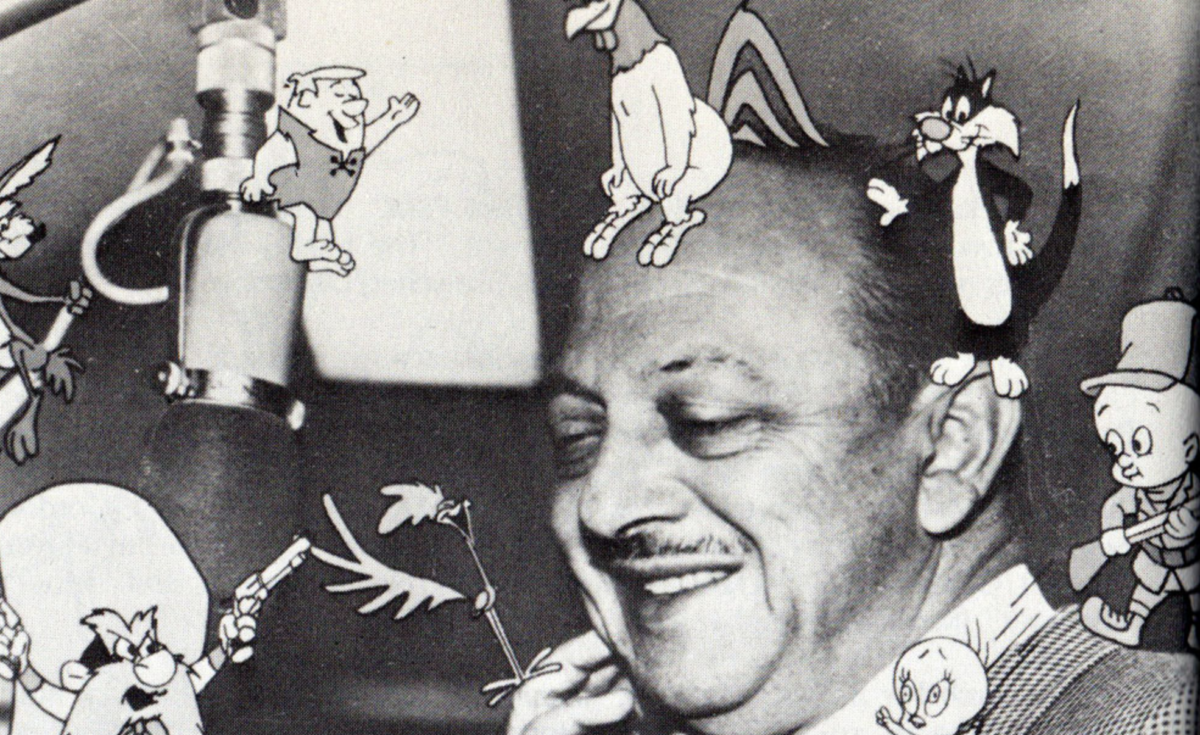
One of the best modern examples of this virtuosity is Mel Blanc, voice of Bugs Bunny and nearly all of the Looney Tunes cartoon gang. Blanc, who voiced more than 1,000 characters, was famously hard-working. At one point in his career, he scrambled from studio to studio around Los Angeles to work on 18 radio shows in one week.
As Malcolm Gladwell likes to say, that kind of practice leads to mastery. And, in Mel Blanc’s case, it may have saved his life.
Radio Lab, broadcast over WNYC, recently aired a piece about Blanc (listen below) featuring an interview with his son Noel Blanc, who is also a voice actor. Noel Blanc tells the story of a terrible car accident that badly injured his father in 1961 as he was driving home along Sunset Boulevard from a job in San Francisco. Mel Blanc, driving an Aston Martin, collided with another car on Dead Man’s Curve. Blanc was almost killed and slipped into a coma. Blanc’s son and wife spent two weeks at his bedside trying to revive him, but got no response.
One day, about 14 days after the accident, one of Blanc’s neurologists walked into the room and tried something completely new. He went to Mel’s bed and asked, “Bugs Bunny, how are you doing today?”
There was a pause while people in the room just shook their heads. Then, in a weak voice, came the response anyone would recognize.
“Myeeeeh. What’s up doc?”
The doctor then asked Tweety if he was there too.
“I tot I taw a puddy tat,” was the reply.
It took seven more months in a body cast for Blanc to recover. He even voiced Barney Rubble in the first episodes of The Flintstones whilelying in bed with a microphone dangling from above.
The Radio Lab piece includes excerpts from an episode of This is Your Life when Blanc’s doctor tried to explain how he revived his patient. “It seemed like Bugs Bunny was trying to save his life,” was all he could say.
Radio Lab features another neurologist’s opinion: Blanc was such a hard-working professional that his characters lived, protected from the brain injury, deep in his unconscious mind. The doctor’s question must have sounded like a director’s cue.
Essentially, “Mr. Blanc, you’re on.”
And he was, until 1989. Listen through to the end of the podcast. The end of Blanc’s life is as remarkable as his long career.
Below, we have added a related documentary, Mel Blanc: The Man of a Thousand Voices.
Kate Rix writes about education and digital media. Visit her website to see more of her work. Follow her on Twitter: @mskaterix.
It used to be that accepting an advance on an unwritten novel was as good as admitting failure before the work is even finished. Can you imagine blue-blood novelists Edith Wharton or Henry James taking a check before finishing their books?
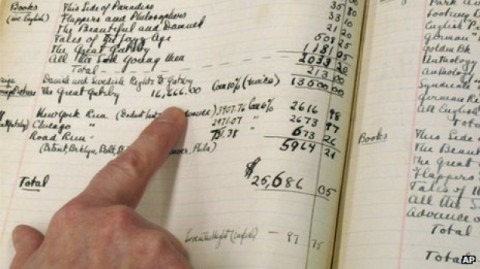
F. Scott Fitzgerald may have been a long-suffering wannabe when it came to high society, but he never pretended to be anything but a businessman when it came to writing. For nearly his entire professional life he kept a detailed ledger of his income from writing, in which he noted the $3,939 advance he received for his in-progress novel, The Great Gatsby. The new Gatsby film out this summer is the fifth adaptation. The first earned Fitzgerald $16,666. (See the surviving footage here.)
Recently digitized by the University of South Carolina, the lined notebook, which the writer probably packed with him on all of his travels, paints a picture of a pragmatic businessman repeatedly on and off the wagon. Sound like Gatsby? Maybe a little.
A true Jazz Age storyteller, Fitzgerald sets up the droll social scene of his own early days: Not long after his birth on September 24, 1896, the infant “was baptized and went out for the first time—to Lambert’s corner store on Laurel Avenue.”
It’s worth a stroll through Fitzgerald’s clipped account of his childhood, for the humor and the poignant references to birthday parties and childhood mischief. By 1920 the writer is married and has some professional momentum. In the margins of that year’s page, he writes “Work at the beginning but dangerous toward the end. A slow year, dominated by Zelda & on the whole happy.”
By the last entry, the state of Fitzgerald’s life is grim—“work and worry, sickness and debt.” The book reads like a whirlwind of drinking, writing, travel and jet-setting. Fitzgerald holds his gaze steady on social dynamics, noting gatherings and arguments with friends alongside the notes about his creative bursts and dry spells.
Kate Rix writes about education and digital media. Visit her website at and follow her on Twitter @mskaterix.
The work of James Joyce has inspired many a musician—from John Cage to Kate Bush, and Lou Reed to Irish band Therapy?. The famed Irish writer was himself a great lover of song (his only collection of poetry is titled Chamber Music); most readers of Joyce know that he packed his stories and novels with thousands of allusions and quotes from popular and classical songs. Fewer know that if the encyclopedic modernist had not become James Joyce the heavyweight author, we might know him as James Joyce, singer and composer. Joyce once shared the stage with opera singer John McCormack and studied and performed music throughout his life.
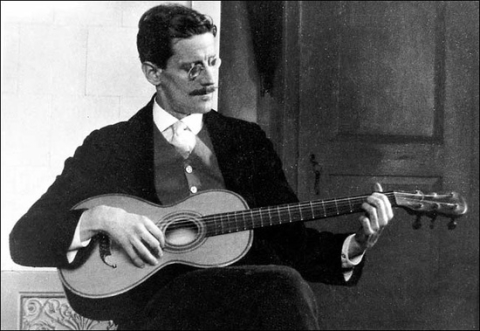
Joyce the singer is typically pictured “drooping over the keys” of a piano (as Shakespeare and Company founder Sylvia Beach put it). But he also played the guitar, as you can see from the 1915 photo above (taken in Trieste by Joyce’s friend Ottacaro Weiss). Joyce’s small-bodied guitar has been housed at the Joyce Tower Museum in Dublin since 1966, in an unplayable state.
Now, English luthier Gary Southwell has undertaken a restoration of the instrument at the behest of Tower Museum curator Robert Nicholson and Fran O’Rourke, professor of philosophy at Joyce’s alma mater, University College Dublin. A musician himself, O’Rourke will perform Joycean Irish songs during Bloomsweek to offset the cost of the project, accompanied on the restored Joyce guitar by Irish classical guitarist John Feeley
Luthier Southwell describes the guitar as “a fairly standard instrument of the period… not from any great maker of the past or anything like that.” In the video above from The Irish Times, see Southwell, Professor O’Rourke, and Joyce scholar Terence Killeen describe the state of the guitar and its history. And below, listen to Joyce’s only known composition, the melancholy “Bid Adieu to Girlish Days,” sung by tenor Kevin McDermott.
We're hoping to rely on loyal readers, rather than erratic ads. Please click the Donate button and support Open Culture. You can use Paypal, Venmo, Patreon, even Crypto! We thank you!
Open Culture scours the web for the best educational media. We find the free courses and audio books you need, the language lessons & educational videos you want, and plenty of enlightenment in between.