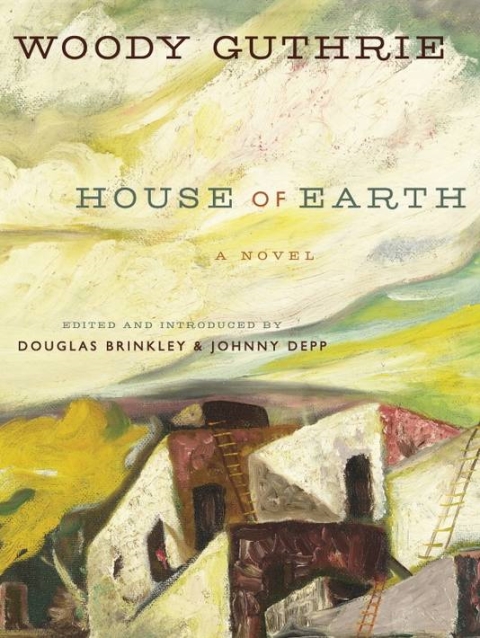
Woody Guthrie may have written as many as 3,000 folk songs, but he didn’t limit himself there. He also managed to write a novel called House of Earth, which only last month saw the light of day. To whom do we owe the pleasure of reading this previously unknown addendum to the prolific singer-songwriter’s career? Why, to historian Douglas Brinkley, actor Johnny Depp, and Guthrie’s daughter Nora. Researching a forthcoming biography of Bob Dylan, Brinkley spotted a mention of House of Earth somewhere deep in the files of famous folk-music recordist Alan Lomax. He traced the manuscript to the University of Tulsa library, which had it in storage. Depp had recently started his own publishing imprint, Infinitum Nihil, and Brinkley passed along this promising piece of material. (The two had known each other for years, having initially met through that great literary connector, Dr. Hunter S. Thompson.)
With House of Earth, Guthrie wrote a Dust Bowl novel, but one very much in tune with his own sensibilities. Unlike John Steinbeck’s The Grapes of Wrath, Guthrie’s story follows not the farm families who fled west, but those who remained on the Texas plains. “Pitched somewhere between rural realism and proletarian protest,” write Brinkley and Depp in a New York Times Book Review essay, “somewhat static in terms of narrative drive, ‘House of Earth’ nonetheless offers a searing portrait of the Panhandle and its marginalized Great Depression residents. Guthrie successfully mixes Steinbeck’s narrative verve with D. H. Lawrence’s openness to erotic exploration.” As of this week, you can read and also now hear the book, as read by Will Patton, in an audio version released by Audible.com. (Find info on how to get it for free below.) At the top of this post, you’ll find a short clip of Patton delivering the singer’s prose. Though Guthrie will remain best known for his politically-charged songs, his novel, which launches broadsides against big finance, big lumber, and big agriculture, should carry charge enough for any of his enthusiasts.
Note: Do you want to download House of Earth from Audible for free? Here’s one way to do it. Just head over to Audible.com and register for a 30-day free trial. You can download any audio book for free. Then, when the trial is over, you can continue your Audible subscription, or cancel it, and still keep the audio book. The choice is yours. And, in full disclosure, let me tell you that we have a nice arrangement with Audible. Whenever someone signs up for a free trial, it helps support Open Culture. That’s cool. But frankly, we work with them because I personally use the service nothing short of religiously.
Related Content:
Woody Guthrie at 100: Celebrate His Amazing Life with a BBC Film
Woody Guthrie’s Fan Letter To John Cage and Alan Hovhaness (1947)
375 Free eBooks: Download to Kindle, iPad/iPhone & Nook
Colin Marshall hosts and produces Notebook on Cities and Culture and writes essays on literature, film, cities, Asia, and aesthetics. He’s at work on a book about Los Angeles, A Los Angeles Primer. Follow him on Twitter at @colinmarshall.