Miles Davis’ Kind of Blue broke new ground in the world of jazz in a year that saw an unusual number of groundbreaking jazz releases, 1959. Following up his experiments on 1958’s Milestones, Davis’ move from bop to modal jazz improvisational techniques shifted the terms of the genre, and, as many critics have argued since, the terms of Western music, popular and classical. Released in August of ’59, Kind of Blue was recorded in New York by Davis’ famous sextet in March and April of that year, and before listeners had a chance to hear the record, those few people lucky enough to be in attendance at the April performance above—at CBS’s Studio 61—got a chance to hear what Davis was up to. Doubtless those lucky attendees were few indeed, but one of them, producer and presenter Robert Herridge showcased the performance for a July, 1960 broadcast of his show The Robert Herridge Theater.
The Davis sextet play a few versions of “So What” from Kind of Blue, previewing the album Quincy Jones would call his “orange juice” for its daily jolt of inspiration. The remainder of the performance consists of compositions by Dave Brubeck, Gil Evans, and Ahmad Jamal. See the full track list below.
1 So What
2 Introduction (Robert Herridge)
3 The Duke (D. Brubeck)
4 Blues for Pablo (G. Evans)
5 New Rhumba (A. Jamal)
6 Announcement (Robert Herridge)
7 So What (reprise)
8 So What (reprise)
9 Orchestral fragment
The style of “So What” and the other compositions from Kind of Blue have been credited with creating, in Chick Corea’s words, “a new language of music.” But Davis cannot take all of the credit. He must share it with pianist and educator George Russell who published a theoretical account of a new way of improvising in 1953 called Lydian Chromatic Concept of Tonal Organization. Davis was greatly influenced by Russell’s theories and found in them a way out of the manic style of bop that had begun to tire him. Russell’s “modal” jazz moved away from basing jazz improvisation on chords and traditional major and minor scales. Though the theory was new, its basis, the Lydian mode, is as ancient as the Greeks. In the video above, see Russell in an interview discussing his modal theory, which Ben Ratliff in Russell’s 2009 New York Times obit describes as “simple”:
[Russell] believed that a new generation of jazz improvisers deserved new harmonic techniques, and that traditional Western tonality was running its course. The Lydian chromatic concept — based on the Lydian mode, or scale, rather than the familiar do-re-mi major scale — was a way for musicians to improvise in any key, on any chord, without sacrificing the music’s blues roots.
Without Russell, we’d have no Kind of Blue, but it’s probably safe to say that without Davis’ brilliant appropriation of modal theory, Russell’s ideas may have faded into obscurity. The collaboration between the humble theorist, the flamboyant composer and bandleader, and his tremendously talented 1959 ensemble produced one of the most enduring musical documents of all time, and in the archival footage above, we can see some of its critical pieces come together.
Novelist Thomas Pynchon does not, as his readers well know, do publicity. But does he need to? When a man has written books like V., The Crying of Lot 49, and Gravity’s Rainbow, doesn’t the appearance of a new one publicize itself, in some sense? Pynchon’s eighth novel Bleeding Edge, a seemingly hard-boiled yet characteristically askew and paranoia-flavored tale of post-tech-bubble but pre‑9/11 New York, comes out on September 17th, and a certain class of fan has no doubt spent hours scrutinizing the excerpt its publisher Penguin has already released. A certain other class of fan, the sort who spent long dorm-room hours with the early books but who somehow never summoned the will for the more recent ones, will at least have felt their curiosity piqued. To another class of fan entirely, those who feel like they could get into Pynchon but can’t quite determine why or how, we offer the documentary above, Fosco and Donatello Dubini’s A Journey into the Mind of P.
“I think of Pynchon as a cryptogram,” says one reader interviewed in the film. “We are almost, in a sense, codebreakers. He presents a puzzle that we are trying to crack.” That, as well as anything, sums up my own findings from talking to Pynchon die-hards about their enthusiasm for their author of choice. A Journey into the Mind of P actually examines two minds at once: the mind of Pynchon the writer, and the mind of the Pynchon fan, which seeks not only to grasp the culturally sweeping, information-dense heightened reality of the novels, but also to construct a coherent image of the man who creates that reality. Thus far, these readers have had to draw this image from only the novels themselves (though, in several cases, large and labyrinthine ones), and for the foreseeable future they must continue to do so. At least Bleeding Edge, whatever its reception, will add almost 500 more pages to their body of available evidence. Best of luck, Pynchon exegetes with copies on pre-order. Perhaps the rest of you would rather start with the book trailer just above. A new Pynchon novel may always make a splash, but Penguin’s publicity department isn’t taking any chances.
“It is 164 years after Chopin’s death. His music is well into the public domain, yet most people consume it as if it were still copyrighted: from CDs, iTunes, or Youtube videos (many of which are copyrighted). We think Chopin deserves better.” That’s how Musopen.org frames its new Kickstarter campaign called Set Chopin Free. If the campaign reaches its goal of raising $75,000 (it’s already at $34,748), Musopen will work with talented musicians to “preserve indefinitely and without question everything Chopin created.” They will record performances of 245 Chopin pieces in both 1080p video and 24 bit 192kHz audio, and then release them all into the public domain. Sounds like something our readers can get behind. If you contribute to this campaign, you can get some pretty nice-looking gifts, while making your own gift to the cultural commons. Learn more about the Set Chopin Free campaign here. And, of course, we’ll let you know when this project is complete and the public domain recordings are online.
On January 29, 1972 Lou Reed and John Cale, founding members of the Velvet Underground, reunited with Nico, the German actress, model and musician who sang several songs on the band’s debut album, for a special concert at le Bataclan nightclub in Paris.
In this scene Nico (in her “deep narcotic monotone voice,” as one writer aptly described it) sings one of three songs she sang on 1967’s The Velvet Underground & Nico. The song, “Femme Fatale,” was written by Reed at the request of the band’s manager, Andy Warhol. “Andy said I should write a song about Edie Sedgwick,” Reed later explained. “I said, Like what?’ and he said, ‘Oh, don’t you think she’s a femme fatale, Lou?’ So I wrote ‘Femme Fatale’ and we gave it to Nico.”
The Bataclan concert was staged four years after Cale left the Velvet Underground and almost two years after Reed left. The show was recorded for French television and has been widely bootlegged. Nico’s performance of “Femme Fatale” came midway through a 16-song set, but was placed at the end of the original 23-minute TV special. You can watch the complete special on YouTube.
In 1972 the Earth Resources Technology Satellite, or Landsat, launched into space with a mission to circle the planet every 16 days and take pictures of the Earth. For more than forty years, the Landsat program has created the longest ever continuous record of Earth’s surface.
Now those images are available to everyone. And thanks to Google Earth Engine, it’s possible to download and analyze them.
Five years ago NASA and the U.S. Geological Survey rewrote their protocols and made the images available for free, trillions of them, a ridiculously massive collection of pictures taken from more than 400 miles away, some of them unrecognizable.
Is that green patch in the Amazon basin a forest or a pasture?
But with a little help from Google’s cloud, this data has amazing power. It used to be that only a big institution, like a university or a country, had the processing power to download the data. With a single CPU it would take months to suck down the images. Now, it only takes a few hours. With that freedom, small environmental watchdog agencies and monitoring groups have access to the same data that the big guys have had for years. All they need to do is write the algorithms to help interpret what they’re seeing.
And best of all, we can all see the results.
Watch Las Vegas grow from a dusty casino town into suburban sprawl.
See the Palm Islands bloom into being off the coast of Dubai between 1984 and 2012.
One of the most devastating is to watch the herringbone of roads develop in the Amazon over just 28 years.
Download GoogleEarth’s free plugin to view precomputed datasets, like this one rendering the few remaining places on the Earth that are more than a kilometer from the nearest road.
In Jorge Luis Borges’ short story “The Library of Babel,” the titular library contains “all that it is given to express, in all languages”:
Everything: the minutely detailed history of the future, the archangels’ autobiographies, the faithful catalogue of the Library, thousands and thousands of false catalogues… the translation of every book in all languages, the interpolations of every book in all books.
As well as an ironic allegorical take on the Newtonian notion of the universe as legible and organized, Borges’ story enacts his experience of a life lived almost entirely inside literature as one of the most erudite writers, essayists, and librarians of all time. Borges was not only intimidatingly widely-read, but his critical opinions were notoriously idiosyncratic and contrarian. He preferred the obscure to the widely celebrated, castigating, for example, admirers of Baudelaire as “imbeciles” (according to his longtime friend and biographer Adolfo Bioy Casares) while professing his own admiration for Baudelaire’s onetime friend, the morose and unpleasant zealous Catholic convert Leon Bloy.
But in addition to his penchant for writers no one reads, Borges also loved more populist writers like G.K. Chesterton and Rudyard Kipling and had the canons of several European literatures memorized, not to mention the labyrinthine works of several medieval Catholic philosophers and all of Spinoza. In short, his tastes were unpredictable and entirely his own, untainted by any gestures toward fashion or public sentiment. And that is why he is an excellent guide to the genre of writing that his name has become associated with more than any other: that of speculative fiction or “fantastic tales.” In 1979, Borges edited a collection of such writing, in 33 volumes, in Spanish (though perhaps originally in Italian). Each volume is devoted to a selection of works from a single author (including Borges himself, volume 2) or to a geographical distribution, such as “Russian Tales” (volume 29) and “Argentinian Tales” (volume 30).
In a 2009 piece for The Rumpus, Grant Monroe details his attempt to track down the contents of this massive anthology, called, after Borges’ story, The Library of Babel. While the collection is considerably less impenetrable, “indefinite and perhaps infinite” than the library-world of his famous story, it is nonetheless daunting, and one could get lost in its corridors for several months. Below, you can find a list of seven selected stories—with links to online versions—very roughly representative of the breadth and strange depths of Borges’ curatorial imagination. Then see the full contents of The Library of Babel anthology below the jump.
A contemporary and friend of Borges’ detested Baudelaire, Villiers de l’Isle-Adam was just the kind of down-at-heel aristocratic roué whom everyone imagines when thinking of French symbolist poetry. Greatly influenced by Poe, his Cruel Tales, from which the story above comes, is a collection of mostly mystical stories.
Hinton, a British mathematician and sci-fi writer who was much interested in the fourth dimension and who coined the word “tesseract,” wrote speculative fiction deeply informed by physics and mathematics, often complete with diagrams, as in the above short work, one of nine pamphlets published as Scientific Romances. Hinton is mentioned in at least two of Borges’ stories.
One does not generally think of Dostoevsky as a writer of “fantastic tales,” nor, for that matter, of short fiction. But Borges includes this little-known short in his volume of Russian Tales.
Briefly associated with British occultists like A.E. Waite and exerting a great deal of influence on Aleister Crowley, H.P. Lovecraft, and generations of genre writers, Welsh writer Arthur Machen was also a favorite of Borges.
Everyone is familiar with Voltaire the philosopher and satirist, but few know of his contribution to the development of science fiction with his seven-part story “Micromegas,” the tale of a 20,000 foot tall alien banished from his world for heresy.
This Argentinian writer was a major influence on Borges. Although he receives his own edited volume in the anthology (volume 19), this story appears in volume 30, “Argentinian Tales.”
An Interview with Borges, with Maria Esther Vasquez
A Chronology of J.L. Borges’ Life, from Siruela Magazine
The Ruler and Labyrinth: An Approximation of J.L Borges’ Bibliography, by Fernandez Ferrer
3. Gustav Meyrink, Cardinal Napellus
“Der Kardinal Napellus”
“J.H. Obereits Besuch bei den Zeitegeln”
“Der Vier Mondbrüder”
4. Léon Bloy, Disagreeable Tales
“La Taie d’Argent”
“Les Captifs de Longjumeau”
“Une Idée Médiocre”
“Une Martyre”
“La Plus Belle Trouvaille de Caïn”
“On n’est pas Parfait”
“La Religion de M. Pleur”
“Terrible Châtiment d’un Dentiste”
“La Tisane”
“Tout Ce Que Tu Voudras!”
“La Dernière Cuite”
“Le Vieux de la Maison”
5. Giovanni Papini, The Mirror That Fled
“Il Giorno Non Restituito”
“Due Immagini in una Vasca”
“Lo Specchio che Fugge”
“Storia Completamente Assurda”
“Il Mendicante di Anime”
“Una Morte Mentale”
“Non Voglio Più Essere Ciò che Sono”
“Chi Sei?”
“Il Suicida Sostituto”
“L’ultima Visita del Gentiluomo Malato”
6. Oscar Wilde, Lord Arthur Savile’s Crime
“Lord Arthur Savile’s Crime”
“The Canterville Ghost”
“The Selfish Giant”
“The Happy Prince”
“The Nightingale and the Rose”
7. Villiers de L’Isle-Adam, El Convidado de las Últimas Festivas
“L’Aventure de Tsé-i-la”
“Le Convive des Dernières Fêtes”
“A Torture By Hope”
“La Reine Ysabeau”
“Sombre Récit Conteur Plus Sombre”
“L’Enjeu”
“Véra”
8. Pedro Antonio de Alarcón, El Amigo de la Muerte
“El Amigo de la Muerte” [or “The Strange Friend of Tito Gil”]
“The Tall Woman”
9. Herman Melville, Bartleby the Scrivener
“Bartleby, the Scrivener: A Story of Wall-Street”
10. William Beckford, Vathek
Vathek, a novella.
11. H.G. Wells, The Door in the Wall
“The Plattner Story”
“The Story of Late Mr. Elvesham”
“The Crystal Egg”
“The Country of the Blind”
“The Door in the Wall”
12. Pu Songling, The Tiger Guest
“The Buddhist Priest of Ch’ang-Ch’ing”
“In the Infernal Regions”
“The Magic Mirror”
“A Supernatural Wife”
“Examination for the Post of Guardian Angel”
“The Man Who Was Changed into a Crow”
“The Tiger Guest”
“Judge Lu”
“The Painted Skin”
“The Stream of Cash”
“The Invisible Priest”
“The Magic Path”
“The Wolf Dream”
“Dreaming Honors”
“The Tiger of Chao-Ch’ëng”
“Taking Revenge”
13. Arthur Machen, The Shining Pyramid
“The Novel of the Black Seal”
“The Novel of the White Powder”
“The Shining Pyramid”
14. Robert Louis Stevenson, The Isle of Voices
“The Bottle Imp”
“The Isle of Voices”
“Thrawn Janet”
“Markheim”
15. G.K. Chesterton, The Eye of Apollo
“The Duel of Dr Hirsch”
“The Queer Feet”
“The Honor of Israel Gow”
“The Eye of Apollo”
“The Three Horsemen of the Apocalypse”
16. Jacques Cazotte, The Devil in Love
The Devil in Love, a novella.
“Jacquez Cazotte,” an essay by Gerard de Nerval
17. Franz Kafka, The Vulture
“The Hunger Artist”
“First Sorrow” [or “The Trapeze Artist”]
“The Vulture”
“A Common Confusion”
“Jackals and Arabs”
“The Great Wall of China”
“The City Coat of Arms”
“A Report to the Academy”
“Eleven Sons”
“Prometheus”
18. Edgar Allan Poe, The Purloined Letter
“The Purloined Letter”
“Ms. Found in a Bottle”
“The Facts in the Case of M. Valdemar”
“The Man in the Crowd”
“The Pit and the Pendulum”
19. Leopoldo Lugones, The Pillar of Salt
“The Pillar of Salt”
“Grandmother Julieta”
“The Horses of Abdera”
“An Inexplicable Phenomenon”
“Francesca”
“Rain of Fire: An Account of the Immolation of Gomorra”
20. Rudyard Kipling, The Wish House
“The Wish House”
“A Sahib’s War”
“The Gardener”
“The Madonna of the Trenches”
“The Eye of Allah”
21. The Thousand and One Nights, According to Galland
“Abdula, the Blind Beggar”
“Alladin’s Lamp”
22. The Thousand and One Nights, According to Burton
“King Sinbad and His Falcon”
“The Adventures of Bululkia”
“The City of Brass”
“Tale of the Queen and the Serpent”
“Tale of the Husband and the Parrot”
“Tale of the Jewish Doctor”
“Tale of the Ensorcelled Prince”
“Tale of the Prince and the Ogres”
“Tale of the Wizir and the Wise Duban”
“The Fisherman and the Genii”
23. Henry James, The Friends of the Friends
“The Friends of the Friends”
“The Abasement of the Northmores”
“Owen Wingrave”
“The Private Life”
24. Voltaire, Micromegas
“The Black and the White”
“The Two Conforters”
“The History of the Travels of Scaramentado”
“Memnon the Philosopher”
“Micromegas”
“The Princess of Babylon”
25. Charles Hinton, Scientific Romances
“A Plane World”
“What is the Fourth Dimension?”
“The Persian King”
26. Nathaniel Hawthorne, The Great Stone Face
“Mr. Higginbotham’s Catastrophe”
“The Great Stone Face”
“Earth’s Holocaust”
“The Minister’s Black Veil”
“Wakefield”
27. Lord Dunsany, The Country of Yann
“Where the Tides Ebb and Flow”
“The Sword and the Idol”
“Carcassonne”
“Idle Days on the Yann”
“The Field”
“The Beggars”
“The Bureau d’Echange de Maux”
“A Night at an Inn”
28. Saki, The Reticence of Lady Anne
“The Story-Teller”
“The Lumber Room”
“Gabriel-Ernest”
“Tobermory”
“The Background” [translated as “El Marco” (or “The Frame”)]
“The Unrest Cure”
“The Interlopers”
“Quail Seed”
“The Peace of Mowsle Barton”
“The Open Window”
“The Reticence of Lady Anne”
“Sredni Vashtar”
29. Russian Tales
“Lazarus”, Leonid Andreyev
“The Crocodile”, Fydor Doestoevsky
“The Death of Ivan Illitch”, Leo Tolstoy
30. Argentinean Tales
“El Calamar Opta por su Tinta,” Adolfo Bioy Casares
“Yzur,” Leopoldo Lugones [See above.]
“A House Taken Over”, Julio Cortazar
“La Galera,” Manuel Mujica Láinez
“Los Objectos,” Silvina D’acampo
“El Profesor de Ajedrez,” Federico Peltzer
“Pudo Haberme Ocurrido,” Manuel Peyrou
“El Elegido,” Maria Esther Vasquez
31. J.L. Borges and Adolfo Bioy Casares, New Stories of H. Bustos Domecq
32. The Book of Dreams (A Collection of Recounted Dreams)
List of Authors: Francisco de Quevedo y Villegas, Alexandra David-Néel, Alfonso X, Alfred de Vigny, Aloysius Bertrand, Antonio Machado, Bernabé Cobo, D. F. Sarmiento, Eliseo Díaz, Francisco Acevedo, François Rabelais, Franz Kafka, Friedrich Nietzsche, Gastón Padilla, Giuseppe Ungaretti, Gottfried Keller, H. Desvignes Doolittle, Herbert Allen Giles, Herodotus, H. Garro, Horace, Ibrahim Zahim [Ibrahim Bin Adham], James G. Frazer, Jorge Alberto Ferrando, Jorge Luis Borges, José Ferrater Mora, José María Eça de Queiroz, Joseph Addison, Juan José Arreola, Lewis Carroll, Lao Tzu, Louis Aragon, Luigi Pirandello, Luis de Góngora, Mircea Eliade, Mohammad Mossadegh, Nemer ibn el Barud [no Wiki entry; see Amazon comment field], O. Henry, Otto von Bismarck, Paul Groussac, Plato, Plutarch, Rabbi Nissim ben Reuven, Raymond de Becker, Rodericus Bartius, Roy Bartholomew, Samuel Taylor Coleridge, Sebastián de Covarrubias Orozco, Thornton Wilder, Lucretius, Tsao Hsue Kin [Cao Xueqin], Ward Hill Lamon, William Butler Yeats, Wu Cheng’en, Giovanni Papini, Nathaniel Hawthorne, Charles Baudelaire
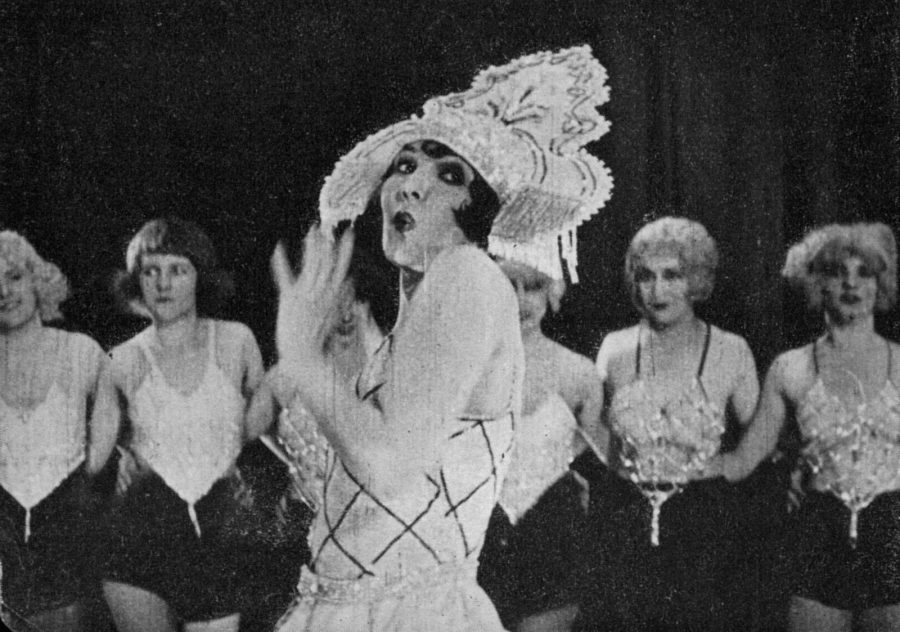
Last week, we featured Sight & Sound magazine’s last critics poll, in which Alfred Hitchcock’s Vertigo unseated the longtime champion, Orson Welles’ Citizen Kane. The latter famously appeared as Welles’ debut, released in 1941, just days before the director and star attained the ripe old age of 26. Vertigo, by contrast, represents the work of a mature filmmaker; when it came out in 1958, its 59-year-old director had 46 previous pictures under his belt. Today, let’s go back to the first of those, to a Hitchcock film far less widely seen — though of no less interest to Hitchcock enthusiasts — than the San Francisco tale of the troubled Scottie Ferguson and elusive Madeleine Elster: 1925’s The Pleasure Garden, viewable free in full at the top of this post. This silent adaptation of an Oliver Sandys novel, a British production meant to showcase American star Virginia Valli, plunges into the romantically turbulent milieu of London chorus girls.
It takes that plunge by opening with a sequence critic Dave Kehr calls “a clip reel of Hitchcock motifs to come.” Clearly the 26-year-old Hitchcock arrived with his skills and sensibilities in place, but when he took on this project in 1925, he’d already had a bad experience in the film industry: 1922’s aborted Number 13 would have given him his first directorial credit, but that production ran out of money when photography had only just begun.
The Pleasure Garden itself wouldn’t get publicly screened until 1927, after Hitchcock had already had some success with his third feature The Lodger. But the picture that will always remain his first has accrued a good deal of respect over the past 86 years, and it received a BFI restoration this year. If you can’t find a showing of the restoration yet, watch the earlier version right here. You can also watch the trailer for the restorationhere.
If you would like to support the mission of Open Culture, consider making a donation to our site. It’s hard to rely 100% on ads, and your contributions will help us continue providing the best free cultural and educational materials to learners everywhere. You can contribute through PayPal, Patreon, and Venmo (@openculture). Thanks!
Patrick Adelman is a student at the University of Rochester pursuing degrees in mathematics and political science. He’s also, according to his LinkedIn profile, a member of the Chamber Boys, the university’s radio comedy group. And, oh yes, a production intern at the Howard Stern show. That’s probably all the set up you need to see what happened in Dr. Benjamin Hafensteiner’s Chemistry 131 class last week. Enjoy the rest of the weekend.
We're hoping to rely on loyal readers, rather than erratic ads. Please click the Donate button and support Open Culture. You can use Paypal, Venmo, Patreon, even Crypto! We thank you!
Open Culture scours the web for the best educational media. We find the free courses and audio books you need, the language lessons & educational videos you want, and plenty of enlightenment in between.