Wonderfully Weird & Ingenious Medieval Books

Medieval Books

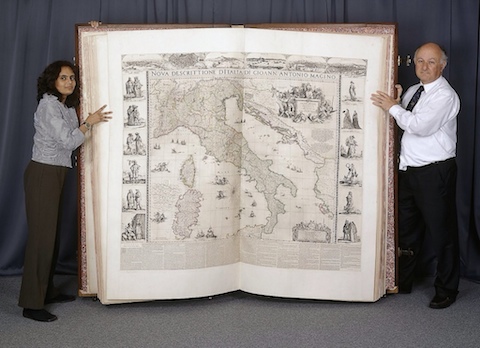
Lei­den Uni­ver­si­ty book his­to­ri­an Erik Kwakkel describes his tum­blr site as fol­lows: “I post images from medieval books.” In the words of Samuel L. Jack­son on the immor­tal Snakes on a Plane, you either want to see that, or you don’t. Pre­sum­ing you do (and giv­en your pre­sum­able sta­tus as an Open Cul­ture read­er, it strikes me as a safe bet) know that Kwakkel does­n’t main­tain just any old images of medieval books; his posts tend to high­light the askew, the obscure, and the inno­v­a­tive, fur­ther demon­strat­ing that we need not find the “dark ages” dull. At the top of the post, you can see one pho­to of the sev­er­al he post­ed of the biggest books in the world, in this case the “famous Klencke Atlas” from the 16th cen­tu­ry. “While they are rare, such large spec­i­mens,” writes Kwakkel, “they do rep­re­sent a tra­di­tion. Choir books, for exam­ple, need­ed to be big because they were used by a half cir­cle of singers gath­ered around it in a church set­ting. If you are impressed with the size of these objects, just imag­ine turn­ing their pages!”

Siamese Books

Above, we have an exam­ple of what Kwakkel calls “Siamese twins,” two books bound as one using an odd bind­ing “called ‘dos-à-dos’ (back to back), a type almost exclu­sive­ly pro­duced in the 16th and 17th cen­turies.” You could read one text one way, then turn the thing over and read a whole oth­er text the oth­er way. “You will often find two com­ple­men­tary devo­tion­al works in them, such as a prayer­book and a Psalter, or the Bible’s Old and New Tes­ta­ment. Read­ing the one text you can flip the ‘book’ to con­sult the oth­er” — no doubt a handy item, giv­en the reli­gious pri­or­i­ties of the aver­age read­er in the Europe of that era. The ani­mat­ed image below high­lights a relat­ed and equal­ly unusu­al bind­ing effort, a dos-à-dos from the late 16th cen­tu­ry con­tain­ing “not two but six books, all neat­ly hid­den inside a sin­gle bind­ing (see this motion­less pic to admire it). They are all devo­tion­al texts print­ed in Ger­many dur­ing the 1550s and 1570s (includ­ing Mar­tin Luther, Der kleine Cat­e­chis­mus) and each one is closed with its own tiny clasp.”

dos a dos

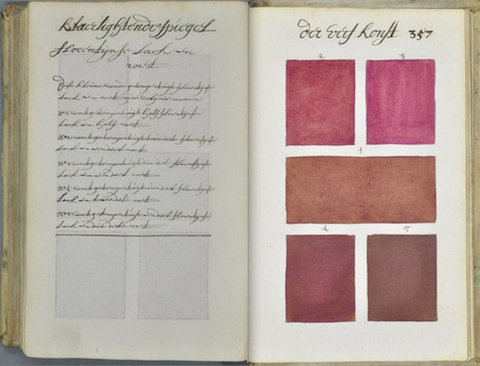
If this kind of high­ly vin­tage, labor-inten­sive book­mak­ing gets your blood flow­ing, make sure to see see also Traité des couleurs ser­vant à la pein­ture à l’eau, the 700-page 17th-cen­tu­ry guide to col­ors we fea­tured in July, and which Kwakkel cov­ered on his blog back in April: “Because the man­u­al is writ­ten by hand and there­fore lit­er­al­ly one of a kind, it did not get the ‘reach’ among painters — or atten­tion among mod­ern art his­to­ri­ans — it deserves.” Just one more rea­son to appre­ci­ate the inter­net, even if, as a medi­um, you far pre­fer the medieval book.

Keep tabs on Kwakkel’s tum­blr site for more unusu­al finds, and don’t miss his oth­er blog, Medieval Frag­ments, where he and oth­er schol­ars delve more deeply into the won­der­ful world of medieval books.

Medieval Color

Relat­ed Con­tent:

Wear­able Books: In Medieval Times, They Took Old Man­u­scripts & Turned Them into Clothes

Dutch Book From 1692 Doc­u­ments Every Col­or Under the Sun: A Pre-Pan­tone Guide to Col­ors

Medieval Cats Behav­ing Bad­ly: Kit­ties That Left Paw Prints … and Peed … on 15th Cen­tu­ry Man­u­scripts

Dante’s Divine Com­e­dy Illus­trat­ed in a Remark­able Illu­mi­nat­ed Medieval Man­u­script (c. 1450)

Col­in Mar­shall hosts and pro­duces Note­book on Cities and Cul­ture and writes essays on cities, lan­guage, Asia, and men’s style. He’s at work on a book about Los Ange­les, A Los Ange­les Primer. Fol­low him on Twit­ter at @colinmarshall or on Face­book.

Read a Never Published, “Subversive” Chapter from Roald Dahl’s Charlie and the Chocolate Factory

chocolate factory unpublished chapter

50 years after the pub­li­ca­tion of Roald Dahl’s beloved chil­dren’s book, Char­lie and the Choco­late Fac­to­ry, The Guardian has post­ed online a nev­er-before-pub­lished draft of the book’s fifth chap­ter. It was cut from the first print­ed edi­tions of Dahl’s clas­sic, writes The Guardian, because it was con­sid­ered “too wild, sub­ver­sive and insuf­fi­cient­ly moral for the ten­der minds of British chil­dren.” You, the read­er liv­ing in 2014, will like­ly have a hard time fig­ur­ing out what the fuss was about.

The lost chap­ter, appro­pri­ate­ly illus­trat­ed by Sir Quentin Blake, begins:

The remain­ing eight chil­dren, togeth­er with their moth­ers and fathers, were ush­ered out into the long white cor­ri­dor once again.

“I won­der how Augus­tus Pot­tle and Miran­da Grope are feel­ing now?” Char­lie Buck­et asked his moth­er.

“Not too cocky, I should­n’t think” Mrs Buck­et answered. “Here – hold on to my hand, will you, dar­ling. That’s right. Hold on tight and try not to let go. And don’t you go doing any­thing sil­ly in here, either, you under­stand, or you might get sucked up into one of those dread­ful pipes your­self, or some­thing even worse maybe. Who knows?”

Lit­tle Char­lie took a tighter hold of Mrs Buck­et’s hand as they walked down the long cor­ri­dor. Soon they came to a door on which it said:

THE VANILLA FUDGE ROOM

“Hey, this is where Augus­tus Pot­tle went to, isn’t it?” Char­lie Buck­et said.

“No”, Mr Won­ka told him. “Augus­tus Pot­tle is in Choco­late Fudge. This is Vanil­la. Come inside, every­body, and take a peek.”

The chap­ter con­tin­ues at The Guardian.

Relat­ed Free­bies: If you head over to Quentin Blake’s web site, you can find some items that are “fun & free” — like free e‑cards designed by Blake; free wall­pa­per for your iPhone, iPad and desk­top; and free draw­ings that you can col­or in. Mean­while Audible.com offers The Roald Dahl Audio Col­lec­tion, which fea­tures Dahl him­self read­ing sec­tions from Char­lie and the Choco­late Fac­to­ry. You can get the col­lec­tion for free by join­ing Audi­ble’s 30-day Free Tri­al pro­gram. Please read the details about the Free Tri­al pro­gram here, and know that we have a part­ner­ship with Audible.com. So, if you make a pur­chase, it will help sup­port Open Cul­ture.

via Men­tal Floss

by | Permalink | Make a Comment ( 2 ) |

Miranda July’s Quirky Film Presents Somebody, the New App That Connects Strangers in the Real World

Hav­ing owned an iPhone for all of one month, I’m still a bit leery of all it can pur­port­ed­ly do for me. Con­ve­nience is great, but I’m not sure I’m ready to cede con­trol of all the lit­tle tasks, chal­lenges, and puz­zles my own imper­fect brain has been han­dling more or less well for near­ly half a cen­tu­ry.

I don’t hate blun­der­ing. And I real­ly like inter­act­ing with librar­i­ans, local res­i­dents, and strangers who might be will­ing to use my cam­era to take a group pho­to in a restau­rant or scenic loca­tion. 

Film­mak­er Miran­da July’s just released Some­body is, I sus­pect, some­thing of a niche app.

If you cringe at the idea of flash mobs, Improv Every­where, and audi­ence inter­ac­tive the­ater, it is most def­i­nite­ly not for you. 

It’s absolute­ly per­fect for me (or will be once I get up to speed on my touch­screen.)

Basi­cal­ly, you take a self­ie, cre­ate a pro­file, and wait for a stranger to select you to deliv­er a live mes­sage as his or her proxy. In addi­tion to trawl­ing the area for the des­ig­nat­ed recip­i­ent, you may be called upon to weep, hug, or get on your knees to get that mes­sage across.

Will you make a new friend? Prob­a­bly not, but you will def­i­nite­ly share a moment.

And because no good deed goes unre­ward­ed, your per­for­mance will be open to the vagaries of cus­tomer review, a humil­i­a­tion July does not shy from in the pro­mo­tion­al video above.

Is this app for real?

Yes, espe­cial­ly if you live in LA, New York, or anoth­er cul­tur­al­ly rich Some­body hotspot.

If you don’t—or if receiv­ing a mes­sage deliv­ered, in all like­li­hood, by a tech savvy hip­ster, makes your flesh crawl—you can still enjoy the film as a com­ment on our dig­i­tal exis­tence, as well as a reflec­tion of July’s ongo­ing desire to con­nect.

Relat­ed Con­tent:

Watch Miran­da July’s Short Film on Avoid­ing the Pit­falls of Pro­cras­ti­na­tion

Learn to Make But­tons with Film­mak­er Miran­da July

David Sedaris Reads You a Sto­ry By Miran­da July

Ayun Hal­l­i­day is an author, home­school­er, and Chief Pri­ma­tol­o­gist of the East Vil­lage Inky zine. Fol­low her @AyunHalliday

Download for Free 2.6 Million Images from Books Published Over Last 500 Years on Flickr

flickr archive globe

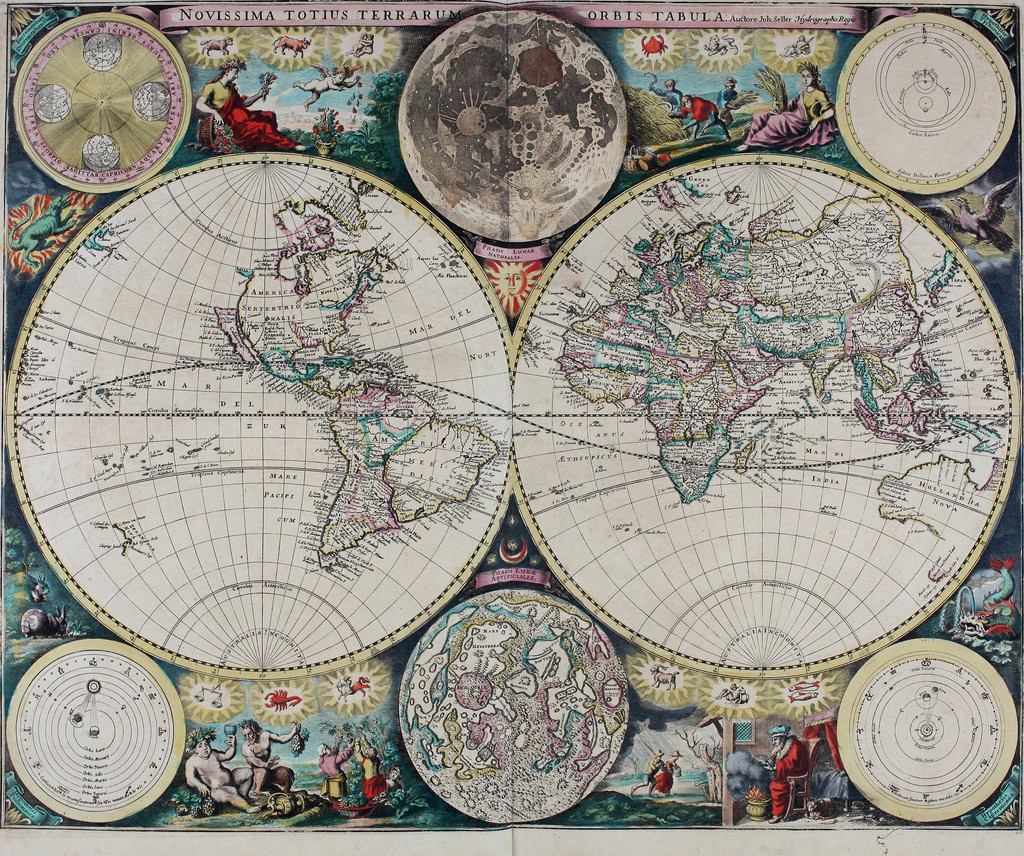
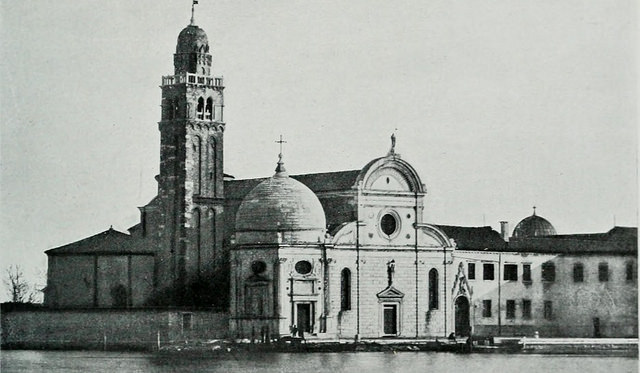
Thanks to Kalev Lee­taru, a Yahoo! Fel­low in Res­i­dence at George­town Uni­ver­si­ty, you can now head over to a new col­lec­tion at Flickr and search through an archive of 2.6 mil­lion pub­lic domain images, all extract­ed from books, mag­a­zines and news­pa­pers pub­lished over a 500 year peri­od. Even­tu­al­ly this archive will grow to 14.6 mil­lion images.

This new Flickr archive accom­plish­es some­thing quite impor­tant. While oth­er projects (e.g., Google Books) have dig­i­tized books and focused on text — on print­ed words — this project con­cen­trates on images. Lee­taru told the BBC, “For all these years all the libraries have been dig­i­tiz­ing their books, but they have been putting them up as PDFs or text search­able works.”  “They have been focus­ing on the books as a col­lec­tion of words. This inverts that.”

flicker reo speedwagon

The Flickr project draws on 600 mil­lion pages that were orig­i­nal­ly scanned by the Inter­net Archive. And it uses spe­cial soft­ware to extract images from those pages, plus the text that sur­rounds the images. I arrived at the image above when I searched for “auto­mo­bile.” The page asso­ci­at­ed with the image tells me that the image comes from an old edi­tion of the icon­ic Amer­i­can news­pa­per, The Sat­ur­day Evening Post. A relat­ed link puts the image in con­text, allow­ing me to see that we’re deal­ing with a 1920 ad for an REO Speed­wag­on. Now you know the ori­gin of the band’s name!

venice flickr

I should prob­a­bly add a note about how to search through the archive, because it’s not entire­ly obvi­ous. From the home page of the archive, you can do a key­word search. As you’re fill­ing in the key­word, Flickr will autopop­u­late the box with the words “Inter­net Archive Book Images’ Pho­to­stream.” Make sure you click on those autopop­u­lat­ed words, or else your search results will include images from oth­er parts of Flickr.

Or here’s an eas­i­er approach: sim­ply go to this inte­ri­or page and con­duct a search. It should yield results from the book image archive, and noth­ing more.

In case you’re won­der­ing, all images can be down­loaded for free. They’re all pub­lic domain.

More infor­ma­tion about the new Flickr project can be found at the Inter­net Archive.

In the relat­eds below, you can find oth­er great image archives that recent­ly went online.

flicker gall

via the BBC and Peter Kauf­man

Relat­ed Con­tent:

Fol­ger Shake­speare Library Puts 80,000 Images of Lit­er­ary Art Online, and They’re All Free to Use

The Met­ro­pol­i­tan Muse­um of Art Puts 400,000 High-Res Images Online & Makes Them Free to Use

New York Pub­lic Library Puts 20,000 Hi-Res Maps Online & Makes Them Free to Down­load and Use

The British Library Puts 1,000,000 Images into the Pub­lic Domain, Mak­ing Them Free to Reuse & Remix

The Rijksmu­se­um Puts 125,000 Dutch Mas­ter­pieces Online, and Lets You Remix Its Art

Where to Find Free Art Images & Books from Great Muse­ums, and Free Books from Uni­ver­si­ty Press­es

by | Permalink | Make a Comment ( 10 ) |

Fans Reconstruct Authentic Version of Star Wars, As It Was Shown in Theaters in 1977

I watched Star Wars for the first time in 1977 at the ten­der age of four. And like a lot of peo­ple in my gen­er­a­tion and younger, that first time was a major, for­ma­tive expe­ri­ence in my life. I got all the toys. I fan­ta­sized about being Han Solo. And dur­ing the sum­mer of ’83, I blew my allowance by watch­ing Return of the Jedi every day for a week in the the­ater. George Lucas’ epic space opera is the rea­son why I spent a life­time watch­ing, mak­ing and writ­ing about movies. And if you asked any movie crit­ic, fan or film­mak­er who grew up in the ‘80s, they will prob­a­bly tell you a sim­i­lar sto­ry.

Over the years though, Lucas suc­cumbed to the dark side of the Force. His pre­quel tril­o­gy, start­ing with tru­ly god awful The Phan­tom Men­ace (1999), is as visu­al­ly over­stuffed as it is cin­e­mat­i­cal­ly inert. (Some­where, there’s a dis­ser­ta­tion to be writ­ten about how wide­spread feel­ings of betray­al from the pre­quels psy­chi­cal­ly pre­pared Amer­i­ca for the anx­i­ety and dis­ap­point­ments of the Bush admin­is­tra­tion.)

Worse, fans who want to con­sole them­selves by watch­ing Star Wars as they remem­ber see­ing it back in the ‘80s are out of luck. Lucas has been qui­et­ly butcher­ing the orig­i­nal movies by adding CGI, sound effects and even whole char­ac­ters – like (gag) Jar Jar Binks — to suc­ces­sive spe­cial edi­tion updates. The prob­lem is these updat­ed ver­sions feel bifur­cat­ed. It’s as if two dif­fer­ent movies with two dif­fer­ent aes­thet­ics were clum­si­ly stitched togeth­er. Lucas’ spare, mus­cu­lar com­po­si­tions in the orig­i­nal movie sit uneasi­ly next to its car­toony, over-wrought addi­tions. Yet this Franken­stein ver­sion is the one that Lucas insists you watch. The orig­i­nal cut is just plain not for sale. Lucas even refused to give the Nation­al Film Reg­istry the 1977 cut of Star Wars for future preser­va­tion. “It’s like this is the movie I want­ed it to be,” said Lucas in an inter­view in 2004, “and I’m sor­ry if you saw half a com­plet­ed film and fell in love with it, but I want it to be the way I want it to be.”

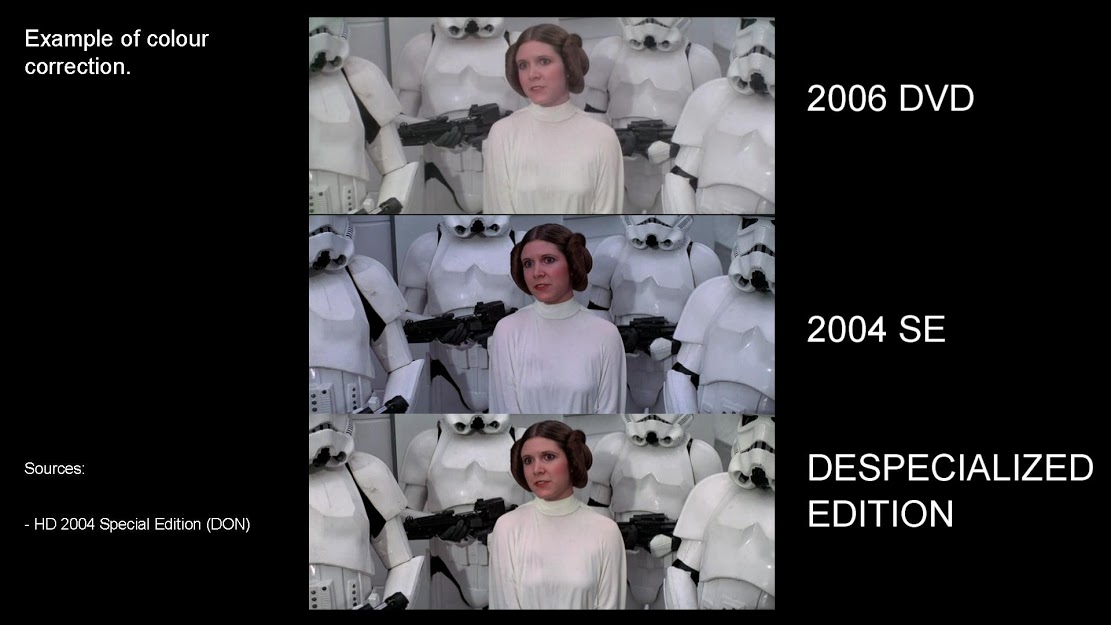
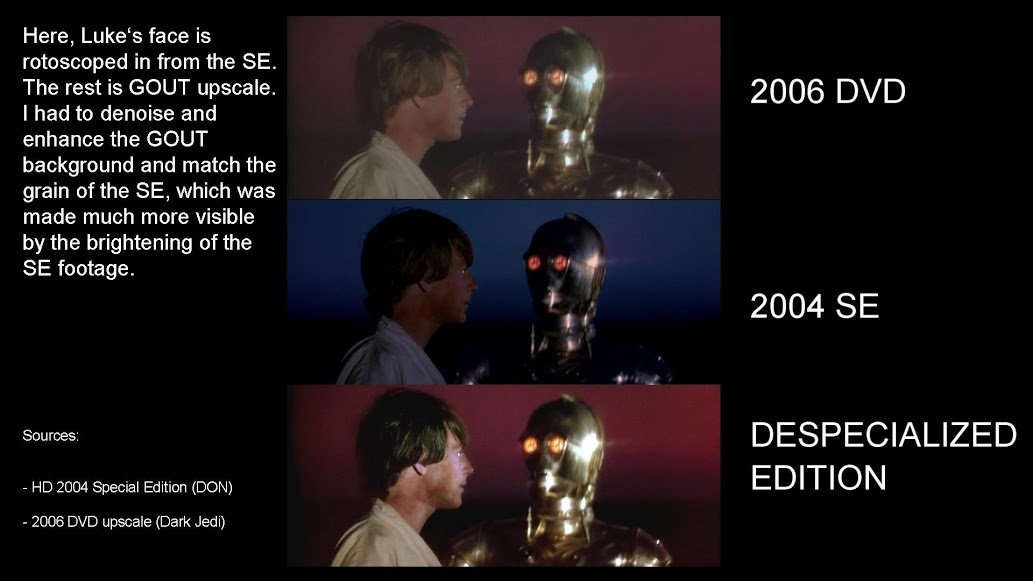
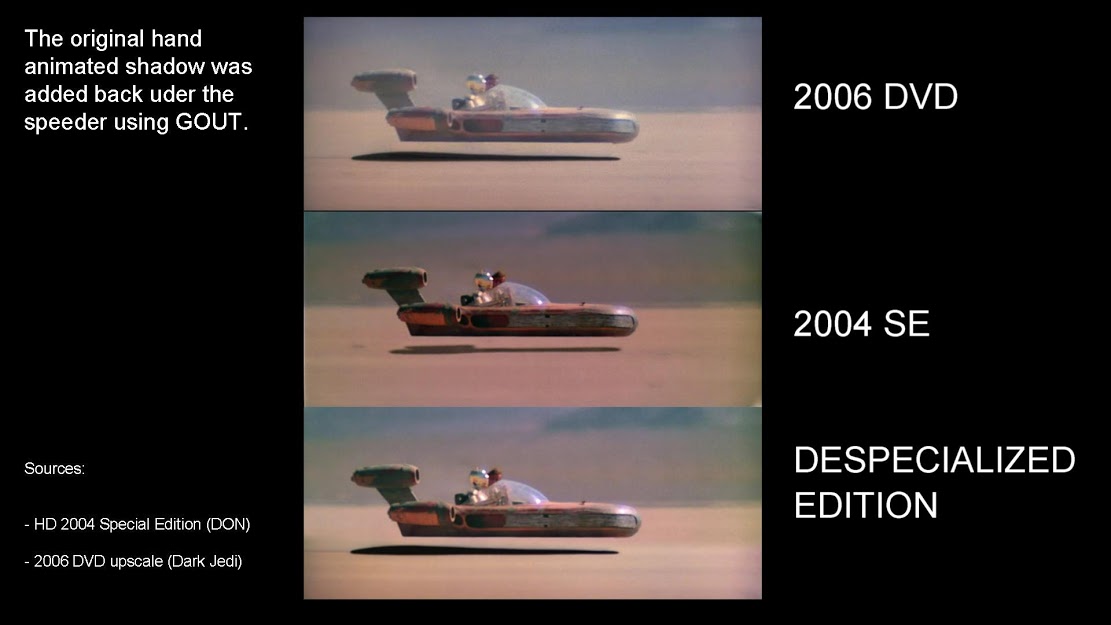
Thank­ful­ly, hard­core Star Wars fans are telling Lucas, respect­ful­ly, to go cram it. As Rose Eveleth in The Atlantic reports, a ded­i­cat­ed online com­mu­ni­ty has set out to cre­ate a “despe­cial­ized” edi­tion of Star Wars that strips away all of Lucas’s dig­i­tal non­sense and restores the movie to its orig­i­nal 1977 state. The de fac­to leader of this move­ment is Petr Harmy, a 25-year-old guy from the Czech Repub­lic who with the help of a legion of tech­ni­cal­ly savvy film nerds has pieced togeth­er footage from exist­ing prints and old­er DVD releas­es to cre­ate the Despe­cial­ized Edi­tion v. 2.5. (Direc­tions on where you can locate it are here.) Above Harmy talks in detail about how he accom­plished this feat. And below you can see some side-by-side com­par­isons. More can be found on Petr Harmy’s page. Final­ly, in the com­ments sec­tion below, Harmy also points us toward pages with Despe­cial­ized stills for Star Wars and The Empire Strikes Back.

Comparison014

Comparison031

Comparison032

Via The Atlantic

Relat­ed Con­tent: 

How Star Wars Bor­rowed From Aki­ra Kurosawa’s Great Samu­rai Films

Frei­heit, George Lucas’ Short Stu­dent Film About a Fatal Run from Com­mu­nism (1966)

Watch the Very First Trail­ers for Star Wars, The Empire Strikes Back & Return of the Jedi (1976–83)

Joseph Camp­bell and Bill Moy­ers Break Down Star Wars as an Epic, Uni­ver­sal Myth

Hun­dreds of Fans Col­lec­tive­ly Remade Star Wars; Now They Remake The Empire Strikes Back

Jonathan Crow is a Los Ange­les-based writer and film­mak­er whose work has appeared in Yahoo!, The Hol­ly­wood Reporter, and oth­er pub­li­ca­tions. You can fol­low him at @jonccrowAnd check out his blog Veep­to­pus, fea­tur­ing one new draw­ing of a vice pres­i­dent with an octo­pus on his head dai­ly. 

A 96-Song Playlist of Music in Haruki Murakami’s Novels: Miles Davis, Glenn Gould, the Beach Boys & More

murakami-playlist

Last month we fea­tured the par­tic­u­lars of nov­el­ist Haru­ki Murakami’s pas­sion for jazz, includ­ing a big Youtube playlist of songs select­ed from Por­trait in Jazz, his book of essays on the music. But we also allud­ed to Murakami’s admis­sion of run­ning to a sound­track pro­vid­ed by The Lovin’ Spoon­ful, which sug­gests lis­ten­ing habits not enslaved to purism. His books — one of the very best known of which takes its name straight from a Bea­t­les song (“Nor­we­gian Wood”) — tend to come pre-loaded with ref­er­ences to sev­er­al vari­eties of music, almost always West­ern and usu­al­ly Amer­i­can.  “The Fierce Imag­i­na­tion of Haru­ki Muraka­mi,” Sam Ander­son­’s pro­file of the writer on the occa­sion of the release of his pre­vi­ous nov­el 1Q84, name-checks not just Stan Getz but Janáček’s Sin­foni­et­ta, The Rolling Stones’ Sym­pa­thy for the Dev­il, Eric Clap­ton’s Rep­tile, Bruce Spring­steen’s ver­sion of “Old Dan Tuck­er,” and The Many Sides of Gene Pit­neyThe title of Murakami’s new Col­or­less Tsuku­ru Taza­ki and His Years of Pil­grim­age, writes The Week’s Scott Mes­low, ref­er­ences Franz Liszt’s ‘Years of Pil­grim­age’ suite, “which plays a cen­tral role in the nov­el­’s nar­ra­tive. The point­ed ref­er­ence isn’t exact­ly a major detour from Muraka­mi.”

Giv­en the writer’s increas­ing reliance on music and the notion of “songs that lit­er­al­ly have the pow­er to change the world,” to say noth­ing of his “abil­i­ty to sin­gle-hand­ed­ly dri­ve musi­cal trends,” it can prove an illu­mi­nat­ing exer­cise to assem­ble Muraka­mi playlists. Select­ing 96 tracks, Mes­low has cre­at­ed his own playlist (above) that empha­sizes the breadth of genre in the music incor­po­rat­ed into Murakami’s fic­tion: from Ray Charles to Bren­da Lee, Duke Elling­ton to Bob­by Darin, Glenn Gould to the Beach Boys. Each song appears in one of Murakami’s nov­els, and Mes­low even includes cita­tions for each track: “I had some cof­fee while lis­ten­ing to May­nard Fer­guson’s ‘Star Wars.’ ” “Her milk was on the house if she would play the Bea­t­les’ ‘Here Comes the Sun,’ said the girl.” Imag­ine The Great­est Hits of Bob­by Darin minus ‘Mack the Knife.’ That’s what my life would be like with­out you.” “The room begins to dark­en. In the deep­en­ing dark­ness, ‘I Can’t Go For That’ con­tin­ues to play.” It all coheres in some­thing to lis­ten to while explor­ing Murakami’s world: in your imag­i­na­tion, in real life, or in his trade­mark realms between. 

To lis­ten to the playlist above, you will first need to down­load Spo­ti­fy. Please note that once you mouse over the playlist, you can scroll through all 96 songs. Look for the ver­ti­cal scroll­bar along the right side of the playlist.

Pho­to above is attrib­uted to “wakari­m­a­sita of Flickr”

via The Week

Relat­ed Con­tent:

Read 5 Sto­ries By Haru­ki Muraka­mi Free Online (For a Lim­it­ed Time)

A Pho­to­graph­ic Tour of Haru­ki Murakami’s Tokyo, Where Dream, Mem­o­ry, and Real­i­ty Meet

Haru­ki Murakami’s Pas­sion for Jazz: Dis­cov­er the Novelist’s Jazz Playlist, Jazz Essay & Jazz Bar

In Search of Haru­ki Muraka­mi, Japan’s Great Post­mod­ernist Nov­el­ist

Haru­ki Muraka­mi Trans­lates The Great Gats­by, the Nov­el That Influ­enced Him Most

Col­in Mar­shall hosts and pro­duces Note­book on Cities and Cul­ture and writes essays on cities, lan­guage, Asia, and men’s style. He’s at work on a book about Los Ange­les, A Los Ange­les Primer. Fol­low him on Twit­ter at @colinmarshall or on Face­book.

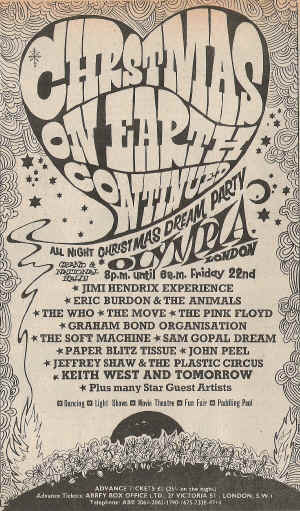
Jimi Hendrix, Pink Floyd, Traffic & Other Bands Play Huge London Festival “Christmas on Earth Continued” (1967)

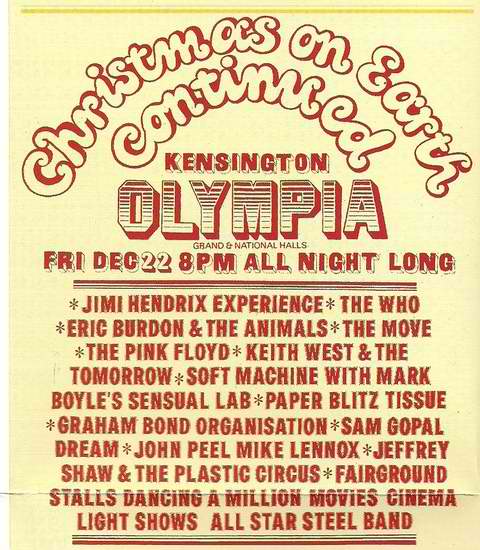
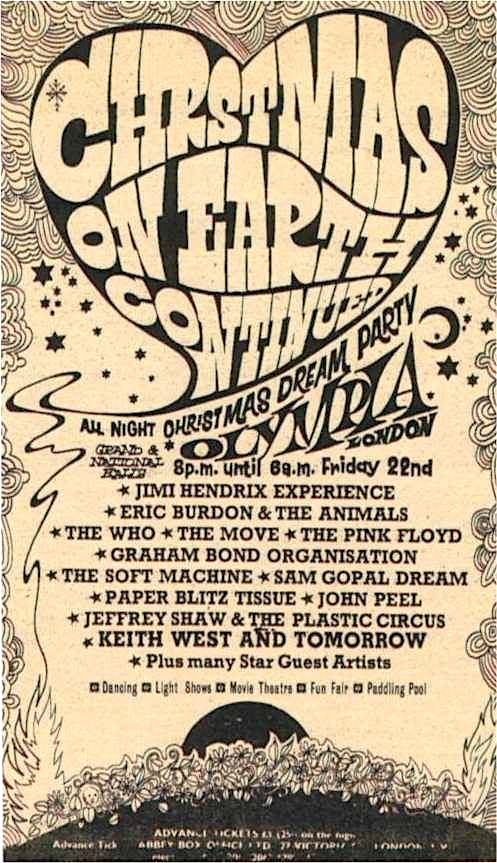
A tru­ly spec­tac­u­lar event, 1967’s “Christ­mas on Earth Continued”—a super-con­cert described in one pro­mo poster as an “All Night Christ­mas Dream Party”—gets sad­ly remem­bered as the last major show Syd Bar­ret played with Pink Floyd—ending the set dazed and motion­less onstage, his arms hang­ing limp at his sides. Barrett’s break­down wasn’t the only thing that kept this mas­sive hap­pen­ing, “the last gasp of the British under­ground scene,” from tak­ing off as it should have.

As the blog Mar­malade Skies recalls, the con­cert, held in the “vast Lon­don Olympia,” had “hope­less­ly inad­e­quate” pub­lic­i­ty.” This, and a “par­tic­u­lar­ly severe win­ter freeze” meant sparse atten­dance and “finan­cial dis­as­ter for the orga­niz­ers.” In addi­tion, a planned film of the event failed to mate­ri­al­ize, “owing to poor pic­ture qual­i­ty of the footage.”

Christmas-On-Earth-2.fullpage-1

Despite all this, it seems, you real­ly had to have been there. The line­up alone will make lovers of 60s psych-rock sali­vate: Jimi Hen­drix Expe­ri­ence, Eric Bur­don, Pink Floyd, The Move, Soft Machine, Tomor­row… The Who didn’t make it, but the unbilled Traf­fic did. We’re lucky to have some of the footage from that win­ter night. Check out Traf­fic below (with a very young Steve Win­wood), play­ing “Dear Mr. Fan­ta­sy.”

Lib­er­al Eng­land blog­ger Jonathan Calder calls the Traf­fic clip “price­less” and quotes Mar­malade Skies’ vivid descrip­tion of the nights fes­tiv­i­ties:

Soft Machine, with Kevin Ayers resplen­dent in pre-punk black string vest, cli­maxed with the ulti­mate Dada ver­sion of ‘We did it again’ as Robert Wyatt leapt into a full bath of water, that just hap­pened to be on-stage with them! At least, we assumed it was water. 

Tomor­row pow­ered through their unique mix of heav­i­ly Bea­t­les influ­enced psy­che­delia. Dur­ing ‘Straw­ber­ry Fields For­ev­er’ Twink (drums) and Junior (bass) per­formed a mimed fight whilst being sub­ject­ed to the most pow­er­ful strobe light effects I’ve ever wit­nessed. Steve Howe was a rev­e­la­tion, mov­ing from raga to clas­si­cal to Bar­rett — style anar­chy with an almost arro­gant ease. 

Traf­fic, still with Dave Mason, even per­formed ‘Hole in my shoe’. Steve Win­wood was into his white cheese­cloth peri­od, and their music was so unlike any­thing else around that they occu­pied a total­ly orig­i­nal space. The song, ‘Here we go round the Mul­ber­ry Bush’ was very typ­i­cal of their trip­py, watery sound at that time. 

Hen­drix — voom! All light shows were killed for his per­for­mance. Noel Red­ding was con­stant­ly nig­gling Jimi, play­ing bass behind his head as Jimi per­formed his tricks with his gui­tar. It was the first time I saw Hen­drix with his Gib­son Fly­ing Arrow, and the ten­sion on-stage pro­duced some elec­tri­fy­ing music.

At the top of the post see Hen­drix in back­stage footage, effort­less­ly coax­ing some beau­ti­ful 12-bar blues from that Gib­son fly­ing V. The film clips of him onstage—blowing an obvi­ous­ly very turned-on audience’s col­lec­tive mind—will con­vince you this was the only place on earth to be on Decem­ber 22, 1967.

And that fate­ful Floyd per­for­mance? We don’t seem to have any film, but we do have the audio, and you can hear it below, slight­ly sped up, it seems. The band were debut­ing their new 3D light­show, which—as much as Barrett’s sad loss of his faculties—left quite an impres­sion on the crowd. One anony­mous com­menter on Calder’s blog, who claims to have seen been in atten­dance at the ten­der age of 18, writes, “I was so impressed with the Soft Machine and Pink Floyd light­shows that I bought an old movie pro­jec­tor from a thrift shop and me and my flat­mate spent hours putting col­or slides into the pro­jec­tor grate and watched them melt psy­che­del­i­cal­ly on the wall.” No doubt impres­sion­able young­sters all over the UK indulged in sim­i­lar kinds of good clean fun, with Piper at the Gates of Dawn on the hi-fi. If like me, you were born too late to expe­ri­ence the zenith of the psy­che­del­ic 60s, then flip off the lights, let your trip­pi­est screen saver take over, and lis­ten to Pink Floyd decon­struct them­selves below.

via Lib­er­al Eng­land

Relat­ed Con­tent:

Jimi Hen­drix at Wood­stock: The Com­plete Per­for­mance in Video & Audio (1969)

Jimi Hen­drix Plays the Bea­t­les: “Sgt. Pepper’s,” “Day Trip­per,” and “Tomor­row Nev­er Knows”

Pink Floyd Plays With Their Brand New Singer & Gui­tarist David Gilmour on French TV (1968)

Josh Jones is a writer and musi­cian based in Durham, NC. Fol­low him at @jdmagness

The Right and Wrong Way to Eat Sushi: A Primer

Vice.com’s food chan­nel, Munchies, spent time with Naomichi Yasu­da and learned the dos and don’ts of eat­ing sushi. And they kind­ly sum­ma­rized some prac­tices that are per­mit­ted and ver­boten.

  1. It’s okay to use your fin­gers to eat cut sushi rolls.
  2. Don’t com­bine gin­ger and sushi, or gin­ger and soy sauce. Gin­ger is a palate cleanser in between bites.
  3. When dip­ping sushi into soy sauce, dip fish-side down.
  4. Nev­er shake soy sauce off of sushi. That’s like shak­ing your wanker in pub­lic.

The video above just begins to scratch the sur­face. If you head over to The­Sushi­FAQ, you can find a long list of rules and sug­ges­tions that will round out your sushi-eat­ing eti­quette. Here are some addi­tion­al tips to keep in mind: Nev­er put wasabi direct­ly in the shoyu dish. And know that Sashi­mi is only to be eat­en with your chop­sticks, not with your hands. Got it? There will be a quiz tomor­row.

via Kot­tke/Munchies

Relat­ed Con­tent:

How to Make Instant Ramen Com­pli­ments of Japan­ese Ani­ma­tion Direc­tor Hayao Miyza­ki

The Best Japan­ese Com­mer­cial Ever? James Brown Sells Miso Soup

What Goes Into Ramen Noo­dles, and What Hap­pens When Ramen Noo­dles Go Into You

Cook­pad, the Largest Recipe Site in Japan, Launch­es New Site in Eng­lish

Learn Japan­ese Free

MIT Teach­es You How to Speak Ital­ian & Cook Ital­ian Cui­sine All at Once (Free Online Course)

by | Permalink | Make a Comment ( 10 ) |

« Go BackMore in this category... »
Quantcast