Back in June we highlighted Neil Halloran’s 15 minute film, The Fallen of World War II, which used “innovative data visualization techniques to put the human cost of WW II into perspective, showing how some 70 million lives were lost within civilian and military populations across Europe and Asia, from 1939 to 1945.” It’s a pretty staggering illustration of the deadliest war. As the film went viral, Halloran raised money that would enable him to develop new films exploring “other trends of war and peace — from drones and terrorism to democracy and peacekeeping.” He has also translated the film into six different languages. They all went online in the last few weeks. Here they are: Russian, Japanese, Polish, French, German, and Serbian.
Above, you can watch the original in English (certainly worth doing if you were vacationing in June), and you might also explore the accompanying interactive web site here.
Follow Open Culture on Facebook and Twitter and share intelligent media with your friends. Or better yet, sign up for our daily email and get a daily dose of Open Culture in your inbox. And if you want to make sure that our posts definitely appear in your Facebook newsfeed, just follow these simple steps.
As you know if you saw our previous posts featuring Leonard Nimoy’s readings of stories by Ray Bradbury and Isaac Asimov, the late Star Trek icon could — unsurprisingly, perhaps — tell a science-fiction tale with the best of them. It turns out that he could also give masterful readings of science fiction from other eras too, as far back as the earliest works to define the genre, which we’ve discovered after hearing his performance of H.G. Wells’ The War of the Worlds, an out-of-print edition recently digitized from cassette tape and posted to Youtube in twoparts.
With this story of Earth invaded from “across the gulf of space” by aliens with “minds that are to our minds as ours are to those of the beasts that perish, intellects vast and cool and unsympathetic,” Wells did much to help give science fiction the form we recognize today. The War of the Worlds came out in book form in 1898, preceded by such similarly speculative and innovative works as The Time Machine and The Invisible Man, and then followed by the likes of The First Men in the Moon and The Shape of Things to Come. (Find most of these works neatly packaged in the HG Wells Classic Collection.) This Leonard Nimoy recording originally came out in 1976, published by the record label Caedmon, known for doing plenty of innovation of their own in the then-yet-unnamed field of audiobooks.
Caedmon put out not just this album and the one with Nimoy reading Bradbury, but others featuring Kurt Vonnegut, Vincent Price, Tennessee Williams, T.S. Eliot, Ernest Hemingway, and Sylvia Plath. As much as science-fiction die-hards will enjoy hearing this pairing of Nimoy and Wells here, some will certainly want to track down the actual LP — not just for the collectors’ value, but because it features liner notes by none other than that other vastly influential creator of sci-fi as we know it, Isaac Asimov. It looks like there’s one used copy on Amazon. The reading, we should note, is an abridged version of the original text.
The lag time between our imagining of social equality and its arrival can be significantly long indeed, or it least it can seem so, given the limitations of human mortality. 113 years may not be an especially long time for a tree, say, or even a very healthy Galapagos tortoise, but if you or I had been alive in 1902, chances are we’d never know that in 2015 the president of Europe’s most powerful nation is a woman, as are two major presidential candidates in the United States. Given the amount of inequality we still see worldwide, this may not always feel like a triumph. In 1902, it might have seemed like “nothing but fantasy.”
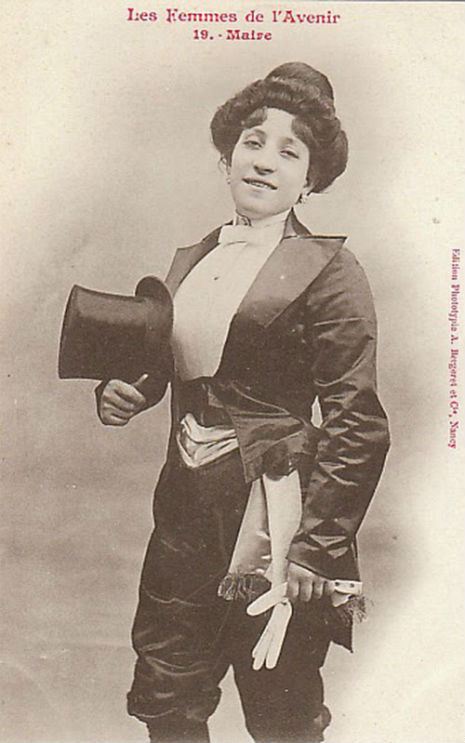
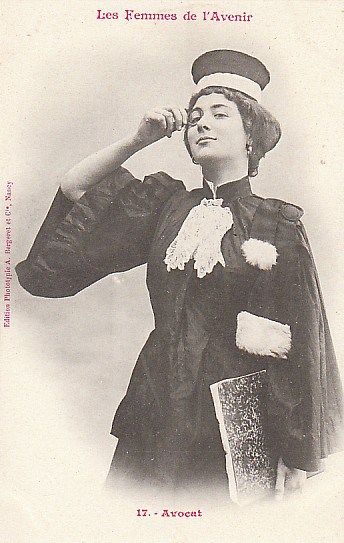
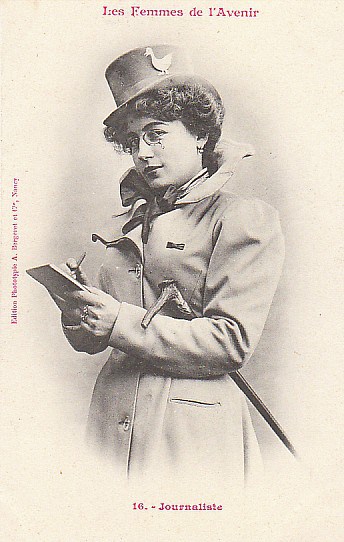
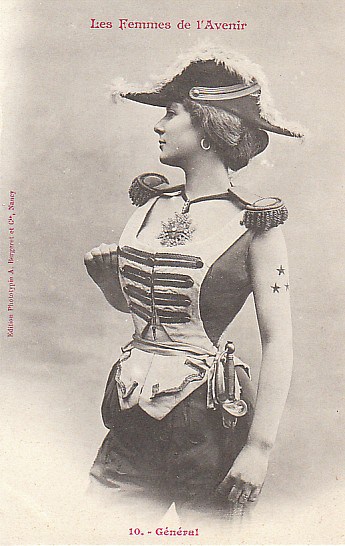
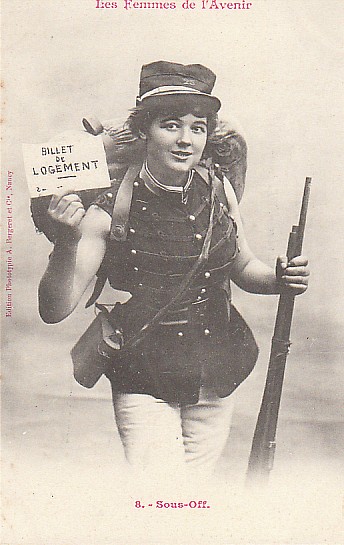
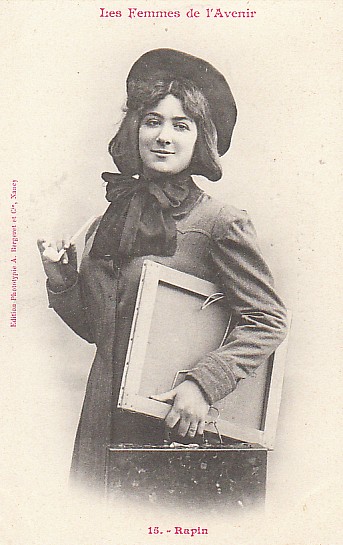
And yet even then, it was certainly possible to foresee women occupying all the roles that men did, through the lenses, writes Laura Hudson at Boing Boing, of “fantasy and science fiction,” which “can often help us open our minds behind the limitations of the world we live in and imagine a better one instead.” In 1902, artist Albert Bergeret was commissioned to create the trading cards you see here—just a small selection of twenty total photographs called “Les Femmes de l’Avenir”—Women of the Future. Only one theme among many in a series of different sets of cards, this “retrofuturistic attempt to expand the role of women in society” showed us a “small and fashionable world” where “women were given a more equal role in society, not to mention spectacular hats.”
That may be so, but just as we can never accurately see the future, we can also never reach consensus on the meaning of the past. The Daily Mail’s Maysa Rawi agrees with Hudson about the “pin-up quality to many of the images,” which show “an awful lot of arm.” And yet Rawi disparages the entire set as “meant to capture men’s fantasies rather than be part of any feminist movement.” I’ll admit, I don’t see the cards this way at all, nor do I think the categories are mutually exclusive. Pin-up girls have also represented social power, albeit mainly sexual power. Scantily-clad female superheroes like Wonder Woman, though crafted to appeal to the fantasies of teenage boys, are also powerful because… well, they have superpowers.
Perhaps that’s one way to look at Bergeret’s cards. He is not mocking his subjects, nor hyper-sexualizing them, but presenting, as each card indicates, advanced futuristic beings who didn’t yet exist in his time. The Daily Mail captions several of the photos with factoids about women’s advances in French history. In some cases, Bergeret did not have to extrapolate far. Women could practice law in 1900; women served in the army during the French Revolution, but did not fight. Colleges had been open to women since 1879. A few women worked as doctors and journalists in Bergeret’s time. Marie Curie, you’ll recall, had discovered polonium, coined the term “radioactivity,” and would win the Nobel Prize in 1903. Queen Victoria had ruled over half the world.
But French women would have to wait several more decades to enter most of the professions represented. No matter how sexy—and in some cases ridiculous—some of the costumes in these photos, Bergeret shot the models with poise, style, and dignity. Perhaps he and many in his audience could easily imagine female generals, mayors, firewomen, soldiers, etc. Yet one particular card stands out. It portrays a self-satisfied, Bohemian model labeled “rapin”—which a reader below informs us is “an argot word for (bad) painter.”
Founded and directed by physicist Lawrence Krauss, Arizona State’s Origins Project has for several years brought together some of the biggest minds in the sciences and humanities for friendly debates and conversations about “the 21st Century’s greatest challenges.” Previous all-star panels have included Krauss, Neil DeGrasse Tyson, Bill Nye, Brian Greene, and Richard Dawkins. Stephen Hawking has graced the ASU Origins Project stage, as has actor and science communicator Alan Alda. And this past March, in a sold-out, highly-anticipated Origins Project event, Krauss welcomed Noam Chomsky to the stage for a lengthy interview, which you can watch above.
Although Krauss says he’s wary of hero worship in his laudatory introduction, he nonetheless finds himself asking “What Would Noam Chomsky Do” when faced with a dilemma. He also points out that Chomsky has been “marginalized in U.S. media” for his anti-war, anarchist political views. Those views, of course, come widely into play during the conversation, which ranges from the theory and purpose of education—a subject Chomsky has expounded on a great deal in books and interviews—to the fate of political dissidents throughout history.
Chomsky also gives us his views on science and technology, particularly in the Q&A portion of the talk above, in which he answers questions about artificial intelligence—another subject he’s touched on in the past—and animal experimentation, among a great many other topics. Krauss mostly hangs back during the initial discussion but takes a more active role in the session above, offering views on medical and scientific ethics that will be familiar to those who follow his atheist activism and championing of rationality over religious dogma.
As Chomsky puts it, “the environment, the commons… they’re a common possession, but space is even more so. For individuals to allow institutions like corporations to have any control over it is devastating in its consequences. It will also almost certainly undermine serious research.” He refers to the example of most modern computing—developed under publicly-funded government programs, then marketed and sold back to us by corporations. Krauss makes a case for unmanned space exploration as the cost-effective option, and both thinkers discuss the problem of militarizing space, the ultimate goal of Cold War space programs before the fall of the Soviet Union. The conversation is rich and revealing and makes an excellent supplement to the already rich discussion Krauss and Chomsky have in the videos above.
To my knowledge, Bob Dylan has only appeared in a handful of TV commercials over the decades, including most notably a bizarre ad for Victoria’s Secret back in 2004. Now you can add another to the small list. Last night, IBM debuted a new ad with the iconic singer-songwriter. And this time around, Dylan isn’t peddling bras. Rather, it’s IBM’s cognitive system called “Watson,” which promises to analyze data for corporations in all kinds of interesting ways. Says IBM:
Humans create a staggering amount of information. Poetry, equations, films, selfies, diagnoses, discoveries. Data pours from our mobile devices, social networks, from every digitized and connected system we use. 80% of this data is virtually invisible to computers—including nearly all the information captured in language, sight and sound. Until now.
IBM Watson applies its cognitive technologies to help change how we approach and understand all of this information. Everything that is digital has the potential to become cognitive, and, in a sense, be able to “think.”
Watson can bring cognition to everything and everyone. To evolve in this data-driven culture, every business will need to become a cognitive business.
To demonstrate its analytical powers, IBM asked Watson to analyze Dylan’s lyrics, and it concluded that the major themes of Dylan’s songs are “time passes and love fades”. It’s a conclusion, I’m sure, that never dawned on casual or ardent fans of Dylan’s music.
“One of the many remarkable things about Charlie Chaplin,” wrote Roger Ebert, “is that his films continue to hold up, to attract and delight audiences.” Richard Brody described Chaplin as not just “alone among his peers of silent-comedy genius,” but also as a maker of “great talking pictures.” Jonathan Rosenbaum asked, “Has there ever been another artist — not just in the history of cinema, but maybe in the history of art — who has had more to say, and in such vivid detail, about what it means to be poor?” Andrew Sarris called Chaplin “arguably the single most important artist produced by the cinema, certainly its most extraordinary performer and probably still its most universal icon.” “For me,” wrote Leonard Maltin, “comedy begins with Charlie Chaplin.”
And so we see that Chaplin, nearly forty decades after his death, maintains his high critical reputation — while also having enjoyed the absolute height of movie-stardom back in the silent era.
Vanishingly few artists of any kind manage to combine such blockbusting commercial success with such flying-colors critical success. That alone might give you good enough reason to plunge into Chaplin’s filmography, but know that you can begin that cinematic adventure for free right here on Open Culture in our archive of more than 60 Charlie Chaplin films on the web.
There you’ll find short comedies like 1914’s Kids Auto Race at Venice, which introduced his famous penniless protagonist “The Tramp”; the following year’s The Tramp, which made it into a phenomenon; 1919’s Sunnyside, in which we find out what happens when Chaplin’s gracefully hapless comedic persona winds up on the farm; and 1925’s The Gold Rush, the film Chaplin most wanted to be remembered for.
But though Chaplin’s oeuvre couldn’t be easier to start watching and laughing at, coming to appreciate the full scope of his craft — in the way that the critics quoted above have spent careers doing — may take time. After all, the man made 80 movies over his 75-year entertainment career, a kind of productivity that, even leaving the considerable artistry aside, cinema may never see again. You can dive into our collection of Chaplin films here.
We got a nice tip from one of our readers, and wanted to pass it along. Paramount Pictures has launched an official, verified YouTube channel — called The Paramount Vault — where you can watch full length films for free [update: if you’re based in the US]. You won’t find Paramount’s best-known films in The Vault, but nonetheless there are some quality, if not entertaining, picks among the 150 films.
Update: it looks like you need to be based in the US to view these films — something that wasn’t apparent to me beforehand since I’m based here. My apologies to anyone who’s geoblocked.
The Gandhi of history doesn’t line up with the Gandhi of legend, just as the beatified Mother Teresa presents a very different picture in certain astute critics’ estimation. But as with most saints, ancient and modern, people tend to ignore Gandhi’s many contradictions and troublingly racist and casteist views. He comes to us more as myth and martyr than deeply flawed human individual. An indispensable part of the mythmaking, Richard Attenborough’s 1982 biopic, Gandhi, may be “over-sanitized,” as The Guardian writes, but Ben Kingsley’s performance as the anti-colonial leader is genuinely “sublime” in his evocation of Gandhi’s “intensity… wit and even the distinctive, determined walk.” It’s these personal qualities—and of course Gandhi’s defeat of the largest empire on the planet with nonviolent action and a spiritual philosophy—that continue to inspire movements for justice and civil rights.
We see a little of that determined walk in the short newsreel interview above, the very first “talking picture” made of Gandhi, and we also hear his intensity and wit, though much subdued by his physical frailty after years of fasting. Taken in 1947 by Fox Movietone News, the film marks a pivotal period in the Indian leader’s life. Very shortly after this Parliament passed the Indian Independence Act. That year also marked the start of a bloody new struggle, instigated by another colonial intervention, as the British partitioned India into two warring countries, an act so poignantly dramatized in Salmon Rushdie’s Midnight’s Children.
This year of turmoil was also Gandhi’s last; he was assassinated in 1948 by a Hindu nationalist who accused him of siding with Pakistan. In the interview, we hear what we might think of as some of Gandhi’s final public pronouncements on such subjects as child marriage, prohibition, his deeply held convictions about an authentic Indian cultural identity, and the lengths that he would go for his country’s independence. At the end of the short interview, the American reporter asks Gandhi, presciently, “would you be prepared to die in the cause of India’s Independence?” to which Gandhi replies, “this is a bad question.”
We're hoping to rely on loyal readers, rather than erratic ads. Please click the Donate button and support Open Culture. You can use Paypal, Venmo, Patreon, even Crypto! We thank you!
Open Culture scours the web for the best educational media. We find the free courses and audio books you need, the language lessons & educational videos you want, and plenty of enlightenment in between.