The Daily Habits of Famous Writers: Franz Kafka, Haruki Murakami, Stephen King & More

stephenking

Image by The USO, via Flickr Com­mons

Though few of us like to hear it, the fact remains that suc­cess in any endeav­or requires patient, reg­u­lar train­ing and a dai­ly rou­tine. To take a mun­dane, well-worn exam­ple, it’s not for noth­ing that Stephen R. Covey’s best-sell­ing clas­sic of the busi­ness and self-help worlds offers us “7 Habits of High­ly Effec­tive Peo­ple,” rather than “7 Sud­den Break­throughs that Will Change Your Life Forever”—though if we cred­it the spam emails, ads, and spon­sored links that clut­ter our online lives, we may end up believ­ing in quick fix­es and easy roads to fame and for­tune. But no, a well-devel­oped skill comes only from a set of prac­ticed rou­tines.

That said, the type of rou­tine one adheres to depends on very per­son­al cir­cum­stances such that no sin­gle cre­ative person’s habits need exact­ly resem­ble any other’s. When it comes to the lives of writ­ers, we expect some com­mon­al­i­ty: a writ­ing space free of dis­trac­tions, some pre­ferred method of tran­scrip­tion from brain to page, some set time of day or night at which the words flow best. Out­side of these basic para­me­ters, the dai­ly lives of writ­ers can look as dif­fer­ent as the images in their heads.

But it seems that once a writer set­tles on a set of habits—whatever they may be—they stick to them with par­tic­u­lar rig­or. The writ­ing rou­tine, says hyper-pro­lif­ic Stephen King, is “not any dif­fer­ent than a bed­time rou­tine. Do you go to bed a dif­fer­ent way every night?” Like­ly not. As for why we all have our very spe­cif­ic, per­son­al quirks at bed­time, or at writ­ing time, King answers hon­est­ly, “I don’t know.”

So what does King’s rou­tine look like? “There are cer­tain things I do if I sit down to write,” he’s quot­ed as say­ing in Lisa Rogak’s Haunt­ed Heart: The Life and Times of Stephen King:

“I have a glass of water or a cup of tea. There’s a cer­tain time I sit down, from 8:00 to 8:30, some­where with­in that half hour every morn­ing,” he explained. “I have my vit­a­min pill and my music, sit in the same seat, and the papers are all arranged in the same places. The cumu­la­tive pur­pose of doing these things the same way every day seems to be a way of say­ing to the mind, you’re going to be dream­ing soon.”

The King quotes come to us via the site (and now book) Dai­ly Rou­tines, which fea­tures brief sum­maries of “how writ­ers, artists, and oth­er inter­est­ing peo­ple orga­nize their days.” We’ve pre­vi­ous­ly fea­tured a few snap­shots of the dai­ly lives of famous philoso­phers. The writ­ers sec­tion of the site sim­i­lar­ly offers win­dows into the dai­ly prac­tices of a wide range of authors, from the liv­ing to the long dead.

HarukiMurakami3

Image via Wiki­me­dia Com­mons

A con­tem­po­rary of King, though a slow­er, more self-con­scious­ly painstak­ing writer, Haru­ki Muraka­mi incor­po­rates into his work­day his pas­sion for run­ning, an avo­ca­tion he has made cen­tral to his writ­ing phi­los­o­phy. Expect­ed­ly, Muraka­mi keeps a very ath­let­ic writ­ing sched­ule and rou­tine.

When I’m in writ­ing mode for a nov­el, I get up at 4:00 am and work for five to six hours. In the after­noon, I run for 10km or swim for 1500m (or do both), then I read a bit and lis­ten to some music. I go to bed at 9:00 pm. I keep to this rou­tine every day with­out vari­a­tion. The rep­e­ti­tion itself becomes the impor­tant thing; it’s a form of mes­merism. I mes­mer­ize myself to reach a deep­er state of mind. But to hold to such rep­e­ti­tion for so long — six months to a year — requires a good amount of men­tal and phys­i­cal strength. In that sense, writ­ing a long nov­el is like sur­vival train­ing. Phys­i­cal strength is as nec­es­sary as artis­tic sen­si­tiv­i­ty.

Not all writ­ers can adhere to such a dis­ci­plined way of liv­ing and work­ing, par­tic­u­lar­ly those whose wak­ing hours are giv­en over to oth­er, usu­al­ly painful­ly unful­fill­ing, day jobs.

Franz-Kafka

Image of Franz Kaf­ka, via Wiki­me­dia Com­mons

An almost arche­typ­al case of the writer trapped in such a sit­u­a­tion, Franz Kaf­ka kept a rou­tine that would crip­ple most peo­ple and that did not bring about phys­i­cal strength, to say the least. As Zadie Smith writes of the author’s por­tray­al in Louis Begley’s biog­ra­phy, Kaf­ka “despaired of his twelve hour shifts that left no time for writ­ing.”

[T]wo years lat­er, pro­mot­ed to the posi­tion of chief clerk at the Work­ers’ Acci­dent Insur­ance Insti­tute, he was now on the one-shift sys­tem, 8:30 AM until 2:30 PM. And then what? Lunch until 3:30, then sleep until 7:30, then exer­cis­es, then a fam­i­ly din­ner. After which he start­ed work around 11 PM (as Beg­ley points out, the let­ter- and diary-writ­ing took up at least an hour a day, and more usu­al­ly two), and then “depend­ing on my strength, incli­na­tion, and luck, until one, two, or three o’clock, once even till six in the morn­ing.” Then “every imag­in­able effort to go to sleep,” as he fit­ful­ly rest­ed before leav­ing to go to the office once more. This rou­tine left him per­ma­nent­ly on the verge of col­lapse.

Might he have cho­sen a health­i­er way? When his fiancée Felice Bauer sug­gest­ed as much, Kaf­ka replied, “The present way is the only pos­si­ble one; if I can’t bear it, so much the worse; but I will bear it some­how.” And so he did, until his ear­ly death from tuber­cu­lo­sis.

While writ­ers require rou­tine, nowhere is it writ­ten that their habits must be salu­bri­ous or mea­sured. Accord­ing to Simone De Beau­voir, out­ré French writer Jean Genet “puts in about twelve hours a day for six months when he’s work­ing on some­thing and when he has fin­ished he can let six months go by with­out doing any­thing.” Then there are those writ­ers who have relied on point­ed­ly unhealthy, even dan­ger­ous habits to pro­pel them through their work­day. Not only did William S. Bur­roughs and Hunter S. Thomp­son write under the influ­ence, but so also did such a seem­ing­ly con­ser­v­a­tive per­son as W.H. Auden, who “swal­lowed Ben­zedrine every morn­ing for twen­ty years… bal­anc­ing its effect with the bar­bi­tu­rate Sec­onal when he want­ed to sleep.” Auden called the amphet­a­mine habit a “labor sav­ing device” in the “men­tal kitchen,” though he added that “these mech­a­nisms are very crude, liable to injure the cook, and con­stant­ly break­ing down.”

So, there you have it, a very diverse sam­pling of rou­tines and habits in sev­er­al suc­cess­ful writ­ers’ lives. Though you may try to emu­late these if you har­bor lit­er­ary ambi­tions, you’re prob­a­bly bet­ter off com­ing up with your own, suit­ed to the odd­i­ties of your per­son­al make­up and your tolerance—or not—for seri­ous phys­i­cal exer­cise or mind-alter­ing sub­stances. Vis­it Dai­ly Rou­tines to learn about many more famous writ­ers’ habits.

Relat­ed Con­tent:

The Dai­ly Rou­tines of Famous Cre­ative Peo­ple, Pre­sent­ed in an Inter­ac­tive Info­graph­ic

Haru­ki Muraka­mi Lists the Three Essen­tial Qual­i­ties For All Seri­ous Nov­el­ists (And Run­ners)

Stephen King’s Top 20 Rules for Writ­ers

Hon­oré de Balzac Writes About “The Plea­sures and Pains of Cof­fee,” and His Epic Cof­fee Addic­tion

The Dai­ly Habits of High­ly Pro­duc­tive Philoso­phers: Niet­zsche, Marx & Immanuel Kant

Philoso­phers Drink­ing Cof­fee: The Exces­sive Habits of Kant, Voltaire & Kierkegaard

Josh Jones is a writer and musi­cian based in Durham, NC. Fol­low him at @jdmagness

The Life & Discoveries of Mary Leakey Celebrated in an Endearing Cutout Animation

“Over half a cen­tu­ry, Mary Leakey labored under the hot African sun, scratch­ing in the dirt for clues to ear­ly human phys­i­cal and cul­tur­al evo­lu­tion. Sci­en­tists in her field said she set the stan­dards for doc­u­men­ta­tion and exca­va­tion in pale­olith­ic arche­ol­o­gy. They spoke of hers as a life of envi­able achieve­ment.” That’s how The New York Times start­ed its 1996 obit­u­ary for Mary Leakey, “matri­arch of the famous fos­sil-hunt­ing fam­i­ly in Africa whose own rep­u­ta­tion in pale­oan­thro­pol­o­gy soared with dis­cov­er­ies of bones, stone tools and the foot­prints of ear­ly human ances­tors.”

Above, you can watch the Timesnew­ly-released cutout ani­ma­tion, cel­e­brat­ing her life and pale­oan­thro­pol­o­gy work in east­ern Africa. The endear­ing sev­en-minute film cov­ers her dis­cov­ery of Pro­con­sul africanus in 1948, Zin­jan­thro­pus boi­sei in 1959, Homo habilis in 1960, and the trail of ear­ly human foot­prints found at Lae­toli in the mid-1970s. The film also fea­tures some­thing you’ll like­ly nev­er see else­where — peo­ple throw­ing ele­phant dung fris­bees! Enjoy.

Relat­ed Con­tent:

A Creepy Cut Out Ani­ma­tion of Samuel Beckett’s 1953 Nov­el, The Unnam­able

Ter­ry Gilliam Reveals the Secrets of Mon­ty Python Ani­ma­tions: A 1974 How-To Guide

The Adven­tures of Famed Illus­tra­tor Gus­tave Doré Pre­sent­ed in a Fantasic(al) Cutout Ani­ma­tion

Spike Jonze Presents a Stop Motion Film for Book Lovers


The First Episode of Serial: Season 2 Is Now Online: Go Inside the World of Sgt. Bowe Bergdahl

serial season 2
If you’ve been won­der­ing how the Ser­i­al pod­cast would fol­low up on its remark­able first sea­son, the sus­pense is over. This morn­ing, Sea­son 2 is get­ting under­way. Episode 1 is now online, ready for down­load.

A year ago, we got inti­mate­ly famil­iar with the 1999 mur­der of Hae Min Lee and the tri­al of Adnan Syed. Now, host Sarah Koenig will take us deep­er into the world of Sgt. Bowe Bergdahl, the sol­dier held cap­tive by the Tal­iban for five years, who is now fac­ing deser­tion charges by the US Army.

You can sub­scribe to Ser­i­al via Rss feed or iTunes, or lis­ten to the episodes via the web.

Fol­low Open Cul­ture on Face­book and Twit­ter and share intel­li­gent media with your friends. Or bet­ter yet, sign up for our dai­ly email and get a dai­ly dose of Open Cul­ture in your inbox. And if you want to make sure that our posts def­i­nite­ly appear in your Face­book news­feed, just fol­low these sim­ple steps.


Time Travel Back to Tokyo After World War II, and See the City in Remarkably High-Quality 1940s Video

In May we fea­tured col­or footage of a bombed-out Berlin a month after Ger­many’s defeat in the Sec­ond World War. Today we have footage of Tokyo, the oth­er Axis pow­er’s cap­i­tal city, shot in that after­math era, albeit in black-and-white — but at such a high lev­el of clar­i­ty and with such smooth­ness that it feels as if it could have come from a his­tor­i­cal movie made today. These clips, assem­bled into a sort of music video by the record pro­duc­er and DJ Boo­gie Bel­gique, take us for a ride down a shop­ping street in the Shin­bashi dis­trict, past mar­ket stalls in Shibuya, along­side the riv­er, and even into areas meant exclu­sive­ly for the occu­py­ing Amer­i­can forces.

Giv­en that, and giv­en the obvi­ous­ly high tech­nol­o­gy used to cap­ture the footage itself, the occu­py­ing Amer­i­can forces more than like­ly shot this film them­selves. But when did they do it? Clear­ly, Tokyo has had time to build itself back up after the immense destruc­tion of the war, but how much time exact­ly? The Japan-watch­ers at Rock­et News 24 have put their heads togeth­er to answer that ques­tion. “Japan was occu­pied from 1945 to 1952, so it was most like­ly around that time,” writes that site’s Scott Wil­son.

He goes on to enu­mer­ate the visu­al clues that help pin down the year, includ­ing one poster for “Hat­su Imai, the first woman elect­ed to the Japan­ese House of Rep­re­sen­ta­tives in 1946” and anoth­er for Mir­a­cle on 34th Street, orig­i­nal­ly released in Novem­ber 1948. The con­sen­sus, in any case, seems to call this the Tokyo of the late 1940s, the city that Yasu­jirō Ozu, one of Japan’s most beloved auteurs, used as a set­ting in films like The Record of a Ten­e­ment Gen­tle­manA Hen in the Wind, and Late Spring.

But Ozu nev­er includ­ed any vis­i­ble traces of the Amer­i­can occu­pa­tion, much less the clear pres­ence we see in this doc­u­men­tary clip, in large part due to the demands of the Amer­i­can cen­sors. They frowned on any direct ref­er­ence to the Unit­ed States, to the point that they almost cut out of Late Spring the admir­ing ref­er­ence to Gary Coop­er, to whom the main char­ac­ter’s match­mak­ing aunt com­pares the suit­or she’s cho­sen for her. That main char­ac­ter, named Noriko, went on to appear in Ozu’s Ear­ly Sum­mer in 1951 and Tokyo Sto­ry in 1953 — not as the exact same per­son each time, but always played by Set­suko Hara, rest her sweet soul, as the arche­typ­al young-ish woman in post­war Tokyo. How many real-life Norikos of Shin­bashi or Shibuya, I won­der, turned their heads to watch the Amer­i­can cam­era crew pass by?

via Rock­et News 24

Relat­ed Con­tent:

Haunt­ing Unedit­ed Footage of the Bomb­ing of Nagasa­ki (1945)

Dra­mat­ic Col­or Footage Shows a Bombed-Out Berlin a Month After Germany’s WWII Defeat (1945)

Berlin Street Scenes Beau­ti­ful­ly Caught on Film (1900–1914)

Watch 1920s “City Sym­phonies” Star­ring the Great Cities of the World: From New York to Berlin to São Paulo

1927 Lon­don Shown in Mov­ing Col­or

Lon­don Mashed Up: Footage of the City from 1924 Lay­ered Onto Footage from 2013

Three Films Cap­ture 1940s New York, Chica­go & Los Ange­les in Vivid Col­or

An Intro­duc­tion to Yasu­jiro Ozu, “the Most Japan­ese of All Film Direc­tors”

Based in Seoul, Col­in Mar­shall writes and broad­casts on cities and cul­ture. He’s at work on a book about Los Ange­les, A Los Ange­les Primer, the video series The City in Cin­e­maand the crowd­fund­ed jour­nal­ism project Where Is the City of the Future? Fol­low him on Twit­ter at @colinmarshall or on Face­book.

Jorge Luis Borges Picks 33 of His Favorite Books to Start His Famous Library of Babel

“Jorge Luis Borges 1951, by Grete Stern.” Licensed under Pub­lic Domain via Wiki­me­dia Com­mons.

Over the years the rec­om­men­da­tion robots of Ama­zon and oth­er online ser­vices seem to be usurp­ing the role of the librar­i­an. I do not know if this is ulti­mate­ly good or bad—we may see in the future arti­fi­cial­ly intel­li­gent librar­i­ans emerge from the web, per­son­al lit­er­ary assis­tants with impec­ca­ble taste and sen­si­tiv­i­ty. But at present, I find some­thing lack­ing in online cura­tion cul­ti­vat­ed by algo­rithms. (I have a sim­i­lar nos­tal­gia for the bygone video store clerk.) Yes, cus­tomers who bought this book also bought oth­ers I might like, but what, tell me, would a gen­uine read­er rec­om­mend?

A read­er, say, like that arch read­er Jorge Luis Borges, “one of the most well read men in his­to­ry,” writes Grant Munroe at The Rum­pus. Part of the thrill of dis­cov­er­ing Borges resides in dis­cov­er­ing all of the books he loved, both real and imag­i­nary. The author always points to his sources. Borges, after all, “pre­sent­ed the genius of Pierre Menard, author of the Quixote [a sto­ry about writ­ing as scrupu­lous­ly faith­ful rewrit­ing] by first care­ful­ly enu­mer­at­ing each book found in Menard’s per­son­al library.” Borges him­self, some read­ers may know, wrote the bulk of the short sto­ries for which he’s known while work­ing at a library in Buenos Aires, a job he described in his 1970 essay “Auto­bi­o­graph­i­cal Notes” as “nine sol­id years of unhap­pi­ness.”

Although he dis­liked the bureau­crat­ic bore­dom of library work, Borges was bet­ter suit­ed than per­haps any­one for a cura­to­r­i­al role. Giv­en this rep­u­ta­tion, Borges was asked more than once to select his favorite nov­els and sto­ries for pub­lished antholo­gies. One such mul­ti-vol­ume project, titled Per­son­al Library, saw Borges select­ing 74 titles for an Argen­tine pub­lish­er between 1985 and his death in 1988. In anoth­er, Borges chose “a list of authors,” Mon­roe writes, “whose works were select­ed to fill 33 vol­umes in The Library of Babel, a 1979 Span­ish lan­guage anthol­o­gy of fan­tas­tic lit­er­a­ture edit­ed by Borges, named after his ear­li­er sto­ry by the same name.”

Mon­roe tracked down all of the titles Borges chose for the eclec­tic anthol­o­gy, “a fun, bril­liant, poly­glot col­lec­tion” that includes a great many of the author’s peren­ni­al favorites, many of which you’ll rec­og­nize from their men­tions in his fic­tion and essays. Below, we repro­duce Mon­roe’s recon­struc­tion of the 33 Library of Babel vol­umes, with links to those works avail­able free online. Unfor­tu­nate­ly, many of these sto­ries are not avail­able in trans­la­tion. Oth­ers, such as those of Leon Bloy, have just become avail­able in Eng­lish since Mon­roe’s 2009 arti­cle. Thanks to his dili­gence, we can enjoy hav­ing Jorge Luis Borges as our per­son­al librar­i­an.

The Library of Babel

(Note: The titles of all sto­ries cur­rent­ly with­out a prop­er trans­la­tion into Eng­lish have been left in their orig­i­nal lan­guage.)

(Also note:  All sto­ries marked with [c] are still pro­tect­ed by US copy­right law.  Only res­i­dents of the UK and Aus­tralia can legal­ly click on the hyper­link pro­vid­ed.)

  1. Jack Lon­don, The Con­cen­tric Deaths

“The Min­ions of Midas”
“The Shad­ow and the Flash”
“Lost Face”
“The House of Mapuhi”
“The Law of Life”

  1. Jorge Luis Borges, August 26, 1983

(All but the last three arti­cles are avail­able in Penguin’s Borges: The Col­lect­ed Fic­tions.)

“August 26, 1983″
“The Rose of Per­acel­sus”
“Blue Tigers”
“Shakespeare’s Mem­o­ry”
An Inter­view with Borges, with Maria Esther Vasquez
A Chronol­o­gy of J.L. Borges’ Life, from Siru­ela Mag­a­zine
The Ruler and Labyrinth: An Approx­i­ma­tion of J.L Borges’ Bib­li­og­ra­phy, by Fer­nan­dez Fer­rer

  1. Gus­tav Meyrink, Car­di­nal Napel­lus[ii]

“Der Kar­di­nal Napel­lus”
“J.H. Obere­its Besuch bei den Zeit­egeln”
“Der Vier Mond­brüder”

  1. Léon Bloy, Dis­agree­able Tales 

[All avail­able in a trans­la­tion pub­lished just this year]

“La Taie d’Argent”
“Les Cap­tifs de Longjumeau”
“Une Idée Médiocre”
“Une Mar­tyre”
“La Plus Belle Trou­vaille de Caïn”
“On n’est pas Par­fait”
“La Reli­gion de M. Pleur”
“Ter­ri­ble Châ­ti­ment d’un Den­tiste”
“La Tisane”
“Tout Ce Que Tu Voudras!”
“La Dernière Cuite”
“Le Vieux de la Mai­son”

  1. Gio­van­ni Pap­i­ni, The Mir­ror That Fled

“Il Giorno Non Resti­tu­ito”
“Due Immag­i­ni in una Vas­ca”
“Lo Spec­chio che Fugge”
“Sto­ria Com­ple­ta­mente Assur­da”
“Il Men­di­cante di Ani­me”
“Una Morte Men­tale”
“Non Voglio Più Essere Ciò che Sono”
“Chi Sei?”
“Il Sui­ci­da Sos­ti­tu­to”
“L’ultima Visi­ta del Gen­tilu­o­mo Mala­to”

  1. Oscar Wilde, Lord Arthur Savile’s Crime

“Lord Arthur Savile’s Crime”
“The Can­ter­ville Ghost”
“The Self­ish Giant”
“The Hap­py Prince”
“The Nightin­gale and the Rose”

  1. Vil­liers de L’Isle-Adam, El Con­vi­da­do de las Últi­mas Fes­ti­vas

(Used copies of the 1985 Oxford U. Press trans­la­tion of Cru­el Tales (the col­lec­tion in which these sto­ries are pub­lished) are avail­able online.)

“L’Aventure de Tsé-i-la”
“Le Con­vive des Dernières Fêtes”
“A Tor­ture By Hope” [trans. 1891]
“La Reine Ysabeau”
“Som­bre Réc­it Con­teur Plus Som­bre”
“L’Enjeu”
“Véra”

  1. Pedro Anto­nio de Alar­cón, El Ami­go de la Muerte

“El Ami­go de la Muerte” [or “The Strange Friend of Tito Gil”]
“The Tall Woman”

  1. Her­man Melville, Bartle­by the Scriven­er

“Bartle­by, the Scriven­er: A Sto­ry of Wall-Street”

  1. William Beck­ford, Vathek

Vathek, a novel­la.

  1. H.G. Wells, The Door in the Wall

“The Plat­tner Sto­ry”
“The Sto­ry of Late Mr. Elve­sham”
“The Crys­tal Egg”
“The Coun­try of the Blind”
“The Door in the Wall”

  1. Pu Songling, The Tiger Guest [iii]

“The Bud­dhist Priest of Ch’ang-Ch’ing”
“In the Infer­nal Regions”
“The Mag­ic Mir­ror”
“A Super­nat­ur­al Wife”
“Exam­i­na­tion for the Post of Guardian Angel”
“The Man Who Was Changed into a Crow”
“The Tiger Guest”
“Judge Lu”
“The Paint­ed Skin”
“The Stream of Cash”
“The Invis­i­ble Priest”
“The Mag­ic Path”
“The Wolf Dream”
“Dream­ing Hon­ors”
“The Tiger of Chao-Ch’ëng”
“Tak­ing Revenge”

  1. Arthur Machen, The Shin­ing Pyra­mid

“The Nov­el of the Black Seal”
“The Nov­el of the White Pow­der”
“The Shin­ing Pyra­mid”

  1. Robert Louis Steven­son, The Isle of Voic­es [iv]

“The Bot­tle Imp”
“The Isle of Voic­es”
“Thrawn Janet”
“Markheim”

  1. G.K. Chester­ton, The Eye of Apol­lo

“The Duel of Dr Hirsch”
“The Queer Feet”
“The Hon­or of Israel Gow”
“The Eye of Apol­lo”
“The Three Horse­men of the Apoc­a­lypse” [c]

  1. Jacques Cazotte, The Dev­il in Love

(A new trans­la­tion is avail­able from Dedalus Press of the UK.)

The Dev­il in Love, a novel­la.
“Jacquez Cazotte,” an essay by Ger­ard de Ner­val

  1. Franz Kaf­ka, The Vul­ture

(While I’ve pro­vid­ed links to online trans­la­tions, they’re some­what sus­pect; prob­a­bly bet­ter to check the Com­plete Short Sto­ries.)

“The Hunger Artist”
“First Sor­row” [or “The Trapeze Artist”]
“The Vul­ture”
“A Com­mon Con­fu­sion”
“Jack­als and Arabs”
“The Great Wall of Chi­na”
“The City Coat of Arms”
“A Report to the Acad­e­my”
“Eleven Sons”
“Prometheus”

  1. Edgar Allan Poe, The Pur­loined Let­ter

“The Pur­loined Let­ter”
“Ms. Found in a Bot­tle”
“The Facts in the Case of M. Valde­mar”
“The Man in the Crowd”
“The Pit and the Pen­du­lum”

  1. Leopol­do Lugones, The Pil­lar of Salt

(A new trans­la­tion of Lugones’ sto­ries, pub­lished by The Library of Latin Amer­i­ca, is avail­able at Powell’s.)

“The Pil­lar of Salt”
“Grand­moth­er Juli­eta”
“The Hors­es of Abdera”
“An Inex­plic­a­ble Phe­nom­e­non”
“Francesca”
“Rain of Fire: An Account of the Immo­la­tion of Gomor­ra”

  1. Rud­yard Kipling, The Wish House

(All the copy­right­ed sto­ries are from Kipling’s Deb­its and Cred­its.  They should be avail­able in any thor­ough col­lec­tion of his short fic­tion.)

“The Wish House” [c]
“A Sahib’s War”
“The Gar­den­er” [c]
“The Madon­na of the Trench­es” [c]
“The Eye of Allah” [c]

  1. The Thou­sand and One Nights, Accord­ing to Gal­land

“Abdu­la, the Blind Beg­gar” [trans. 1811]
“Alladin’s Lamp” [ibid]

  1. The Thou­sand and One Nights, Accord­ing to Bur­ton

“King Sin­bad and His Fal­con”
“The Adven­tures of Bul­ulkia”
“The City of Brass”
“Tale of the Queen and the Ser­pent”
“Tale of the Hus­band and the Par­rot”
“Tale of the Jew­ish Doc­tor”
“Tale of the Ensor­celled Prince”
“Tale of the Prince and the Ogres”
“Tale of the Wiz­ir and the Wise Duban”
“The Fish­er­man and the Genii”

  1. Hen­ry James, The Friends of the Friends

“The Friends of the Friends”
“The Abase­ment of the North­mores”
“Owen Wingrave”
“The Pri­vate Life”

  1. Voltaire, Micromegas

(A con­tem­po­rary trans­la­tion of these sto­ries is avail­able at Powell’s.)

“The Black and the White”
“The Two Con­forters”
“The His­to­ry of the Trav­els of Scara­men­ta­do”
“Mem­non the Philoso­pher”
“Micromegas”
“The Princess of Baby­lon”

  1. Charles Hin­ton, Sci­en­tif­ic Romances

“A Plane World”
“What is the Fourth Dimen­sion?”
“The Per­sian King”

  1. Nathaniel Hawthorne, The Great Stone Face

“Mr. Higginbotham’s Cat­a­stro­phe”
“The Great Stone Face”
“Earth’s Holo­caust”
“The Minister’s Black Veil”
“Wake­field”

  1. Lord Dun­sany, The Coun­try of Yann

“Where the Tides Ebb and Flow”
“The Sword and the Idol”
“Car­cas­sonne”
“Idle Days on the Yann”
“The Field”
“The Beg­gars”
The Bureau d’Echange de Maux”
“A Night at an Inn”

  1. Saki, The Ret­i­cence of Lady Anne

“The Sto­ry-Teller”
“The Lum­ber Room”
“Gabriel-Ernest”
“Tober­mory”
“The Back­ground” [trans­lat­ed as “El Mar­co” (or “The Frame”)]
“The Unrest Cure”
“The Inter­lop­ers”
“Quail Seed”
“The Peace of Mowsle Bar­ton”
“The Open Win­dow”
“The Ret­i­cence of Lady Anne”
“Sred­ni Vashtar”

  1. Russ­ian Tales

“Lazarus,” Leonid Andreyev
“The Croc­o­dile,” Fydor Doesto­evsky
“The Death of Ivan Illitch,” Leo Tol­stoy

  1. Argen­tinean Tales

“El Cala­mar Opta por su Tin­ta,” Adol­fo Bioy Casares
“Yzur,” Leopol­do Leones [See above.]
“A House Tak­en Over,” Julio Cor­tazar
“La Galera,” Manuel Muji­ca Láinez
“Los Objec­tos,” Sylv­ina Decam­po
“El Pro­fe­sor de Aje­drez,” Fed­eri­co Peltzer
“Pudo Haberme Ocur­ri­do,” Manuel Pey­rou
“El Elegi­do,” Maria Esther Vasquez

  1. J.L. Borges and Adol­fo Bioy Casares, New Sto­ries of H. Bus­tos Domecq

(Avail­able at Amazon.com.)

  1. The Book of Dreams (A Col­lec­tion of Recount­ed Dreams)

List of Authors: Fran­cis­co de Queve­do y Vil­le­gas, Alexan­dra David-Néel, Alfon­so X, Alfred de Vigny, Aloy­sius Bertrand, Anto­nio Macha­do, Bern­abé Cobo, F. Sarmien­to, Eliseo Díaz, Fran­cis­co Aceve­do, François Rabelais, Franz Kaf­ka, Friedrich Niet­zsche, Gastón Padil­la, Giuseppe Ungaret­ti, Got­tfried Keller, H. Desvi­gnes Doolit­tle, Her­bert Allen Giles, Herodotus, H. Gar­ro, Horace, Ibrahim Zahim [Ibrahim Bin Adham], James G. Fraz­er, Jorge Alber­to Fer­ran­do, Jorge Luis Borges, José Fer­rater Mora, José María Eça de Queiroz, Joseph Addi­son, Juan José Arreo­la, Lewis Car­roll, Lao Tzu, Louis Aragon, Lui­gi Piran­del­lo, Luis de Gón­go­ra, Mircea Eli­ade, Moham­mad Mossadegh, Nemer ibn el Barud [no Wiki entry; see Ama­zon com­ment field], O. Hen­ry, Otto von Bis­mar­ck, Paul Grous­sac, Pla­to, Plutarch, Rab­bi Nis­sim ben Reuven, Ray­mond de Beck­er,  Roder­i­cus Bar­tius, Roy Bartholomew, Samuel Tay­lor Coleridge, Sebastián de Covar­ru­bias Oroz­co, Thorn­ton Wilder, Lucretius, Tsao Hsue Kin [Cao Xue­qin], Ward Hill Lam­on, William But­ler Yeats, Wu Cheng’en, Gio­van­ni Pap­i­ni, Nathaniel Hawthorne, Charles Baude­laire

  1. Borges A to Z (A Com­pi­la­tion)

via The Rum­pus

Relat­ed Con­tent:

Jorge Luis Borges Selects 74 Books for Your Per­son­al Library

Jorge Luis Borges’ 1967–8 Nor­ton Lec­tures On Poet­ry (And Every­thing Else Lit­er­ary)

Vis­it The Online Library of Babel: New Web Site Turns Borges’ “Library of Babel” Into a Vir­tu­al Real­i­ty

Josh Jones is a writer and musi­cian based in Durham, NC. Fol­low him at @jdmagness

A Superconductor Levitating on a Möbius Strip

We’ve seen some pret­ty cre­ative things done on a Möbius strip – like watch­ing a Bach canon get played for­wards, then back. But how about this? Above, watch Andy Marmery show a super­con­duc­tor lev­i­tat­ing on a Möbius strip made with over 2,000 mag­nets. The mag­ic is in the super­con­duct­ing mate­r­i­al, Yttri­um bar­i­um cop­per oxide, which lets the super­con­duc­tor whiz along, seem­ing­ly float­ing both above and below the track. This video comes from a video series called “Tales from the Prep Room,” cre­at­ed by The Roy­al Insti­tu­tion, “a 200 year old char­i­ty based in Lon­don ded­i­cat­ed to con­nect­ing peo­ple with the world of sci­ence through events, edu­ca­tion, and [its] Christ­mas Lec­tures.

Relat­ed Con­tent:

The Genius of J.S. Bach’s “Crab Canon” Visu­al­ized on a Möbius Strip

Math­e­mu­si­cian Vi Hart Explains the Space-Time Con­tin­u­um With a Music Box, Bach, and a Möbius Strip

Free Online Physics Cours­es

Fol­low Open Cul­ture on Face­book and Twit­ter and share intel­li­gent media with your friends. Or bet­ter yet, sign up for our dai­ly email and get a dai­ly dose of Open Cul­ture in your inbox. And if you want to make sure that our posts def­i­nite­ly appear in your Face­book news­feed, just fol­low these sim­ple steps.

Watch Groundbreaking Comic Artist Mœbius Draw His Characters in Real Time

Jean Giraud, bet­ter known as Mœbius, may have passed away in 2012, but he gave his many fans glimpses into his unpar­al­leled artis­tic imag­i­na­tion right up until the end. In 2010 and 2012, the Fon­da­tion Carti­er pour l’Art Con­tem­po­rain put on Mœbius-Transe-Forme, the first major exhi­bi­tion in Paris devot­ed to his work, and one that, at Mœbius’ request, explored “the theme of meta­mor­pho­sis, a leit­mo­tif that runs through­out his comics, draw­ings, and film projects” and that pre­sent­ed his work in a vari­ety of ways that even some of his most avid read­ers, used to expe­ri­enc­ing his work only on the page, would nev­er have seen before.

One such way took the form of The Danc­ing Line, a series of videos which cap­ture Mœbius draw­ing live on a graph­ic tablet, offer­ing an artist’s-eye-view into how he trans­formed a blank dig­i­tal can­vas into a win­dow on the world he spent his career cre­at­ing. Here we have three selec­tions from the series: at the top we have Mœbius fill­ing in the details on the face of Malv­ina from The Air­tight Garage.

Just above, he draws the title char­ac­ter from his even bet­ter known com­ic series Blue­ber­ry, the uncon­ven­tion­al West­ern he cre­at­ed with Jean-Michel Char­li­er. Below, you can watch the cre­ation of a piece called “Inside Mœbius” — not a self-por­trait, exact­ly, but a por­trait of the sort of artist that exists in Mœbius’ world draw­ing a por­trait of Mœbius him­self.

“Stay­ing alive for an artist means to always be in an unknown part of him­self, to be out of him­self,” Mœbius told the Los Ange­les Times in 2011. “The exhi­bi­tion in Paris, the theme was trans­for­ma­tion. Art is the big door but real life is a lot of small doors that you must pass through to cre­ate some­thing new. You don’t always need to go far.” Nobody, artist or oth­er­wise, stays alive for­ev­er, but Mœbius knew how, in the time he had, to stay as alive as pos­si­ble by con­stant­ly seek­ing out those unknown parts. The Danc­ing Line videos show us how he felt his way through that ter­ra incog­ni­ta, point­ing the way with the expan­sive body of work he left behind toward all those small doors we, too, must pass through to cre­ate some­thing new of our own.

Relat­ed Con­tent:

Mœbius & Jodorowsky’s Sci-Fi Mas­ter­piece, The Incal, Brought to Life in a Tan­ta­liz­ing Ani­ma­tion

Moe­bius’ Sto­ry­boards & Con­cept Art for Jodorowsky’s Dune

The Inscrutable Imag­i­na­tion of the Late Com­ic Artist Mœbius

Moe­bius Gives 18 Wis­dom-Filled Tips to Aspir­ing Artists (1996)

French Stu­dent Sets Inter­net on Fire with Ani­ma­tion Inspired by Moe­bius, Syd Mead & Hayao Miyaza­ki

Mœbius Illus­trates Paulo Coelho’s Inspi­ra­tional Nov­el The Alchemist (1998)

Mœbius Illus­trates Dante’s Par­adiso

Based in Seoul, Col­in Mar­shall writes and broad­casts on cities and cul­ture. He’s at work on a book about Los Ange­les, A Los Ange­les Primer, the video series The City in Cin­e­maand the crowd­fund­ed jour­nal­ism project Where Is the City of the Future? Fol­low him on Twit­ter at @colinmarshall or on Face­book.

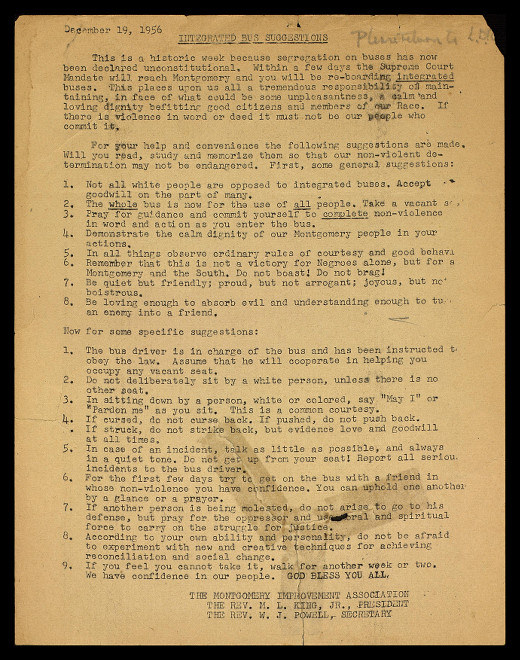
Martin Luther King, Jr. Writes a List of 16 Suggestions for African-Americans Riding Newly-Integrated Buses (1956)

Montgomery Bus Integration Suggestions

Last Tues­day, Decem­ber 1st, marked the 60th anniver­sary of Rosa Parks’ refusal to relin­quish her seat at the front of a Mont­gomery, Alaba­ma bus, and as some peo­ple point­ed out, the sto­ry many of us were told as chil­dren about Parks’ act of civ­il dis­obe­di­ence was fab­ri­cat­ed. Parks was not a hum­ble, elder­ly seam­stress worn out from a long day of work, a myth author Her­bert Kohl sum­ma­rizes as “Rosa Parks the Tired.” She was a well-con­nect­ed activist and NAACP leader who had already ini­ti­at­ed actions to inte­grate local libraries. Of her gross­ly over­sim­pli­fied biog­ra­phy, Parks remarked in her mem­oirs, “I was not tired phys­i­cal­ly, or no more tired than I usu­al­ly was at the end of a work­ing day. I was not old, although some peo­ple have an image of me as being old then. I was forty-two. No, the only tired I was, was tired of giv­ing in.”

Nor was Parks the first to brave arrest for refus­ing to give up a seat at the front of the bus. That same year, 15-year-old Claudette Colvin refused to give in, and sev­en months lat­er, so did 18-year-old Mary Louise Smith. Nei­ther of their arrests, how­ev­er, had the pow­er to spark the Mont­gomery Bus Boy­cott, the action that brought nation­al atten­tion to the civ­il rights move­ment and to Mar­tin Luther King, Jr.’s lead­er­ship role. King would lat­er recall that “Mrs. Parks was ide­al for the role assigned to her by his­to­ry” because “her char­ac­ter was impec­ca­ble and her ded­i­ca­tion deep-root­ed.” King’s repeat­ed empha­sis on “char­ac­ter” through­out his direc­tion of the boy­cott and beyond often seems an awful lot like what is today dis­par­aged, with good rea­son, as “respectabil­i­ty pol­i­tics”—the notion that only those who con­form to con­ser­v­a­tive, mid­dle-class norms of dress and behav­ior deserve to be treat­ed with dig­ni­ty and to have their civ­il rights respect­ed.

But this was not nec­es­sar­i­ly his point. His embrace of non­vi­o­lent resis­tance was in part a strate­gic means of pre­sent­ing the Jim Crow pow­er struc­ture with an implaca­ble unit­ed front that could not be moved to react in ways that might seem to jus­ti­fy vio­lence in the eyes of a large­ly unsym­pa­thet­ic public—to make it clear beyond any doubt who was the aggres­sor. And the vio­lence and repres­sion direct­ed at the boy­cotters was sig­nif­i­cant. They were attacked while walk­ing to work; King’s and civ­il rights leader E.D. Nixon’s hous­es were both fire­bombed; and King, Parks, and 87 oth­ers were indict­ed for their par­tic­i­pa­tion in the boy­cott.

Nor did the boycott’s suc­cess in 1956 put an end to the attacks. As a site com­mem­o­rat­ing this his­to­ry sum­ma­rizes, “After the boy­cott came to a close, snipers shot into bus­es in black com­mu­ni­ties, at one point hit­ting a young black woman, Rosa Jor­dan, in the legs.” And on one sin­gle night in 1957, “four black church­es and two homes were bombed.” These acts were on the extreme end of a dai­ly series of aggres­sive con­fronta­tions and humil­i­a­tions black rid­ers faced as they board­ed the new­ly-inte­grat­ed Mont­gomery bus­es. To help those rid­ers nav­i­gate this envi­ron­ment, King pre­pared the list of guide­lines above on the week before the bus­es inte­grat­ed. You can read a full tran­script of the list below, thanks to Lists of Note, who include it in their recent book-length col­lec­tion.

King makes his agen­da clear in the intro­duc­to­ry para­graph: “If there is vio­lence in word or deed it must not be our peo­ple who com­mit it.” Some of these direc­tives encour­age great pas­siv­i­ty in the face of often extreme hos­til­i­ty. It is very dif­fi­cult for me to imag­ine respond­ing in such ways to insults or phys­i­cal attacks. And yet, the boy­cotters had already dai­ly, and calm­ly, faced death and severe injury. As white Luther­an min­is­ter Robert Graetz—whose home was also bombed—remembered lat­er, “Dr. King used to talk about the real­i­ty that some of us were going to die and that if any of us were afraid to die we real­ly shouldn’t be there.”


INTEGRATED BUS SUGGESTIONS


This is a his­toric week because seg­re­ga­tion on bus­es has now been declared uncon­sti­tu­tion­al. With­in a few days the Supreme Court Man­date will reach Mont­gomery and you will be re-board­ing inte­grat­ed bus­es. This places upon us all a tremen­dous respon­si­bil­i­ty of main­tain­ing, in face of what could be some unpleas­ant­ness, a calm and lov­ing dig­ni­ty befit­ting good cit­i­zens and mem­bers of our Race. If there is vio­lence in word or deed it must not be our peo­ple who com­mit it.

For your help and con­ve­nience the fol­low­ing sug­ges­tions are made. Will you read, study and mem­o­rize them so that our non-vio­lent deter­mi­na­tion may not be endan­gered. First, some gen­er­al sug­ges­tions:

1 Not all white peo­ple are opposed to inte­grat­ed bus­es. Accept good­will on the part of many.

2 The whole bus is now for the use of all Take a vacant seat.

3 Pray for guid­ance and com­mit your­self to com­plete non-vio­lence in word and action as you enter the bus.

4 Demon­strate the calm dig­ni­ty of our Mont­gomery peo­ple in your actions.

5 In all things observe ordi­nary rules of cour­tesy and good behav­ior.

6 Remem­ber that this is not a vic­to­ry for Negroes alone, but for all Mont­gomery and the South. Do not boast! Do not brag!

7 Be qui­et but friend­ly; proud, but not arro­gant; joy­ous, but not bois­ter­ous.

8 Be lov­ing enough to absorb evil and under­stand­ing enough to turn an ene­my into a friend.

Now for some spe­cif­ic sug­ges­tions:

1 The bus dri­ver is in charge of the bus and has been instruct­ed to obey the law. Assume that he will coop­er­ate in help­ing you occu­py any vacant seat.

2 Do not delib­er­ate­ly sit by a white per­son, unless there is no oth­er seat.

3 In sit­ting down by a per­son, white or col­ored, say “May I” or “Par­don me” as you sit. This is a com­mon cour­tesy.

4 If cursed, do not curse back. If pushed, do not push back. If struck, do not strike back, but evi­dence love and good­will at all times.

5 In case of an inci­dent, talk as lit­tle as pos­si­ble, and always in a qui­et tone. Do not get up from your seat! Report all seri­ous inci­dents to the bus dri­ver.

6 For the first few days try to get on the bus with a friend in whose non-vio­lence you have con­fi­dence. You can uphold one anoth­er by a glance or a prayer.

7 If anoth­er per­son is being molest­ed, do not arise to go to his defense, but pray for the oppres­sor and use moral and spir­i­tu­al force to car­ry on the strug­gle for jus­tice.

8 Accord­ing to your own abil­i­ty and per­son­al­i­ty, do not be afraid to exper­i­ment with new and cre­ative tech­niques for achiev­ing rec­on­cil­i­a­tion and social change.

If you feel you can­not take it, walk for anoth­er week or two. We have con­fi­dence in our peo­ple. GOD BLESS YOU ALL.

via Lists of Note

Relat­ed Con­tent:

‘Tired of Giv­ing In’: The Arrest Report, Mug Shot and Fin­ger­prints of Rosa Parks (Decem­ber 1, 1955)

Read Mar­tin Luther King and The Mont­gomery Sto­ry: The Influ­en­tial 1957 Civ­il Rights Com­ic Book

‘You Are Done’: The Chill­ing “Sui­cide Let­ter” Sent to Mar­tin Luther King by the F.B.I.

200,000 Mar­tin Luther King Papers Go Online

Josh Jones is a writer and musi­cian based in Durham, NC. Fol­low him at @jdmagness

« Go BackMore in this category... »
Quantcast