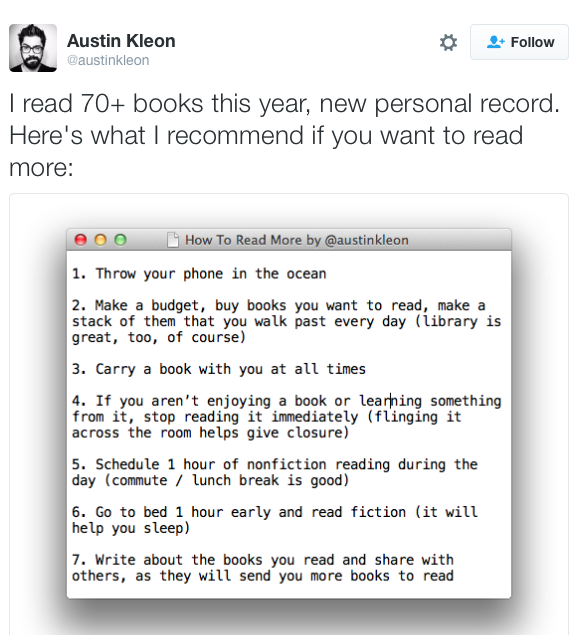
On Twitter, Austin Kleon, author of Steal Like an Artist: 10 Things Nobody Told You About Being Creativehas served up 7 tips for achieving the seemingly impossible–getting more books read in this age of constant distraction. The tips are simple and effective–effective enough to help Austin read 70+ books during a year, a new personal record.
No doubt, you have your own strategies for spending more time with books (and not just watching them pile up, unread, on your shelves. There’s a word for that in Japanese folks. It’s called “Tsundoku.”) If you care to share them, please put your best tips in the comments section below. We, and your fellow readers, thank you in advance.
Looking for free, professionally-read audio books from Audible.com? (Speaking of an easy way to spend more time with books.) Here’s a great, no-strings-attached deal. If you start a 30 day free trial with Audible.com, you can download two free audio books of your choice. Get more details on the offer here. Also note that Audibooks.com has a very similar offer that you can explore here.
It is the end of term this week and my film production students asked me to name my favorite part of filmmaking. I told them it’s directing, as it’s something I so rarely get to do (compared to writing) yet so involving that an entire day goes by in a flash. Regardless, I always pop out the other side knowing I was at my absolute creative best. I was in the “zone” or as Mihaly Csikszentmihalyi called it in 1990, “the flow state.” And in a wonderful bit of synchronicity, not a little while later, I have been charged with presenting to you this example of artificial intelligence (AI) creativity. It similarly uses this understanding of the flow state to create.
In the above video, the Flow Machine developed by François Pachet at Sony CSL-Paris has been fed Beethoven’s “Ode to Joy”, and then asked to orchestrate “cover versions” following the rules set down by a genre–say bossa nova or electronic chill music–or a song itself, in this case being the Beatles’ “Penny Lane.”
Previous attempts to create random computer music have resulted in exactly that–random notes, drawn from a selection determined by a programmer. But that isn’t how creativity works. When we create, we understand our parameters already, subconsciously, and not only that, we know what we and others have done before, what “pushes the envelope” compared to using a completely wrong element, and what makes our own creativity unique. (If we discover it and emphasize the latter over and over, it’s called style.)
The Flow Machine project aims to understand style and treat it as a computational object through which other information can pass. That’s what we’re seeing in the above video. For a more thorough explanation of Flow Machine, watch this video.
Supposedly, this will help us poor human beings in the end, as it might (it’s never explained how) help us get into our own flow state more readily.
But really, that’s not what I’m thinking about. I’m more imagining a night club sometime in the future where Beatles androids play not just their hits, but the hits of others as if John, Paul, George and Ringo wrote them instead. (Yes, I know that has already been done. By humans.) And your local used record shop will have a lot of LPs full of classical versions of Beatles hits.
It’s an interesting video, but I wouldn’t pack up your guitars yet folks!
Ted Mills is a freelance writer on the arts who currently hosts the artist interview-based FunkZone Podcast. You can also follow him on Twitter at @tedmills, read his other arts writing at tedmills.com and/or watch his films here.
The Japanese term kaizen, which just means something like “good change,” has come to signify in global management culture a process of continuous small-scale improvement — an element of the “Japanese business philosophy” so enviously scrutinized during that country’s postwar economic boom. Toyota has done the most to associate themselves with the idea of kaizen-as-continuous-improvement, but it has made its way to countless other businesses, including foreign ones selling completely different products; even the American grocery store Trader Joe’s has worked the word into their internal customer-service lexicon.
These mini-documentaries take in-depth looks at the nuts and bolts (sometimes literally) of production systems that have evolved, small improvement after small improvement, over decades or indeed centuries. You can see in action every stage of these hybrid processes of advanced and highly specialized technology with skilled and sometimes even artisanal human labor, somehow at once elaborate and elegant. This goes for every product featured, no matter how important or trivial it may seem. (I got hooked myself after watching one on chicken-shaped sweets.)
Even non-Japanese-speakers can enjoy all of The Making’s clear and almost completely visual-driven episodes, but the JST has also made select ones available with English subtitles (see top playlist) in order to tell the world all about what it takes to make what it has come to see as quintessentially Japanese, like urban railroad cars, steel balls (of many uses, including but not limited to pachinko machines), and Hina dolls.
Any American old-timer will tell you that, back in their day — a time when the United States’ former enemy had yet to fully rebuild its economy, let alone to become a technological leader — the “made in Japan” stamp signified a piece of junk. These videos show us, in detail, what it took to refute that notion for good.
The broadcast features Amy Berg’s never-before-seen extended film cut with additional archival performance footage and new interviews with Janice Joplin’s sister Laura Joplin and musicians influenced by Janis: Alecia Moore (a.k.a. Pink), Juliette Lewis, Melissa Etheridge and the film’s narrator, Chan Marshall, who is best known as indie rock star Cat Power.
The doc runs 102 minutes, and just started airing on television on PBS this week. Enjoy.
h/t goes to Elana and Robin.
If you would like to support the mission of Open Culture, consider making a donation to our site. It’s hard to rely 100% on ads, and your contributions will help us continue providing the best free cultural and educational materials to learners everywhere. You can contribute through PayPal, Patreon, and Venmo (@openculture). Thanks!
There is a perpetual argument among stringed instrument aficionados about the esoteric value of so-called “tonewoods.” Certainly, to most discriminating ears, the differences between an acoustic guitar, mandolin, or violin made of solid spruce or maple and one made of plywood seem sonically obvious. When it comes to electric guitars, the distinctions between materials can seem more negligible. In blind tests many of us might have some difficulty telling the difference between an electric guitar made of the finest woods and one made of cheap balsa, lucite, or even an oil can. (Not that differences don’t exist!) It’s hardly controversial to point out that acoustic instruments depend upon their materials and workmanship in ways electric instruments don’t.
So how might discriminating ears respond to an electric, digitally 3‑D printed acrylic violin, based loosely on a real Stradivarius? Can such an instrument replicate the sweet sustain of an acoustic violin, Strad or otherwise? You can judge for yourself in the demonstrations here. Created by French engineer and musician Laurent Bernadac, the “3Dvarius”—the world’s first 3‑D printed violin—is perhaps, reports Wired, “a harbinger of what’s to come for musical instruments.” Critics have shown how it falls far short of recreating the sound of a traditional instrument. (See violinist Joanna Wronko compare the two at a TEDx Amsterdam talk here). And yes, the 3Dvarius may look “more like an avian skeleton than a stringed instrument.” But it does have some advantages over traditional violins made of wood.
For one thing, synthetic instruments are highly durable and lightweight (violins and cellos made of carbon fiber have been on the market for several years). For another, the 3Dvarius can indeed make some pretty sweet sounds when plugged into Bernadac’s rig, consisting of various effects pedals and loopers. At the top, see how he uses his setup to create jazzy multi-layered, multi-track arrangements of popular songs with the 3Dvarius. And hear a few of those songs here, along with snazzy videos—including U2’s “With or Without You,” the Game of Thrones and X‑Files themes, and “Se Bastasse Una Canzone” by Italian singer/songwriter Eros Ramazzotti. (See many more on Youtube.) The 3Dvarius website has a step-by-step explanation of how the instrument is made, from initial design to surface treatment and final assembly.
Despite its name and inspiration, the 3Dvarius doesn’t claim to actually duplicate a Stradivarius, a feat long thought impossible by even the finest modern luthiers. Even computer scientists admit: no matter how good machines get at replication, replacing traditional, handmade violins with printed copies “would lead to digitally cloned instruments,” writes Wired, “and the loss of sonic character that makes music, well, music.” And it isn’t only sonic character that matters to musicians. Surprisingly enough, in blind tests, many violinists can’t tell the difference between a Stradivarius and a high-quality newer model violin, but these findings do not diminish the Stradivarius mystique. The look and feel of an instrument and its make and pedigree matter. As musician and writer Clemency Burton-Hill points out, much of our fascination with the Stradivarius violin has to do with the “story of Stradivari,” as well as those of the musicians who have owned and played his instruments.
And though it may be possible to come close to their tones with cheaper modern copies and digital technology, we still gush over Jimi Hendrix’s Stratocaster or Jimmy Page’s Les Paul. The 3Dvarius, I’ll admit, is a very cool idea, but it’s hard to imagine a digitally-produced plastic artifact ever acquiring the same intangible aura of not only the most famous instruments in the world, but also of unique, hand-crafted new instruments on their way to making history. As Walter Benjamin argued in “The Work of Art in the Age of Mechanical Reproducibility,” it’s the authenticity of “aura”—the specific traces of history and the fingerprints of artists and master craftsmen—that we treasure in art. These are qualities that elude the most advanced technological processes.
The affinities between England and Japan go far beyond the fact that both are tea-loving nations with a devotion to gardens; far beyond the fact that both drive on the left, are the world’s leading overseas investors, and are rainy islands studded with green villages. They go even beyond the fact that both have an astringent sense of hierarchy, subscribe to a code of social reticence, and are, in some respects, proud, isolated monarchies with more than a touch of xenophobia. The very qualities that seem so foreign, even menacing, to many Americans in Japan — the fact that people do not invariably mean what they say, that uncertain distances separate politeness from true feelings, and that everything is couched in a kind of code in which nuances are everything — will hardly seem strange to a certain kind of Englishman.
That astute comparison comes from an essay called “For Japan, See Oscar Wilde” by Pico Iyer, a writer uniquely well-placed to sense this sort of thing by virtue of his childhood in England and longtime residence as an adult in Japan. His Indian heritage and penchant for world travel have also equipped him to write with clarity about the ways — sometimes grotesque, sometimes delusional, sometimes aspirational, sometimes fantastical — in which one country can perceive another.
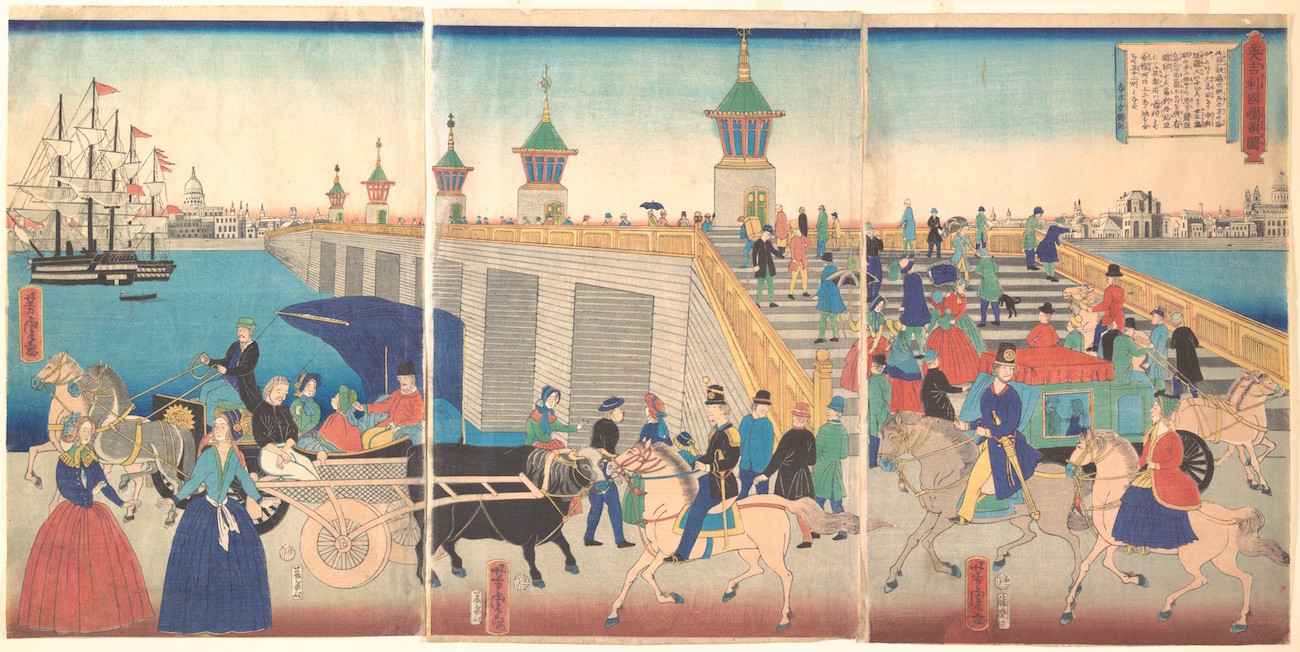
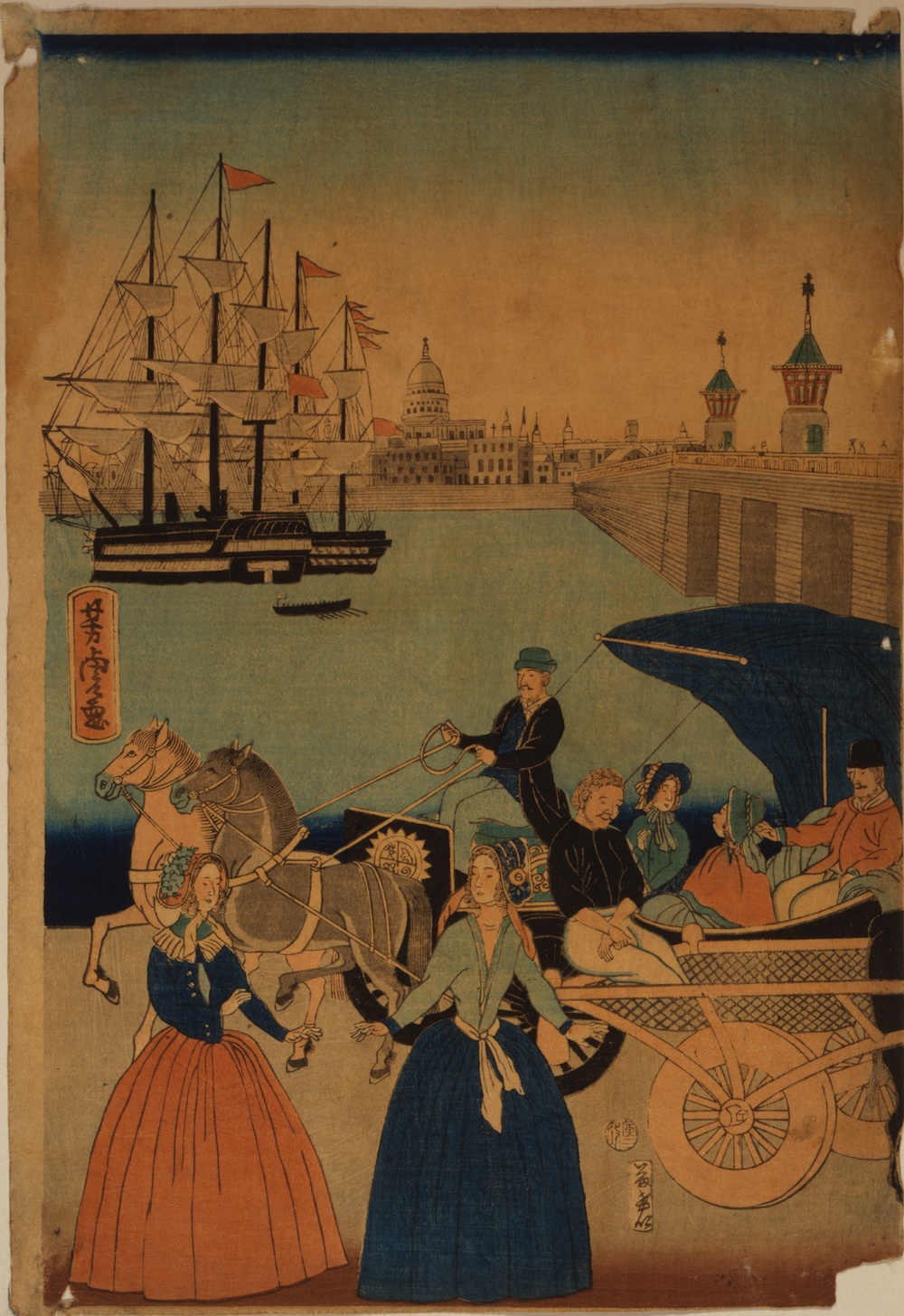
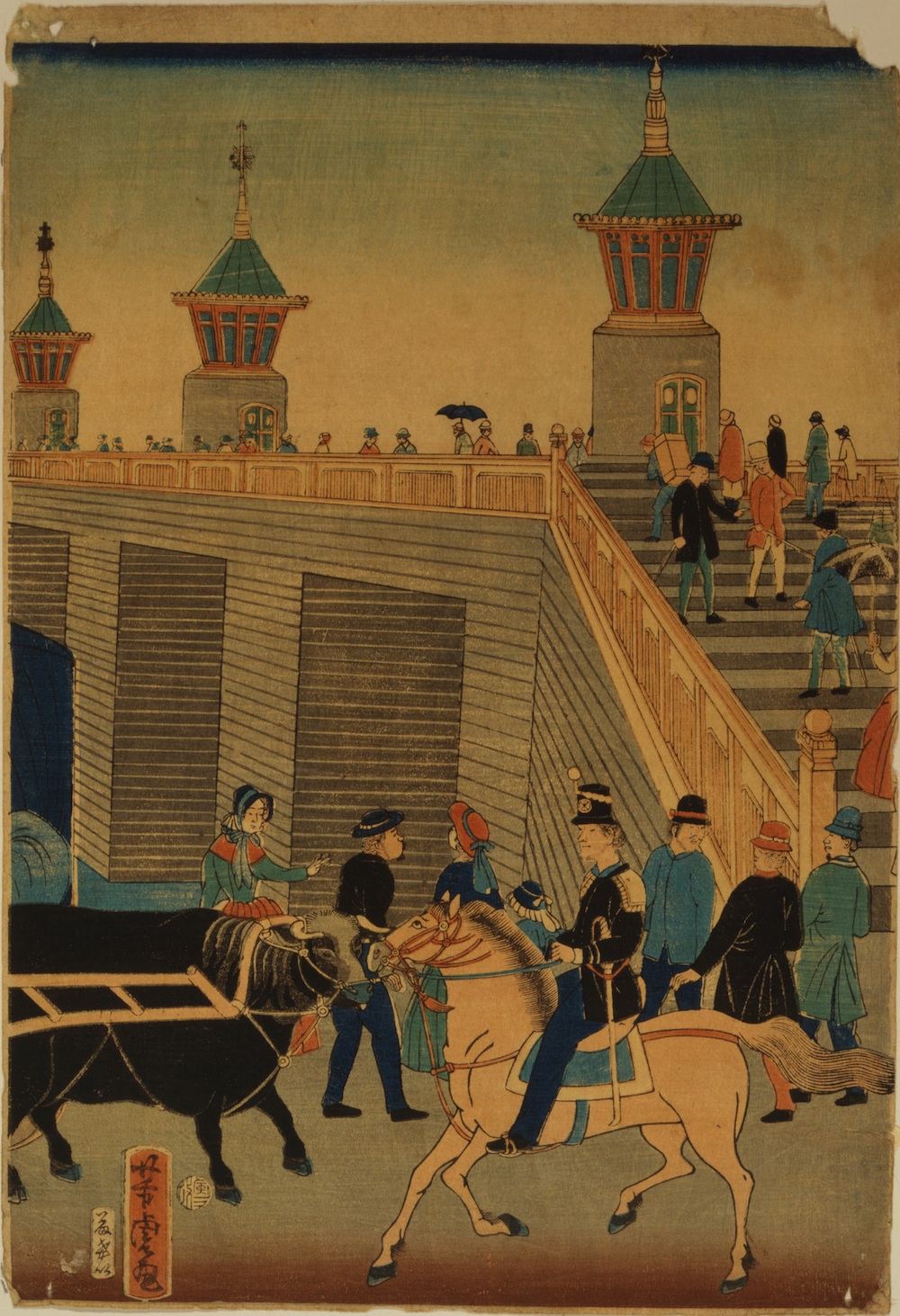
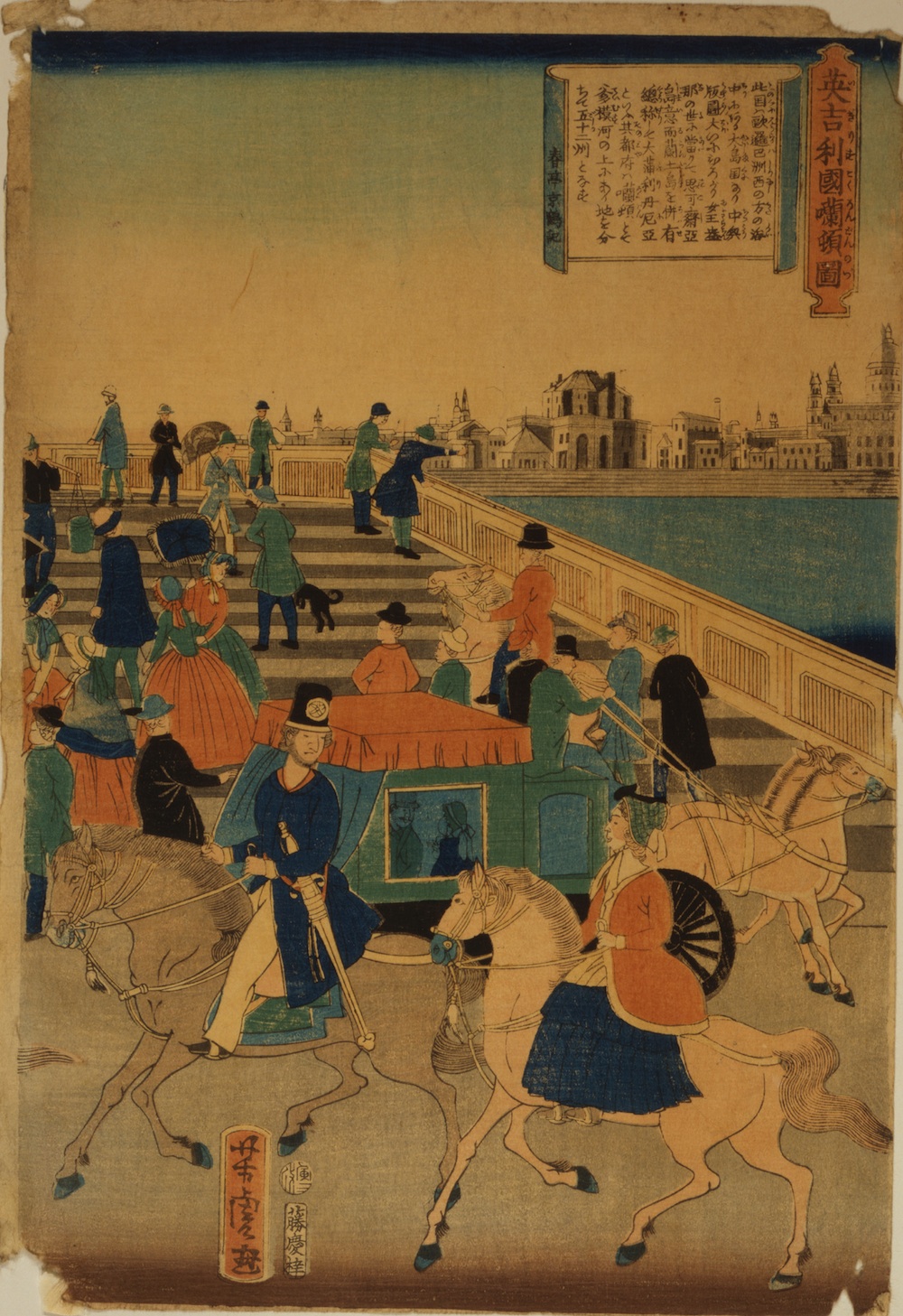
In the case of the somehow separated-at-birth nations of England and Japan, we have some direct documentation of the former as dreamed of by the latter in Utagawa Yoshitora’s 1866 triptych Igirisukoku Rondon no zu.
“Together, the three images depict a street scene near the River Thames, complete with thronging English pedestrians, two sailing ships, horses, oxen, and carriages,” writes Slate’s Rebecca Onion: “The images would have sold fairly cheaply, in the thriving market in woodblock (ukiyo‑e) prints in 19th-century Japan. Utagawa, a relatively minor artist from an extensive lineage of woodblock printers, also produced portraits of Kabuki actors, triptychs of historical battle scenes, and images of foreigners in Yokohama—one of the only places in Japan where they were allowed to trade at the time. (Here’s an 1861 print titled ‘Two Americans.’) Utagawa probably did not visit London, and was instead working from secondhand reports.”
That would make him a perfect subject for Iyer, who has tended to specialize in writing not just about the places of the world but the places of the mind. While the people of Utagawa’s London of the mind display a simplified typical English style of dress, and do so before a proud domed building and a mighty-looking, elaborately rigged sailing ship, their composition remains somehow quintessentially Japanese. But then, how much separates the quintessentially Japanese from the quintessentially English? “The actual people who live in Japan,” said Oscar Wilde as quoted in Iyer’s essay, “are not unlike the general run of English people.”
And the affinity goes both ways. When Prince Fushimi Sadanaru made a state visit to England forty years after Utagawa made his prints, he hoped to catch a performance of The Mikado, Gilbert and Sullivan’s hit comic opera set very much in the Japan of the English mind (and one that faces accusations of cultural imperialism to this day). Alas, the British government had preemptively canceled all performances during the Prince’s stay for fear of offending him. This prompted a Japanese journalist in London to later see the show himself. He went on to write of his disappointment: he’d gone in expecting “real insults” to his homeland, only to find “bright music and much fun.”
Take two of the most prominent English cultural properties of the past several decades, bring them together, and what have you got? You’ve got Patrick Troughton, better known as the Second Doctor in TV’s Doctor Who, in a 1965 BBC Radio adaptation of George Orwell’s 1984. Troughton was not yet the Doctor; the honor would not fall to him until the following year when he replaced William Hartnell (with the latter’s full approval, it seems). But he was a well-known character actor, the first to play Robin Hood on television (in a 1953 BBC mini-series), and a figure who inspired a good deal of respect in the British entertainment industry. Troughton was also a decorated World War II veteran (who, when the year 1984 finally arrived, suffered his second major heart attack).
Troughton brings to the role of everyman Winston Smith a gravitas shared by a number of actors who have inherited the role since the very first radio adaptation in 1949, starring David Niven. Of course Orwell’s story is not an ongoing series like Doctor Who, but it has remained remarkably relevant to every generation post-World War II, and like the Doctor’s character, has been constantly re-imagined in adaptations on radio, film, and television. The conditions of government repression, censorship, and mass surveillance Orwell foresaw have seemed imminent, if not fully realized, in the decades following the novel’s 1948 publication, though the adjective “Orwellian” and many of the novel’s coinages have suffered a good deal through overuse and misapplication.
Just as the first radio play of 1984 warned of a “disturbing broadcast,” this 1965 version begins, “The following play is not suitable for those of a nervous disposition.” It’s interesting that even this long after the novel’s publication, and in the midst of the swinging sixties, Orwell’s dystopian fable still had the power to shock. Or at least the producers of this broadcast thought so. Perhaps we’ve been so thoroughly inured to the prospects Orwell warned of that revelations of the NSA’s massive data collection, or of the global expropriation disclosed by the Panama Papers, or of any number of nefarious government dealings often elicit a cynical shrug from the average person. Those who do express alarm at such documented abuses are often branded… well, alarmists.
But then again, we keep returning to Orwell.
Continuing in the tradition begun by David Niven and carried forward by Patrick Troughton (and on film by Edmond O’Brien and John Hurt), another respected British actor recently took on the role of Winston Smith in a BBC 4 radio adaptation three years ago. This time the actor was Christopher Eccleston, who also, it turns out, once played Doctor Who.
If you would like to support the mission of Open Culture, consider making a donation to our site. It’s hard to rely 100% on ads, and your contributions will help us continue providing the best free cultural and educational materials to learners everywhere. You can contribute through PayPal, Patreon, and Venmo (@openculture). Thanks!
We're hoping to rely on loyal readers, rather than erratic ads. Please click the Donate button and support Open Culture. You can use Paypal, Venmo, Patreon, even Crypto! We thank you!
Open Culture scours the web for the best educational media. We find the free courses and audio books you need, the language lessons & educational videos you want, and plenty of enlightenment in between.