Before the advent of digital studio technology, a degree of imprecision naturally resulted from the recording process. It may now be too easy to erase and correct perceived errors. As Brian Eno has pointed out, “the temptation of the technology is to smooth everything out.” Perhaps that’s why so many of the famous songs containing mistakes in pop culture lore come from a pre-digital age. In any case, such lore abounds. Some of it speculative, some anecdotal, some apocryphal, and much of it clearly evident in close listens and confirmed by the musicians, engineers, and producers themselves.
A recent Reddit thread compiled 500 comments worth of discussion on the subject. One prominent example is Ella Fitzgerald’s 1960 “Mack the Knife,” in which she forgets the lyrics to the chorus and improvises. “Talk about failing gracefully,” writes user Bleue22. The album, they note, went on to win a Grammy.
But this example, you may object, comes from a live album—no second takes allowed. And Fitzgerald sets up the error by saying beforehand, “we hope we remember all the words.” (I’d guess she’s using the royal “we,” to which she’s fully entitled.) Nonetheless, her “Mack the Knife” may have no equal.
Still, we don’t lack for studio examples of mistakes in great recordings. If you’re a metal fan, Metallica’s “Seek and Destroy” from 1983’s Kill ‘Em All likely holds a special place of honor in your collection. As Kirk Hammett revealed in a 2002 interview with Guitar World after his induction into the magazine’s hall of fame, his solo on the track was only a second or third take, with little rehearsal. “There were no frills, no contemplation, no overintellectualizing,” he says. The result? Amazing, right? But, Hammett continues, “On a couple of notes in that solo, I bend the notes out of pitch; for 18 years, every time I’ve heard that guitar solo, those sour notes come back to haunt me!”
Every guitarist has suffered through this experience while listening back to their records. Few make Guitar World’s hall of fame. The point is that greatness and perfection are not always the best of friends. Another example of the kind of thing that might only haunt a musician: In Steely Dan’s “Aja” from the 1977 Grammy-winning album of the same name, drummer Steve Gadd plays “one of the best drum solos ever recorded,” writes Michael Duncan as Sonic Scoop. Drummers for decades have sought to replicate the moment, especially an idiosyncratic click at 4:57. Turns out, it was “actually a slip of his stick; albeit a well-timed one.” The solo, Duncan notes, was done in one take.
Other examples may have had life-changing consequences for the musician in question. It’s rumored that David Gilmour’s faintly recorded coughing on Pink Floyd’s “Wish You Were Here” bothered him so much that he quit smoking. In some cases, the mistake can turn into a hook or a musical statement, such as Cindy Wilson’s shout of “Tiiiiiiin Roof! Rusted” in the B‑52’s “Love Shack,” apparently a mistake on Wilson’s part. The phenomenon, granted, tends to manifest in genres that accommodate all varieties of looseness—rock, blues, jazz, etc.—and the great bulk of examples in the Reddit mistake thread come from such recordings. I couldn’t say whether it’s possible to compile such a list in music with far stricter arrangements or reliance on electronic instrumentation.
I also couldn’t say whether mistakes in, say classical or electronic music, would produce such desirable results. What often emerges in these discussions is the degree to which mistakes, unplanned improvisations, or happy accidents can become essential features of a song. Take The Breeder’s “Cannonball,” which intentionally incorporates a mistake bassist Josephine Wiggs repeatedly made in rehearsals, sliding to the wrong note in the solo bass intro, then correcting when the guitars came in. “We all just thought it was hilarious and thought it sounded really great,” she remembered. “It was clear to us at that moment that that was the right thing to do, to keep the wrong note in there.” Does it matter that some recorded mistakes are intentional and others are not? That question may be fodder for another 500-comment-long discussion. Or we could heed the wisdom of Brian Eno or Miles Davis and just go with it either way.
If Senator Al Franken won’t run for President in 2020, perhaps he’d temper fans’ disappointment with a repeat of his early 80’s turn as Mick Jagger, above.
The performance took place at Stockton State, a public university conveniently located in New Jersey–what the late Tom Davis, Franken’s long time Saturday Night Live writing partner and Keith Richards to his Jagger called “the Blair Witch scrub forests twenty-five miles north of Atlantic City.”
Franken’s performance is an immersive triumph, especially for those who remember his best known SNL character, the lispingly upbeat Stuart Smalley.
His Jagger is the opposite of Stuart–butch, preening, athletic … a less than sober student fan in the Stockton State crowd might have drunkenly wondered if he or she had accidentally bought tickets to the Tattoo You tour. Those lips are pretty convincing.
The costuming is dead on too, and Franken did not take the route Chris Farley would later take, lampooning the male strippers of Chippendales. He may not be Jagger-rangy, but he’s certainly fit in an outfit that leaves no room to hide.
As we started “Under My Thumb,” Franken came running out as Mick Jagger, wearing yellow football pants and Capezios and was so good, it was scary. Unfortunately, Franken and Davis at Stockton State never sold very well… maybe it would be re-released if one of us became president, or shot a president.
Knowing that Davis, who died five years ago, would likely never have predicted the outcome of the recent election, and that Senator Franken, outspoken as he is, is in no position to joke about the second option, we suggest truffling up a used copy, if you’d like to see more.
And for comparison’s sake, here are the originals performing to an arena-sized crowd in Arizona in 1981:
If your Facebook news feed looks anything like mine, you wake up each morning to a stream of not just food snapshots and selfies but pictures of books, whether stacked up, dumped into a pile, or arranged neatly on shelves. Why do we post digital photos of our printed matter? Almost certainly for the same reason we do anything on social media: to send a message about ourselves. We want to tell our friends who we are, or who we think we are, but not in so many words, or rather not in so few; a few of the books we’ve read (or intend to read), carefully selected and arranged, does the job. But what if, instead of assembling a self-portrait through books, someone else entered your personal library and did it for you?
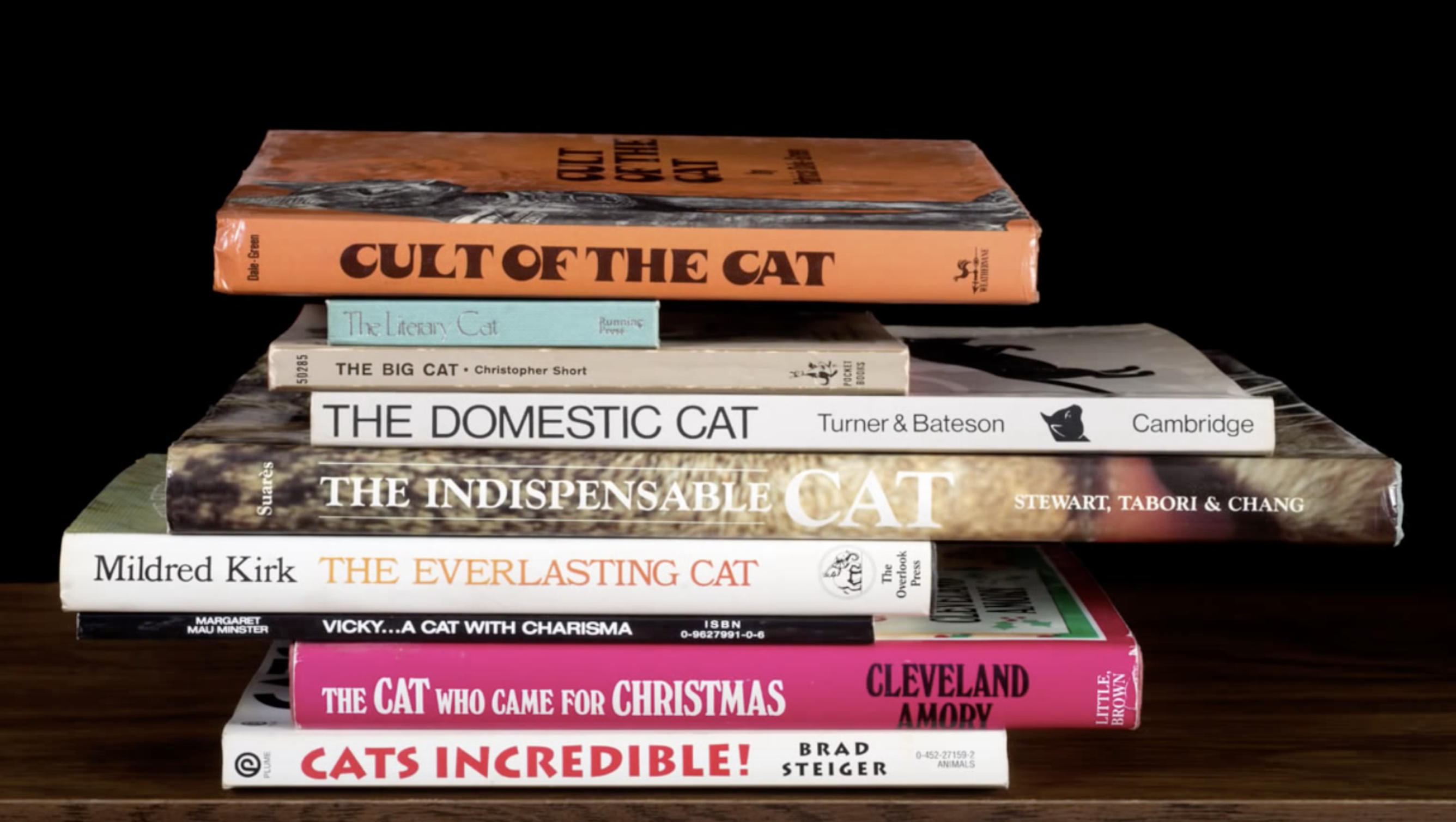
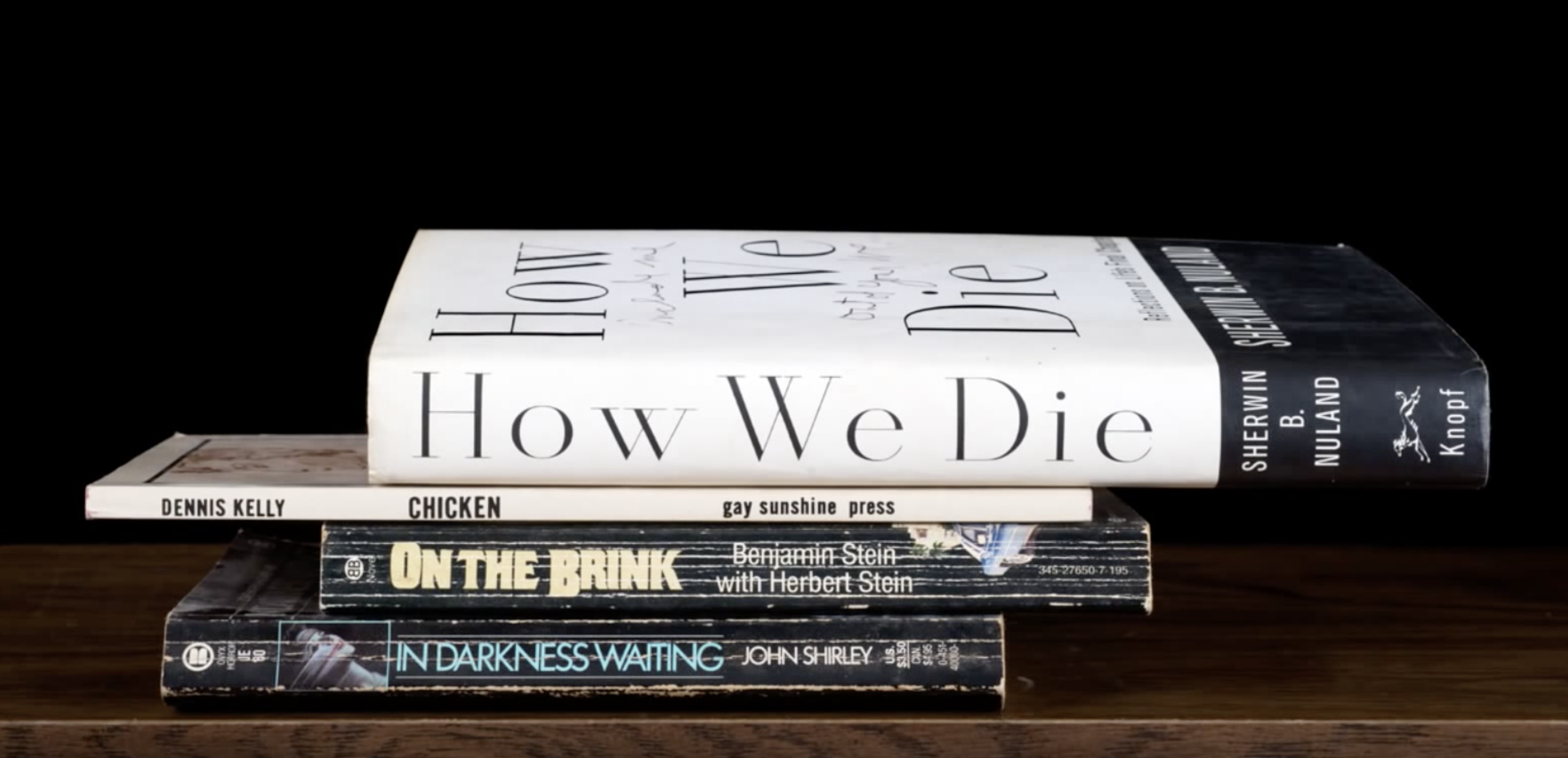
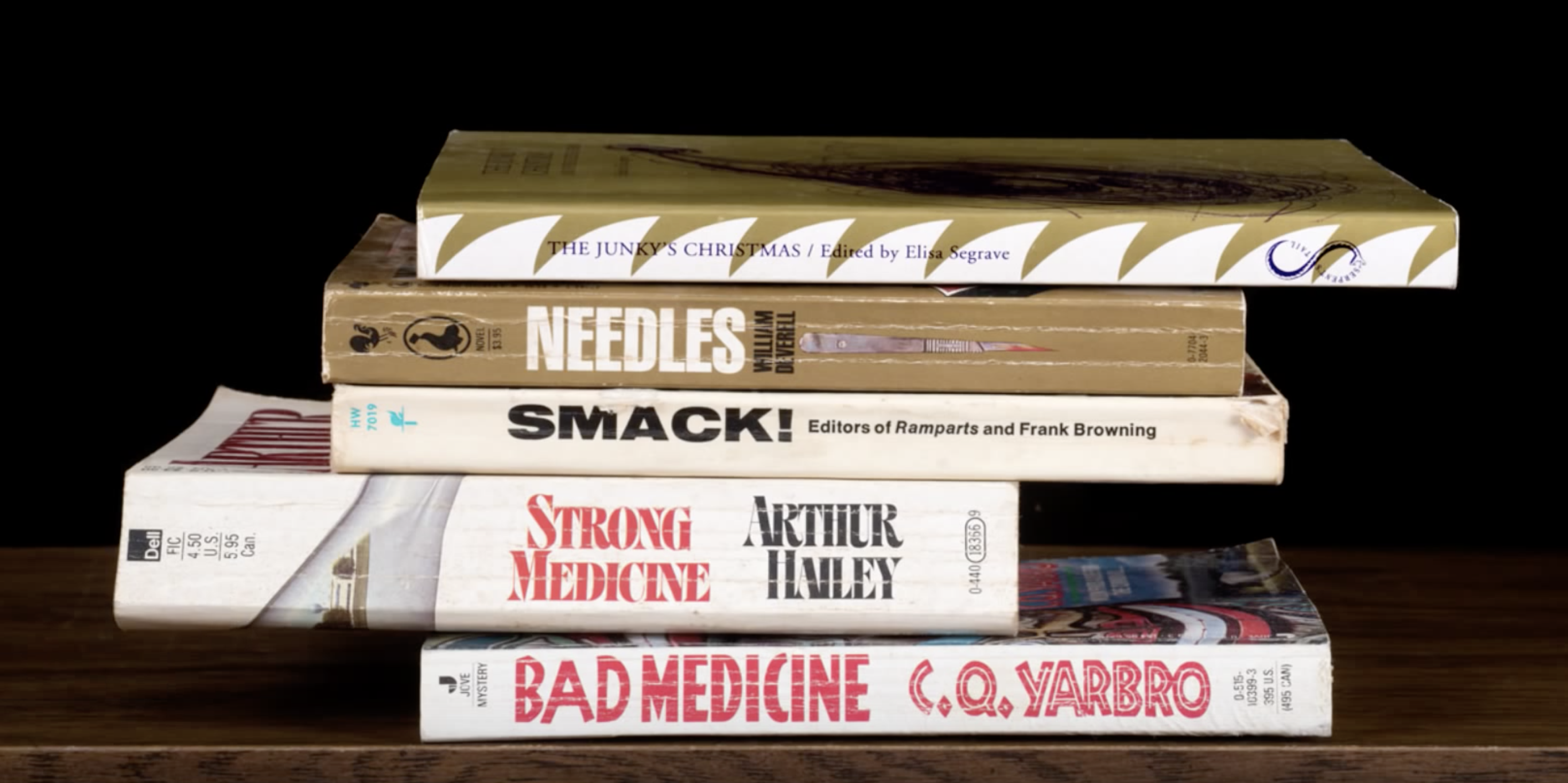
Artist Nina Katchadourian (she of, among many other endeavors, the airplane-bathroom 17th-century Flemish portraiture) recently took on that task in the Lawrence, Kansas home of famously hard-living and furiously creative beat writer William S. Burroughs. She did it as part of her long-running Sorted Books project, in which, in her words, “I sort through a collection of books, pull particular titles, and eventually group the books into clusters so that the titles can be read in sequence.
The final results are shown either as photographs of the book clusters or as the actual stacks themselves, often shown on the shelves of the library they came from. Taken as a whole, the clusters are a cross-section of that library’s holdings that reflect that particular library’s focus, idiosyncrasies, and inconsistencies.”
Kansas Cut-Up, the Burroughs chapter of Sorted Books, features such arrangements as How Did Sex Begin? / Uninvited Guests / Human Error, Memoirs of a Bastard Angel / A Night of Serious Drinking / A Little Original Sin, and American Diplomacy / Physical Interrogation Techniques / In the Secret State. Thom Robinson of the European Beat Studies Network describes Burroughs’ book collection as “a selection of largely European works whose contents include paranoia, theories of language, pseudoscience, mordant humour and drugs: in retrospect, it’s easy to imagine the owner of such an idiosyncratic library producing the melange of Naked Lunch. Perhaps for this reason, it seems hard to resist reordering the books which Burroughs owned in 1944 in order to emphasise the most recognisable elements of the later Burroughs persona.”
Sometimes Katchadourian seems to do just that and sometimes she doesn’t, but her method of book-sorting, which she explains in the episode of John and Sarah Green’s series The Art Assignment at the top of the post, bears more than a little resemblance to Burroughs’ own “cut-up” method of literary composition. “Take a page,” as Burroughs himself explained it. “Now cut down the middle and cross the middle. You have four sections: 1 2 3 4 … one two three four. Now rearrange the sections placing section four with section one and section two with section three. And you have a new page. Sometimes it says much the same thing. Sometimes something quite different.” And just as a rearranged book can speak in a new and strange voice, so can a rearranged library.
In 2015, Paige Breithart, an artist and student living in Hamtramck, Michigan, had grown tired of the countless potholes marring Hamtramck’s streets. So she took matters into her own hands, and drove around town, filling the potholes with flowers, replacing the decay with symbols of growth and beauty. The story went viral, and Breithart’s aesthetic treatment has since caught on. Look around Twitter, and you’ll find stories about flowers filling potholes around the United States, and indeed around the world.
In some cases, these guerilla projects aren’t just decorative, a simple way to spruce up a neighborhood. There’s an activist element to them. In Bath, England, one flower pot vigilante said:
In an area of America there were a load of potholes filled in with pot plants, although that’s not what we are doing here. We think it’s a good thing to do but it’s more than about making people smile. Potholes are a real problem and have the potential to be death traps for bikers and cyclists and with cars there is an issue with blow-outs to wheels. The whole point is to raise awareness of them.
And local governments are taking notice, though not always happily. Concerned that drivers might get surprised or distracted by flowers suddenly appearing in the middle of a road, politicians are discouraging this form of protest. But you can’t argue with the results. Once protesters call attention to them, the potholes have a magical way of getting properly paved and filled. Quickly.
Below you can see a gallery of potholes around the world that have gotten the flower treatment–from Missoula, Montana, to Montreal, Bath, Bosnia and Ukraine. Maybe the artist from Chicago (see image at bottom) is the one who got it right?
Wetzel County, West Virginia
Terry Bartrug shares this giant pothole that he filled with flowers along 8 mile road in Wetzel county near Reader. pic.twitter.com/jZiDlZ47U7
If you would like to sign up for Open Culture’s free email newsletter, please find it here. It’s a great way to see our new posts, all bundled in one email, each day.
If you would like to support the mission of Open Culture, consider making a donation to our site. It’s hard to rely 100% on ads, and your contributions will help us continue providing the best free cultural and educational materials to learners everywhere. You can contribute through PayPal, Patreon, and Venmo (@openculture). Thanks!
Everyone used to read Samuel Johnson. Now it seems hardly anyone does. That’s a shame. Johnson understood the human mind, its sadly amusing frailties and its double-blind alleys. He understood the nature of that mysterious act we casually refer to as “creativity.” It is not the kind of thing one lucks into or masters after a seminar or lecture series. It requires discipline and a mind free of distraction. “My dear friend,” said Johnson in 1783, according to his biographer and secretary Boswell, “clear your mind of cant.”
There’s no missing apostrophe in his advice. Inspiring as it may sound, Johnson did not mean to say “you can do it!” He meant “cant,” an old word for cheap deception, bias, hypocrisy, insincere expression. “It is a mode of talking in Society,” he conceded, “but don’t think foolishly.” Johnson’s injunction resonated through a couple centuries, became garbled into a banal affirmation, and was lost in a graveyard of image macros. Let us endeavor to retrieve it, and ruminate on its wisdom.
We may even do so with our favorite modern brief in hand, the scientific study. There are many we could turn to. For example, notes Derek Beres, in a 2014 book neuroscientist Daniel Levitin brought his research to bear in arguing that “information overload keeps us mired in noise.… This saps us of not only willpower (of which we have a limited store) but creativity as well.” “We sure think we’re accomplishing a lot,” Levitin told Susan Page on The Diane Rehm Show in 2015, “but that’s an illusion… as a neuroscientist, I can tell you one thing the brain is very good at is self-delusion.”
Johnson’s age had its own version of information overload, as did that of another curmudgeonly voice from the past, T.S. Eliot, who wondered, “Where is the wisdom we have lost in knowledge? Where is the knowledge we have lost in information?” The question leaves Eliot’s readers asking whether what we take for knowledge or information really are such? Maybe they’re just as often forms of needless busyness, distraction, and overthinking. Stanford researcher Emma Seppälä suggests as much in her work on “the science of happiness.” At Quartz, she writes,
We need to find ways to give our brains a break.… At work, we’re intensely analyzing problems, organizing data, writing—all activities that require focus. During downtime, we immerse ourselves in our phones while standing in line at the store or lose ourselves in Netflix after hours.
Seppälä exhorts us to relax and let go of the constant need for stimulation, to take longs walks without the phone, get out of our comfort zones, make time for fun and games, and generally build in time for leisure. How does this work? Let’s look at some additional research. Bar-Ilan University’s Moshe Bar and Shira Baror undertook a study to measure the effects of distraction, or what they call “mental load,” the “stray thoughts” and “obsessive ruminations” that clutter the mind with information and loose ends. Our “capacity for original and creative thinking,” Bar writes at The New York Times, “is markedly stymied” by a busy mind. “The cluttered mind,” writes Jessica Stillman, “is a creativity killer.”
In a paper published in Psychological Science, Bar and Baror describe how “conditions of high load” foster unoriginal thinking. Participants in their experiment were asked to remember strings of arbitrary numbers, then to play word association games. “Participants with seven digits to recall resorted to the most statistically common responses (e.g., white/black),” writes Bar, “whereas participants with two digits gave less typical, more varied pairings (e.g. white/cloud).” Our brains have limited resources. When constrained and overwhelmed with thoughts, they pursue well-trod paths of least resistance, trying to efficiently bring order to chaos.
“Imagination,” on the other hand, wrote Dr. Johnson elsewhere, “a licentious and vagrant faculty, unsusceptible of limitations and impatient of restraint, has always endeavored to baffle the logician, to perplex the confines of distinction, and burst the enclosures of regularity.” Bar describes the contrast between the imaginative mind and the information processing mind as “a tension in our brains between exploration and exploitation.” Gorging on information makes our brains “’exploit’ what we already know,” or think we know, “leaning on our expectation, trusting the comfort of a predictable environment.” When our minds are “unloaded,” on the other hand, which can occur during a hike or a long, relaxing shower, we can shed fixed patterns of thinking, and explore creative insights that might otherwise get buried or discarded.
As Drake Baer succinctly puts in at New York Magazine’s Science of Us, “When you have nothing to think about, you can do your best thinking.” Getting to that state in a climate of perpetual, unsleeping distraction, opinion, and alarm, requires another kind of discipline: the discipline to unplug, wander off, and clear your mind.
For more than eighty years, MIT Press has been publishing acclaimed titles in science, technology, art and architecture. Now, thanks to a new partnership between the Internet Archive and MIT Press, readers will be able to borrow these classics online for the first time. With generous support from Arcadia, a charitable fund of Peter Baldwin and Lisbet Rausing, this partnership represents an important advance in providing free, long-term public access to knowledge.
“These books represent some of the finest scholarship ever produced, but right now they are very hard to find,” said Brewster Kahle, founder and Digital Librarian of the Internet Archive. “Together with MIT Press, we will enable the patrons of every library that owns one of these books to borrow it online–one copy at a time.”
This joint initiative is a crucial early step in Internet Archive’s ambitious plans to digitize, preserve and provide public access to four million books, by partnering widely with university presses and other publishers, authors, and libraries.…
We will be scanning an initial group of 1,500 MIT Press titles at Internet Archive’s Boston Public Library facility, including Cyril Stanley Smith’s 1980 book, From Art to Science: Seventy-Two Objects Illustrating the Nature of Discovery, and Frederick Law Olmsted and Theodora Kimball’s Forty Years of Landscape Architecture: Central Park, which was published in 1973. The oldest title in the group is Arthur C. Hardy’s 1936 Handbook of Colorimetry.
Throughout the summer, we’ve been checking in, waiting for the first MIT Press books to hit Archive.org’s virtual shelves. They’re now starting to arrive. Click here to find the beginnings of what promises to be a much larger collection.
As Brewster Kahle (founder of Internet Archive) explained it to Library Journal, his organization is “basically trying to wave a wand over everyone’s physical collections and say, Blink! You now have an electronic version that you can use” in whatever way desired, assuming its permitted by copyright. In the case of MIT Press, it looks like you can log into Archive.org and digitally borrow their electronic texts for 14 days.
Archive.org hopes to digitize 1,500 MIT Press classics by the end of 2017. Digital collections from other publishing houses seem sure to follow.
If you would like to sign up for Open Culture’s free email newsletter, please find it here. It’s a great way to see our new posts, all bundled in one email, each day.
If you would like to support the mission of Open Culture, consider making a donation to our site. It’s hard to rely 100% on ads, and your contributions will help us continue providing the best free cultural and educational materials to learners everywhere. You can contribute through PayPal, Patreon, and Venmo (@openculture). Thanks!
Robert Browning’s poem “Abt Vogler” imagines composer Georg Joseph Vogler as an old man reflecting on his diminishing powers and the likelihood that his life’s work would not survive in the public’s memory.
Let us overlook the fact that Vogler was 65 when he died, or that Browning, who lived to 77, was 52 when he composed the poem.
What’s most striking these days is its significance to longevity expert, physician, and chairman emeritus of St. Luke’s International University, Dr. Shigeaki Hinohara, who passed away last month at the age of 105:
My father used to read it to me. It encourages us to make big art, not small scribbles. It says to try to draw a circle so huge that there is no way we can finish it while we are alive. All we see is an arch; the rest is beyond our vision but it is there in the distance.
For breakfast I drink coffee, a glass of milk and some orange juice with a tablespoon of olive oil in it. Olive oil is great for the arteries and keeps my skin healthy. Lunch is milk and a few cookies, or nothing when I am too busy to eat. I never get hungry because I focus on my work. Dinner is veggies, a bit of fish and rice, and, twice a week, 100 grams of lean meat.
Keep on Truckin’…
Nor was Dr. Hinohara a sit-around-the-piazza-drinking-limoncello-with-his-cronies kind of guy. For him a vigorously plotted out calendar was synonymous with a vigorous old age:
Always plan ahead. My schedule book is already full … with lectures and my usual hospital work.
Mother Was Wrong…
…at least when it comes to bedtime and the importance of consuming three square meals a day. Disco naps and bottled water all around!
We all remember how as children, when we were having fun, we often forgot to eat or sleep. I believe that we can keep that attitude as adults, too. It’s best not to tire the body with too many rules such as lunchtime and bedtime.
To Hell with Obscurity!
You may not be able to pull in the same crowds as a man whose career spans founding a world class hospital in the rubble of post WWII Tokyo and treating the victims of the radical Aum Shinrikyo cult’s sarin gas subway attack, but you can still share your ideas with those younger than you. If nothing else, experience will be on your side:
Share what you know. I give 150 lectures a year, some for 100 elementary-school children, others for 4,500 business people. I usually speak for 60 to 90 minutes, standing, to stay strong.
Don’t Slack on Everyday Physical Activity
Dr. Hinohara schlepped his own bags and turned his back on such modern conveniences as elevators and escalators:
I take two stairs at a time, to get my muscles moving.
Having Fun Is Better Than Tylenol (Or Bitching About It)
Rather than turning off young friends and relatives with a constant litany of physical complaints, Dr. Hinohara sought to emulate the child who forgets his toothache through the diversion of play. And yes, this was his medical opinion:
Hospitals must cater to the basic need of patients: We all want to have fun. At St. Luke’s we have music and animal therapies, and art classes.
Think Twice Before You Go Under the Knife
Not willing to put all your trust into music therapy working out for you? Consider your age and how a side dish of surgery or radiation might impact your all over enjoyment of life before agreeing to radical procedures. Especially if you are one of those aforementioned sit-around-the-piazza-drinking-limoncello-with-your-cronies type of guys.
When a doctor recommends you take a test or have some surgery, ask whether the doctor would suggest that his or her spouse or children go through such a procedure. Contrary to popular belief, doctors can’t cure everyone. So why cause unnecessary pain with surgery?
Divest of Material Burdens
Best selling author and professional organizer, Marie Kondo, would approve of her countryman’s views on “stuff”:
Remember: You don’t know when your number is up, and you can’t take it with you to the next place.
Pick a Role Model You Can Be Worthy Of
It need not be someone famous. Dr. Hinohara revered his dad, who introduced him to his favorite poem and traveled halfway across the world to enroll at Duke University as a young man.
Later I found a few more life guides, and when I am stuck, I ask myself how they would deal with the problem.
Find a Poem That Speaks to You and Let It Guide You
The good doctor didn’t recommend this course of action in so many words, but you could do worse than to follow his example. Pick a long one. Reread it frequently. For added neurological oomph, memorize a few lines every day. Bedazzle people half your age with an off-book recitation at your next family gathering. (It’ll distract you from all that turkey and stuffing.)
The career of Jenny Holzer, the artist who became famous in the 1970s and 80s through her public installations of phrases like “ABUSE OF POWER COMES AS NO SURPRISE” and “PROTECT ME FROM WHAT I WANT,” has made her into an ideal Tweeter. By the same token, the career of Cindy Sherman, the artist who became famous in the 1970s and 80s through her inventive not-exactly-self-portraits — pictures of herself elaborately remade as a variety of other people, including other famous people, in a variety of time periods — has made her into an ideal Instagrammer.
But though Sherman had been using Instagram for quite some time, most of the public had no idea she had any presence there at all until just this week. “The account, which mysteriously switched from private to public in recent months, is a mix of personal photos alongside Sherman’s ever-famous manipulated images of herself,” reports Artnet’s Caroline Elbaor.
“What we see here is somewhat of a departure from the artist’s traditional model: the frame is tighter and closer to her face, in what is clear use of a phone’s front-facing camera. Plus, the subject matter is decidedly intimate in comparison to her usual work — the latest posts document a stay in the hospital. She may even be having fun with filters.”
She apparently started having fun with them a few months ago, from one May post whose photo she describes as “Selfie! No filter, hahaha” — but in which she does seem to have made use of certain effects to give the image a few of the suite of uncanny qualities in which she specializes. Though not a member of the generations the world most closely associates with avid selfie-taking, Sherman brings a uniquely rich experience with the form, or forms like it. Her “method of turning the lens onto herself is uncannily appropriate to our times,” writes Elbaor,” in which the stage-managed selfie has become so ubiquitous that it’s now fodder for exhibitions and often cited as an art form in itself.”
Sherman’s Instagram self-portraiture, in contrast to the often (but not always) glamorous productions that hung on the walls of her shows before, has entered fascinating new realms of strangeness and even grotesquerie. Using the image-modification tools so many of us might previously assumed were used only by teenage girls desperate to erase their imagined flaws, Sherman twists and bends her own features into what look like living cartoon characters. “A bit scary,” one commenter wrote of Sherman’s recent hospital-bed selfie (taken while recovering from a fall from a horse), “but I can’t look away.” Many of the artist’s thousands and thousands of new and captivated Instagram followers are surely reacting the same way. Check out Sherman’s Instagram feed here.
We're hoping to rely on loyal readers, rather than erratic ads. Please click the Donate button and support Open Culture. You can use Paypal, Venmo, Patreon, even Crypto! We thank you!
Open Culture scours the web for the best educational media. We find the free courses and audio books you need, the language lessons & educational videos you want, and plenty of enlightenment in between.