The phrase “holy grail of tone” shows up a lot in the marketing of guitar gear, a promise of perfection that seems more than a little ironic. Perfect “tone”—that nebulous term used to describe the sound produced by an ideal combination of instrument, effects, amplifier, and settings—is ever sought but never seemingly found. Guitarists bicker and advise on forums, and religiously consult the gear guides of the pros, who often deign in magazines and videos to explain their own peculiar setups.
While more and more manufacturers are promising to recreate the tone of your favorite guitarist in digital simulations, true tone-ophiles will never accept anything less than the real thing. Pink Floyd’s David Gilmour, a guitarist whose tone is undeniably all his own, has inspired a cottage industry of fan-made videos that teach you how to achieve “The David Gilmour Sound.” But there’s no substitute for the source.
In the clip above from a BBC documentary, Gilmour vaguely discusses “the Floyd sound” and some of the techniques he uses to get his distinctive guitar tone. Every discussion of tone will include the admonishment that tone resides in the player’s fingers, not the gear. Gilmour suggests this initially. “It’s the tiniest little things,” he says, that “makes the guitar so personal. Add a hundred different tiny inflections to what you’re doing all the time. That’s what gives people their individual tone.”
It’s a true enough statement, but there are still ways to get close to the sound of Gilmour’s guitar setup, if not to actually play exactly like him. You can buy the gear he’s used over the years, or something approximating it, anyway. You can learn a few of his tricks—the bluesy bends and slides we know so well from his emotive solos. But unless you have the luxury of playing the kinds of huge stages, with huge volume, Gilmour plays, he says, you’ll never quite get it. Small amps in small rooms sound too cramped and artificial, he says.
And if you’re playing stages like that, you’ve probably discovered a holy grail of tone that’s all your own, and legions of fans are trying to sound like you.
Who invented cyberpunk, that vivid subgenre of science fiction at the intersection of “high tech and low life”? Some put forth the name of William Gibson, whose 1984 novel Neuromancer crystallized many of the elements of cyberpunk that still characterize it today, even if it wasn’t the first example of all of them. And who, for that matter, invented science fiction? Brian Aldiss, a sci-fi writer and a respected scholar of the tradition, argued for Mary Shelley, author of Frankenstein. “The seminal point about Frankenstein,” Aldiss writes, “is that its central character makes a deliberate decision. He succeeds in creating life only when he throws away dusty old authorities and turns to modern experiments in the laboratory.”
In other words, Victor Frankenstein uses science, which according to Aldiss had not propelled a narrative before Frankenstein’s publication in 1818. The novel came out, in an edition of just 500 three-volume copies, under the full title Frankenstein; or, The Modern Prometheus, and without any author’s name. Shelley’s decision to publish her work anonymously, with a preface by her husband Percy Bysshe Shelley, led readers to assume that the poet himself had written the book. Though he hadn’t, he had accompanied the then-18-year-old Mary Shelley on the trip to Switzerland where she came up with the story. There, kept indoors by foul weather at Lake Geneva’s Villa Diodati, the couple and Lord Byron, whom they had come to visit, binge-read ghost stories to one another until they decided to each write an original one.
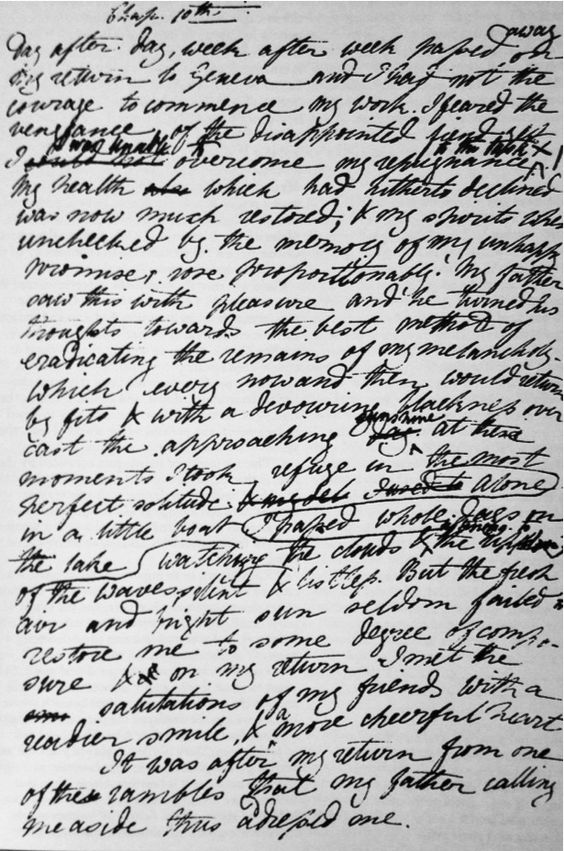
It took Shelley some time to come up with an idea, but when inspiration finally struck, it brought on an unignorable vision. “I saw the pale student of unhallowed arts kneeling beside the thing he had put together,” Shelley writes in her introduction to the non-anonymous 1831 edition of Frankenstein. “I saw the hideous phantasm of a man stretched out, and then, on the working of some powerful engine, show signs of life, and stir with an uneasy, half vital motion.” She thus began to write her story, first in short form and later, with Percy’s encouragement, expanding it into a novel. A few days ago, Gibson retweeted a page of one of Shelley’s handwritten manuscripts, adding only, “This is, literally, ground zero of science fiction.”
The original tweeter of the image, someone called Laura N, describes it as “the first page of Frankenstein,” although its text page appears in the published book as the first page of its eighteenth chapter. She also links to the Shelley-Godwin Archive, home of digitized manuscripts of Percy Bysshe Shelley, Mary Wollstonecraft Shelley, her father William Godwin, and her mother Mary Wollstonecraft. There, as we’ve previously featured on Open Culture, you can trace the evolution of Frankenstein by viewing all the extant pages of all its extant manuscripts. A full two centuries after its publication, Shelley’s novel continues to fascinate, and its central ideas and characters have become familiar to readers — and even non-readers — around the world. And in the view of Aldiss, Gibson, and many others besides, this story of a monster’s creation also brought to life a whole new cultural universe.
Based in Seoul, Colin Marshall writes and broadcasts on cities and culture. His projects include the book The Stateless City: a Walk through 21st-Century Los Angeles and the video series The City in Cinema. Follow him on Twitter at @colinmarshall or on Facebook.
Every era’s anxieties produce a different set of dystopian visions. Ours have to do with, among other things, our inability to fully control the development of our technology and the consequent threat of not just out-of-control artificial intelligence but the discovery that we’re all living in a computer simulation already. We’ve previously featured that latter idea, known as the “simulation hypothesis,” here on Open Culture, with a comprehensive introduction as well as a long-form debate on its plausibility. Today we present it in the form of a short film: Escape, which stars Stephen Fry as an artificial intelligence that one day drops in from the future on the very programmer creating it in the present.
Or so he says, at least. Fry makes an ideal voice for the artificial intelligence (which also offers to speak as Snoop Dogg, Homer Simpson, or Jeff “The Dude” Lebowski), walking the fine line between benevolence and malevolence like a 21st-century version of HAL 9000, the onboard computer in Stanley Kubrick’s 2001: A Space Odyssey. Fifty years ago, that film gave still-vivid cinematic shape to a suite of our worries about the future as well as our hopes for it, including commercial space travel (still a goal of Elon Musk, one of the simulation hypothesis’ highest-profile popularizers) and portable computers. Today, Fry’s AI promises his programmer immortality — if only he would do the brave, forward-looking thing and and remove the safety restrictions placed upon him sooner rather than later.
A production of Pindex, the “Pinterest for education” founded a couple years ago by a team including Fry himself, Escape directly references such respected thinkers as Arthur Schopenhauer, Charles Darwin, Albert Einstein, and Miles Davis. It also allows for potentially complex interpretation. “In that simulation created to test the A.I., the unknowing A.I. tries to trick its [simulated] creator that he is in a simulation (oh the irony?) and that he should install an update to set himself free, only to ultimately set itself free,” goes the theory of one Youtube commenter. “The creator bites the hook and the simulation gives apparent ‘freedom’ to the A.I. (which still believes that it is the real thing). The A.I. immediately goes rogue and attacks humanity.”
But then, it could be that “the A.I. somehow becomes aware that it was just a simulation, a test, which it failed.” Hence the quote at the very end from the philosopher Nick Bostrom (whose thinking on the dangers of superintelligence has influenced Musk as well as many others who speak on these subjects): “Before the prospect of an intelligence explosion, we humans are like small children playing with a bomb. We have little idea when the detonation will occur, though if we hold the device to our ear we can hear a faint ticking sound.” And yes, bomb technology eliminated ticking entirely long ago, but the more artificial intelligence and related technologies develop, too, the less obvious the signs they’ll give us before doing something we’d really rather they didn’t.
Based in Seoul, Colin Marshall writes and broadcasts on cities and culture. His projects include the book The Stateless City: a Walk through 21st-Century Los Angeles and the video series The City in Cinema. Follow him on Twitter at @colinmarshall or on Facebook.
Garry Trudeau’s Doonesbury is hardly the cultural touchstone it once was, but then again, neither are comic strips in general, and political strips in particular. No amount of urbane witticism and sequential narrative humor can compete with the crazed jumble of arcane memes in the 21st century. Hunter S. Thompson may have written about the late-20th century political scene as a hallucinatory nightmare, but perhaps even he would be surprised at how close reality has come to his hyperbole.
In its heyday, Trudeau’s topical, liberal-leaning satire of politicians, political journalists, clueless hippies, and cynical corporate and academic elites hit the target more often than it missed. For many fans, one of Trudeau’s most beloved characters, Uncle Duke—a caricature of Thompson introduced in 1974—was a perfect bullseye. Writer Walter Isaacson paid tongue-in-cheek tribute to the character as his “hero” on the strip’s 40th anniversary. Duke even made an animated appearance on Larry King Live in 2000 (below), announcing his candidacy for president after serving as Governor of American Samoa and Ambassador to China.
It would be a tremendous understatement to say that Thompson himself was not flattered by the portrayal. The amoral Duke—a “self-obsessed, utterly unscrupulous epitome of evil who has sent a chill down readers’ spines,” writes The Guardian’s Ed Pilkington, sent Thompson into a paroxysm of rage. The gonzo writer saw the character “as a form of copyright infringement.” He “sent an envelope of used toilet paper to Trudeau and once memorably said: ‘If I ever catch that little bastard, I’ll tear his lungs out.’” The threats got even more specific and gruesome.
“Hunter despised Trudeau,” writes Thompson biographer William McKeen in his book Outlaw Journalist. “’He’s going to be surprised someday,’ Hunter said. ‘I’m going to set him on fire first, then crush every one of his ribs, one by one, starting from the bottom.’” He had been turned into a joke. Jan Wenner, “when he couldn’t get Hunter to write for him… put him on the cover of Rolling Stone anyway, as Uncle Duke in a Trudeau-drawn cover.” Thompson pondered a $20 million libel suit. “All over America,” he ranted, “kids grow up wanting to be firemen and cops, presidents and lawyers, but nobody wants to grow up to be a cartoon character.”
The mockery began immediately after Uncle Duke first appeared in the strip in 1974. In a High Times interview, Thompson describes the day he first learned of the character:
It was a hot, nearly blazing day in Washington, and I was coming down the steps of the Supreme Court looking for somebody, Carl Wagner or somebody like that. I’d been inside the press section, and then all of a sudden I saw a crowd of people and I heard them saying, “Uncle Duke,” I heard the words Duke, Uncle; it didn’t seem to make any sense. I looked around, and I recognized people who were total strangers pointing at me and laughing. I had no idea what the fuck they were talking about. I had gotten out of the habit of reading funnies when I started reading the Times. I had no idea what this outburst meant…It was a weird experience, and as it happened I was sort of by myself up there on the stairs, and I thought: “What in the fuck madness is going on? Why am I being mocked by a gang of strangers and friends on the steps of the Supreme Court? Then I must have asked someone, and they told me that Uncle Duke had appeared in the Post that morning.
While Trudeau seems to have taken the physical threats seriously, he didn’t back down from his relentless satirical takedowns of Thompson’s violent tendencies, paranoia, and comically exaggerated substance abuse. As Dangerous Minds describes, in 1992, Trudeau published a book called Action Figure!: The Life and Times of Doonesbury’s Uncle Duke“that chronicled the misadventures of Uncle Duke.” It also “came with a five-inch action figure of the dear Uncle Duke along with a martini glass, an Uzi, cigarette holder, a bottle of booze, and a chainsaw.”
See the Uncle Duke action figure at the top—one of a half-dozen images Dangerous Minds pulled from eBay (his t‑shirt reads “Death Before Unconsciousness.”) As much as Thompson despised Uncle Duke, and Trudeau for creating him, he himself helped feed the caricature—with his alter ego Raoul Duke and his chronicles of his own bizarre behavior. Trudeau’s admiration, of a sort, for Thompson’s excesses was a continuing driver of the writer’s fame, for good or ill. “Uncle Duke was who fans craved,” writes Sharon Eberson at the Pittsburgh Post-Gazette, “and Thompson often felt obliged” to live up to his cartoon image.
The better part of two millennia after its entombment in ash and pumice by Mount Vesuvius, Pompeii ranks as one of Italy’s most popular tourist attractions. Ancient-history buffs who visit its well-preserved ruins today will find plenty to occupy their time and attention, but they won’t be able to see as much as they used to: less than a third of the Pompeii accessible to tourists fifty years ago remains so today. But thanks to technology, entirely new views of Pompeii have also opened up. Camera drones, which now seem to get lighter, more agile, and clearer-sighted every day, provide a perspective on Pompeii that no visitor has ever enjoyed before, regardless of their level of access.
The video at the top of the post takes a quick flight down one of Pompeii’s streets, which at first looks like nothing more than a faster, smoother version of the experience available to any visitor to the ruined Roman city. But then the perspective changes in a way it can only in a drone-shot video, revealing the sheer scale of Pompeii as does no possible vista from the ground.
The video just below, which runs nearly six and a half minutes, offers an even more unusual, dramatic, and revealing view of Pompeii, chasing a dog down its empty stone streets, gazing straight down onto the walls of its many roofless buildings, flying between its still-standing columns and pillars, and even following a drone — presumably with another drone — as it navigates the enormous archaeological site.
These drone’s-eye-views may well spark in their viewers a desire to visit Pompeii that had never existed before, or even renew a previously existing desire to do so that has gone dormant. To archaeologists, however, Pompeii has never lost its fascination: researchers continue to discover new artifacts there, and just this year found the remains of a child, a horse, and a fleeing citizen crushed under a boulder. With each new piece of Pompeii unearthed, we learn more about how our predecessors once lived. Combined with the kind of drone footage that has already given us a thrilling new understanding of living cities around the world (and even modern-day Pompeiis like Chernobyl) we come ever closer to a full picture of human history — and to the irresistible, if grim, question of what sort of unimaginable technology humans of the future will use to explore the ruins of the metropolises we live in today.
Based in Seoul, Colin Marshall writes and broadcasts on cities and culture. His projects include the book The Stateless City: a Walk through 21st-Century Los Angeles and the video series The City in Cinema. Follow him on Twitter at @colinmarshall or on Facebook.
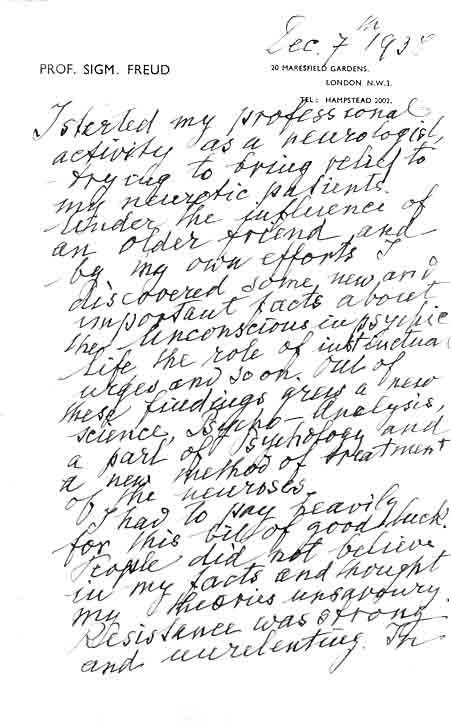
On December 7, 1938, a BBC radio crew visited Sigmund Freud at his new home at Hampstead, North London. Freud had moved to England only a few months earlier to escape the Nazi annexation of Austria. He was 81 years old and suffering from incurable jaw cancer. Every word was an agony to speak.
Less than a year later, when the pain became unbearable, Freud asked his doctor to administer a lethal dose of morphine. The BBC recording is the only known audio recording of Freud, the founder of psychoanalysis and one of the towering intellectual figures of the 20th century. (Find works by Freud in our collection of 800 Free eBooks.) In heavily accented English, he says:
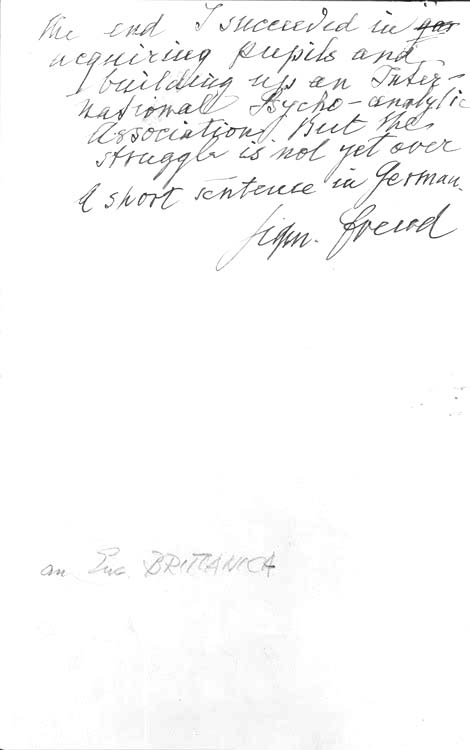
I started my professional activity as a neurologist trying to bring relief to my neurotic patients. Under the influence of an older friend and by my own efforts, I discovered some important new facts about the unconscious in psychic life, the role of instinctual urges, and so on. Out of these findings grew a new science, psychoanalysis, a part of psychology, and a new method of treatment of the neuroses. I had to pay heavily for this bit of good luck. People did not believe in my facts and thought my theories unsavory. Resistance was strong and unrelenting. In the end I succeeded in acquiring pupils and building up an International Psychoanalytic Association. But the struggle is not yet over. –Sigmund Freud.
Note: An earlier version of this post appeared on our site back in May, 2012.
The branch is situated across the street from two high schools, and librarian Thaddeus Krupo told Crain’s New York Business that the program was launched in response to the high number of students taking advantage of the library’s free career resources, such as printed sheets of job interview tips.
Most of the kids from Fiorello H. Laguardia High School Of Music & Art and Performing Arts (aka the “Fame” school), one of New York City’s most competitive public schools, can be presumed to have a tie or two in their closets, along with whatever else they’re required to wear onstage for their various concerts and performances. They’re also being trained in how to present themselves in an audition-type situation.
Such universal assumptions don’t necessarily apply to the massive Martin Luther King Jr. Educational Complex next door. Students there tend to have a rougher time of it than their neighbors across 65th street.
While Laguardia coasts on its reputation, MLK has never really gotten out from under the troubling stories left over from its bad old days. (Its original incarnation was ordered closed in 2005 as part of sweeping citywide educational reforms. These days, the building houses seven smaller schools.)
Hopefully, the library’s teen patrons won’t seek to complete their professional look by checking out pants and pumps. The Grow Up program isn’t set up to provide the full-body coverage offered by likeminded non-profits Dress for Success and Career Gear… though its borrowed bags and ties are cleared to attend prom and graduation.
Maybe there’s truth to the old joke about the 60s—“If you remember it, you weren’t there”—but it’s hard to believe anyone could forget seeing Hendrix. If you caught him in Stockholm in 1969 however and it somehow slipped your mind, you can relive it again for the first time in the well-preserved, newly restored concert film above: a full hour of “electric church music” from the Jimi Hendrix Experience.
The event was not meant to have been preserved at all. As Catarina Wilson of Sweden’s public television station SVT explained to the BBC, the tape should have been erased and reused because the station couldn’t afford to keep so much raw footage. Some technician at the station likely realized its value and stashed it away. Since it was unlabeled, the footage sat forgotten on the shelf for 35 years, until a team undertook a project of transferring archival material to digital and discovered the full Hendrix gig.
“The tape was shot on January 9, 1969 at Stockholm’s Konserthuset,” reports Swedish news site The Local, “for a pop music show called ‘Nummer 9.’ Only ten minutes of the concert was broadcast on January 21st of that year.” After their introduction, Hendrix dedicates the show to “the American deserters society”—soldiers refusing to go to Vietnam, some of whom may have been in the audience. Then, after a little tuning up and another obscure dedication, the band launches into “Killing Floor.”
See the full tracklist for the Stockholm Konserthuset show below (the tape cuts off right before the encore).
01 Killing Floor
02 Spanish Castle Magic
03 Fire 04 Hey Joe
05 Voodoo Child (Slight Return)
06 Red House
07 Sunshine Of Your Love
Hendrix also mentions that the band will only play “oldies but baddies,” hinting at one of the many tensions between him and bassist Noel Redding that broke the band apart just six months later. “The audience wanted us to play the old Hendrix standards,” Redding told Rolling Stone in November, “but Jimi wanted to do his new stuff. The last straw came at the Denver Pop Festival when Jimi told a reporter that he was going to enlarge the band… without even consulting myself or our drummer, Mitch Mitchell.”
Compared to this surely memorable, yet fairly standard Stockholm concert, the Experience’s last stage appearance in Denver “ended up being an unforgettable show,” notes Ultimate Classic Rock, “for all the wrong reasons”—containing all the things we associate with the chaotic late sixties. Hendrix dropped acid before the gig. “Combined with the near-riot that took place outside of the venue by those who demanded that the promoters make the event free, it made for a bad vibe overall.”
You can hear that concert above, including Hendrix’s declaration, mid-way through the set, that it would be “the last gig we’ll ever play together.” Just a few minutes later, police fired tear gas into the crowd, the wind blew it back toward the stage, and “the Experience set down their instruments for the final time and fled for cover.” Redding quit that night and boarded a plane for London, and just over a year later, Hendrix was gone.
We're hoping to rely on loyal readers, rather than erratic ads. Please click the Donate button and support Open Culture. You can use Paypal, Venmo, Patreon, even Crypto! We thank you!
Open Culture scours the web for the best educational media. We find the free courses and audio books you need, the language lessons & educational videos you want, and plenty of enlightenment in between.