Elizabeth Cotten Wrote “Freight Train” at 11, Won a Grammy at 90, and Changed American Music In-Between
When I first moved to North Carolina, one of the first visits I made was to the little town of Carrboro. There sits a plaque on East Main commemorating Elizabeth “Libba” Cotton: “Key Figure. 1960s folk revival. Born and raised on Lloyd Street,” just west of Chapel Hill, in 1893. It’s an accurate-enough description of Cotten’s importance to 60s-era folk, but the limited space on the sign elides a much richer story, with a typical musical theft and unusual late-life triumph.
The sign sits next to a retired train depot converted into a restaurant called The Station, which advertises two claims to fame—R.E.M. played their first show outside of Georgia there in 1980, and Elizabeth Cotten “was inspired to write her famous folk song, ‘Freight Train,’ in the early 1900s as a tribute to the trains that stopped in Carrboro, which she could hear at night from the bedroom of her childhood home.” The song became a standard in American folk and British skiffle.
“Freight Train” was credited for years to two British songwriters, who claimed it as their own in the mid-fifties. However, not only did Cotten write the song, but she did so decades earlier when she was only 11 or 12 years old. It first made its way to England by way of Peggy Seeger, who had heard it from her onetime nanny, Libba, when she was young. “Freight Train” was then picked up by several singers and groups, including The Quarrymen, the skiffle band that would become The Beatles.
Cotten “built her musical legacy,” writes Smithsonian’s Folkways, “on a firm foundation of late 19th- and early 20th-century African-American instrumental traditions.” She had a keen grasp of her musical roots, with her own innovations. A self-taught guitar and banjo player, she flipped the instruments over to play them left-handed. She did not restring them, however, but played them upside-down, developing a captivating fingerstyle technique “that later became widely known as ‘Cotten style.’”
Persuaded by her church to stop playing “worldly music,” Cotten all but gave it up and moved to Washington, DC. There, she might have faded into obscurity, the story of “Freight Train” highlighting just one more injustice in a long history of misappropriated black American music. But the folk-singing Seeger family worked to secure her recognition and relaunch her career.
Cotten first “landed entirely by accident” with the Seegers after returning a young, lost Peggy to her mother Ruth at a Washington D.C. department store where Cotten had been working. The family hired her on as help, and did not learn of her talent until later. After her song became famous, Mike Seeger recorded Cotten singing “Freight Train” and a number of other tunes from “the wealth of her repertoire” in 1957. He was eventually able to secure her the credit for the song.
Thanks to these recordings, Cotten “found herself giving small concerts in the homes of congressmen and senators, including that of John F. Kennedy.” In 1958, Seeger recorded her first album, made when she was sixty-two, Elizabeth Cotten: Negro Folk Songs and Tunes. “This was one of the few authentic folk-music albums available by the early 1960s,” notes Smithsonian, “and certainly one of the most influential.”
Cotten’s story (and her guitar playing) is reminiscent of that of Mississippi John Hurt, who left music for farming in the late 20s, only to be rediscovered in the early sixties and go on to inspire the likes of fingerstyle legends John Fahey and Leo Kottke. But Cotten doesn’t get enough credit in popular music for her influence, despite writing songs like “Freight Train,” “Oh, Babe, It Ain’t No Lie,” and “Shake Sugaree,” covered by The Grateful Dead, Bob Dylan, and a host of traditional folk artists.
Fans of folk and acoustic blues, however, will likely know her name. She toured and performed to the end of her life, giving her last concert in New York in 1987, just before her death at age 94. The recording industry gave Cotten her due as well. In 1984, when she was 90, she won a Grammy in the category of “Best Ethnic or Traditional Folk Recording.” Two years later, she was nominated again, but did not win.
The recognition was a long time coming. In 1963, when Peter, Paul & Mary had a hit with their version of “Freight Train,” few people outside of a small circle knew anything about Elizabeth Cotten. In 1965, The New York Times published an article about her headlined “Domestic, 71, Sings Songs of Own Composition in ‘Village,’” as Nina Renata Aron points out in a profile at Timeline.
But thanks to her own quiet persistence and some famous benefactors, Elizabeth Cotten is remembered not as a housekeeper and nanny who happened to write some songs, but as a Grammy-winning folk legend and “key figure” in both American and British musical history. In addition to her Grammy and other awards, she received the Burl Ives Award in 1972 and was included in the company of Rosa Parks and Marian Anderson in Brian Lanker’s book of portraits I Dream a World: Black Women Who Changed America.
In 1983, Syracuse, New York, where she spent her last years and now rests, named a park after her. And it may have taken them entirely too long to catch up to her legacy, but in 2013, the state of North Carolina recognized one of its most influential daughters, putting up the Historical Marker sign in her honor.
In the videos here, see Cotten, in her spry, prolific old age, play “Freight Train,” at the top, “Spanish Flang Dang” and “A Jig,” further up, in 1969, and “Washington Blues” and “I’m Going Away,” above in 1965.
Related Content:
Watch Rock Pioneer Sister Rosetta Tharpe Wow Audiences With Her Gospel Guitar
Pete Seeger Teaches You How to Play Guitar for Free in The Folksinger’s Guitar Guide (1955)
Download Images From Rad American Women A‑Z: A New Picture Book on the History of Feminism
Josh Jones is a writer and musician based in Durham, NC. Follow him at @jdmagness
Classic Children’s Books Now Digitized and Put Online: Revisit Vintage Works from the 19th & 20th Centuries
Children’s books are big business. And the market has never been more competitive. Bestselling, character-driven series spawn their own TV shows. Candy-colored readers feature kids’ favorite comic and cartoon characters. But kids’ books can also be fine art—a venue for well-written, finely-illustrated literature. And they are a serious subject of scholarship, offering insights into the histories of book publishing, education, and the social roles children were taught to play throughout modern history.
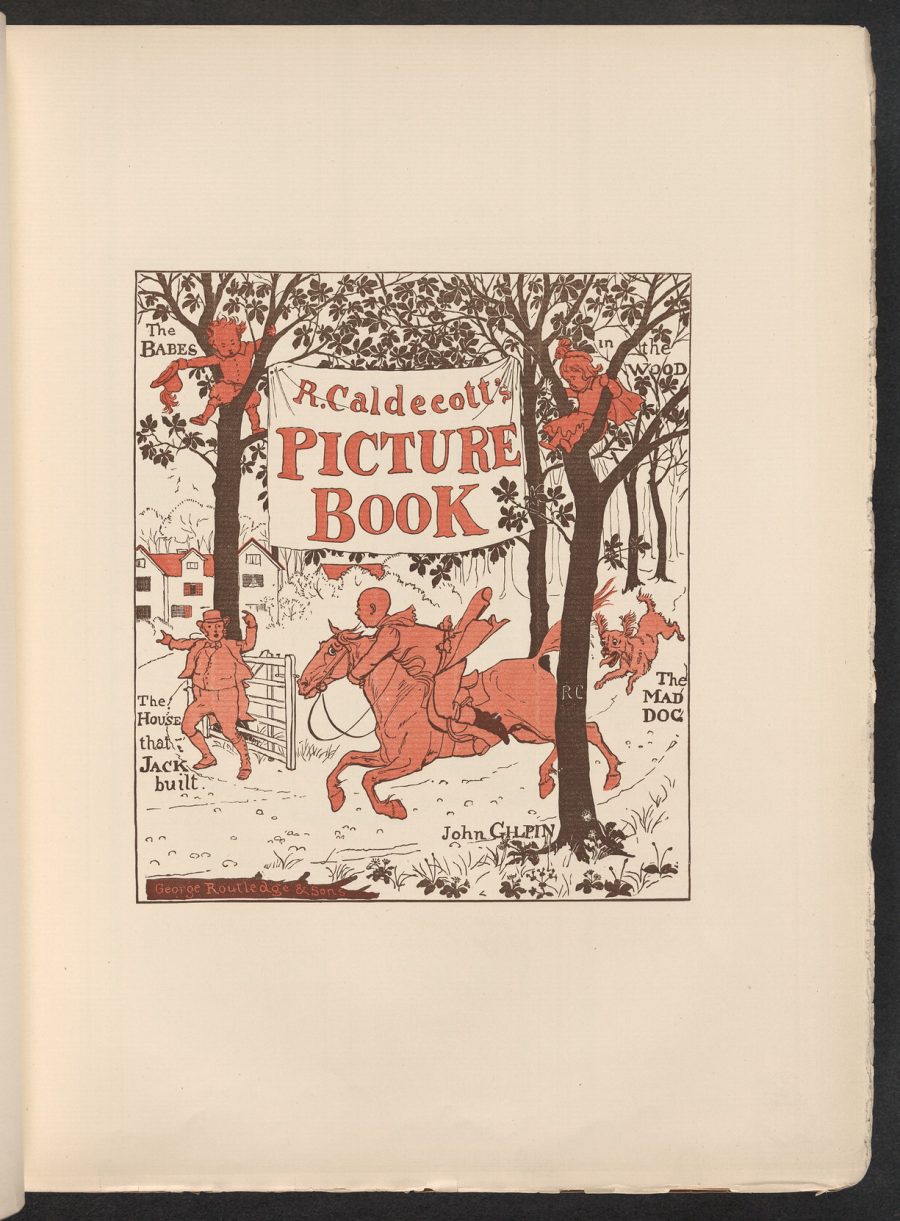
Digital archives of children’s books now make these histories widely accessible and preserve some of the finest examples of illustrated children’s literature. The Library of Congress’ new digital collection, for example, includes the 1887 Complete Collection of Pictures & Songs, illustrated by English artist Randolph Caldecott, who would lend his name fifty years later to the medal distinguishing the highest quality American picture books.
The LoC’s collection of 67 digitized kids’ books from the 19th and 20th centuries includes biographies, nonfiction, quaint nursery rhymes, the Gustave Doré-illustrated edition of Edgar Allan Poe’s The Raven, and a number of other titles sure to charm grown-ups, if not, perhaps, many of today’s young readers.
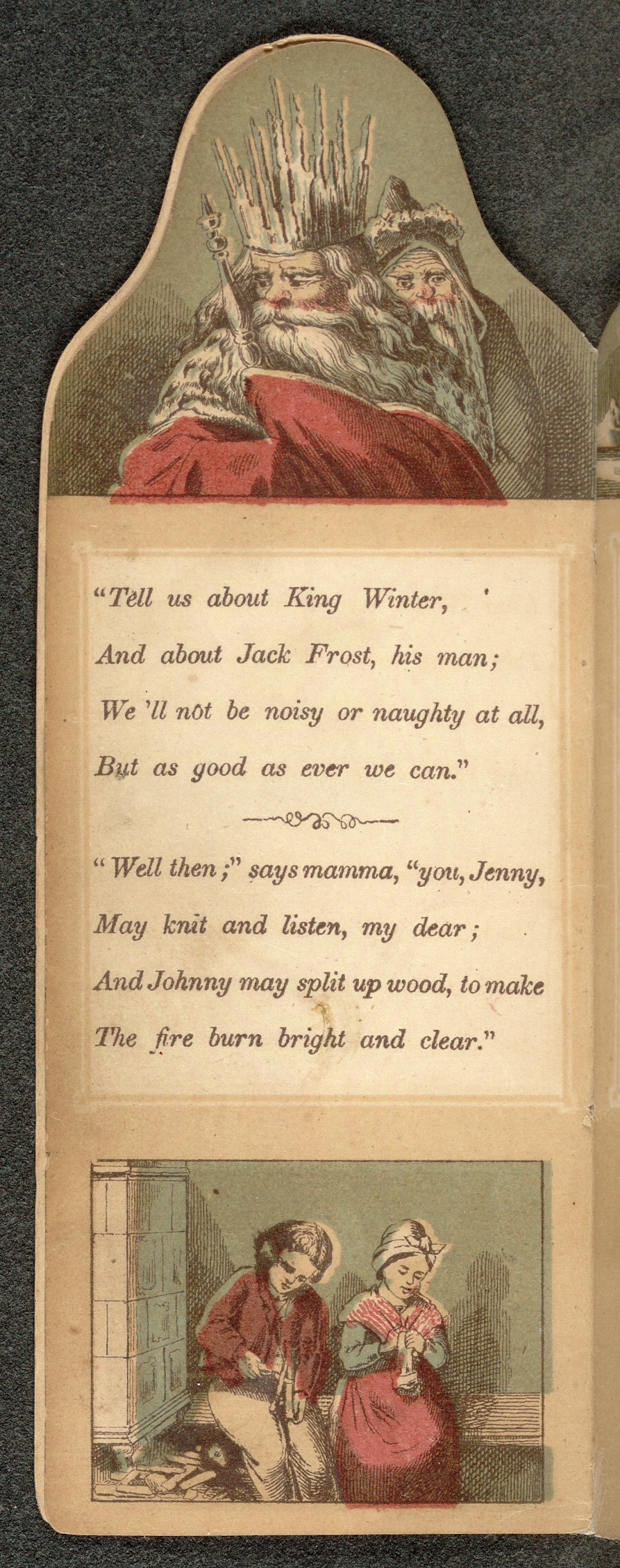
But who knows, King Winter—an 1859 tale in verse of a proto-Santa Claus figure, in a book partially shaped like the outline of the title character’s head—might still captivate. As might many other titles of note.
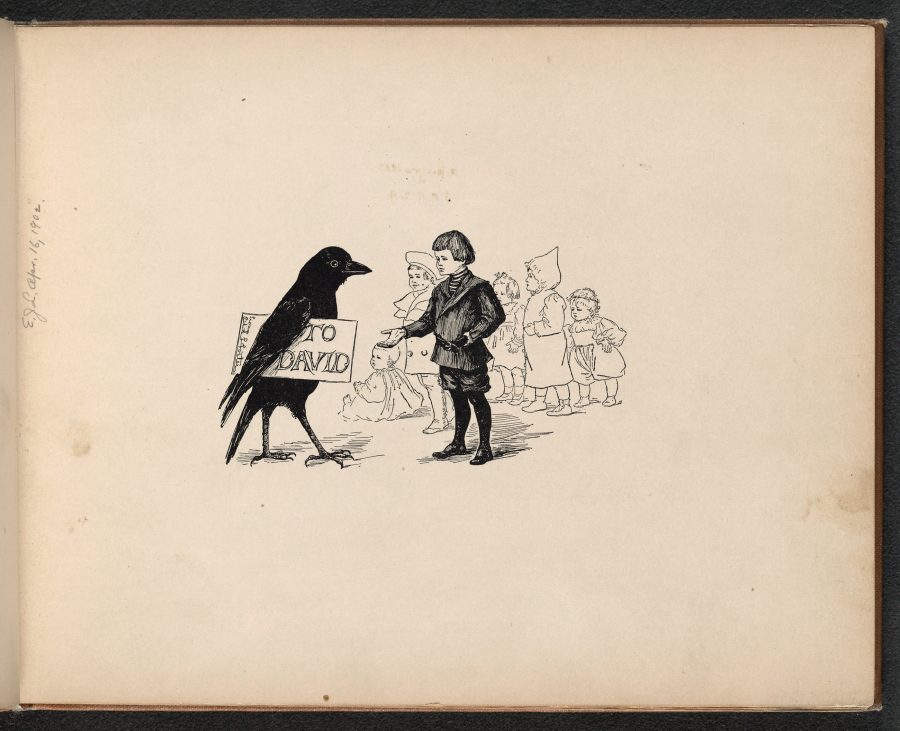
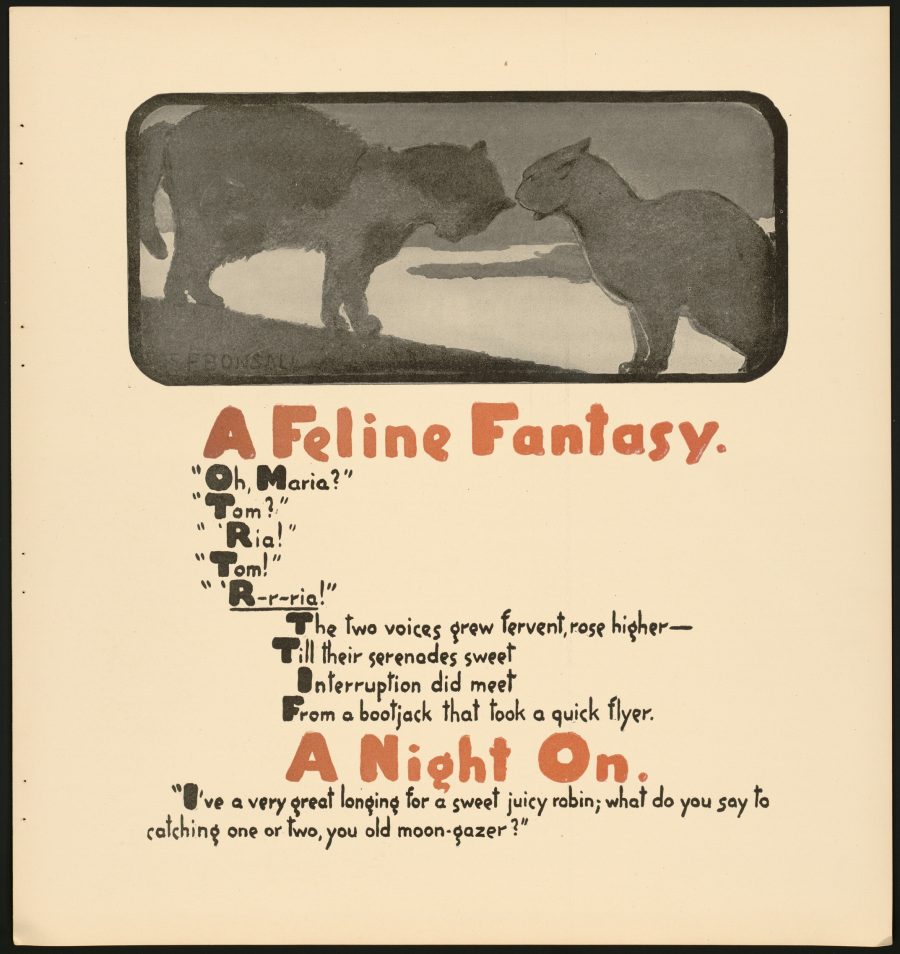
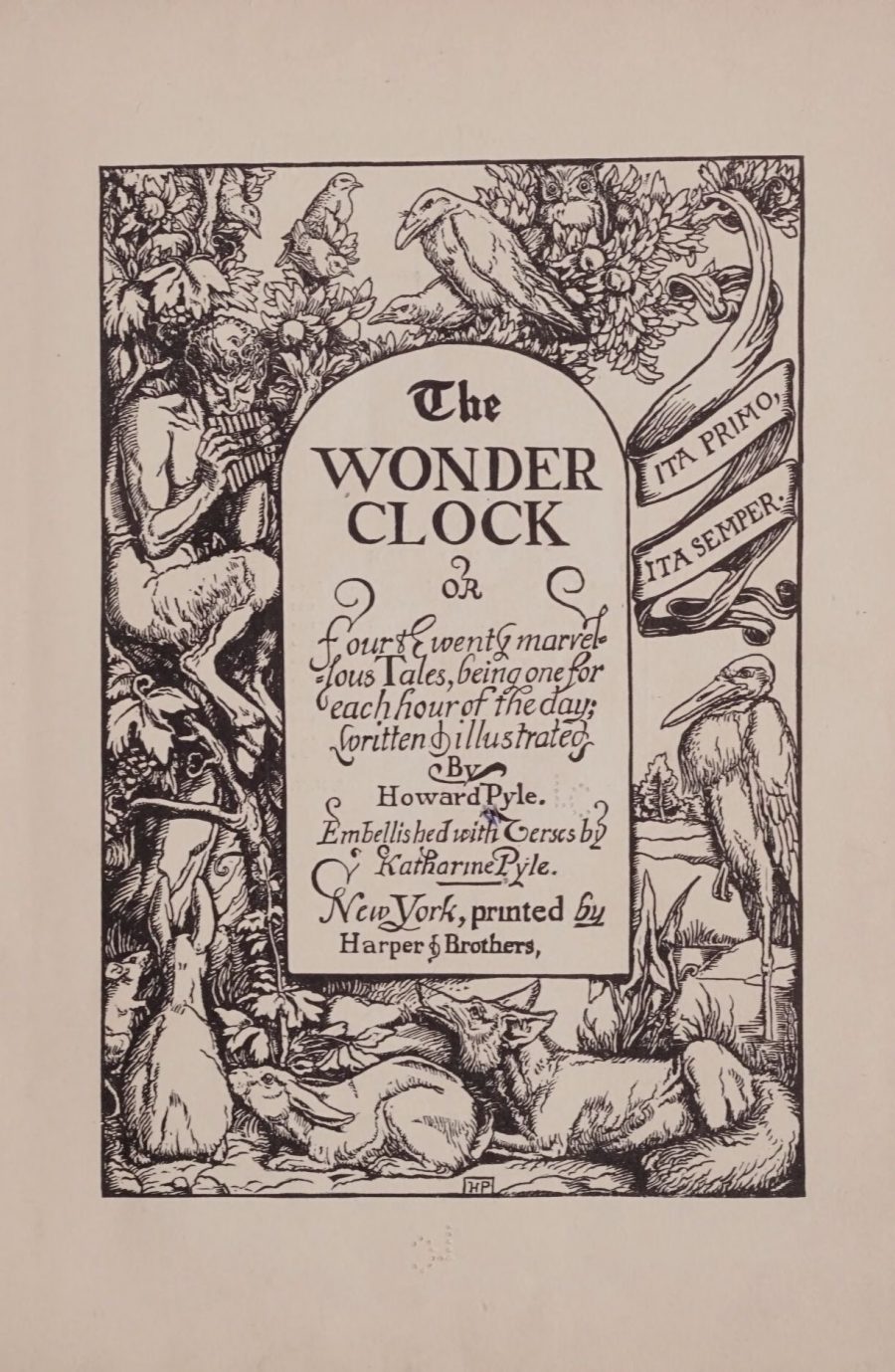
A sly collection of stories from 1903 called The Book of the Cat, with “facsimiles of drawings in colour by Elisabeth F. Bonsall”; a book of “Four & twenty marvellous tales” called The Wonder Clock, written and illustrated by Howard Pyle in 1888; and Edith Francis Foster’s 1902 Jimmy Crow about a boy named Jack and his boy-sized crow Jimmy (who could deliver messages to other young fancy lads).
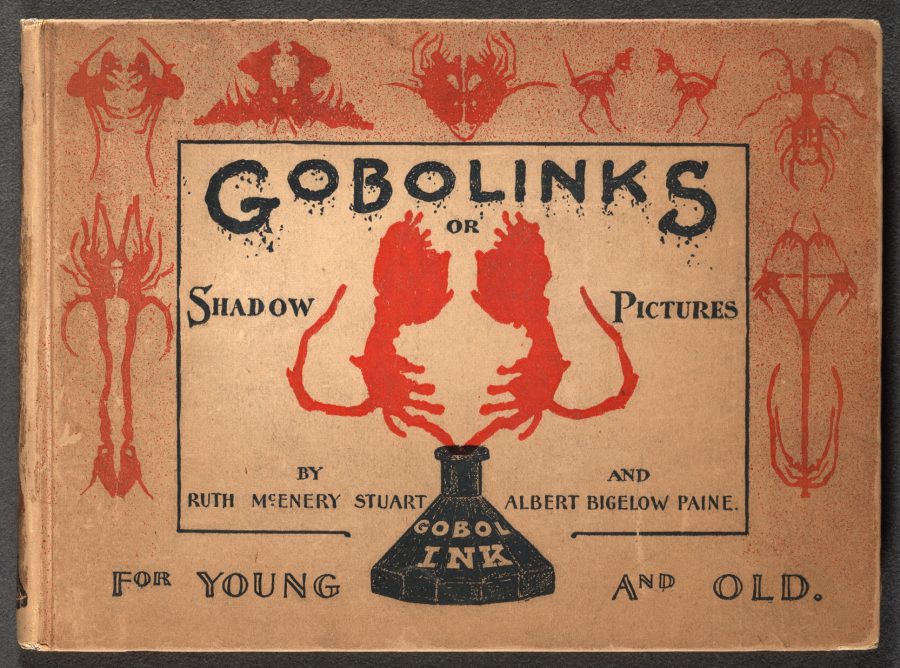
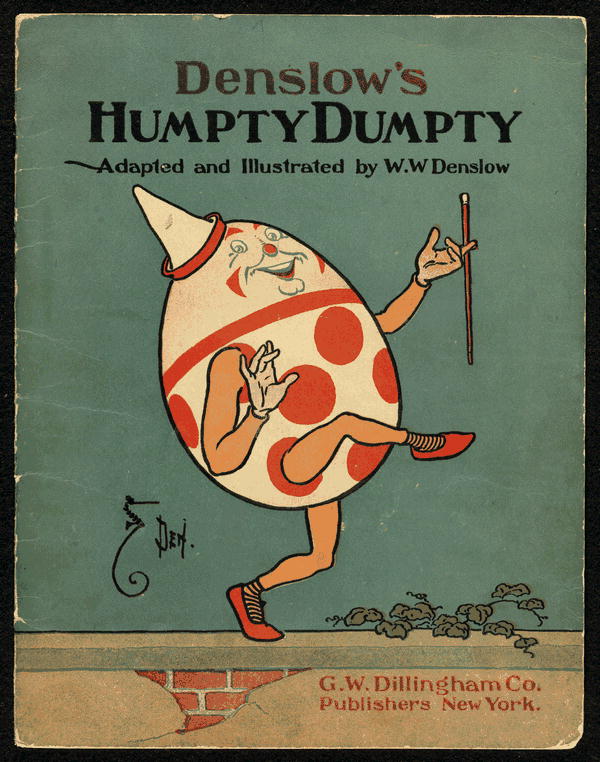
An 1896 book called Gobolinks introduces a popular inkblot game of the same name that predates Hermann Rorschach’s tests by a couple decades. Other highlights include “examples of the work of American illustrators such as W.W. Denslow, Peter Newell… Walter Crane and Kate Greenaway,” writes the Library on its blog. The digitized collection debuted to mark the 100th anniversary of Children’s Book Week, celebrated during the last week of April in all 50 states in the U.S.
“It is remarkable,” says Lee Ann Potter, director of the LoC’s Learning and Innovation Office, “that when the first Children’s Book Week was celebrated, all of the books in the online collection… already existed.” Now they exist online, not only because of the technology to scan, upload, and share them, but “because careful stewards insured that these books have survived.”
Digital versions of today’s kids books could mean that there is no need to carefully preserve paper copies for posterity. But we can be grateful that archivists and librarians of the past saw fit to do so for this fascinating collection of children’s literature. The theme of this year’s Children’s Book Week—Read Now, Read Forever—“looks to the past, present, and most important, the future of children’s books.” Enter the Library of Congress digital collection of children’s books from over a century ago (and see the other sizable online archives at the links below) to visit their past, and imagine how vastly different their future might be.
Related Content:
A Digital Archive of 1,800+ Children’s Books from UCLA
Hayao Miyazaki Picks His 50 Favorite Children’s Books
Enter an Archive of 6,000 Historical Children’s Books, All Digitized and Free to Read Online
Josh Jones is a writer and musician based in Washington, DC. Follow him at @jdmagness
Watch Six New Short Alien Films: Created to Celebrate the 40th Anniversary of Ridley Scott’s Film
Alien came out 40 years ago this month, not that its age shows in the least. The terror of the ever-diminishing crew of the Nostromo trapped on their ship with the merciless extraterrestrial monster of the title remains as visceral as it was in 1979, and the dank, pre-digital confines of its setting have taken on a retro patina that successive generations of filmmakers struggle to recreate for themselves.
Now, in a series of brand new short films set in the Alien universe, you can see how six young filmmakers pay tribute to Ridley Scott’s original film and its cinematic legacy, each in their own way. These shorts come as the fruits of an initiative launched by 20th Century Fox to mark 40 years of Alien.
“Developed by emerging filmmakers selected from 550 submissions on the Tongal platform,” writes Collider’s Dave Trumbore, “the anniversary initiative focused on finding the biggest fans of the Alien franchise to create new, thrilling stories for the Alien fandom.”
These stories include many of the elements that fandom has come to expect — isolated and endangered spacefarers, bleak colonies on distant planets, tough women, fearsome creatures lurking in the darkness, escape pods, chest-bursting — as well a few it hasn’t. Indiewire’s Michael Nordine highlights Noah Miller’s Alone, “which follows a woman named Hope who’s hurtling through space on her lonesome. She eventually gains access to a restricted part of her ship after a system malfunction, and you can probably guess what’s on the other side of that sealed-off door.” But you certainly won’t be able to guess what happens next.
Nordine also has praise for the protagonist of the Spears Sisters’ Ore: “A miner about to welcome her latest grandchild, she puts herself in harm’s way rather than risk letting the latest alien specimen make it out of the mine and threaten the colony (and, more to the point, her family) above. That’s a simple, familiar tack, but it’s well told — something true of most Alien stories.” Collectively, he writes, these shorts “emphasize what makes Alien such an enduring franchise: its industrial, working-class environs full of clunky green-screen computers and disgruntled laborers; its bleak view of the corporate bureaucrats who enable the xenomorphs’ carnage by trying to control them and writing off their underlings as collateral damage; and, of course, its heroines.”
Taking pitches from fans through a crowdsourcing platform and distributing the resulting films on Youtube may seem like an almost parodically 21st-century way of extending a franchise that began in the 1970s, but testing out different filmmakers’ visions has long been a part of the greater Alien project: the sequels directed in the 1980s and 90s by James Cameron, David Fincher, and Jean-Pierre Jeunet hinted at the great variety of possibilities laid down by Scott’s original, the cinematic standard-bearer for the contest of wills between man and alien — or rather, woman and alien.
Related Content:
High School Kids Stage Alien: The Play and You Can Now Watch It Online
Sigourney Weaver Stars in a New Experimental Sci-Fi Film: Watch “Rakka” Free Online
Three Blade Runner Prequels: Watch Them Online
Based in Seoul, Colin Marshall writes and broadcasts on cities, language, and culture. His projects include the book The Stateless City: a Walk through 21st-Century Los Angeles and the video series The City in Cinema. Follow him on Twitter at @colinmarshall or on Facebook.
A Dictionary of Words Invented to Name Emotions We All Feel, But Don’t Yet Have a Name For: Vemödalen, Sonder, Chrysalism & Much More
Philosophers have always distrusted language for its slipperiness, its overuse, its propensity to deceive. Yet many of those same critics have devised the most inventive terms to describe things no one had ever seen. The Philosopher’s Stone, the aether, miasmas—images that made the ineffable concrete, if still invisibly gaseous.
It’s important for us to see the myriad ways our common language fails to capture the complexity of reality, ordinary and otherwise. Ask any poet, writer, or language teacher to tell you about it—most of the words we use are too abstract, too worn out, decayed, or rusty. Maybe it takes either a poet or a philosopher to not only notice the many problems with language, but to set about remedying them.
Such are the qualities of the mind behind The Dictionary of Obscure Sorrows, a project by graphic designer and filmmaker John Koenig. The blog, YouTube channel, and soon-to-be book from Simon & Schuster has a simple premise: it identifies emotional states without names, and offers both a poetic term and a philosopher’s skill at precise definition. Whether these words actually enter the language almost seems beside the point, but so many of them seem badly needed, and perfectly crafted for their purpose.
Take one of the most popular of these, the invented word “Sonder,” which describes the sudden realization that everyone has a story, that “each random passerby is living a life as vivid and complex as your own.” This shock can seem to enlarge or diminish us, or both at the same time. Psychologists may have a term for it, but ordinary speech seemed lacking.
Sonder likely became as popular as it did on social media because the theme “we’re all living connected stories” already resonates with so much popular culture. Many of the Dictionary’s other terms trend far more unambiguously melancholy, if not neurotic—hence “obscure sorrows.” But they also range considerably in tone, from the relative lightness of Greek-ish neologism “Anecdoche”—“a conversation in which everyone is talking, but nobody is listening”—to the majorly depressive “pâro”:
the feeling that no matter what you do is always somehow wrong—as if there’s some obvious way forward that everybody else can see but you, each of them leaning back in their chair and calling out helpfully, “colder, colder, colder…”
Both the coinages and the definitions illuminate each other. Take “Énouement,” defined as “the bittersweetness of having arrived in the future, seeing how things turn out, but not being able to tell your past self.” A psychology of aging in the form of an eloquent dictionary entry. Sometimes the relationship is less subtle, but still magical, as in the far from sorrowful “Chrysalism: The amniotic tranquility of being indoors during a thunderstorm.”
Sometimes, it is not a word but a phrase that speaks most poignantly of emotions that we know exist but cannot capture without deadening clichés. “Moment of Tangency” speaks poignantly of a metaphysical philosophy in verse. Like Sonder, this phrase draws on an image of interconnectedness. But rather than taking a perspective from within—from solipsism to empathy—it takes the point of view of all possible realities.
Watch the video for “Vemödalen: The Fear That Everything Has Already Been Done” up top. See several more short films from the project here, including “Silience: The Brilliant Artistry Hidden All Around You”—if, that is, we could only pay attention to it. Below, find 23 other entries describing emotions people feel, but can’t explain.
1. Sonder: The realization that each passerby has a life as vivid and complex as your own.
2. Opia: The ambiguous intensity of Looking someone in the eye, which can feel simultaneously invasive and vulnerable.
3. Monachopsis: The subtle but persistent feeling of being out of place.
4 Énouement: The bittersweetness of having arrived in the future, seeing how things turn out, but not being able to tell your past self.
5. Vellichor: The strange wistfulness of used bookshops.
6. Rubatosis: The unsettling awareness of your own heartbeat.
7. Kenopsia: The eerie, forlorn atmosphere of a place that is usually bustling with people but is now abandoned and quiet.
8. Mauerbauertraurigkeit: The inexplicable urge to push people away, even close friends who you really like.
9. Jouska: A hypothetical conversation that you compulsively play out in your head.
10. Chrysalism: The amniotic tranquility of being indoors during a thunderstorm.
11. Vemödalen: The frustration of photographic something amazing when thousands of identical photos already exist.
12. Anecdoche: A conversation in which everyone is talking, but nobody is listening
13. Ellipsism: A sadness that you’ll never be able to know how history will turn out.
14. Kuebiko: A state of exhaustion inspired by acts of senseless violence.
15. Lachesism: The desire to be struck by disaster – to survive a plane crash, or to lose everything in a fire.
16. Exulansis: The tendency to give up trying to talk about an experience because people are unable to relate to it.
17. Adronitis: Frustration with how long it takes to get to know someone.
18. Rückkehrunruhe: The feeling of returning home after an immersive trip only to find it fading rapidly from your awareness.
19. Nodus Tollens: The realization that the plot of your life doesn’t make sense to you anymore.
20. Onism: The frustration of being stuck in just one body, that inhabits only one place at a time.
21. Liberosis: The desire to care less about things.
22. Altschmerz: Weariness with the same old issues that you’ve always had – the same boring flaws and anxieties that you’ve been gnawing on for years.
23. Occhiolism: The awareness of the smallness of your perspective.
Related Content:
How a Word Enters the Dictionary: A Quick Primer
Josh Jones is a writer and musician based in Washington, DC. Follow him at @jdmagness
High School Kids Stage Alien: The Play and You Can Now Watch It Online
Several weeks back, Colin Marshall told you about an enterprising group of high school students in North Bergen, New Jersey who staged a dramatic production of Ridley Scott’s 1979 film Alien. And they did it on the cheap, creating costumes and props with donated and recycled materials. The production was praised by Ridley Scott and Sigourney Weaver alike. Now, above, you can watch a complete encore performance made possible by a $5,000 donation by Scott, and attended by Weaver herself. Have fun.
If you would like to sign up for Open Culture’s free email newsletter, please find it here. It’s a great way to see our new posts, all bundled in one email, each day.
If you would like to support the mission of Open Culture, consider making a donation to our site. It’s hard to rely 100% on ads, and your contributions will help us continue providing the best free cultural and educational materials to learners everywhere. You can contribute through PayPal, Patreon, and Venmo (@openculture). Thanks!
Related Content:
High School Kids Stage Alien: The Play, Get Kudos from Ridley Scott and Sigourney Weaver
Sigourney Weaver Stars in a New Experimental Sci-Fi Film: Watch “Rakka” Free Online
Ridley Scott Walks You Through His Favorite Scene from Blade Runner
Elementary School Students Perform in a Play Inspired by David Lynch’s Twin Peaks
Herbie Hancock’s Joyous Soundtrack for the Original Fat Albert TV Special (1969)
Millions of kids grew up with the groovy yet educational cartoon comedy of Fat Albert, and millions of adults may find it difficult or impossible now to watch the show without thinking of the crimes of its creator. Such is life in the 21st century, but so it was too at the end of the 1960s when the first iteration of Fat Albert debuted. There were plenty of reasons to feel terrible about the culture. Yet the music that came out of the various jazz/funk/fusion/soul scenes seemed like it couldn’t let anyone feel too bad for long.
In 1969, Herbie Hancock had just been let go from the Miles Davis quintet and left historic Blue Note. During this pivotal time, he signed on to compose the soundtrack for the TV special Hey, Hey, Hey, It’s Fat Albert, the precursor to the episodic cartoon Fat Albert and the Cosby Kids, which ran from 1972 to 1985 and taught serious ethical lessons about such subjects as kindness, respect, stealing, drugs, scams, kidnapping, smoking, racism, and more with original songs.
The later show’s unforgettable theme song (“na, na, na, gonna have a good time!”) was not penned by Hancock, nor were any of its other tunes. Only the original special used his music, which is maybe why the soundtrack is not better known, as well it should be. “It’s a deeply soulful affair,” writes Boing Boing, “that presaged Hancock’s 1973 jazz-funk classic Head Hunters.” The album, Fat Album Rotunda, had gone out of print, but has now been reissued on the label Antarctica Starts Here.
After listening to the tracks (hear samples above and below), you might find it difficult to resist buying a copy. Whether or not you still enjoy the cartoon, the incredible grooves here evoke much more than its adolescent characters and their junkyard mishaps. This is such an expansive, joyous album, one “in which Hancock,” Superior Viaduct writes, “clearly had a great time.” So too did the rest of the band, “which by the time of recording in late 1969 was both razor-sharp and confidently loose from rehearsing and touring.”
The band included three horn players, “Joe Henderson on sax and flute, Garnett Brown on trombone and Johnny Coles on trumpet and flugelhorn.” Hancock’s solos run fluidly through each song, held in place by the rock-solid swing of Albert Heath’s drums. The compositions are complex and catchy, with lilting melodies, mean hooks, and big refrains.
The album is instantly classic, whether you heard it fifty years ago or just now for the first time. Warner Brothers agreed, and gave Hancock and his band a deal on the strength of the album. So did Quincy Jones, who recorded his own version of the track “Tell Me a Bedtime Story,” a mellow, dynamic slow burn that builds to some of the finest Fender Rhodes playing Hancock put to tape. Fat Albert Rotunda was hardly his first or his last soundtrack album, but while it has fallen into obscurity, it should rank as one of his best.
Related Content:
How Innovative Jazz Pianist Vince Guaraldi Became the Composer of Beloved Charlie Brown Music
Josh Jones is a writer and musician based in Washington, DC. Follow him at @jdmagness
The Cast of Avengers: Endgame Rendered in Traditional Japanese Ukiyo‑e Style
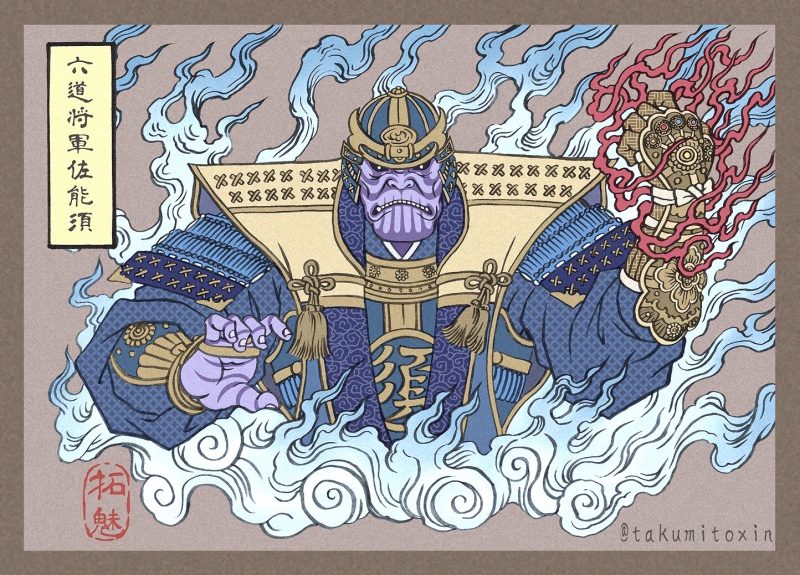
Wherever in the world you live, you’ve heard of Avengers: Endgame, and may well have seen it already — or, depending on your enthusiasm for superheroes, may well have seen it more than a few times. It comes, as fans need not be reminded, as the culmination of a 22-film series in the Marvel Cinematic Universe that began with 2008’s Iron Man. The $356 million picture (which has already earned, as of this writing, more than $1.2 billion) uses, of course, only the latest and most high-tech visual effects, and a great deal of them, which does get one wondering: how would these superheroic (and supervillianous) characters, all of them larger than life, come through a transplantation to another art form, from an entirely different culture, and a much less overtly spectacular one at that?
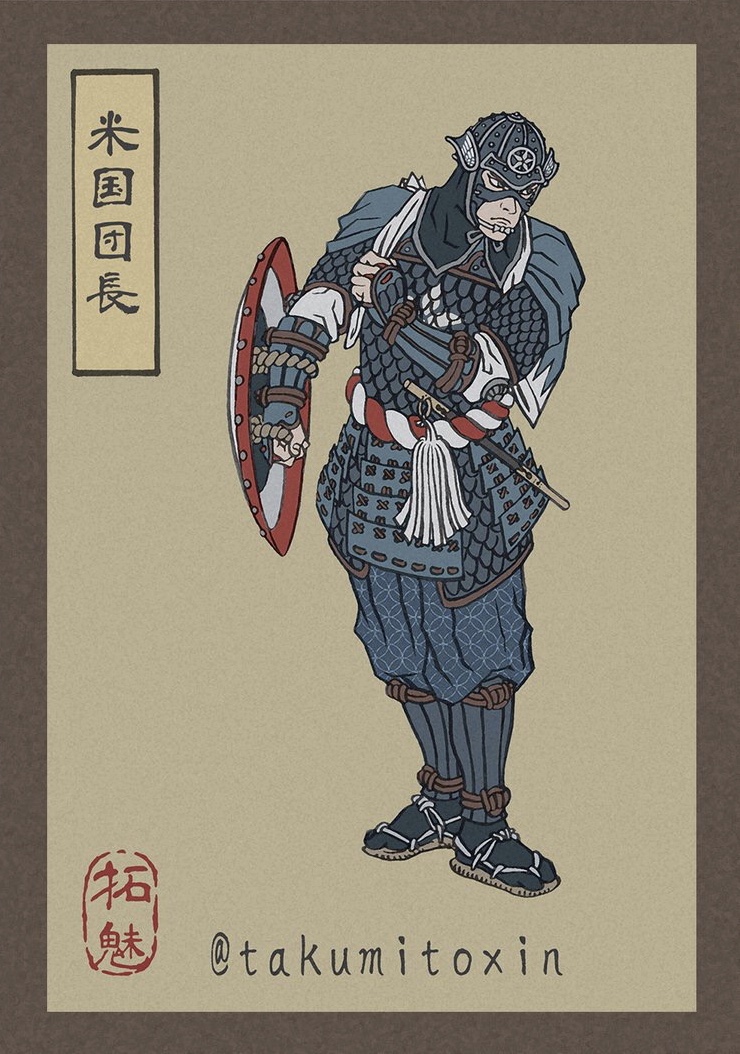
A Japanese illustrator who goes by the name Takumi has taken on that challenge. “To commemorate the film’s release, the artist has created a series of illustrations that render characters from the film in Ukiyo‑e style,” writes Spoon & Tamago’s Johnny Waldman.
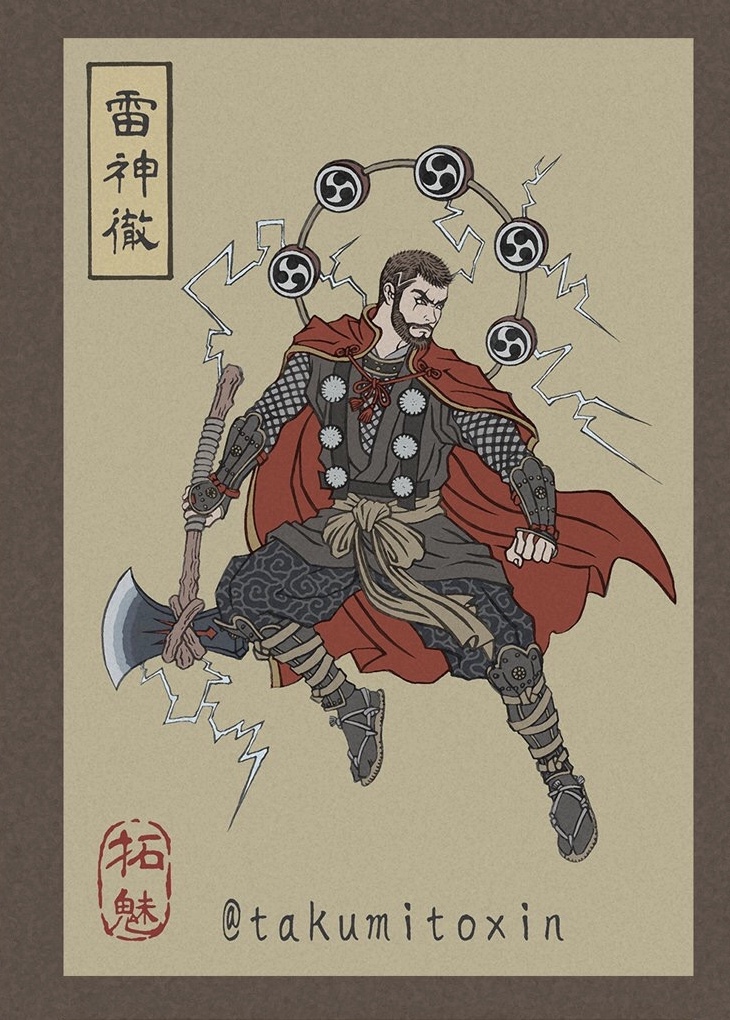
Takumi’s task of translating these American-made characters to that Japanese woodblock print form (which does have a history of portraying actors) included “a lot of time thinking about the unique patterns and kanji names for each character. Thor is pronounced tooru in Japanese, so he assigned the Japanese equivalent, which is 徹(とおる). Thanos’ 6 infinity stones served as the inspiration behind that name, which references the 6 realms of Buddhism.” And all of the Avengers characters Takumi has rendered in this fashion wear costumes with “traditional Japanese designs and each references certain traits of the characters.”
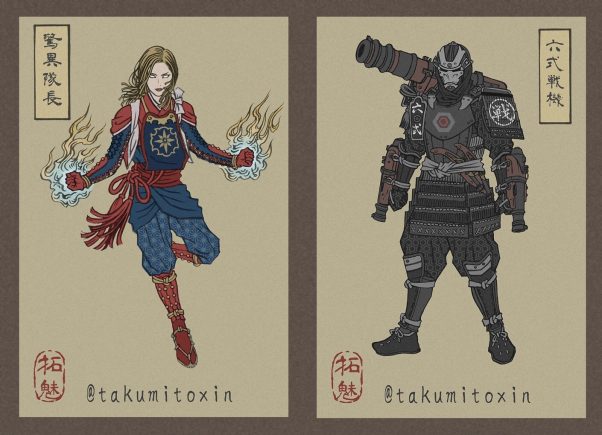
Captain America’s pants, for instance, “use the shippo (七宝) pattern of layered circles, which references the shape of his shield. Thor’s pattern is pretty straightforward: the traditional cloud (雲) pattern. Iron Man uses the complex bishamon kikko (毘沙門亀甲) pattern, which mimics the look of a circuit board.”
Takumi previously made a splash by creating “Ghibli Land,” a hypothetical version of Disney Land themed entirely around the animated films of Studio Ghibli. (The idea turns out to be less hypothetical than it once sounded: Studio Ghibli, as we’ve previously featured here on Open Culture, plans to open its own theme park in 2022.) Just as the staggering success of the Marvel Cinematic Universe movies proves the popular viability of the kind of superhero stories assumed not so long ago to be the domain of obsessive fans alone, Takumi’s ukiyo‑e Avengers cast, all of which you can see at Spoon & Tamago, shows how versatile this traditional art form remains.
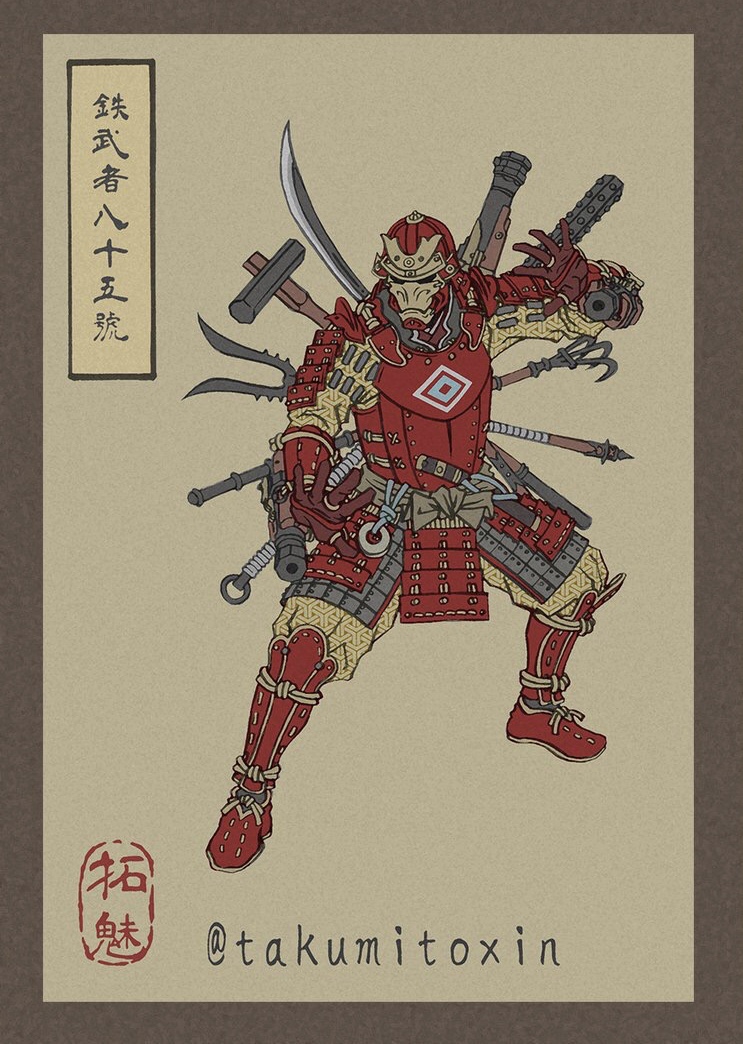
via Spoon & Tamago
Related Content:
David Bowie Memorialized in Traditional Japanese Woodblock Prints
The Religious Affiliation of Comic Book Heroes
Colin Marshall hosts and produces Notebook on Cities and Cultureand writes essays on cities, language, Asia, and men’s style. He’s at work on a book about Los Angeles, A Los Angeles Primer. Follow him on Twitter at @colinmarshall or on Facebook.
Support Us
We're hoping to rely on loyal readers, rather than erratic ads. Please click the Donate button and support Open Culture. You can use Paypal, Venmo, Patreon, even Crypto! We thank you!

Receive our Daily Email
About Us

Open Culture scours the web for the best educational media. We find the free courses and audio books you need, the language lessons & educational videos you want, and plenty of enlightenment in between.
Advertise With Us

