The Ukrainian Band “Brunettes Shoot Blondes” took a broken, vintage grand piano and reengineered it, turning it into “a hybrid, containing 20 instruments.” Now, when you press the keys, the “piano hammers beat a marimba, tambourine, cymbals or even castanets. There are also special mechanical devices that allow for the playing of cello, violins and organ.” Watch it in action above…
If you would like to sign up for Open Culture’s free email newsletter, please find it here. It’s a great way to see our new posts, all bundled in one email, each day.
If you would like to support the mission of Open Culture, consider making a donation to our site. It’s hard to rely 100% on ads, and your contributions will help us continue providing the best free cultural and educational materials to learners everywhere. You can contribute through PayPal, Patreon, and Venmo (@openculture). Thanks!
I recently heard someone quip that proposals to cut the Academy Awards are tantamount to suggesting that the NFL trim down the Super Bowl. Certainly for many who would rather watch the former any day of the week, even the play-by-play of technical categories repays attention. Yet people who think of the Oscars as a major sporting event with big stars and blockbusters going head-to-head can still appreciate the show as more than spectacle. How else, for example, would most of us learn about brilliant animated short films like the National Film Board of Canada’s Animal Behaviour, made by husband and wife team Alison Snowden and David Fine and nominated in this year’s Oscars? (See the trailer above.)
Snowden and Fine previously won an Oscar in 1995 for Bob’s Birthday, a hilarious short about an unhappy British dentist. Their latest film takes a charming, anthropomorphic route to the question Fine poses as, “Should what comes naturally to you be something that you seek to change to please others, or should others accept you as you are?”
Group therapy participants seeking acceptance include Lorraine, a leech with separation anxiety, Victor, an ape with anger issues, and Cheryl, a praying mantis, writes the National Film Board, “who can’t seem to keep a man.”
The NFB informs us that Animal Behaviour is their 75th Oscar-nomination in the category of Animated Short Film, and whether you’re inclined to watch this part of the awards or not, you can get caught up with their extensive playlist of 66 Oscar-winning and nominated films on YouTube. (Bob’s Birthday is not available, at least in the U.S., but you can watch it here.) See Snowden and Fine’s first film, George and Rosemary, a story in which “two golden agers prove that passion isn’t reserved for the very young.”
Watch the very impressive stop-motion animation of 2007’s Madame Tutli-Putli, an “exhilarating existential journey” directed by Chris Lavis & Maciek Szczerbowski. See Chris Landreth’s 2013 Oscar-winning computer-animated short, Ryan, about a character “living every artist’s worst nightmare.”
And see the 2007 Oscar-winning existential animated short The Danish Poet, directed by Torill Kove and featuring narration by Liv Ullmann. The offerings are vast and varied, displaying the very best of Canadian animation, a national art that usually goes unseen and unacknowledged by audiences outside its borders. But after watching several of these films you might agree that NFB animation deserves its long history of recognition at the Oscars. See the complete playlist of films here.
Mark Mothersbaugh’s studio is located in a cylindrical structure painted bright green — it looks more like a festive auto part than an office building. It’s a fitting place for the iconoclast musician. For those of you who didn’t spend your childhoods obsessively watching the early years of MTV, Mark Mothersbaugh was the mastermind behind the band Devo. They skewered American conformity by dressing alike in shiny uniforms and their music was nervy, twitchy and weird. They taught a nation that if you must whip it, you should whip it good.
In the years since, Mothersbaugh has segued into a successful career as a Hollywood composer, spinning scores for 21 Jump Streetand The Royal Tenenbaums among others.
In the video above, you can see Mothersbaugh hang out in his studio filled with synthesizers of various makes and vintages, including Bob Moog’s own personal Memorymoog. Watching Mothersbaugh pull out and play with each one is a bit like watching a precocious child talk about his toys. He just has an infectious energy that is a lot of fun to watch.
Probably the best part in the video is when he shows off a device that can play sounds backward. It turns out that if you say, “We smell sausage” backwards it sounds an awful lot like “Jesus loves you.” Who knew?
Below you can see Mothersbaugh in action with Devo, performing live in Japan during the band’s heyday in 1979.
If you would like to sign up for Open Culture’s free email newsletter, please find it here. It’s a great way to see our new posts, all bundled in one email, each day.
If you would like to support the mission of Open Culture, consider making a donation to our site. It’s hard to rely 100% on ads, and your contributions will help us continue providing the best free cultural and educational materials to learners everywhere. You can contribute through PayPal, Patreon, and Venmo (@openculture). Thanks!
Note: An earlier version of this post appeared on our site in February 2015.
Jonathan Crow is a Los Angeles-based writer and filmmaker whose work has appeared in Yahoo!, The Hollywood Reporter, and other publications. You can follow him at @jonccrow. And check out his blog Veeptopus, featuring lots of pictures of badgers and even more pictures of vice presidents with octopuses on their heads. The Veeptopus store is here.
Some Americans like their pop musicians to be more accessible, less theatrical, and eccentric—and generally more desperate for the approval of their audience. Kate Bush, thankfully, has never seemed bothered by this need. She could leave the spotlight when she needed to, or leave the music business altogether for a time, and yet remain a creative force to be reckoned with for four decades now. Her legacy has permeated contemporary music since she appeared in 1978, then retired from the stage the following year after her first tour to focus solely on writing, recording, and making short musical films.
Her debut, The Kick Inside, proved that an original new songwriter worth watching had arrived, and she delivered on the promise in ten studio albums and a career she seemed to sum up in the title of “This Woman’s Work,” from 1989’s The Sensual World. It is work she has always done in her own delightfully odd, passionate, eccentrically British, theatrical, and deftly literary way, all qualities that have made her a massive star in the UK and a hero to artists like Tori Amos, Annie Lennox, Grimes, Florence and the Machine, and too many more to name.
Bush’s unusual traits also make her a perfect artist to pay tribute to in an orchestral setting, as Sweden’s Gothenburg Symphony has done in the 2018 concert also titled “This Woman’s Work” and featuring the very-Bush-worthy vocal talents of guest singers Jennie Abrahamson and Malin Dahlström. It’s “a towering tribute,” the Symphony writes, “with hit songs and pure poetry in special arrangements by Martin Schaub.” And it arrived to mark a special moment indeed: the 40th anniversary of the release of Bush’s brilliantly strange debut single “Wuthering Heights.” See the full performance at the top of the post and excerpted songs throughout, including Abrahamson’s cover of “This Woman’s Work,” above.
Appearing in the ghostly guise and ethereally high-pitched voice of Cathy Earnshaw, doomed heroine of Emily Brontë’s novel, Bush captivated millions in two videos that are now absolute classics. She drew on the mime theatrics of her teacher Lindsay Kemp, who previously mentored David Bowie, and gave us the indelible image of a woman possessed by weird imagination, uncanny musical talent, and some frightening dance moves. The images and sounds she created in just those 3 and a half minutes are iconic. Or, putting it a little differently in a short BBC documentary, John Lydon says, “Kate Bush and her grand piano… that’s like John Wayne and his saddle… her shrieks and warbles are beauty beyond belief.”
If you came to Bush later in her career, say during 1985’s huge Hounds of Love, and somehow missed her unbelievable first fine art-rock performances on film, watch both the white and red dress versions first, then watch the Gothenburg Symphony’s glowing, career-spanning tribute to a woman who “laid the groundwork for [a] generation of performers,” as Marc Hirsh writes at NPR. Even though he is an American who does not care for Kate Bush, Hirsh can’t seem to help enumerating the very reasons she is so special to so many, and he features a number of her videos that demonstrate why she’s an artist her fans love “from the very core of their being.”
“What’s the one thing that all great works of science fiction have in common?” asks a 1997 episode of The Net, the BBC’s television series about the possibilities of this much-talked-about new thing called the internet. “They all tried to see into the future, and they all got it wrong. Orwell’s 1984, Huxley’s Brave New World, Arthur C. Clarke’s 2001: all, to some extent or other, wrong. And there’s another name to add to this list: William Gibson.” But then on strolls Gibson himself, fresh off the writing of Idoru, a novel involving a human who wants to marry a digitally generated Japanese pop star, to grant the interview above.
In it Gibson admits that computers hadn’t gone quite the way he’d imagined thirteen years earlier in his debut novel Neuromancer — but in which he also offers prescient advice about how we should regard new technology even today. “The thing that Neuromancer predicts as being actually like the internet isn’t actually like the internet at all!” Gibson says in a more recent interview with Wired. “I didn’t get it right but I said there was going to be something.” Back in the mid-1980s, as he tells the BBC, “there was effectively no internet to extrapolate from. The cyberspace I made up isn’t being used in Neuromancer the way we’re using the internet today.”
Gibson had envisioned a corporate-dominated network infested with “cybernetic car thieves skulking through it attempting to steal tidbits of information.” By the mid-1990s, though, the internet had become a place where “a really talented and determined fifteen-year-old” could create something more compelling than “a multinational entertainment conglomerate might come up with.” He tells the BBC that “what the internet has become is as much a surprise to me as the collapse of the Soviet Union was,” but at that point he had begun to perceive the shape of things to come. “I can’t see why it won’t become completely ubiquitous,” he says, envisioning its evolution “into something like television to the extent that it penetrates every level of society.”
At the same time, “it doesn’t matter how fast your modem is if you’re being shelled by ethnic separatists” — still very much a concern in certain parts of the world — and even the most promising technologies don’t merit our uncritical embrace. “I think we should respect the power of technology and try to fear it in a rational way,” he says. “The only appropriate response” is to give in to neither technophobia nor technophilia, but “to teach ourselves to be absolutely ambivalent about them and imagine their most inadvertent side effects,” the side effects “that tend to get us” — not to mention the ones that make the best plot elements. Seeing as how we now live in a world where marriage to synthetic Japanese idols has become a possibility, among other developments seemingly pulled from the pages of Gibson’s novels, we would do well to heed even these decades-old words of advice about his main subject.
Based in Seoul, Colin Marshall writes and broadcasts on cities, language, and culture. His projects include the book The Stateless City: a Walk through 21st-Century Los Angeles and the video series The City in Cinema. Follow him on Twitter at @colinmarshall or on Facebook.
As far as I’m concerned, debate over whether or not Ringo Starr is a good drummer is over, done with, settled. How is it possible that some of the greatest recorded music of the 20th century, with some of the most distinctive rhythms, fills, and drum breaks in pop music, could have come from a mediocre musician? The standard response has been to allege that Starr’s best parts were played by someone else. In a handful of recordings—though I won’t argue over which ones—it seems he might have been replaced, for whatever reason. But Ringo could do more than hold his own. He was something rarer and more valuable than any studio musician. He remains one of the most distinctively musical drummers on record.
What does that mean? It means he intuited exactly what a song needed, and what it didn’t. He used what Buddy Rich called his “adequate” abilities (a compliment, I’d say, coming from Buddy Rich) to serve the songs best, finding ways to enhance the structures and arrangements with drum parts that are as uniquely memorable as the melodies and harmonies.
His humility and sense of humor come through in his tasteful, yet dynamic playing. I say this as a serious Ringo fan, but if you, or someone you know, needs convincing, don’t take my word for it. Take it from skilled drummers Sina and Brandon Khoo.
What are Sina’s credentials for making a pro-Ringo case? Well, for one thing, her father played in Germany’s biggest Beatles tribute band, the Silver Beatles. Also, she’s a very good musician who has memorized Ringo’s repertoire and can explain it well. Above, she demonstrates how his uncomplicated grooves complement the songs, so much so they have become iconic in their own right. (To skirt copyright issues, Sina plays along to convincing covers by her dad’s band.)
Ringo’s drum pattern for “In My Life,” for example, she says “is absolutely unique, nobody ever played this before. It’s truly original and the song won’t work with any other drum part.” If you were to write a new song around the drums alone, it would probably come out sounding just like “In My Life.” As Harrison remarks at the top, “he’s very good because he’ll listen to the song once, and he knows exactly what to play.”
Virtuoso drummer Brandon Khoo makes the case for Ringo as a good drummer, above, after a brief defense of much-maligned White Stripes drummer Meg White. He, too, chooses “In My Life” to show how “Ringo lays it down” with maximum feel and efficiency, deftly but subtly changing things up in nearly every phrase of the song. Conversely—in an exaggerated counterexample—Koo shows what a technically-skilled, but unmusical, drummer might do, namely trample over the delicate guitars and vocals with an aggressive attack and distracting, unnecessary fills and cymbal crashes. “A good drummer is a drummer who knows how to play, number one, for the music.”
If these clear demonstrations fail to sway, maybe some celebrity endorsements will do. Just above, in a video made by the Rock and Roll Hall of Fame to celebrate an exhibit of Ringo’s famous drum kit, see Dave Grohl, Taylor Hawkins, Stewart Copeland, Questlove, Tre Cool, Max Weinberg, Chad Smith, and more pay tribute. Grohl describes him as the “king of feel,” Smith talks about his “knack for coming up with really interesting musical parts that became rhythmic hooks.” In the span of just three minutes, we get a sense of exactly why the most famous drummers in rock and roll admire Ringo.
Millions of drummers have come and gone since The Beatles’ day, most of them influenced by Ringo, as Weinberg says. And not one of them has ever played like Ringo Starr. “You hear his drumming,” says Grohl, “and you know exactly who it is.” Hear how his style evolved right along with the band’s songwriting in Kye Smith’s chronological drum medley of Beatles hits below.
In an 1846 speech to the British and Foreign Anti-Slavery Society, Frederick Douglass summed up the twisted bond between slavery and religion in the U.S. He began with a short summary of atrocities that were legal, even encouraged, against enslaved people in Virginia and Maryland, including hanging, beheading, drawing and quartering, rape, “and this is not the worst.” He then made his case:
No, a darker feature is yet to be presented than the mere existence of these facts. I have to inform you that the religion of the Southern states, at this time, is the great supporter, the great sanctioner of the bloody atrocities to which I have referred. While America is printing tracts and Bibles; sending missionaries abroad to convert the heathen; expending her money in various ways for the promotion of the gospel in foreign lands, the slave not only lies forgotten, uncared for, but is trampled underfoot by the very churches of the land.
Douglass did not intend his statement to be taken as an indictment of Christianity, but rather the hypocrisy of American religion, both that “of the Southern states” and of “the Northern religion that sympathizes with it.” He speaks, he says, to reject “the slaveholding, the woman-whipping, the mind-darkening, the soul-destroying religion” of the country, while professing a religion that “makes its followers do unto others as they themselves would be done by.”
Douglass harshly condemns slave society in the U.S., but, perhaps given his audience, he also politically elides the extensive role many churches in the British Empire played in the slave trade and Atlantic slave economy—a continued role, to Douglass’s dismay, as he found during his UK travels in the 1840s. I’m not sure if he knew that forty years earlier, British missionaries traveled to slave plantations in the Caribbean armed with heavily-edited Bibles in which “any passage that might incite rebellion was removed,” as Brigit Katz writes at Smithsonian. But he would hardly have been surprised.
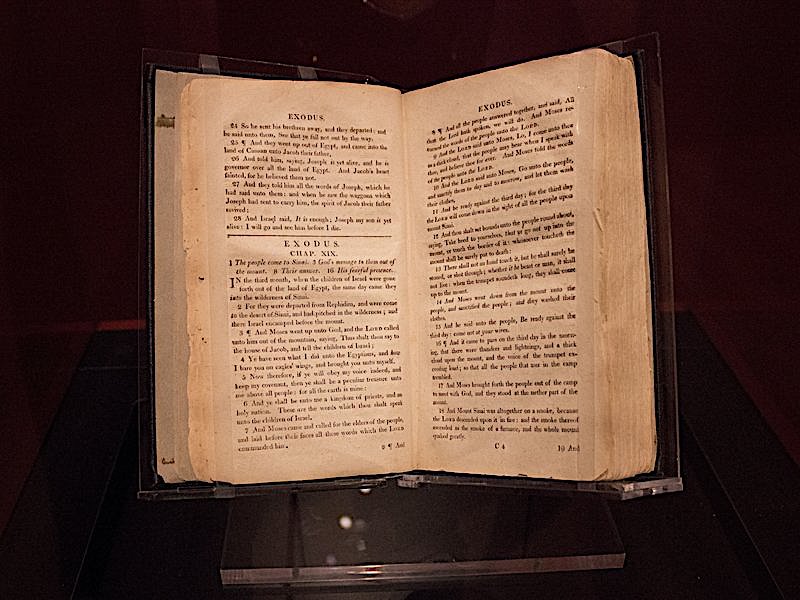
The use of religion to terrorize and control rather than liberate was something Douglass understood well, having for decades keenly observed slaveowners finding what they needed in the text and ignoring or suppressing the rest. In 1807, the Society for the Conversion of Negro Slaves went so far as to literally excise the central narrative of the Old Testament, creating an entirely different book for use by missionaries to the West Indies. “Gone,” Katz points out, “were references to the exodus of enslaved Israelites from Egypt,” references that were integral to the self-understanding of millions of Diaspora Africans.
Gone also were verses that might explicitly contradict the few proof texts slaveholders quoted to justify themselves. Especially dangerous was Exodus 21:16: “And he that stealeth a man, and selleth him, or if he be found in his hand, he shall surely be put to death.” The typical 66 books of a Protestant Bible had been reduced to parts of just 14. How is it possible to publish a Bible without what amounts to the mythic origin story of ancient Israel? One answer is that this was a different religion, one whose aim, says Anthony Schmidt, curator of the Museum of the Bible, was to make “better slaves.”
The “Slave Bible” did not cut out the subject completely. Joseph’s enslavement in Egypt remains, but this is likely as an example, says Schmidt, of someone who “accepts his lot in life” and is rewarded for it, a story U.S. churches used in a similar fashion. Passages in the New Testament that seemed to emphasize equality were cut, as was the entire book of Revelation. The infamous Ephesians 6:5—“servants be obedient to them that are your masters according to the flesh, in fear and trembling”—remained.
Whether or not the Bible really did sanction slavery is a question still up for debate—and maybe an unanswerable one given differences in interpretive frameworks and the patchwork nature of the disparate, redacted texts stitched together as one. But the fact that British and American churches deliberately used it as a weaponized tool of propaganda and indoctrination is beyond dispute. The so-called “Slave Bible” is both a fascinating historical artifact, a very literal symbol of a practice that was integral to the institution of slavery—the total control of the narrative.
Such practices became more extreme after the Haitian Revolution and the many bloody slave revolts in the U.S., as the planter class became increasingly desperate to hold on to power. One of only three extant “Slave Bibles,” the abridged version—called Parts of the Holy Bible, selected for the use of the Negro Slaves, in the British West-India Islands—is now on display at the Museum of the Bible in Washington, DC, on loan from Fisk University. In the NPR interview above, Schmidt explains the book’s history to All Things Considered’s Michel Martin, who herself describes the text’s purpose in the most concise way: “To associate human bondage and human slavery with obedience to the higher power.”
The custom chart’s fifty-one colors comprise about 90 percent of the finished work. A palette of thirteen Golden Fluid Acrylics supplied the jewel-toned accents so thrilling to birdwatchers.
Along the way, Kim absorbed a tremendous amount of information about the how and why of bird feather coloration:
The iridescence on the neck and back of the Superb Starling comes not from pigment,
but from structural color. The starling’s outer feathers are constructed in a way
that refracts light like myriad prisms, making the bird appear to shimmer. The eponymous
coloring of the Lilac-breasted Roller results from a different kind of structural
color, created when woven microstructures in the feathers, called barbs and barbules,
reflect only the shorter wavelengths of light like blue and violet.
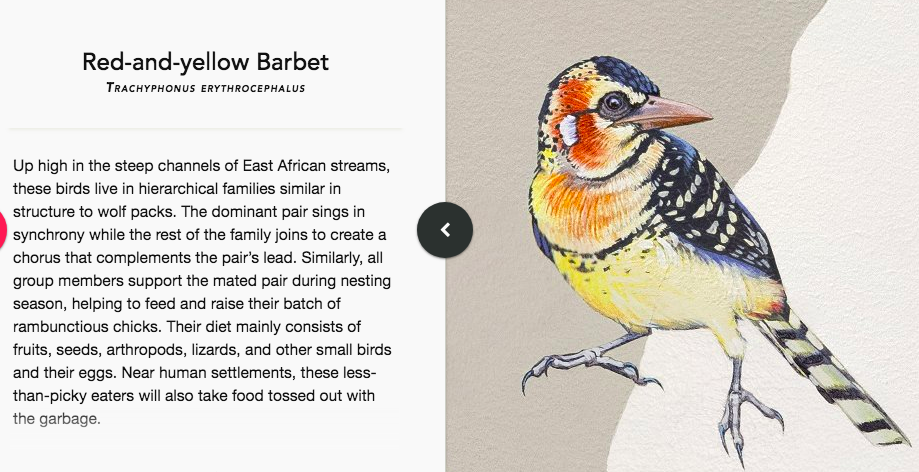
The primary colors that lend their name to the Red-and-yellow Barbet are
derived from a class of pigments called carotenoids that the bird absorbs in its diet.
These are the same compounds that turn flamingos’ feathers pink. As a member of
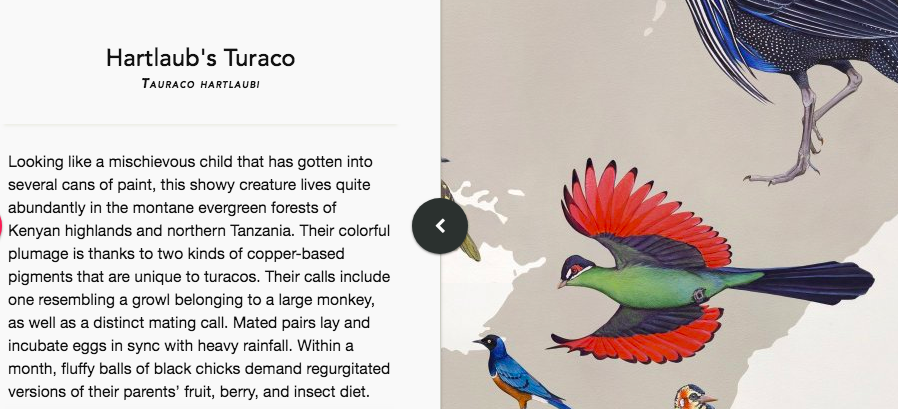
the family Musophagidae, the Hartlaub’s Turaco displays pigmentation unique in the
bird world. Birds have no green pigmentation; in most cases, verdant plumage is a
combination of yellow carotenoids and blue structural color. Turacos are an exception,
displaying a green, copper-based pigment called turacoverdin that they absorb
in their herbivorous diet. The flash of red on the Hartlaub’s underwings comes from
turacin, another copper-based pigment unique to the family.
She examined specimens from the center’s collection and reviewed centuries’ worth of field observations.
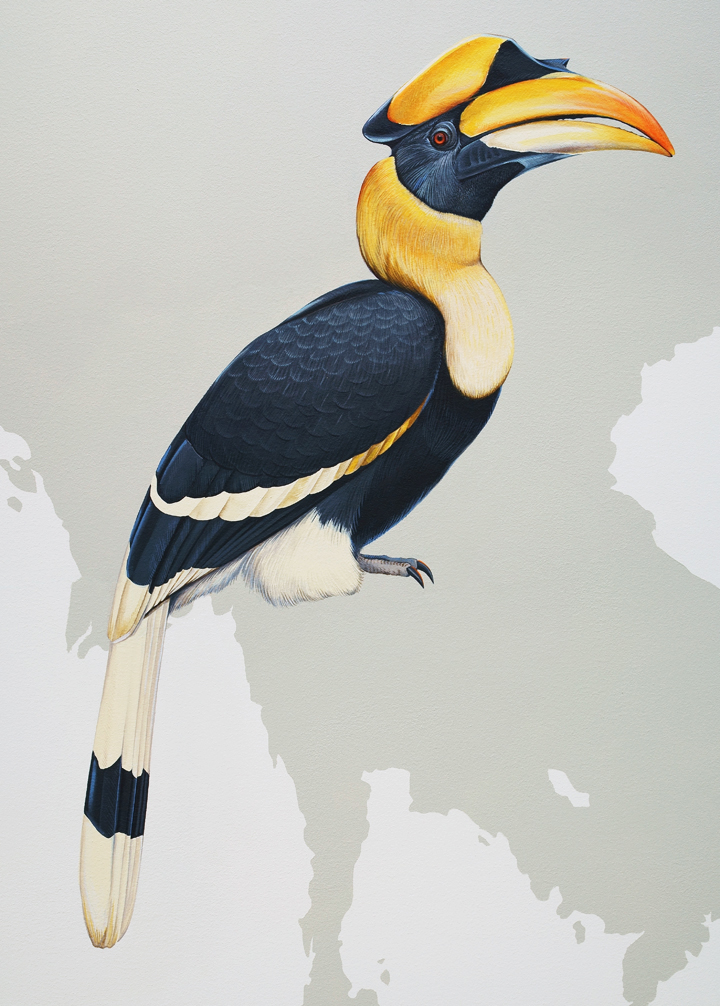
(The seventeenth-century English naturalist John Ray dismissed the hornbill family as having a “foul look,” a colonialism that ruffled Kim’s own feathers somewhat. In retaliation, she dubbed the Great Hornbill, “the Cyrano of the Jungle” owing to his “tequila-sunrise-hued facial phallus,” and selected him as the cover boy for her book about the mural.)
Research and preliminary sketching consumed an entire year, after which it took 17 months to inscribe 270 life-size creatures—some long extinct—onto the lab’s main wall. The birds are set against a greyscale map of the world, and while many are depicted in flight, every one save the Wandering Albatross has a foot touching its continent of origin.
We're hoping to rely on loyal readers, rather than erratic ads. Please click the Donate button and support Open Culture. You can use Paypal, Venmo, Patreon, even Crypto! We thank you!
Open Culture scours the web for the best educational media. We find the free courses and audio books you need, the language lessons & educational videos you want, and plenty of enlightenment in between.