Take a Virtual Drive through London, Tokyo, Los Angeles & 45 Other World Cities

When asked once about his beliefs, This Amer­i­can Life cre­ator Ira Glass replied that he believes “the car is the best place to lis­ten to the radio.” That seems to be a cul­tur­al­ly sup­port­ed per­cep­tion, or at least it has been in over the past half-cen­tu­ry in Amer­i­ca. But does it hold true in oth­er coun­tries? Does lis­ten­ing to the radio in the car feel as good in Lon­don, Buenos Aires, Mum­bai, and Tokyo as it does in Chica­go, New York, Mia­mi, and Los Ange­les?

You can see and hear for your­self with the wealth of vir­tu­al urban-dri­ving-and-radio-lis­ten­ing expe­ri­ences on offer at Dri­ve & Lis­ten, where you can take your pick from any of the afore­men­tioned cities and 40 oth­ers besides. The site makes this pos­si­ble by bring­ing togeth­er two forms of media that have come into their own on the inter­net of the 21st cen­tu­ry: stream­ing radio and stream­ing video.

In most every major met­ro­pol­i­tan area, radio sta­tions now make their broad­casts avail­able online. At the same time, Youtu­bers have by now shot and uploaded a great many through-the wind­shield views of all those places, cre­at­ing the once-unlike­ly enter­tain­ment genre of the dri­ving video.

Here we’ve includ­ed some prime exam­ples from pop­u­lar Youtube dri­ver J Utah, whose scope includes Amer­i­can cities large and small as well as such world cap­i­tals as Tokyo, Paris, Sin­ga­pore, Hong Hong, and São Paulo. All in 4K video.

Click on one of the cities on Dri­ve & Lis­ten’s menu, and chances are you’ll see one of J Utah’s videos. It will come with a stream­ing-radio sound­track, sourced from one of the sta­tions in the city or coun­try on dis­play. Your vir­tu­al Havana dri­ve may be accom­pa­nied by announce­ments of the news of the day, your vir­tu­al Istan­bul dri­ve by Turk­ish rock, your vir­tu­al Chica­go dri­ve by an NPR affil­i­ate (per­haps even WBEZ, home of This Amer­i­can Life), your vir­tu­al Guadala­jara dri­ve by soc­cer scores, your vir­tu­al Mia­mi dri­ve by straight-ahead jazz, your vir­tu­al Berlin dri­ve by Pat­ti Smith.

Each time you select a city, you’ll get a dif­fer­ent com­bi­na­tion of radio sta­tion and dri­ving footage. As every dri­ver knows, day dri­ving and night dri­ving — to say noth­ing of rush hour ver­sus the wee hours — feels com­plete­ly dif­fer­ent, and so the dri­vers of Youtube have shot at all pos­si­ble times. Some of their routes thread right between down­town sky­scrap­ers, while oth­ers stick to free­ways along the out­skirts. As a res­i­dent of Seoul, I can tell you that Dri­ve & Lis­ten accu­rate­ly con­veys the expe­ri­ence of rid­ing in a cab through that city — pro­vid­ed you first crank the video speed up to 2x.

Enter Dri­ve & Lis­ten here.

Relat­ed Con­tent:

Take a Dri­ve Through 1940s, 50s & 60s Los Ange­les with Vin­tage Through-the-Car-Win­dow Films

Time Trav­el Back to Tokyo After World War II, and See the City in Remark­ably High-Qual­i­ty 1940s Video

Lon­don Mashed Up: Footage of the City from 1924 Lay­ered Onto Footage from 2013

A Trip Through New York City in 1911: Vin­tage Video of NYC Gets Col­orized & Revived with Arti­fi­cial Intel­li­gence

Pris­tine Footage Lets You Revis­it Life in Paris in the 1890s: Watch Footage Shot by the Lumière Broth­ers

Read­ing While Dri­ving, Seri­ous­ly?

Based in Seoul, Col­in Mar­shall writes and broad­casts on cities, lan­guage, and cul­ture. His projects include the book The State­less City: a Walk through 21st-Cen­tu­ry Los Ange­les and the video series The City in Cin­e­ma. Fol­low him on Twit­ter at @colinmarshall, on Face­book, or on Insta­gram.

Hear Enchanting Mixes of Japanese Pop, Jazz, Funk, Disco, Soul, and R&B from the 70s and 80s

Franz Kafka’s unfin­ished first nov­el, pub­lished by his lit­er­ary execu­tor Max Brod as Ameri­ka, tells the sto­ry of a young Euro­pean exiled in New York City. He has a series of mad­cap adven­tures, winds up in Okla­homa as a “tech­ni­cal work­er,” and adopts the name “Negro.” Ameri­ka is a nov­el writ­ten by an artist who had nev­er been to Amer­i­ca nor met an Amer­i­can. His impres­sion of the coun­try came entire­ly from his read­ing. And yet, Kaf­ka leaves read­ers with an authen­ti­cal­ly vivid, last­ing impres­sion of the har­ried din of Amer­i­can life.

We may feel sim­i­lar­ly when watch­ing the films of Ser­gio Leone, who had nev­er seen the West when he start­ed mak­ing West­erns. Detached from their cul­tur­al ori­gins, West­ern tropes in the Ital­ian director’s hands reveal their arche­typ­al depths as avatars of law­less vio­lence.

Euro­peans have been dream­ing imag­i­nary Amer­i­c­as for hun­dreds of years. And giv­en U.S. pop­u­lar culture’s glob­al reach in the 20th cen­tu­ry, near­ly every place in the world has its own Amer­i­cana, an homage from afar made up of local ingre­di­ents. Nowhere, per­haps, is this truer than in Japan.

“Jazz and Japan shouldn’t mix,” notes Col­in Mar­shall in an ear­li­er post on Japan­ese jazz, quot­ing the book All-Japan, which alleges a lack of impro­vi­sa­tion in Japan­ese cul­ture. But they have mixed par­tic­u­lar­ly well, as you can hear in the 30-minute mix of 70s Japan­ese jazz above from Cof­fee Break Ses­sions, a YouTube chan­nel filled with intro­duc­tions to gen­res and styles from around the world. What’s more, jazz arrived in Japan as a dou­ble import, two steps removed. It “dates back to the 1920s,” writes Mar­shall, “when it drew inspi­ra­tion from vis­it­ing Fil­ipino bands who had picked the music up from their Amer­i­can occu­piers.” When Japan itself was occu­pied by U.S. sol­diers two decades lat­er, the coun­try already had a jazz tra­di­tion.

Japan­ese cul­ture has long since sur­passed the Amer­i­can influ­ences it absorbed to cre­ate hybrid gen­res Amer­i­cans have been furi­ous­ly import­ing at a seem­ing­ly expo­nen­tial rate. One of the newest such gen­res was actu­al­ly cre­at­ed by an Amer­i­can DJ, Van Paugam, who aggre­gat­ed a col­lec­tion of Japan­ese records into what he calls “City Pop.” In anoth­er Open Cul­ture post on this YouTube phe­nom­e­non, Mar­shall describes the music as “draw­ing influ­ences from West­ern dis­co, funk, and R&B, and using the lat­est son­ic tech­nolo­gies mas­tered nowhere more than in Japan itself.” Like Japan­ese jazz, city pop comes from music that began in the U.S. but become glob­al­ized and cos­mopoli­tan as it trav­eled the world.

Paugam char­ac­ter­izes his City Pop mix­es as infused with “themes of aus­tere feel­ings, melan­cholic vibes, and a sense of hav­ing mem­o­ries of liv­ing in a dif­fer­ent time and place.” The cul­tur­al dis­lo­ca­tion one might feel when lis­ten­ing to these songs comes from their uncanniness—they sound like hits we might have heard on top 40 radio, but their idioms don’t exact­ly click into place. This is espe­cial­ly appar­ent in the Cof­fee Break Ses­sions mix of late 70s, ear­ly 80s Japan­ese pop singers, above.

But there’s some­thing too provin­cial in call­ing City Pop—or the dis­parate types of smooth pop that fall under the designation—a Japan­ese take on Amer­i­can music, since Amer­i­can music is itself a hybrid of glob­al influ­ences. YouTube phe­nom­e­na like City Pop have them­selves become part of a uni­ver­sal inter­net pop cul­ture that belongs every­where and nowhere. Some­day every­one will expe­ri­ence the his­toric 80s pop music of Japan just as they’ll expe­ri­ence the his­toric 80’s pop music of every­where else: as part of what Paugam calls a “false sense of nos­tal­gia” for a past they nev­er knew. Hear more mix­es of Japan­ese pop, jazz, and funk over at Cof­fee Break Ses­sions.

Relat­ed Con­tent: 

A 30-Minute Intro­duc­tion to Japan­ese Jazz from the 1970s: Like Japan­ese Whisky, It’s Under­rat­ed, But Very High Qual­i­ty

Stream Loads of “City Pop,” the Elec­tron­ic-Dis­co-Funk Music That Pro­vid­ed the Sound­track for Japan Dur­ing the Roar­ing 1980s

How Youtube’s Algo­rithm Turned an Obscure 1980s Japan­ese Song Into an Enor­mous­ly Pop­u­lar Hit: Dis­cov­er Mariya Takeuchi’s “Plas­tic Love”

Josh Jones is a writer and musi­cian based in Durham, NC. Fol­low him at @jdmagness

After MLK’s Assassination, a Schoolteacher Conducted a Famous Experiment–“Blue Eyes/Brown Eyes”–to Teach Kids About Discrimination

Get­ting his­to­ry across to young stu­dents is chal­leng­ing enough, but what should a teacher do when actu­al his­to­ry-mak­ing events hap­pen on their watch? They have to be acknowl­edged, but to what extent do they have to be explained, even “taught”? Of the teach­ers who have turned his­to­ry-in-the-mak­ing into a les­son, per­haps the most famous is Jane Elliott of Riceville, Iowa. On April 5, 1968, the day after Mar­tin Luther King Jr.‘s assas­si­na­tion, she divid­ed her class­room of third-graders along col­or lines: blue-eyed and brown-eyed. On the first day she grant­ed the brown-eyed stu­dents such spe­cial priv­i­leges as desks in the front rows, sec­ond help­ings at lunch, and five extra min­utes of recess. The next day she reversed the sit­u­a­tion, and the blue-eyed kids had the perks.

What brought seri­ous atten­tion to Elliot­t’s small-town class­room exper­i­ment was the result­ing arti­cle in the Riceville Recorder, which report­ed some of what her stu­dents wrote in their assign­ments respond­ing to the expe­ri­ence. The Asso­ci­at­ed Press picked up the arti­cle and soon Elliott received a call from The Tonight Show invit­ing her to come chat with John­ny Car­son about her “Blue Eyes/Brown Eyes” exer­cise on nation­al tele­vi­sion.

“I did­n’t know how this exer­cise would work,” Elliott tells Jim­my Fal­lon on the clip from the cur­rent Tonight Show at the top of the post. “If I had known how it would work, I prob­a­bly would­n’t have done it. If I had known that, after I did that exer­cise, I lost all my friends, no teacher would speak to me where they could be seen speak­ing to me, because it was­n’t good pol­i­tics to be seen talk­ing to the town’s only ‘N‑word lover.’ ”

Elliot­t’s fam­i­ly also expe­ri­enced severe blow­back from her sud­den fame, but it did­n’t stop her from fur­ther­ing the clear­ly res­o­nant idea she had devised. She con­tin­ued to per­form Blue Eyes/Brown Eyes in class: the third time, it was filmed and became the 1970 tele­vi­sion doc­u­men­tary The Eye of the Storm. (Some of the lan­guage used by her stu­dents sure­ly would­n’t make it to the air today.) Fif­teen years lat­er, PBS’ Front­line reunit­ed Elliot­t’s third-grade class of 1970 for its Emmy Award-win­ning episode A Class Divid­ed, and a decade there­after Ger­man film­mak­er Bertram Ver­haag would again film Elliott per­form­ing her sig­na­ture exer­cise for the doc­u­men­tary Blue Eyed. In a vari­ety of set­tings across Amer­i­ca and the world, Elliott con­tin­ues, in her late eight­ies, to make her point. It isn’t always well received, as she reveals in this Front­line fol­low-up inter­view, and at times has even drawn threats of vio­lence. “I can be scared, but I won’t be scared to death,” she says. “Or, at my age, of death.”

via Boing Boing

Relat­ed Con­tent:

Mar­tin Luther King, Jr.’s Hand­writ­ten Syl­labus & Final Exam for the Phi­los­o­phy Course He Taught at More­house Col­lege (1962)

How Mar­tin Luther King, Jr. Used Niet­zsche, Hegel & Kant to Over­turn Seg­re­ga­tion in Amer­i­ca

Read Mar­tin Luther King and The Mont­gomery Sto­ry: The Influ­en­tial 1957 Civ­il Rights Com­ic Book

How a Virus Spreads, and How to Avoid It: A For­mer NASA Engi­neer Demon­strates with a Black­light in a Class­room

Based in Seoul, Col­in Mar­shall writes and broad­casts on cities, lan­guage, and cul­ture. His projects include the book The State­less City: a Walk through 21st-Cen­tu­ry Los Ange­les and the video series The City in Cin­e­ma. Fol­low him on Twit­ter at @colinmarshall, on Face­book, or on Insta­gram.

Revisiting The Wire During 2020’s Black Lives Matter Movement

George Floyd’s mur­der while under arrest for alleged­ly pass­ing a coun­ter­feit bill of small denom­i­na­tion sparked mas­sive world­wide demon­stra­tions against police bru­tal­i­ty and in sup­port of Black Lives Mat­ter.

It also led to the abrupt can­cel­la­tion of television’s recent hit, Live PD, and its longest-run­ning real­i­ty show, Cops.

As Aman­da Hess recent­ly observed in The New York Times, pub­lic opin­ion has turned on any show that pro­motes an image of police offi­cers as uni­ver­sal­ly decent forces for good, “lov­able goof­balls,” or anti-heroes whose rough edges make a play for view­ers’ alle­giance by sug­gest­ing the char­ac­ters are real­is­ti­cal­ly flawed and thus, relat­able:

The “good cop” trope is a stan­dard of both police pro­ce­du­rals and real-life police tac­tics, and now crowd­sourced video of the protests has giv­en cops a new stage for per­form­ing the role. In recent days, sup­pos­ed­ly uplift­ing images of the police have spread wild­ly across the inter­net, com­pet­ing for views with evi­dence of cops beat­ing, gassing and arrest­ing pro­test­ers. In Hous­ton, an offi­cer con­soled a young black girl at a ral­ly: “We’re here to pro­tect you, OK?” he told her, envelop­ing her in a hug. “You can protest, you can par­ty, you can do what­ev­er you want. Just don’t break noth­ing.” In Nashville, the police tweet­ed a pho­to of cops kneel­ing next to a black boy with a “Black Lives Mat­ter” sign, smil­ing from behind their riot hel­mets. And in Atlanta, a line of Nation­al Guard sol­diers did the Macare­na. On the final rump shake, a black rifle slung over one soldier’s back swung to the beat.

These images show cops engag­ing in a kind of pan­tomime of protest, mim­ic­k­ing the ges­tures of the demon­stra­tors until their mes­sages are dilut­ed beyond recog­ni­tion. They reframe protests against racist police vio­lence into a bland, non­spe­cif­ic goal of sol­i­dar­i­ty. These moments are meant to rep­re­sent the shared human­i­ty between offi­cers and pro­test­ers, but cops already rank among the most human­ized groups in Amer­i­ca; the same can­not be said for the black Amer­i­cans who live in fear of them. Cops can dance, they can hug, they can kneel on the ground, but their indi­vid­ual acts of kind­ness can no longer obscure the vio­lence of a sys­tem. The good-cop act is wear­ing thin.

Accord­ing to Hol­ly­wood Reporter crit­ic Inkoo Kang, almost any por­tray­al of cops on TV right now ran­kles, even one that was laud­ed for its real­is­tic por­tray­al of cor­rup­tion and abuse on the force, HBO’s crit­i­cal­ly acclaimed The WireBarack Obama’s avowed favorite.

Kang writes:

In the first sea­son of The Wire, just about every on-the-ground cop par­tic­i­pates in police bru­tal­i­ty — often as a kind of pro­fes­sion­al pre­rog­a­tive. Their vio­lence is meant to add dark­er streaks to the char­ac­ters’ oth­er­wise hero­ic gloss, but it also has the effect of nor­mal­iz­ing police bru­tal­i­ty as a part, even a perk, of the job.

Her com­ments touched a nerve with actor Wen­dell Pierce, whose char­ac­ter was based on a Bal­ti­more homi­cide detec­tive, Oscar Requer, who achieved his posi­tion at a time when black offi­cers rou­tine­ly faced racial harass­ment from with­in the force. Pierce pub­lished his response on Twit­ter:

How can any­one watch “The Wire” and the dys­func­tion of the police & the war on drugs and say that we were depict­ed as hero­ic. We demon­strat­ed moral ambi­gu­i­ties and the pathol­o­gy that leads to the abus­es. Maybe you were react­ing to how good peo­ple can be cor­rupt­ed to do bad things.

If The Wire did any­thing right, it depict­ed the human­i­ty of the Black lives so eas­i­ly pro­filed by police and the destruc­tion of them by the so-called war on drugs; a delib­er­ate pol­i­cy of mass incar­cer­a­tion to sus­tain a wealth dis­par­i­ty in Amer­i­ca that thrives keep­ing an under­class.

The Wire, if any­thing, was the canary-in-the-mine that fore­casts the insti­tu­tion­al moral morass of pol­i­tics and polic­ing that lead us to the protests of today. “The big­ger the lie, the more they believe” was a line of mine that is so salient and pro­found in today’s cli­mate.

“The Wire” is a deep dive study of the con­tribut­ing vari­ables that feed the vio­lence in our cul­ture: in the streets and at the hand of police. Clas­sism, racism, destruc­tion of pub­lic edu­ca­tion, and moral ambi­gu­i­ty in our lead­er­ship all feed this par­a­digm of Amer­i­can decline.

I know I sound defen­sive and I prob­a­bly am, The Wire is per­son­al for me. The Wire is also Art. The role of Art is to ignite the pub­lic dis­course. Art is where we come togeth­er as a com­mu­ni­ty to con­front who we are as a soci­ety, decide what our val­ues are, and then act on them.

The cri­tique here is that tele­vi­sion seems to fol­low behind the cur­rent events of the day. I would ask that you con­sid­er that maybe The Wire was a pre­cur­sor to the dis­cus­sion that is manda­to­ry now. It was an indi­ca­tor, a warn­ing light, of the implo­sion we are feel­ing today.

At a time when the world is called upon to lis­ten care­ful­ly to what black peo­ple are say­ing, and much of the world has shown them­selves ready to do so, Pierce’s words car­ry extra weight.

His asser­tion that the show, which ran from 2002 to 2008, accu­rate­ly depict­ed a sys­tem so rot­ten that col­lapse was inevitable, is echoed in inter­view clips with cre­ator and one-time police reporter, David Simon, above.

The video essay was put togeth­er by aspi­rant screen­writer Nehemi­ah T. Jor­dan whose Behind the Cur­tain series aims to pro­vide insights on how cel­e­brat­ed scripts for both the big and small screensFight Club, Uncut Gems, The Sopra­nos, Break­ing Bad—come by their aes­thet­ic qual­i­ty.

Simon’s ambi­tion for The Wire was that it truth­ful­ly con­vey what he had observed as a reporter, as well as the lives of the peo­ple he inter­act­ed withboth Bal­ti­more cops and those they most­ly failed to serve.

In a 2015 White House con­ver­sa­tion with then-Pres­i­dent Oba­ma, Simon remarks that an empha­sis on drug-relat­ed offens­es led to an epi­dem­ic of pre­sump­tive police work, and a decline in “com­pe­tent retroac­tive inves­ti­ga­tion of felonies.” A dis­pro­por­tion­ate num­ber of young black and Lati­no men were incar­cer­at­ed dur­ing this time, and upon their release, their felony his­to­ries meant that few of them were able to secure mean­ing­ful employ­ment. America’s prob­lems were com­pound­ed.

Whether or not you are moved to watch, or rewatch The Wire, we hearti­ly rec­om­mend Where We Go from Here, a recent New York Dai­ly News op-ed by actor Michael K. Williams, who played fan favorite Omar Lit­tle, and whose real life coun­ter­part Simon dis­cuss­es with Omar-fan Oba­ma.

New York native Williams, who has worked to end mass juve­nile incar­cer­a­tion, foment col­lab­o­ra­tion between police and at-risk youth and serves as an ambas­sador for The Inno­cent Project, pos­sess­es a deep under­stand­ing of the New York Police Department’s struc­ture, chain of com­mand, and day to day work­ings. Stat­ing that tan­gi­ble action is need­ed to “shift police cul­ture” and “trans­form the rela­tion­ships between law enforce­ment and com­mu­ni­ties of col­or,” he makes a case for six con­crete reforms:

  1. Over­haul Comp­Stat, the NYPD’s crime track­ing mech­a­nism.
  2. Elim­i­nate plain­clothes units.
  3. Cre­ate an inde­pen­dent body to inves­ti­gate “use of force” inci­dents at the time they occur.
  4. Reimag­ine the duties of civil­ians with­in the depart­ment tasked with com­mu­ni­ty-build­ing.
  5. Imple­ment ongo­ing trau­ma-cen­tered train­ing, edu­ca­tion and activ­i­ties for offi­cers, exec­u­tives and the com­mu­ni­ties they serve.
  6. Make racial jus­tice a core com­po­nent of NYPD train­ing and edu­ca­tion.

Read Michael  K. William’s Op-Ed here.

Relat­ed Con­tent:

An Art­ful, Ani­mat­ed Trib­ute to The Wire, Cre­at­ed by a Fan of the Crit­i­cal­ly-Acclaimed TV Series

The Wire Breaks Down The Great Gats­by, F. Scott Fitzgerald’s Clas­sic Crit­i­cism of Amer­i­ca (NSFW)

The Wire as Great Vic­to­ri­an Nov­el

Ayun Hal­l­i­day is an author, illus­tra­tor, the­ater mak­er and Chief Pri­ma­tol­o­gist of the East Vil­lage Inky zine.  Fol­low her @AyunHalliday.

Explaining the Pandemic to My Past Self: A Dark, Comedic Reflection on the Last Few Months

What would hap­pen if I tried to explain what’s hap­pen­ing now to the Jan­u­ary 2020 ver­sion of myself? That’s the ques­tion that Julie Nolke asked and answered in ear­ly April.

Now she’s back with a sequel where she tries to explain the events of June to her April self.

If you would like to sign up for Open Culture’s free email newslet­ter, please find it here. It’s a great way to see our new posts, all bun­dled in one email, each day.

If you would like to sup­port the mis­sion of Open Cul­ture, con­sid­er mak­ing a dona­tion to our site. It’s hard to rely 100% on ads, and your con­tri­bu­tions will help us con­tin­ue pro­vid­ing the best free cul­tur­al and edu­ca­tion­al mate­ri­als to learn­ers every­where. You can con­tribute through Pay­Pal, Patre­on, and Ven­mo (@openculture). Thanks!

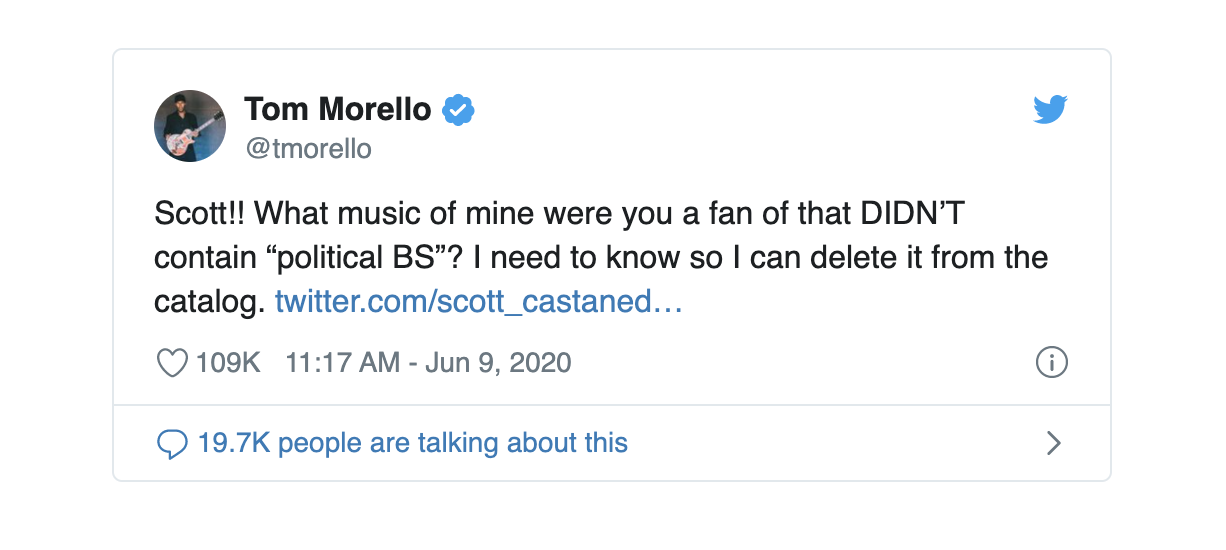
Tom Morello Responds to Angry Fans Who Suddenly Realize That Rage Against the Machine’s Music Is Political: “What Music of Mine DIDN’T Contain Political BS?”

I, Danc­ing Bear,” a song by an obscure folk artist who goes by the name Bir­d­engine, begins thus:

There are some things that I just do not care to know

It’s a love­ly lit­tle tune, if maudlin and macabre are your thing, a song one might almost call anti-polit­i­cal. It is the art of solip­sism, denial, an inward­ness that dances over the abyss of pure self, navel gaz­ing for its own sake. It is Kaf­ka-esque, pathet­ic, and hys­ter­i­cal. I love it.

My appre­ci­a­tion for this weird, out­sider New Roman­ti­cism does not entail a belief that art and cul­ture should be “apo­lit­i­cal,” what­ev­er that is.

Or that artists, writ­ers, musi­cians, actors, ath­letes, or whomev­er should shut up about pol­i­tics and stick to what they do best, talk about them­selves.

The idea that artists should avoid pol­i­tics seems so per­va­sive that fans of some of the most bla­tant­ly polit­i­cal, rad­i­cal artists have nev­er noticed the pol­i­tics, because, I guess, they just couldn’t be there.

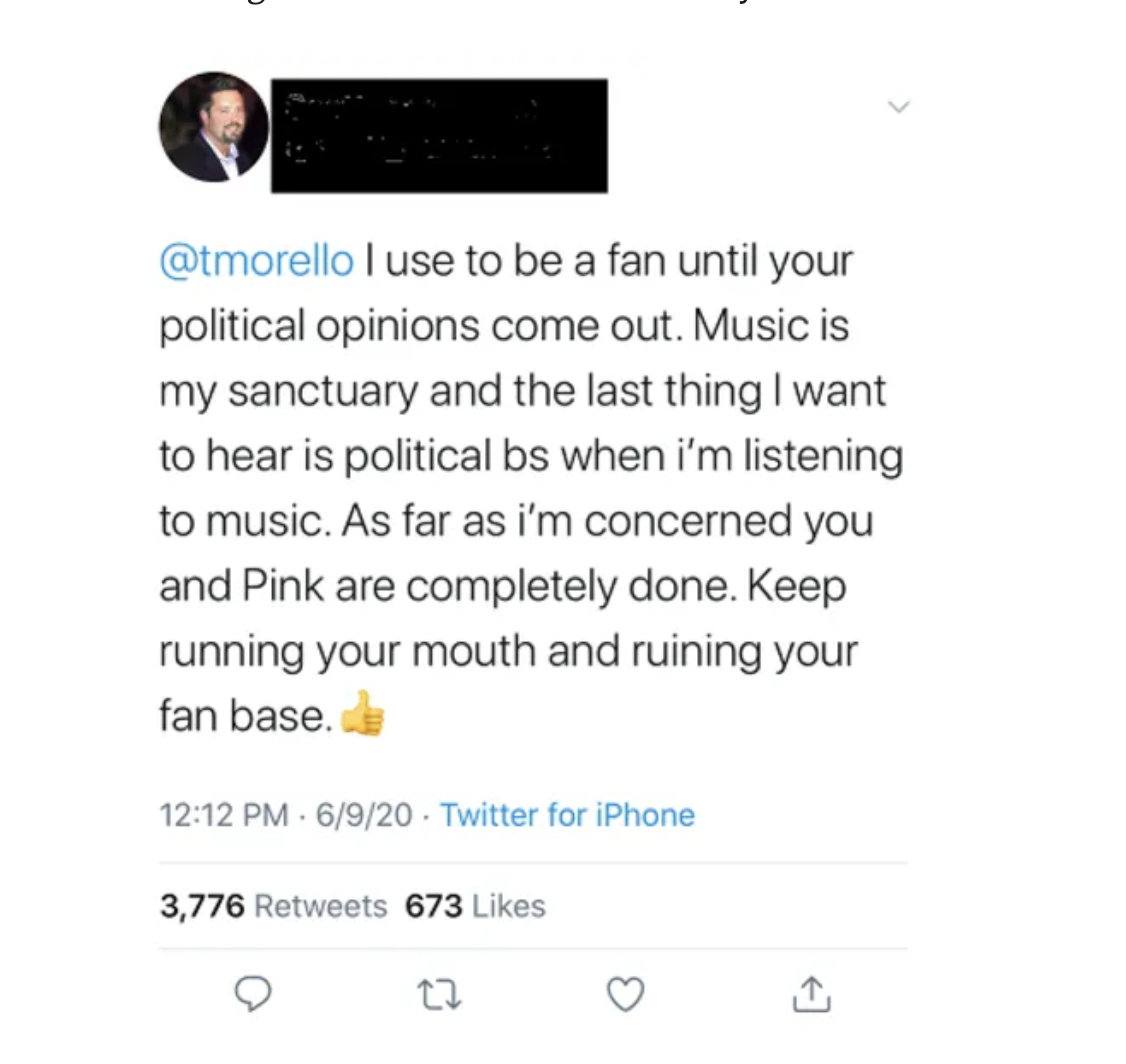
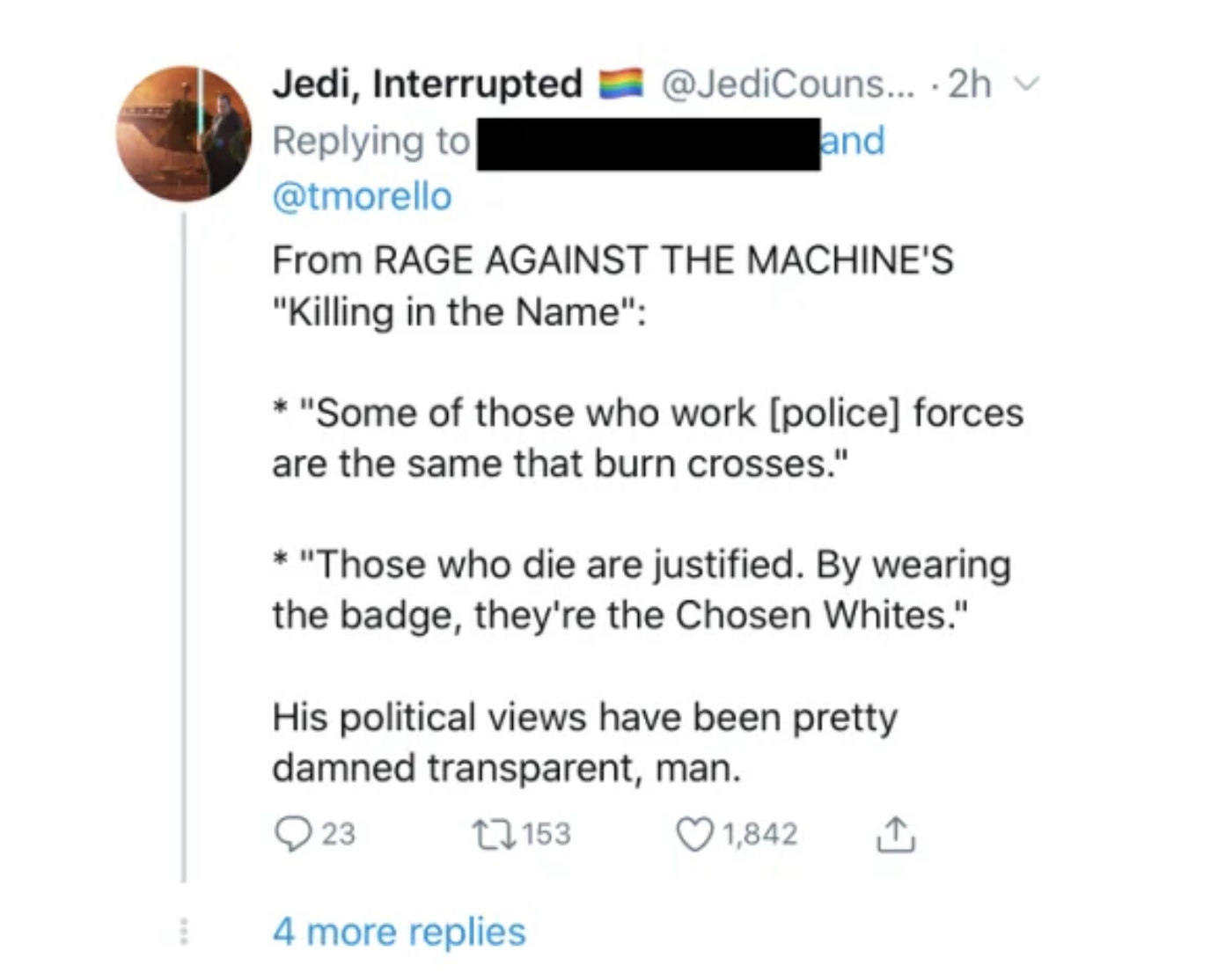
One such fan just got dunked on, as they say, a whole bunch on Twit­ter when he raged against Tom Morel­lo for the “polit­i­cal bs.”

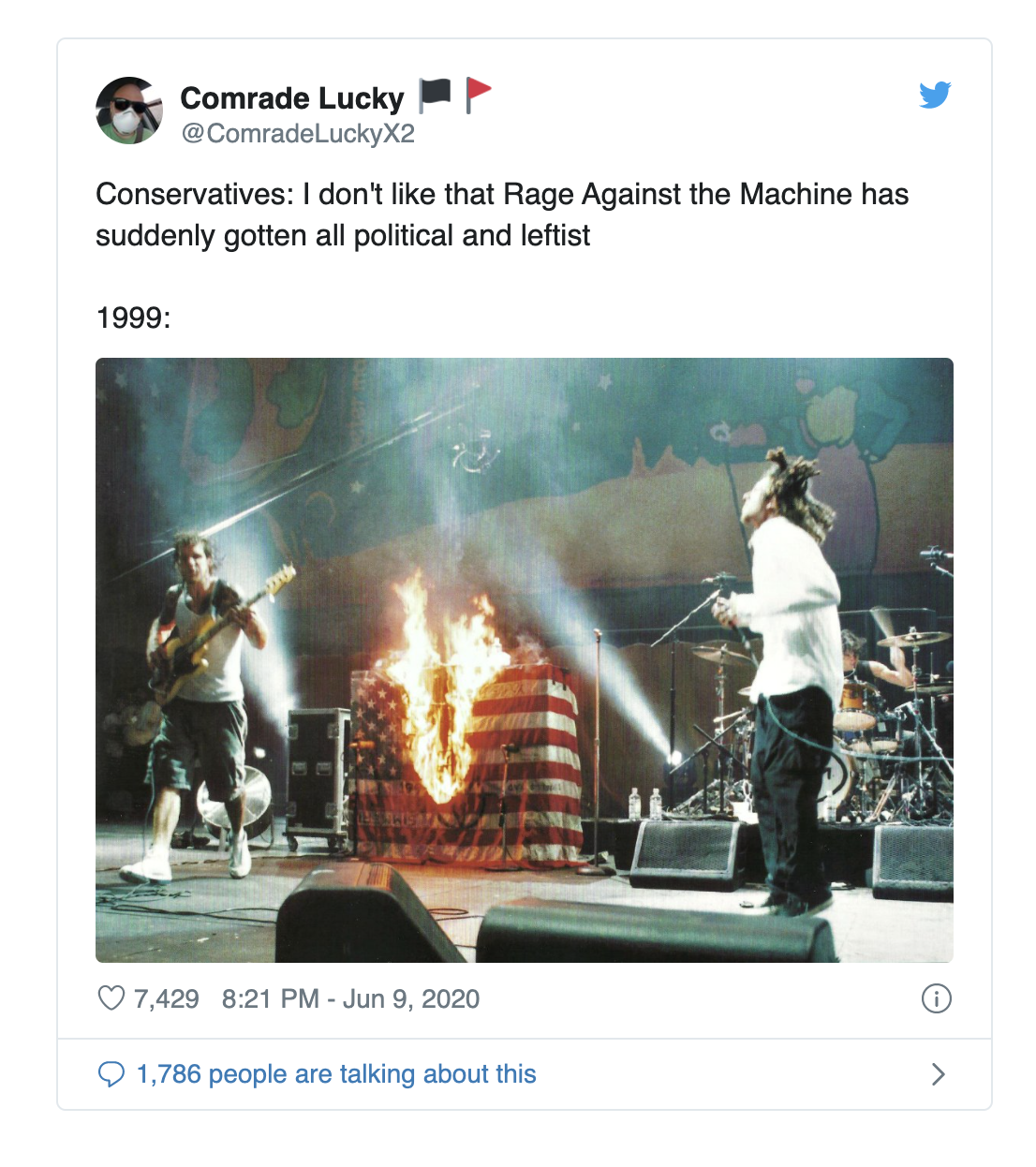
That’s Tom Morel­lo of Rage Against the Machine, whose debut 1992 album informed us that the police and the Klan work hand in hand, and that cops are the “cho­sen whites” for state-sanc­tioned mur­der. That Rage Against the Machine, who raged against the same Machine on every album: “Bam, here’s the plan; Moth­er­fuck Uncle Sam.”

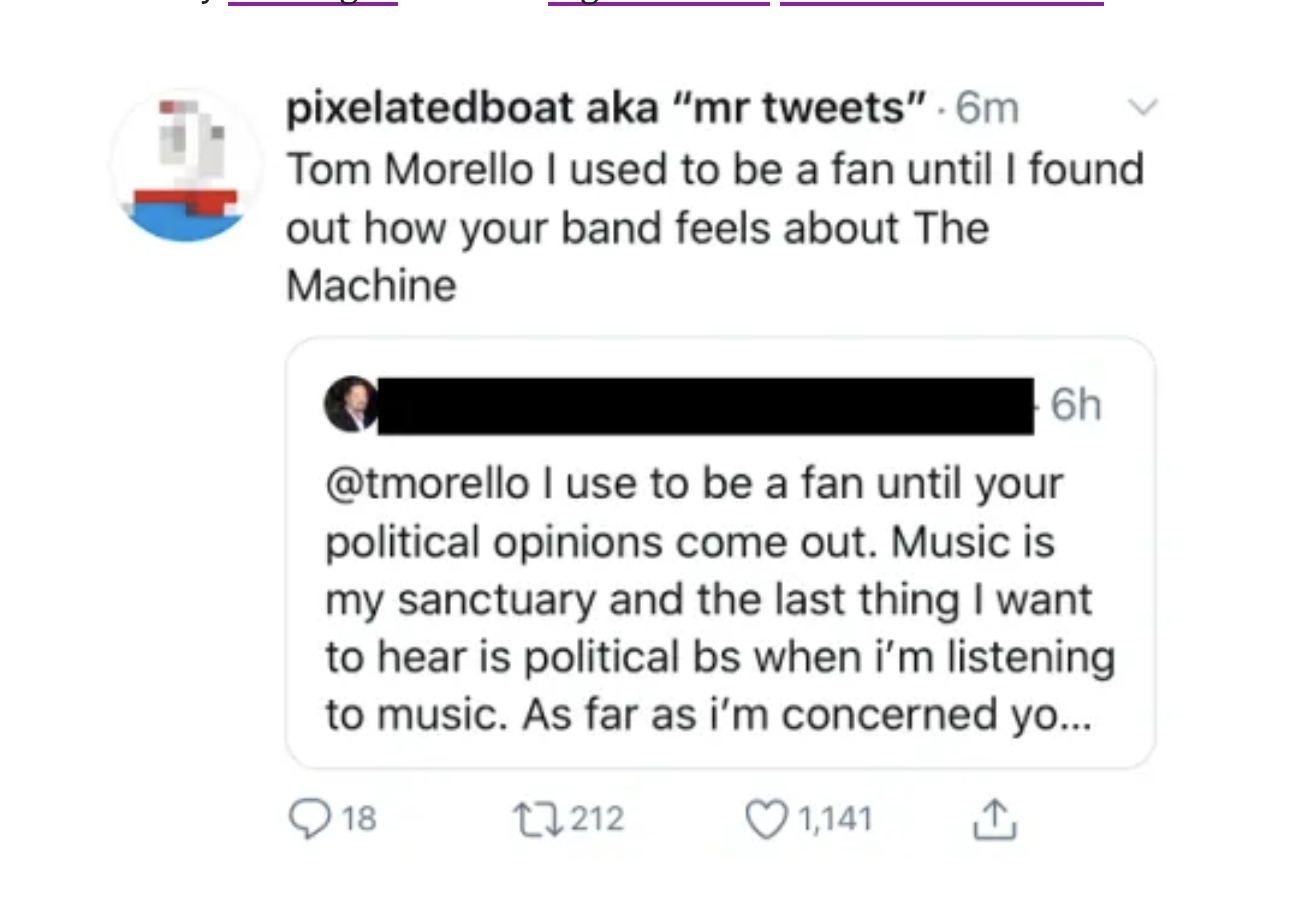
The poor sod was burned so bad­ly he delet­ed his account, but the laughs at his expense kept com­ing. Even Morel­lo respond­ed.

Why? Because the dis­grun­tled for­mer fan is not just one lone crank who didn’t get it. Many peo­ple over the years have expressed out­rage at find­ing out there’s so much pol­i­tics in their cul­ture, even in a band like Rage that could not have been less sub­tle. Many, like for­mer lever-puller of the Machine, Paul Ryan, seem to have cyn­i­cal­ly missed the point and turned them into work­out music. Morel­lo’s had to point this out a lot. (Dit­to Spring­steen.)

This uncrit­i­cal con­sump­tion of cul­ture with­out a thought about icky polit­i­cal issues is maybe one rea­son we have a sep­a­rate polit­i­cal class, paid hand­some­ly to do the dirty work while the rest of us go shop­ping. It’s a recipe for mass igno­rance and fas­cism.

You might think me crazy if I told you that the CIA is part­ly respon­si­ble for our expec­ta­tion that art and cul­ture should be apo­lit­i­cal. The Agency did, after all, fol­low the lead of the New Crit­ics, who exclud­ed all out­side polit­i­cal and social con­sid­er­a­tions from art (so they said).

Influ­en­tial lit­er­ary edi­tors and writ­ing pro­gram direc­tors on the Agency pay­roll made sure to fall in line, pro­mot­ing a cer­tain kind of writ­ing that focused on the indi­vid­ual and ele­vat­ed psy­cho­log­i­cal con­flict over social con­cerns. This influ­ence, writes The Chron­i­cle of High­er Edu­ca­tion, “flat­tened lit­er­a­ture” and set the bound­aries for what was cul­tur­al­ly accept­able. (Still, CIA-fund­ed jour­nals like The Paris Review pub­lished dozens of “polit­i­cal” writ­ers like Richard Wright, Gabriel Gar­cia Mar­quez, and James Bald­win.)

Then there’s the whole busi­ness of Hol­ly­wood film as a source of Pen­ta­gon-fund­ed pro­pa­gan­da, sold as innocu­ous, apo­lit­i­cal enter­tain­ment….

When it comes to jour­nal­ism, an ide­al of objec­tiv­i­ty, like Emerson’s inno­cent, dis­em­bod­ied trans­par­ent eye, became a stan­dard only in the 20th cen­tu­ry, osten­si­bly to weed out polit­i­cal bias. But that ide­al serves the inter­ests of pow­er more often than not. If media rep­re­sents exist­ing pow­er rela­tion­ships with­out ques­tion­ing their legit­i­ma­cy, it can claim objec­tiv­i­ty and bal­ance; if it chal­lenges pow­er, it becomes too “polit­i­cal.”

The adjec­tive is weaponized against art and cul­ture that makes cer­tain peo­ple who have pow­er uncom­fort­able. Say­ing “I don’t like polit­i­cal bs in my cul­ture” is say­ing “I don’t care to know the pol­i­tics are there.”

If, after decades of pump­ing “Killing in the Name,” you final­ly noticed them, then all that’s hap­pened is you’ve final­ly noticed. Cul­ture has always includ­ed the polit­i­cal, whether those pol­i­tics are shaped by mon­archs or state agen­cies or shout­ed in rap met­al songs (just ask Ice‑T) and fought over on Twit­ter. Maybe now it’s just get­ting hard­er to look away.

Relat­ed Con­tent:

The Pol­i­tics & Phi­los­o­phy of the Bauhaus Design Move­ment: A Short Intro­duc­tion

Hear a 4 Hour Playlist of Great Protest Songs: Bob Dylan, Nina Simone, Bob Mar­ley, Pub­lic Ene­my, Bil­ly Bragg & More

Love the Art, Hate the Artist: How to Approach the Art of Dis­graced Artists

Josh Jones is a writer and musi­cian based in Durham, NC. Fol­low him at @jdmagness

Why James Baldwin’s Writing Stays Powerful: An Artfully Animated Introduction to the Author of Notes of a Native Son

Every writer hopes to be sur­vived by his work. In the case of James Bald­win, the 32 years since his death seem only to have increased the rel­e­vance of the writ­ing he left behind. Con­sist­ing of nov­els, essays, and even a chil­dren’s book, Bald­win’s body of work offers dif­fer­ent points of entry to dif­fer­ent read­ers. Many begin with with Go Tell it on the Moun­tain, the semi-auto­bi­o­graph­i­cal debut nov­el in which he mounts a cri­tique of the Pen­te­costal Church. Oth­ers may find their gate­way in Bald­win’s fic­tion­al treat­ment of desire and love under adverse cir­cum­stances: among men in Paris in Gio­van­ni’s Room, for exam­ple, or teenagers in Mem­phis in If Beale Street Could Talk. But unlike most nov­el­ists, Bald­win’s name con­tin­ues to draw just as many acco­lades — if not more of them — for his non­fic­tion.

Those look­ing to read Bald­win’s essays would do well to start with his first col­lec­tion of them, 1955’s Notes of a Native Son. In assem­bling pieces he orig­i­nal­ly pub­lished in mag­a­zines like Harper’s and the Par­ti­san Review, the book reflects the impor­tance to the young Bald­win of what would become the major themes of his career, like race and expa­tri­ate life.

Though res­i­dent at dif­fer­ent times in Turkey, Switzer­land, and (right up until his dying day) France, he nev­er took his eyes off his home­land of the Unit­ed States of Amer­i­ca for long. Nor, in fact, did the Unit­ed States of Amer­i­ca take its eyes off him. “Over the course of the 1960s,” says Ford­ham Uni­ver­si­ty polit­i­cal sci­ence pro­fes­sor Christi­na Greer in the ani­mat­ed TED-Ed intro­duc­tion to Bald­win above, “the FBI amassed almost 2,000 doc­u­ments” as they inves­ti­gat­ed his back­ground and activ­i­ties.

That the U.S. gov­ern­ment saw Bald­win as so polit­i­cal­ly dan­ger­ous is rea­son enough to read his books. But as one of Amer­i­ca’s most promi­nent men of let­ters, he could hard­ly be writ­ten off as a sim­ple fire­brand. Though known for his inci­sive views of white and black Amer­i­ca, he believed that every­one, what­ev­er their race, “was inex­tri­ca­bly enmeshed in the same social fab­ric,” that “peo­ple are trapped in his­to­ry, and his­to­ry is trapped in them.” As he found recep­tive audi­ences for his argu­ments in print and on tele­vi­sion, “his fac­ul­ty with words led the FBI to view him as a threat.” But that very fac­ul­ty with words — insep­a­ra­ble, as in all the great­est essay­ists, from the astute­ness of the per­cep­tions they express — has assured him a still-grow­ing read­er­ship in the 21st cen­tu­ry. Con­tend­ing with the most volatile social and polit­i­cal issues of his time cer­tain­ly did­n’t low­er Bald­win’s pro­file, but any giv­en page of his prose sug­gests that what­ev­er he’d cho­sen to write about, we’d still be read­ing him today.

Relat­ed Con­tent:

Great Cul­tur­al Icons Talk Civ­il Rights: James Bald­win, Mar­lon Bran­do, Har­ry Bela­fonte & Sid­ney Poiti­er (1963)

James Bald­win Bests William F. Buck­ley in 1965 Debate at Cam­bridge Uni­ver­si­ty

James Baldwin’s One & Only, Delight­ful­ly Illus­trat­ed Children’s Book, Lit­tle Man Lit­tle Man: A Sto­ry of Child­hood (1976)

James Bald­win: Wit­ty, Fiery in Berke­ley, 1979

Chris Rock Reads James Baldwin’s Still Time­ly Let­ter on Race in Amer­i­ca: “We Can Make What Amer­i­ca Must Become”

Based in Seoul, Col­in Mar­shall writes and broad­casts on cities, lan­guage, and cul­ture. His projects include the book The State­less City: a Walk through 21st-Cen­tu­ry Los Ange­les and the video series The City in Cin­e­ma. Fol­low him on Twit­ter at @colinmarshall, on Face­book, or on Insta­gram.

David Lynch Posts His Nightmarish Sitcom Rabbits Online–the Show That Psychologists Use to Induce a Sense of Existential Crisis in Research Subjects

If recent world events feel to you like an exis­ten­tial cri­sis, you may find your­self brows­ing Youtube for calm­ing view­ing mate­r­i­al. But there’s also some­thing to be said for fight­ing fire with fire, so why not plunge straight into the dread and pan­ic with David Lynch’s sit­com Rab­bits? Set “in a name­less city del­uged by a con­tin­u­ous rain” where a fam­i­ly of three humanoid rab­bits live “with a fear­ful mys­tery,” the eight-episode web series has, as we’ve pre­vi­ous­ly men­tioned here on Open Cul­turebeen used by Uni­ver­si­ty of British Colum­bia psy­chol­o­gists to induce a sense of exis­ten­tial cri­sis in research sub­jects. Hav­ing orig­i­nal­ly shot it on a set in his back­yard in 2002 (and incor­po­rat­ed pieces of it into his 2006 fea­ture Inland Empire), Lynch has just begun mak­ing Rab­bits avail­able again on Youtube.

The first episode of Rab­bits went up yes­ter­day on David Lynch The­ater, the offi­cial Youtube chan­nel of the man who direct­ed Eraser­headBlue Vel­vetMul­hol­land Dri­ve, and oth­er such pieces of Lynchi­an cin­e­ma. Though he has­n’t made a fea­ture film in quite some time, he’s kept busy, as his fre­quent uploads have doc­u­ment­ed: take his 2015 ani­mat­ed short Fire (Pozar), which we fea­tured last month, or his dai­ly Los Ange­les weath­er reports.

More recent­ly, Lynch has been post­ing short videos called “What Is David Work­ing on Today?” These offer just what their title promis­es: a look at such art projects as and craft projects as “a drain spout for the bot­tom of my wood­en sink,” the “swing-out uri­nal” installed, and most recent­ly “the incred­i­ble check­ing stick.”

This might at first sound dispir­it­ing­ly nor­mal — at least until you get to how the check­ing stick is sup­posed to work — but those who have long enjoyed Lynch’s films know that nor­mal­i­ty is what gives them pow­er. David Fos­ter Wal­lace described the “Lynchi­an” as “a par­tic­u­lar kind of irony where the very macabre and the very mun­dane com­bine in such a way as to reveal the for­mer’s per­pet­u­al con­tain­ment with­in the lat­ter.” There is, of course, noth­ing macabre (and often noth­ing mun­dane) about the wood­en objects Lynch builds and repairs in his work­shop these days. But Rab­bits, too, was also one of his home­made projects, and its “sto­ry of mod­ern life,” as Lynch called it on Twit­ter, still makes for a har­row­ing­ly mun­dane view­ing expe­ri­ence.

Relat­ed Con­tent:

David Lynch Made a Dis­turb­ing Web Sit­com Called “Rab­bits”: It’s Now Used by Psy­chol­o­gists to Induce a Sense of Exis­ten­tial Cri­sis in Research Sub­jects

David Lynch Cre­ates Dai­ly Weath­er Reports for Los Ange­les: How the Film­mak­er Pass­es Time in Quar­an­tine

David Lynch Releas­es an Ani­mat­ed Film Online: Watch Fire (Pozar)

What Makes a David Lynch Film Lynchi­an: A Video Essay

Based in Seoul, Col­in Mar­shall writes and broad­casts on cities, lan­guage, and cul­ture. His projects include the book The State­less City: a Walk through 21st-Cen­tu­ry Los Ange­les and the video series The City in Cin­e­ma. Fol­low him on Twit­ter at @colinmarshall, on Face­book, or on Insta­gram.

« Go BackMore in this category... »
Quantcast