If you would like to support the mission of Open Culture, consider making a donation to our site. It’s hard to rely 100% on ads, and your contributions will help us continue providing the best free cultural and educational materials to learners everywhere. You can contribute through PayPal, Patreon, and Venmo (@openculture). Thanks!
Pretty Much Pop hosts Mark Linsenmayer, Erica Spyres, and Brian Hirt–along with guest Mike Wilson–discuss the director’s films from Eraserhead to Inland Empire plus Twin Peaks and his recent short films. We get into the appeal and the stylistic and storytelling hallmarks of his mainstays–Blue Velvet, Wild at Heart, Lost Highway, and Mulholland Drive–and also consider outliers like Dune, The Elephant Man, and The Straight Story.
What’s with the campy acting and the weird attitudes toward women? Why make us stare at something moving very slowly for a long time? Are these films appealing to young people interested in something different but not on the whole actually enjoyable? Is there actually a “solution” to make sense of the senseless, or are these wacky plots supposed to remain unassimilable and so not dismissible?
Some articles we drew on included:
“David Lynch Films Ranked from Worst to Best” by Swapnil Dhruv Bose
Every empire seems to think (as much as empires seem to think) that it will be the one to outlast them all. And all of them have ended up more or less the same way in the end. This isn’t just a gloomy fact of human history, it’s a fact of entropy, mortality, and the linear experience of time. If imperial rulers forget—begin to think themselves immortal—there have always been poets to remind them, though maybe not so directly. Epic poetry often legitimizes the founding of empires. Another form, the poetry of ruin, interprets their inevitable demise.
All the Romantics were doing it, and so too was an unknown 8th century British poet who encountered Roman ruins during the so-called “Dark Ages.” The poem they left behind “gives us a glimpse of a world of mystery,” says Paul Cooper above in episode one of his Fall of Civilizations podcast, which begins with Roman Britain and continues, in each subsequent (but not chronological) episode, to explore the collapse of empires around the world through literature and culture. “Every ruin,” says Cooper in an interview with the North Star Podcast, “is a place where a physical object was torn apart, and that happened because of some historical force.”
But as our Old English poet above demonstrates, the fascination predates Shakespeare and Marlowe. Cooper would know. He has dedicated his life to studying and writing about ruins, earning a PhD in their cultural and literary significance. Along the way, he has written for The New York Times, The Atlantic, National Geographic, Discover Magazine, and the BBC.
Cooper also began publishing one of the most intriguing Twitter feeds in 2017, detailing in “several nested threads” various “ruin-related thoughts and feelings,” as Shruti Ravindran writes at Timber Media. His tweets became so popular that he turned them into a podcast, and it is not your standard informally chatty podcast fare. Fall of Civilizations engages deeply with its subjects on their own terms, and avoids the sensationalist cliches of so much popular history. Cooper “knew, for certain, what he wanted to avoid,” when he began: the “focus on gruesome torture techniques, executions, and the sexcapades of nobles.”
“History writers often don’t trust their audience will be interested in the past if they don’t Hollywoodize it,” says Cooper. Instead, in the latest episode on the Byzantine Empire he recruits the choir from the Greek Orthodox Cathedral in London, “and a number of musicians playing traditional Byzantine instruments such as the Byzantine lyra, the Qanun and the Greek Santur,” he explains. In his episode on the Han dynasty, Cooper looks back through “ancient Chinese poetry, songs and folk music” to the empire’s rise, “its remarkable technological advances, and its first, tentative attempts to make contact with the empires of the west.”
This is a rich journey through ancient history, guided by a master storyteller dedicated to taking ruins seriously. (Cooper has published a novel about ruins, River of Ink, “inspired by time spent in UNESCO sites in Sri Lanka,” Ravindran reports.) There is “love among the ruins,” wrote Robert Browning, and there is poetry and music and story and song—all of it brought to bear in Fall of Civilizations to “make sense about what must have happened,” says Cooper. Find more episodes, on fallen civilizations all around the world, on YouTube or head to Fall of Civilizations to subscribe through the podcast service of your choice.
Jazz has often moved forward in seismic shifts, powered by revolutionary figures who make everything that came before them seem quaint by comparison and radiate their influence beyond the jazz world. Perhaps no figure epitomizes such a leap forward more than Charlie Parker. The legendary inventor of bebop, born a little over a century ago, may be the most universally respected and admired musician in jazz, and far beyond.
Kansas City trumpet player Lonnie McFadden, who grew up hearing stories about hometown hero Parker, was told by everyone he met to learn from the master. “Everybody. It was a consensus. All of them said, ‘You got to listen to Bird. You got to listen to Charlie Parker.’” Furthermore, he says, “every tap dancer I know, every jazz musician I know, every rock and blues musician I know honors Charlie Parker.”
Parker has been called “The Greatest Individual Musician Who Ever Lived.” Not just jazz musician, but musician, period, as the PBS Sound Field short introduction above notes, because there had never been one single musician who influenced “all instruments.” Kansas City saxophone player Bobby Watson and archivist Chuck Haddix explain how Parker made such an impact at such a young age, before dying at 34.
Unlike the swing of Benny Goodman or Louis Armstrong, Parker’s bebop is completely non-danceable. He didn’t care. He was not an entertainer, he insisted, but an artist. Jazz might eventually return to danceability in the late 20th century, but the music—and popular music writ large—would never be the same.
The video’s host, LA Buckner gives a brief summary of the evolution of jazz in four regional centers—New Orleans, Chicago, Kansas City, and New York. Parker made a transit through the last three of these cities, eventually ending up on big apple stages. “By 1944,” Jazzwise writes, “the altoist was… making a huge impact on the young Turks hanging out in Harlem, Dizzy Gillespie and Thelonious Monk in particular… no one had ever played saxophone in this manner before, the harmonic, rhythmic and melodic imagination and the emotional intensity proving an overwhelming experience.”
It’s too bad more musicians didn’t listen to Bird when it came to playing high. “Anyone who said they played better when on drugs or booze ‘are liars. I know,’” he said. Heroin and alcohol abuse ended his career prematurely, but perhaps no single instrumental musician since has cast a longer shadow. Jazz critic Stanley Crouch, author of Parker biography Kansas City Lightning: The Rise and Times of Charlie Parker, explains in an interview how Parker created his own mystique.
Parker sometimes gave the impression that he was largely a natural, an innocent into whom the cosmos poured its knowledge while never bothering his consciousness with explanations.
The facts of his development were quite different. He worked for everything he got, and whenever possible, he did that work in association with a master.
Parker was not appreciated at first, either in his hometown of Kansas City or in New York, where “people didn’t like the way he played” when he first arrived in 1939. He responded to criticism with ceaseless practice, learning, and experimentation, an almost superhuman work ethic that probably wasn’t great for his health but has grown into a legend all its own, giving musicians in every form of music a model of dedication, intensity, and fearlessness to strive toward.
The timeless modernism of the IKEA catalog, its promise of tidiness, clean, economical lines, and excellent value belie a struggle ahead, an ordeal customers of the global Swedish build-it-yourself juggernaut know too well. Will the bulky, majorly-inconveniently shaped boxes fit in the car? Will the rebus-like instructions make sense? Will we assemble a bed with love and care, only to find ourselves in a pile of its broken parts come morning?
Clearly outweighing such tragedies are the many happy memories we associate with buying, building, and living with IKEA products. The company itself has built such memories over the course of almost eight decades with an empire of Scandinavian design supermarkets.
“As of 2019,” Marie Patino writes at CityLab, “IKEA boasts 433 stores across 53 countries.” The IKEA catalog is as widely circulated as the Bible and Quran. The Swedish company with the quirkily named products and legendary cafeteria meatballs defines furniture shopping.
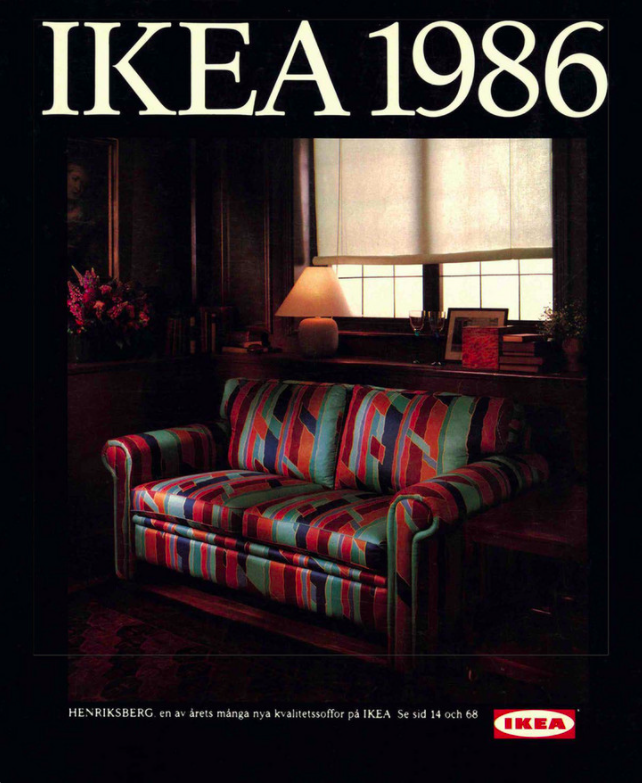
The layout of IKEA’s showrooms may turn “retail into retail therapy,” with corridors filled with monochromatic visions of clutter-free living. In these times, of course, we’re far more likely to take refuge in those venerable catalogs or the company’s always-improving website. Now we can do both at once with a trip through seven decades of IKEA catalogs, uploaded to the website for the 70th anniversary of the first 1950 release.
1951 “marked the first proper IKEA catalog,” writes Patino, as well as the first iconic cover featuring the first iconic design, the MK wing chair. Covers became more elaborate, with smooth mid-century modern living room layouts that tantalized, but the contents of the catalog looked like government order forms until the late 60s and 70s. It did not appear in English until 1985. In these early layouts we can see just how dated so many of these designs appear in hindsight.
The company’s signature business model came together slowly at first. It started in 1943, founded by Ingvar Kamprad in Sweden, as a mail-order business for stationary supplies. The furniture arrived soon after, but it would take another decade or so for the flat-pack idea to fully emerge. The BILLY bookshelf, perhaps the most popular IKEA design ever, debuted in 1979. Other staples followed, and in 2013, the original wingback chair made a modified comeback as the STRANDMON. Through it all, the catalog has documented Swedish design trends in a global marketplace.,
The 21st century has seen not only the return of the wingback but of the mid-century Scandinavian modernism with which the company made its name in the 1950s and 60s. Maybe that’s why it’s easy to think of IKEA as consistently embodying this trend, slightly updated every few years. But browsing through these catalogs shows how thoroughly IKEA absorbed all sorts of European influences—as well as the look of hotel room furniture from Miami Vice.
What kind of therapy is this? Gazing at dated or retro-hip products we are years too late to buy? It offers the same experience as all IKEA catalog shopping—without the struggle and expense of transporting and assembling the results: the distraction of a world without distractions. Explore the new archive of IKEA catalogs here.
Most of us use the terms “coronavirus” and “COVID-19” to refer to the pandemic that has gone around the world this year. We do know, or can figure out, that the former term refers to a virus and the latter to the disease caused by that virus. But do we know the full name “severe acute respiratory syndrome coronavirus 2,” or “SARS-CoV‑2” for short? We will if we take the online course “COVID-19, SARS-CoV‑2 and the Pandemic,” which MIT is making available to the general public free online. We’ll also learn what makes both the virus and the disease different from other viruses and diseases, what we can do to avoid infection, and how close we are to an effective treatment.
All this is laid out in the course’s first lecture by Bruce Walker, director of the Ragon Institute of Massachusetts General Hospital, MIT and Harvard. Walker introduces himself by telling us how he graduated from medical school when HIV was at its height in America, timing that placed him well for a career focused on deadly viral diseases.
The course’s complete lineup of guest lecturers, all of them listed on its syllabus, includes many other high-profile figures in the field of epidemiology, immunology, vaccine development, and related fields: Harvard’s Michael Mina, Yale’s Akiko Iwasaki, the Broad Institute’s Eric Lander, and — perhaps you’ve heard of him — the National Institute of Allergy and Infectious Diseases’ Anthony Fauci (find his session below).
“COVID-19, SARS-CoV‑2 and the Pandemic” began last Tuesday, and its lectures, which you’ll find uploaded to this Youtube playlist, will continue weekly until December 8th. Even if you have no background in medicine, biology, or science of any kind, don’t be intimidated: as leading professors Richard Young and Facundo Batista emphasize, this course is meant as an introductory overview.
And as Bruce Walker’s first lecture demonstrates, it’s not just open to the general public but geared toward the understanding and concerns of the general public as well. Taking it may not reassure you that an end to the pandemic lies just around the corner, but it will give you clearer and more coherent ways to think about what’s going on. The virus and disease involved are still incompletely understood, after all — but thanks to these and other researchers around the world, getting better understood every day.
Based in Seoul, Colin Marshall writes and broadcasts on cities, language, and culture. His projects include the book The Stateless City: a Walk through 21st-Century Los Angeles and the video series The City in Cinema. Follow him on Twitter at @colinmarshall, on Facebook, or on Instagram.
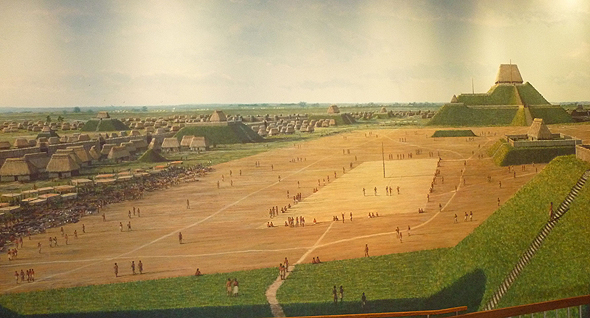
In our current epoch of human history, when populations of major cities swell into the tens of millions, an urban center of 30,000 people doesn’t seem very impressive. 1,000 years ago, a city that size was larger than London or Paris, and sat atop what is now East St. Louis. At its height in 1050, Annalee Newitz writes at Ars Technica, “it was the largest pre-Colombian city in what became the United States…. Its colorful wooden homes and monuments rose along the eastern side of the Mississippi, eventually spreading across the river to St. Louis.”
It is called Cahokia, but that name comes from later inhabitants who themselves didn’t know who built the ancient metropolis, Roger Kaza explains, “We really have no idea what the builders called their city.” Also, no one, including the people who settled there not long afterward, knows what happened to the city’s inhabitants. Archaeologists call these lost indigenous societies the Mississippians.
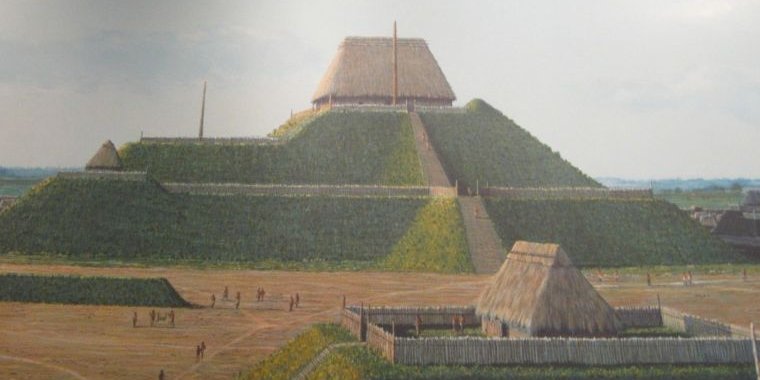
They occupied a territory along the river of nearly 1,600 hectares during what is called the Mississippian period, roughly between 800 and 1400 A.D. The society built mounds, “some 120,” notes UNESCO, who have designated Cahokia a world heritage site. (See an introductory video below from the Cahokia Mounds Museum Society and two artist recreations elsewhere on this page.) The largest of these mounds, Monk’s Mound, stands 30 meters high.
Cahokia is “a striking example of a complex chiefdom society, with many satellite mound centres and numerous outlying hamlet and villages.” Size estimates vary. UNESCO’s is more conservative “This agricultural society may have had a population of 10–20,000 at its peak between 1050 and 1150,” they write—still, at any rate, a major city at the time. The Mississippian civilization left behind “pottery, ceremonial art, games and weapons,” Kaza notes. “Their trade network was vast, stretching from the Great Lakes to the Gulf of Mexico.”
The mounds were a symbol of both earthly and religious power, and the city appears to have been a pilgrimage site of some kind, with remains of what may have been a 5,000 square foot temple at the top of Monk’s Mound and evidence of human sacrifice on other mounds. “A circle of posts west of Monk’s Mound has been dubbed ‘Woodhenge,’ because the posts clearly mark solstices and equinoxes,” writes Kaza.
But the true strength of Cahokia, as in all great metropolises, was economic power. As archaeologist Timothy Pauketat of the University of Illinois notes, “it just so happens that some of the richest agricultural soils in the midcontinent are right up against that area of Cahokia.” Corn grew plentifully, produced surpluses, and the society grew rich. Then, seemingly inexplicably, it collapsed. “By the time European colonizers set foot on American soil in the 15th century, these cities were already empty,”
One recent study suggests two natural climate change events several hundred years apart explain both Cahokia’s rise and fall: “an unusually warm period called the Medieval Climatic Anomaly” gave rise to the region’s abundance, and an abrupt cooling period called “the Little Ice Age” brought on its end. Climatologists have found evidence showing how a drought in 1350 caused the pre-Columbian Mississippian corn industry to implode.
Pauketat finds this explanation persuasive, but insufficient. Politics and culture played a role. It’s possible, says archeologist Jeremy Wilson, who coauthored the recent climate paper, that “the climate change we have documented may have exacerbated what was an already deteriorating sociopolitical situation.”
Evidence suggests mounting conflict and violence as food grew scarcer. Climatologist Broxton Bird argues that the Mississippians left their cities and “migrated to places farther south and east like present-day Georgia,” Angus Chen writes at NPR, “where conditions were less extreme. Before the end of the 14th century, the archaeological record suggests Cahokia and other city-states were completely abandoned.”
We should be careful of seeing in this contemporary language any close parallels to the situation major cities face in the 21st century. Just one link in the global supply chain that drives climate change today can employ 10,000–20,000 people. But perhaps it’s possible to see, in the distant indigenous past of North America, the not-so-future vision of a migratory future for the inhabitants of many cities around the world.
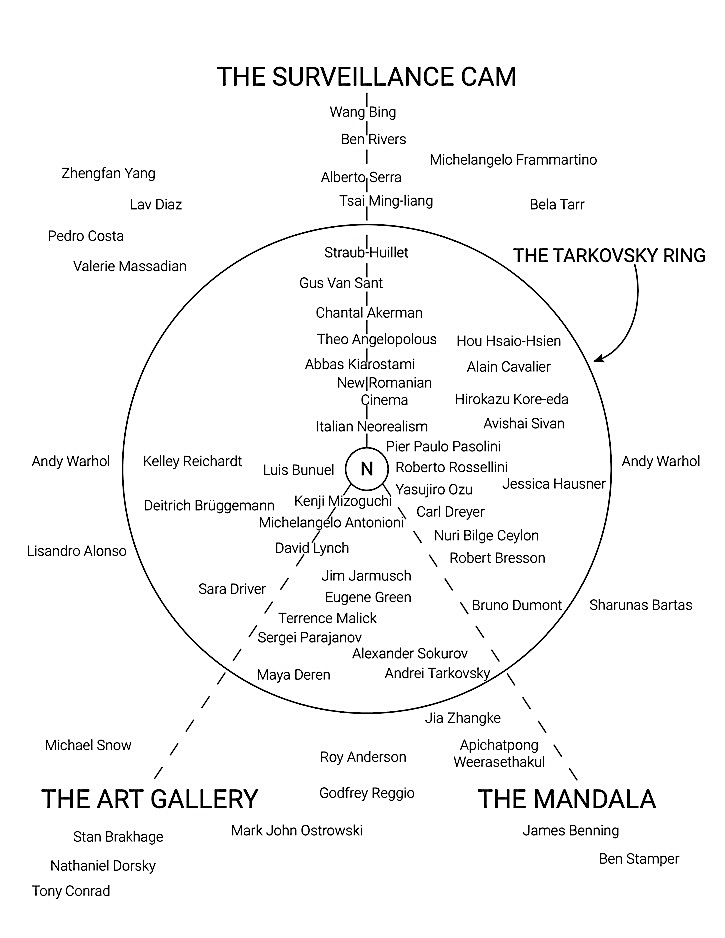
The dozens of filmmakers in the diagram above belong to a variety of cultures and eras, but what do they have in common? Some of the names that jump out at even the casual filmgoer — Andrei Tarkovsky, Jim Jarmusch, Pier Paolo Pasolini, Terrence Malick — may suggest a straightforward connection: cinephiles love them. Of course, not every cinephile loves every one of these directors, and indeed, bitter cinephile arguments rage about their relative merits even as we speak. But in one way or another, all of them are taken seriously as auteurs by those who take film seriously as an art form — and not least by Paul Schrader, one of the most serious auteur-cinephiles alive.
This transcendental style in film “seeks to maximize the mystery of existence; it eschews all conventional interpretations of reality: realism, naturalism, psychologism, romanticism, expressionism, impressionism, and, finally, rationalism.” It “stylizes reality by eliminating (or nearly eliminating) those elements which are primarily expressive of human experience, thereby robbing the conventional interpretations of reality of their relevance and power.”
45 years on, Schrader revisits this concept in the Toronto International Film Festival interview clip above. “Most movies lean toward you. They lean toward you aggressively with their hands around your throat, trying to grab every second of your attention.” But transcendental films “lean away from you, and they use time — and as other people would call it, boredom — as a technique.” They linger on the everyday, the uneventful, the repetitive. Used adeptly, this “withholding device” is a way of “activating” viewers and their attention. Then comes the “decisive action,” the moment in which the film does “something unexpected”: the “big blast of Mozart” at the end of Bresson’s Pickpocket, the “big blast of emotion” at the end of an otherwise reserved Ozu picture. “What are you going to do with it, now that he has totally conditioned you not to expect it?”
In the new edition of Transcendental Style in Filmpublished in 2018, Schrader includes the diagram at the top of the post. It illustrates the three major directions in which filmmakers have departed from traditional narrative, represented by the N at the center. Ozu, Bresson, and Dreyer all go off toward the meditative “mandala.” Abbas Kiarostami, Gus Van Sant, and the Italian neorealists start on path that leads to the “surveillance cam,” with its unblinking eye on an unchanging patch of reality. The likes of Kenji Mizoguchi, Michelangelo Antonioni, and David Lynch point the way to the audiovisual abstraction of the “art gallery.” Floating around these aesthetic end points are the names of filmmakers known for the “difficulty” of their work: Stan Brakhage, Wang Bing, James Benning.
Their work resides well past what Schrader calls the “Tarkovsky Ring,” named for the auteur of Mirror, Stalker, and Nostalghia. When an artist passes through the Tarkovsky Ring, as Schrader put it to Indiewire, “that’s the point where he is no longer making cinema for a paying audience. He’s making it for institutions, for museums, and so forth.” Within the Tarkovsky Ring appear a fair few adventurous directors still working today, like Hirokazu Kore-eda, Kelly Reichardt, Alexander Sokurov, and Hou Hsiao-hsien. Schrader has neglected to include his own name on the diagram, perhaps leaving his exact placement as an exercise for the reader. He certainly belongs on there somewhere: after all, some critics have called his last feature First Reformed his most transcendent yet.
Based in Seoul, Colin Marshall writes and broadcasts on cities, language, and culture. His projects include the book The Stateless City: a Walk through 21st-Century Los Angeles and the video series The City in Cinema. Follow him on Twitter at @colinmarshall, on Facebook, or on Instagram.
We're hoping to rely on loyal readers, rather than erratic ads. Please click the Donate button and support Open Culture. You can use Paypal, Venmo, Patreon, even Crypto! We thank you!
Open Culture scours the web for the best educational media. We find the free courses and audio books you need, the language lessons & educational videos you want, and plenty of enlightenment in between.