Now you know what knock me down with a feather means…
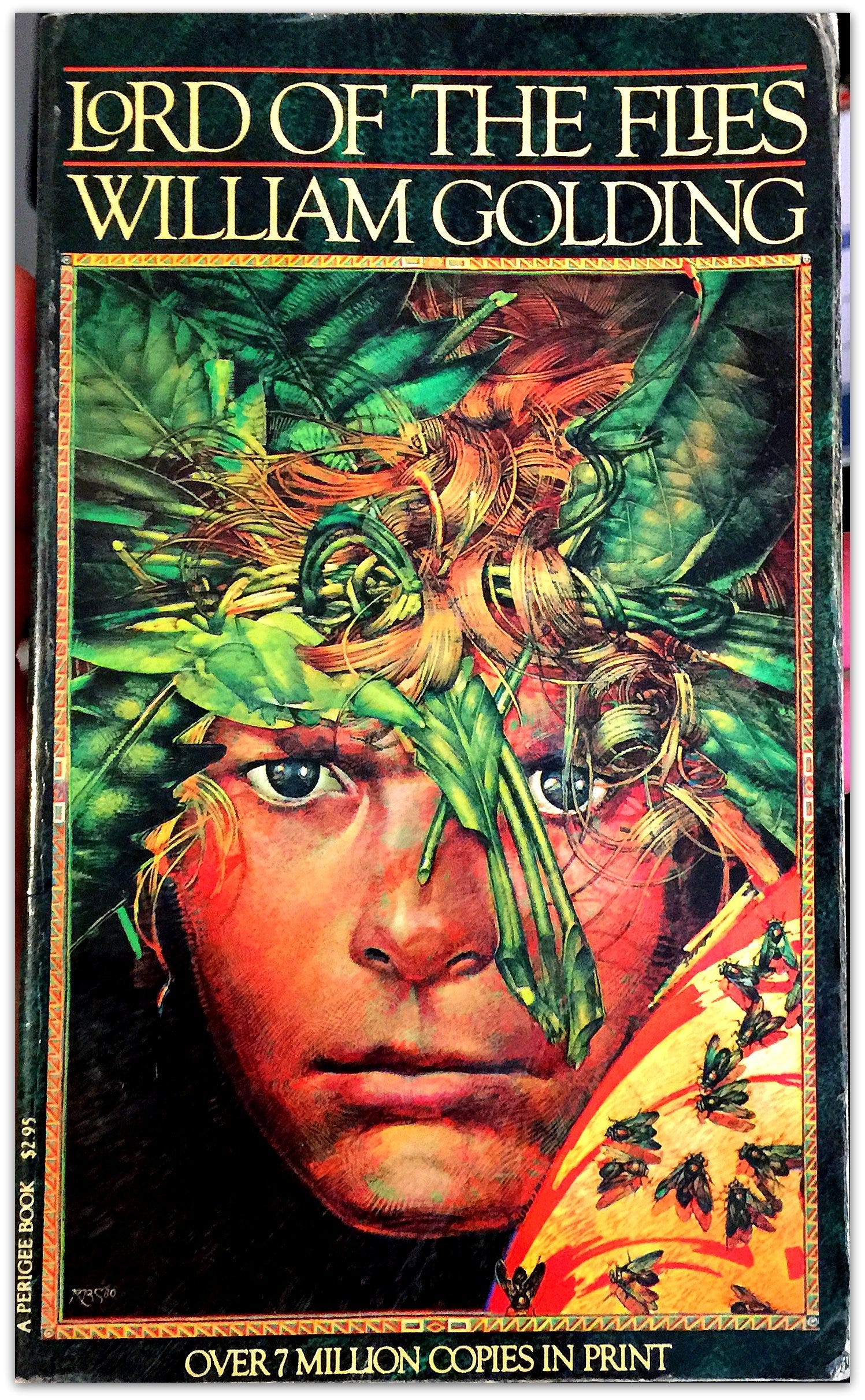
Like many of you, I was assigned to read William Golding’s Lord of the Flies in junior high. (Raise your hand if you had the one with this cover). Looking back, was there a subconscious reason our teacher gave us this famous tale of a group of shipwrecked children and young teens turning into murderous savages? Were we really that bad?
Perhaps you’ve never read the book and got assigned To Kill a Mockingbird or Kes instead. Is Golding’s book still worth picking up as an adult?
For sure, yes, and this animated explainer from Jill Dash of TED-Ed hopefully will entice you do so. What it provides is what we didn’t get in school: context.
Golding had been a lieutenant in the Royal Navy during the war, and had returned to find a post-war world where nuclear annihilation felt palpable. He was also teaching at a private school for boys. He got to wondering: are we doomed as a species to savagery? Is war inevitable?
Golding was also thinking about the popular Young Adult novels (as we now call them) of his day, because he read them to his own children. A popular trope featured young boys as castaways on a desert island who get up to all sorts of fun adventures, with a dash of British colonialism thrown in for good measure. All were riffs on Daniel Defoe’s Robinson Crusoe.
Lord of the Flies, then, is a brutal satire, reducing angelic British schoolboys to a bloodthirsty mob in very little time, while in the greater world of the novel nuclear war rages. (Having read this during the ‘80s, the nuclear background was never impressed on us students. I think I would have found the novel even more terrifying.)
It took Golding ten years to find an interested publisher, and even then it was a flop on initial release. But its reputation soon grew, helped by Peter Brook’s black-and-white film adaptation, and its pedagogical use as an allegorical tale during the Cold War. It also influenced a generation of writers. Stephen King named his fictional town Castle Rock after the kids’ fort in the novel. It also opened the door for any number of Young Adult authors to deal with dark and troubling themes.
There were also real-world examples to draw from. In the same year, 1954, as Golding’s novel appeared, Muzafer Sherif’s The Robbers Cave Experiment was published. This was non-fiction, however, detailing an experiment in which 22 middle-class white boys were set up in two groups at a deserted Oklahoma summer camp. With scientists posing as counselors, they let the groups–the Rattlers and the Eagles–sort out their own hierarchies, then set up competitions.
The psychologists watched the arms race escalate over the following days. Finally, one violent mob brawl became so sustained that the researchers were forced to step in, drag the boys apart and remove them to separate locations.
How long did it take for mere friction to escalate into a juvenile war, in an idyllic setting where everyone had plenty of food? Phase two lasted just six days from the first insult (“Fatty!”) to the final all-out brawl. Golding would have loved it.
We can see Golding’s warning everywhere in popular culture, from the back-biting and betrayals in reality shows like Survivor to horror movies like The Purge. We’ve also seen the terrors that children can inflict on each other, Columbine school shooting onward. In Golding’s novel, the children are rescued and revert back to a sobbing, dependent state. In the real world, alas, nobody’s coming to save us.
Related Content:
Why You Should Read One Hundred Years of Solitude: An Animated Video Makes the Case
Why Should We Read William Shakespeare? Four Animated Videos Make the Case
Ted Mills is a freelance writer on the arts who currently hosts the artist interview-based FunkZone Podcast and is the producer of KCRW’s Curious Coast. You can also follow him on Twitter at @tedmills, read his other arts writing at tedmills.com and/or watch his films here.

![]()
Johns Hopkins has created an interactive website that tracks the spread of the coronavirus around the globe. The site is updated daily, if not several times per day. And it shows the number of confirmed coronavirus cases around the globe (along with the precise location on a map), the number of people who have recovered from the virus, and the total number who have perished. With the report today that Italy has seen coronavirus spike from 3 cases, to 132 230, in a matter of days, it does look like coronavirus is taking on a more global dimension. That’s all reflected on the Johns Hopkins site, whose data is drawn from the WHO, CDC, ECDC, NHC and DXY. You can read more about the interactive website at The Lancet.
Find information about the Coronavirus at this dedicated CDC website.
If you would like to sign up for Open Culture’s free email newsletter, please find it here. It’s a great way to see our new posts, all bundled in one email, each day.
If you would like to support the mission of Open Culture, consider making a donation to our site. It’s hard to rely 100% on ads, and your contributions will help us continue providing the best free cultural and educational materials to learners everywhere. You can contribute through PayPal, Patreon, and Venmo (@openculture). Thanks!
In 1996, the Fugees burst on the scene with “Ready or Not,” and most listeners were not ready: for the ominous, eclectic, Caribbean-inflected production, the smooth, sexy menace of Lauryn Hill’s hook (“you can’t hide / Gonna find you and take it slowly”), or the interplay of references in the breakout star’s rhymes. “Rap orgies with Porgy and Bess / Capture your bounty like Eliot Ness,” Hill raps, and then a few lines later, “So while you’re imitating Al Capone, I’ll be Nina Simone / And defecating on your microphone.”
The tongue-in-cheek line introduced a generation of fans to the iconic singer and virtuoso pianist, who could and did play everything from blues, jazz, soul, cabaret, classical, and Broadway tunes like those from the Gershwin classic (hear Simone’s “I Loves You Porgy,” here).
Hill has paid homage to Simone ever since. In 2015, she promoted the tribute album, Nina Revisted—the soundtrack to documentary What Happened to Nina Simone?—at the Apollo. Reporting on the event in The Verge, Kwame Opam likely spoke for thousands in admitting he’d “first heard Nina’s name in that classic line on ‘Ready or Not.’”
Last year saw the release of The Miseducation of Eunice Waymon, a title combining Hill’s acclaimed solo album with Simone’s birth name. The record, produced by Amerigo Gazaway, is a “mashup of songs by Fugees emcee and hip hop legend Lauryn Hill, and the jazz and soul icon Nina Simone.” What might have come off like a marketing stunt trading on both names instead “elevates them to new heights,” writes Zack Gingrich-Gaylord at KMUW, “putting them in conversation with each other and making it sound like the collaboration was always meant to be.”
Maybe one reason these imaginary studio sessions work so well has to do not only with Hill’s veneration of Simone, and the harmonious meeting of their two voices and sensibilities, but also with Simone’s prominence in so much recent hip hop. Among the dozens of soul artists whose grooves have given loops and hooks to many a rap classic, she now holds a special place, as the Polyphonic video at the top shows in an exploration of four Simone songs that have left an indelible mark on hip hop’s current sound.
The first of those songs, “Feeling Good,” appears on both the Hill/Simone mashup album and in a powerful cover by Hill on Nina Revisited. Simone’s soaring version of the song—originally from the British musical The Roar of the Greasepaint—The Smell of the Crowd—“turned it into a musical standard” for the next several decades. In the 2000s, it popped up in tracks from Wax Tailor, Lil Wayne, and Jay Z and Kanye West, “two artists who have made careers out of sampling the high priestess” of soul and whose names come up frequently in this discussion.
The second song identified as one of “hip hop’s secret weapons,” Simone’s interpretation of the gospel “Sinnerman,” may be her “greatest accomplishment” and appears in tracks by Timbaland and Flying Lotus and in the Talib Kweli track “Get By,” produced by a young Kanye West.
Simone’s appeal to hip hop artists goes beyond her incredibly powerful voice and piano. She was a fierce civil rights activist who used her music as a form of protest. Her version of “Strange Fruit,” a song first turned into a civil rights anthem by Billie Holiday from a poem by Abel Meeropol, has inspired tracks by Cassidy, Common, and, most famously, West again on his 2013 “Blood on the Leaves.” West uses the song as a backdrop for a narrative of his personal problems and relationship woes, which doesn’t really honor its history, the Polyphonic argument in favor of his use notwithstanding.
That’s not the case with reimaginings of the last Simone song in this explainer, her original composition “Four Women,” which imagines four different women expressing the pain racism has caused them. In 2000, Talib Kweli and producer Hi-Tek came together as Reflection Eternal and recorded their own version, mentioning Simone’s Southern inspirations in the intro before telling contemporary tales of four women in New York. “More than just a sample,” the track “reinterprets the message” of “Four Women” and applies Simone’s 1966 insights to the present, something Jay Z also does on 2017’s “The Story of O.J.”
It is worth noting that all of the tracks the Polyphonic video mentions as examples of Simone’s influence on hip hop were released after Lauryn Hill and the Fugees brought Simone to the attention of young rappers, DJs, producers, and fans just coming of age in the mid-nineties. Since then, Simone’s music has since left its mark all over the genre, and it’s easy to see why so many would be drawn to her intense, authoritative musicianship and political urgency.
Simone may not have had the chance herself to enter into conversations with Lauryn Hill, Talib Kweli, Common, Kanye, or Jay Z, but through hip hop’s endlessly creative ability to make the musical heroes of its past live again in song, it is as if she is still speaking, singing, and playing to the current generation of black artists—and through them, to the future of hip hop.
Related Content:
Watch a New Nina Simone Animation Based on an Interview Never Aired in the U.S. Before
Josh Jones is a writer and musician based in Durham, NC. Follow him at @jdmagness
In a very crowded field, Garren Lazar’s comical take on Queen’s “Bohemian Rhapsody” is a stand-out.
Comical in the literal sense. Lazar, aka Super G, struck a rich vein when he thought to mash the Rolling Stones’ “Sympathy for the Devil” with footage culled from Charles Schulz’s animated Peanuts specials.
And over the last six years, he’s mined a lot of gold, using Final Cut Pro to pair familiar clips of a drumming Pigpen, Snoopy slapping a double bass, and the iconic “Linus And Lucy” scene from A Charlie Brown Christmas with rock and pop classics.
Schulz, an ardent music lover, frequently pictured his characters singing, dancing, and playing instruments, so Lazar, who has an uncanny knack for matching animated mouths to recorded lyrics, has plenty to choose from.
Charlie Brown’s anxieties fuel the introduction to a 15 minute remix of Lynyrd Skynyrd’s “Free Bird,” until he gets hold of the Christmas special’s megaphone…
The megaphone serves Charlie equally well on “Stayin’ Alive,” the Bee Gees’ disco chart topper, though depending on your vintage, the vision of Snoopy in leg warmers and sweatband may come as a shock. Those clips come courtesy of It’s Flashbeagle, Charlie Brown, Schulz’s 1984 goofy spin on Flashdance, Footloose, Saturday Night Fever and other dance-based pop cultural phenomenons of the era. Although that special—Schulz’s 27th—features a rotoscoped Snoopy busting moves originated by Flashdance’s stunt dancer Marine Jahan, that old holiday chestnut still manages to steal the show.
And whenever you need a lift, you can’t do better than to spend a few minutes with Lazar’s heady reboot of Chicago’s quintessential 1970s single, “Saturday In the Park,” wherein the normally reserved Schroeder reveals a more exuberant side.
Begin your explorations of Garren Lazar’s musical Peanuts remixes on his YouTube channel, warm in the knowledge that he entertains requests in the comments.
Related Content:
Umberto Eco Explains the Poetic Power of Charles Schulz’s Peanuts
Ayun Halliday is an author, illustrator, theater maker and Chief Primatologist of the East Village Inky zine. Join Ayun’s company Theater of the Apes in New York City this March for her book-based variety series, Necromancers of the Public Domain, and the world premiere of Greg Kotis’ new musical, I AM NOBODY. Follow her @AyunHalliday.
Hunter S. Thompson died on February 20, 2005, fifteen years ago, and ever since we’ve been wondering aloud what he would make of the state of the world today. Though events have all but cried out for another Thompson to savagely describe and even more savagely ridicule them, what other writer could live up to the formidable standard Thompson set with Hell’s Angels, “The Kentucky Derby Is Decadent and Depraved,” Fear and Loathing in Las Vegas, and his other harrowing gonzo-journalistic views of the American scene? These works, as the late Tom Wolfe puts it in the interview clip above, made Thompson “the great comic writer of the twentieth century.”
Like anyone who knew the man, Wolfe had Hunter Thompson stories. The one he tells here takes place in Aspen, Colorado, years after Thompson ran for sheriff there and nearly won. As soon as Thompson and Wolfe were seated at a local restaurant, Thompson ordered four banana daiquiris and four banana splits.
After consuming all that, he called the waitress back: “Do it again.” This may remind fans of a more gluttonous version of the scene in Fear and Loathing in Las Vegas where Raoul Duke and Dr. Gonzo threateningly demand an entire pie at a diner. The real-life Thompson also had voracious appetites, not just for junk food and intoxicants but also for destruction, as evidenced by the story of propane-tank target practice Johnny Depp tells above.
Depp, who played Thompson in Terry Gilliam’s film adaptation of Fear and Loathing in Las Vegas, also bonded with the writer in ways not involving eighty-foot fireballs. Both came from Kentucky, and both admired the writing of the 1930s satirist Nathanael West. The two would read West’s work aloud to one another, and later Thompson’s own. (We’ve previously featured Depp reading the “wave speech,” Thompson’s best-known passage, here on Open Culture.) “Hunter taught me how he wanted his work read,” Depp remembers, “and if there’s anything such as a blessing, that was it.” The private Thompson may have loved American prose, but the public Thompson loved outrageous behavior. As John Cusack puts it in the clip above, “He was ready for a show that was beyond any sense of decency and went into some absurdist land that made your heads bend.”
Few had as much exposure to Th0mpson’s head-bending as Ralph Steadman, the artist whose illustrations made visible the Thompsonian “gonzo” sensibility. “Gonzo is a Portuguese word, and it means hinge,” Steadman says in the news segment above. “I guess to be gonzo is to be hinged — or unhinged.” The two first met at the 1970 Kentucky Derby, where they were meant to collaborate on a piece about the race. In the event, they did more drinking and rumor-spreading than reporting, and it all led to a moment of truth: “We looked in the mirror and there we saw the evil face: it was us, looking back at us.” The final product, “The Kentucky Derby Is Decadent and Depraved,” now looks like the birth of a form Thompson and Steadman created, perfected, and quite possibly destroyed.
In the Joe Rogan Experience clip above, journalist Matt Taibbi describes Thompson’s writing thus: “He let it all hang out and just said whatever the hell he thought, and he let the chips fall where they may.” Easy though that may sound, in his best work Thompson managed to employ “the same techniques that the great fiction writers use” to craft a “four-dimensional story, but at the same time it was also journalism.” As the current occupant of Thompson’s old political-reporter job at Rolling Stone, Taibbi knows better than anyone that “most people couldn’t get away with that.” It takes “a Mark Twain-level talent to do what he did, which is to mix the ambition of great fiction with journalism” — like most of Thompson’s endeavors, “one of those don’t-try-this-at-home things.”
Related Content:
Read 11 Free Articles by Hunter S. Thompson That Span His Gonzo Journalist Career (1965–2005)
Johnny Depp Reads Hunter S. Thompson’s Famous “Wave Speech” from Fear and Loathing in Las Vegas
Hunter S. Thompson Interviews Keith Richards, and Very Little Makes Sense
Hunter S. Thompson, Existentialist Life Coach, Gives Tips for Finding Meaning in Life
Watch Hunter S. Thompson & Ralph Steadman Head to Hollywood in a Revealing 1978 Documentary
Based in Seoul, Colin Marshall writes and broadcasts on cities, language, and culture. His projects include the book The Stateless City: a Walk through 21st-Century Los Angeles and the video series The City in Cinema. Follow him on Twitter at @colinmarshall or on Facebook.
It can be difficult to know what to do sometimes with adding machine heir and Naked Lunch and Junky author William S. Burroughs. In the trickle-down academese of contemporary jargon, he is a “problematic” figure who doesn’t fit neatly inside anyone’s ideological comfort zone, what with his unrepentant heroin addiction, occult weirdness, conspiracy mongering, and extensive firsthand knowledge of criminal underworlds.
There was no one better qualified to midwife the counterculture.
NME’s Leonie Cooper calls Burroughs “a dour punk in a sharp suit,” and lists some of the highlights of his biography, including his famous accidental shooting of his wife and mother of his only child—an event that did nothing to diminish his love of guns. “He wrote bleakly comic tales which were subject to obscenity trials in the States thanks to their dwelling on sodomy and drugs but which later saw him elected to the prestigious American Academy of Arts and Letters.”
The mainstreaming of Burroughs happened in part because of his appeal to musicians, from Paul McCartney, Mick Jagger, and David Bowie to Kurt Cobain, Tom Waits, Throbbing Gristle, and Ministry’s Al Jourgenson. “Musicians flocked to him in a quest for authenticity.” Although the deadpan Burroughs usually appeared “massively unimpressed” by their attentions, he was “happy to comply and associate himself with artists both up and coming and established.”
David Bowie went further than seeking a photo op or one-off collaboration, adopting Burroughs’ cut-up technique as his primary method for writing lyrics, a technique also put into practice at various times by The Beatles, Cobain, and Radiohead’s Thom Yorke. Other artists, like Steely Dan and The Soft Machine, took their names from Burroughs’ work but shared little of his nightmarish sci-fi-cult-noir sensibility.
Burroughs “preferred to associate himself with an edgier kind of performer,” collaborating with R.E.M., Waits, and Cobain and “hanging out at seminal rock club CBGBs” in the 70s and 80s. He became a friend and mentor to artists like Patti Smith, Lou Reed, and Thurston Moore. Although Iggy Pop is often referred to as the “godfather of punk,” that title might as well belong to William S. Burroughs.
During the birth of rock and roll in the 50s, Burroughs was a mostly unknown fringe figure. By the late sixties, his influence became central to popular music thanks to The Beatles, Led Zeppelin, and The Rolling Stones. But he would not be tamed or sanitized. An early gay hero who sided with outsiders and underdogs against corporate machines, he was defiant to the end, leaving a legacy that continues to inspire anti-establishment artists, even if they’re unaware of their debt to him.
In the new book William S. Burroughs and the Cult of Rock ‘n’ Roll, by Casey Rae, you can learn much more about Burroughs’ major influence on rock and roll in the 60s, 70s, 80s, “when it became a rite of passage to hang out with the author or to experiment with his cut-up techniques,” as the book description notes. His direct influence continued into the punk revival of the grunge era and has become “more subliminal” since his death in 1997, as Rae tells Jim DeRogatis and Greg Kot in the Sound Opinions interview above. (Scroll to the 14:50 minute mark.)
It’s hard to find contemporary artists who aren’t influenced by the artists Burroughs influenced, and who—wittingly or not—haven’t inherited some of the Burroughsisms that are everywhere in the past fifty-plus years of rock and roll history. Hear a playlist of Burroughs-adjacent songs referenced in Rae’s book at the top of the post (opening with Duke Ellington’s “East St. Louis Toodle Oo,” later covered by Steely Dan), and learn more about Burroughs’ musical adventures at the links below.
Related Content:
How David Bowie, Kurt Cobain & Thom Yorke Write Songs With William Burroughs’ Cut-Up Technique
William S. Burroughs Drops a Posthumous Album, Setting Readings of Naked Lunch to Music (NSFW)
Hear a Great Radio Documentary on William S. Burroughs Narrated by Iggy Pop
Josh Jones is a writer and musician based in Durham, NC. Follow him at @jdmagness
The techno-futurist prophets of the late 20th century, from J.G. Ballard to William Gibson to Donna Haraway, were right, it turns out, about the intimate physical unions we would form with our machines. Haraway, professor emeritus of the History of Consciousness and Feminist Studies at the University of California, Santa Cruz, proclaimed herself a cyborg back in 1985. Whether readers took her ideas as metaphor or proleptic social and scientific fact hardly matters in hindsight. Her voice was predictive of the everyday biometrics and mechanics that lay just around the bend.
It can seem we are a long way, culturally, from the decade when Haraway’s work became required reading in “undergraduate curriculum at countless universities.” But as Hari Kunzru wrote in 1997, “in terms of the general shift from thinking of individuals as isolated from the ‘world’ to thinking of them as nodes on networks, the 1990s may well be remembered as the beginning of the cyborg era.” Three decades later, networked implants that automate medical data tracking and analysis and regulate dosages have become big business, and millions feed their vitals daily into fitness trackers and mobile devices and upload them to servers worldwide.
So, fine, we are all cyborgs now, but the usual use of that word tends to put us in mind of a more dramatic melding of human and machine. Here too, we find the cyborg has arrived, in the form of prosthetic limbs that can be controlled by the brain. Psychologist, DJ, and electronic musician Bertolt Meyer has such a prosthesis, as he demonstrates in the video above. Born without a lower left arm, he received a robotic replacement that he can move by sending signals to the muscles that would control a natural limb. He can rotate his hand 360 degrees and use it for all sorts of tasks.
Problem is, the technology has not quite caught up with Meyer’s need for speed and precision in manipulating the tiny controls of his modular synthesizers. So Meyer, his artist husband Daniel, and synth builder Chrisi of KOMA Elektronik set to work on bypassing manual control altogether, with a prosthetic device that attaches to Meyer’s arm where the hand would be, and works as a controller for his synthesizer. He can change parameters using “the signals from my body that normally control the hand,” he writes on his YouTube page. “For me, this feels like controlling the synth with my thoughts.”
Meyer walks us through the process of building his first prototypes in an Inspector Gadget-meets-Kraftwerk display of analogue ingenuity. We might find ourselves wondering: if a handful of musicians, artists, and audio engineers can turn a prosthetic robotic arm into a modular synth controller that transmits brainwaves, what kind of cybernetic enhancements—musical and otherwise—might be coming soon from major research laboratories?
Whatever the state of cyborg technology outside Meyer’s garage, his brilliant invention shows us one thing: the human organism can adapt to being plugged into the unlikeliest of machines. Showing us how he uses the SynLimb to control a filter in one of his synthesizer banks, Meyer says, “I don’t even have to think about it. I just do it. It’s zero effort because I’m so used to producing this muscle signal.”
Advancements in biomechanical technology have given disabled individuals a significant amount of restored function. And as generally happens with major upgrades to accessibility devices, they also show us how we might all become even more closely integrated with machines in the near future.
via Boing Boing
Related Content:
Neurosymphony: A High-Resolution Look into the Brain, Set to the Music of Brain Waves
Twerking, Moonwalking AI Robots–They’re Now Here
Josh Jones is a writer and musician based in Durham, NC. Follow him at @jdmagness